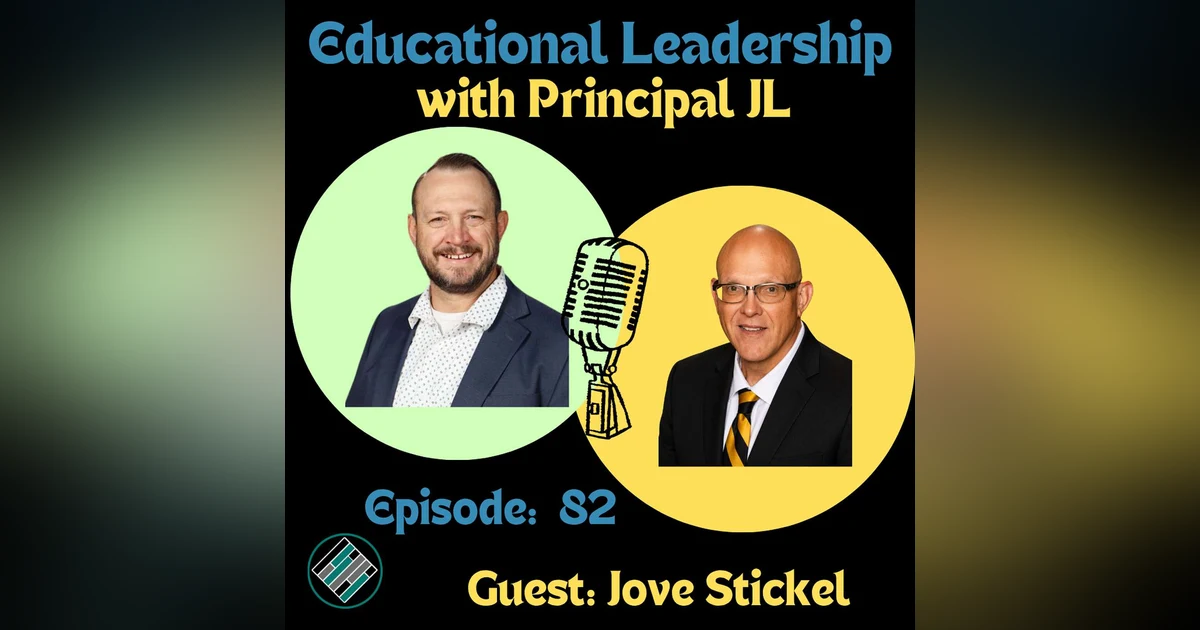
Episode 82: Lighting the WICK of Leadership: Building Trust, Culture & Stronger Schools with Jove Stickel

Connect with the Show Here! Leadership doesn’t fail because educators don’t care. It fails when we bury people under noise, overthinking, and systems no one can carry into a tough hallway moment. I sit down with Jove Stickle, a former social studies teacher, multi-sport coach, and middle school principal who now mentors and coaches other leaders, to talk about what actually holds up when the job gets heavy. We dig into the turning points in Jove’s educational leadership journey: the classroo...


Leadership doesn’t fail because educators don’t care. It fails when we bury people under noise, overthinking, and systems no one can carry into a tough hallway moment. I sit down with Jove Stickle, a former social studies teacher, multi-sport coach, and middle school principal who now mentors and coaches other leaders, to talk about what actually holds up when the job gets heavy.
We dig into the turning points in Jove’s educational leadership journey: the classroom habits that built credibility, the coaching lessons that taught him to keep feedback simple, and the reality of becoming the principal in a building where your coworkers used to be your friends. He’s honest about what he’d change, how trust can fracture when roles shift, and why working longer hours is not the same as leading well. If you care about school culture, staff morale, and sustainable principal practices, you’ll hear plenty you can apply right away.
Jove also shares the framework behind his upcoming book, “Lighting the WICK of Leadership,” built around WICK: work hard, act with integrity, be committed, be kind. We talk about giving trust before you try to “earn” it, building standards that stay steady, and where education is heading as schools rethink technology overload and refocus on core skills and character.
Connect with Jove Stickel Here:
nstagram @Jovestickel
X @Jovestickel
Tik Tok @Jovestickel
YouTube @JoveStickel
website Jovestickel.com
substack Jovestickel.substack.com
email Principalstickel@gmail.com
phone (573) 692-3448
New Book Coming Soon! "Lighting the WICK of Leadership"
New and Improve
Teach Better Mid Roll Network Ad
Click Here to Connect with Principal JL:
00:00 - Opening And Guest Introduction
03:01 - Why Service Sparked His Career
05:21 - Coaching Taught Simple Clear Leadership
08:49 - The Moment He Chose Administration
13:49 - Leading Friends Without Losing Connection
21:49 - Mentoring Principals And Giving Trust
24:40 - Lighting The Wick With WIC
34:39 - After Tech Overload What Matters
40:22 - How To Connect And Final Takeaways
Opening And Guest Introduction
Principal JLWhat does it take to light the wick of leadership? Not just in yourself, but in the people you lead. And how do the lessons we learn along the way shape the leader we ultimately become? Well, that's just what we'll be talking about. But today's guest, Jove Stickle. Jove's leadership journey has taken him from the classroom to the athletic field, to the principal's office, and he's now mentoring and developing other leaders. He spent 18 years as a social studies teacher, a coach where he coached football, wrestling, and track. He also spent 10 years as a middle school principal. And along the way, Jove earned numerous honors, including Teacher of the Year, Regional Wrestling Coach of the Year. He's twice been named the MOA SSP middle level regional principal of the year as well. Jove is also the founder of Committed Leadership Solutions, where he served as a keynote speaker. He's also a leadership coach, a principal mentor, and he's got an upcoming new book called Lighting the Wit of Leadership. I hope you guys enjoyed this episode as much as I did recording it. Now let's get to the conversation with Jove Stickle. Welcome back, everybody, to another exciting episode of the Educational Leadership Podcast. Today I'm really excited to bring in Mr. Jove Stickle. Jove, welcome to the show.
Jove StickelHey, it's nice to be here.
Why Service Sparked His Career
Principal JLAll right, Jove. I'm gonna go ahead. I'm gonna start you off with the same question I ask everybody on the show. What inspired you to become an educator?
Jove StickelI a lot of it was my upbringing. My parents were served to others. My dad ran an opportunity workshop, had been a social worker, and my mother was the mayor of our town. And they just that was service to others was always an important part of our life. And then when I was a kid, I loved playing playing sports, and and a lot of kids dreamed of being a great athlete or being an athlete on a pro team. I always wanted to be like the manager. I always liked the situations, the strategy, putting people together, cheering people on. And so those things just, you know, met hand in hand. I had a love of history. My dad was a history major in college, and it just evolved from there. And it was, I never really wanted to do anything else. You know, I once I decided that's what I wanted to do, and it was pretty early on, that for me was you know the ultimate job. And I love I loved it. It's great.
Principal JLAwesome. Now, as a teacher, you spent 18 years in the social studies classroom. So, what experiences did you have as a classroom teacher that helped you with your leadership?
Jove StickelYeah, I think I learned, you know, when you're dealing with 30 kids, you know, seven, eight hours a day, and then you're going to a practice, you get a crash course in relationships. And it's, and I think that was very helpful. But it also, you know, reaffirmed a lot of things I already knew, like working hard. I I really learned the importance of integrity in in your word with kids. I think sometimes, you know, as I remember, you know, adults would tell me things when I was a student and it didn't always come to fruition. And I learned really fast that that was important. The the importance of being kind. I didn't have, you know, I had didn't have to yell at people to get them to do the things you needed. And I was a hard lesson to learn. I think early on I was swimming and I would get frustrated, and I had to learn how to be kind and be consistent, which I think those are all things that are important for leaders today. But they were, you know, especially when you're dealing with kids, but you know, working hard, having integrity, being kind, being committed to the job. It's it's not something that's for the faint of heart, and you you can't do it halfway. You've got to be all in.
Coaching Taught Simple Clear Leadership
Principal JLNow, you also coached football, wrestling, and track, the three sports that I also coached. Oh, awesome! As an educator. So if you didn't know that, and so I was a head football coach, a head wrestling coach, and I also was a assistant, well, basically the head throwers coach at one point back in back to my time when I was coaching and teaching. So, you know, there's a lot of um leadership opportunities when you're a coach. And so, I mean, you coached, you know, for 18 years, and it sounds like you are pretty good at it. I mean, I think you're coach of the year in wrestling and in the state of Missouri, if I remember right. And, you know, what are some things you learn in your coaching journey that help with your leadership as well?
Jove StickelYou know, I really there's a great story early on in my coaching career. I remember, you know, I remember telling a kid uh, you know, trying to explain to him, you know, what he needed to do while he was on the map, right? And I remember I I remember, you know, I'm yelling all these instructions and he comes off the mat and he says, Coach, he goes, I appreciate the advice there, but it right now is not the time to be giving me all this advice. You know, that that's too much instruction. So I learned really, really early on that you need to keep it simple, right? Too much is is never does anybody any good. You know, pick your spots, be be deliberate, be intentional, and and and prioritize what's important. The other thing that came to me as a coach early on was we had this, I had this huge book of rules, right? Like, you know, training rules, but rules for our team, rules of conduct. And I mean, they were really specific, they were really long. And I a kid got in trouble once, and I said, Listen, you you signed the handbook. You know this is illegal. Why did you do it? And he looked me dead in the eye and he said, Coach, he said, I might have signed that handbook, but it would take me days to read that thing. You know, I I can't can you remember all the rules in the handbook, coach? And I couldn't. Like I wrote the book and I couldn't remember it all. So I learned really early, you know, I need to make things clear to our kids. And and I it became the same way as a principal, you know, work hard, do the right thing, be kind to others. Everything else will take care of itself. And and it, you know, the just the older I got, the more experience I got, the more I realized I had to put trust in other people, and I had to make sure that I didn't make it too complicated. We make leadership way too complicated sometimes. And those are two huge things that I learned from this kid.
Principal JLYeah, you bet. I kind of can identify with the you know, coaching wrestling and trying to help kids while they're on the mat a little bit. Like you said, it is much simpler to a have those things established before they even walk out on the mat, so they kind of have an idea what they're doing. Um, but at the same time, have I don't know if they I've seen this in Nebraska. I was also a wrestling official as well as a coach because I stepped away from coaching, I started officiating. I would see coaches sit on the sideline and start like demonstrating oh yeah, I was there demonstrating the moves, like hey, do this, do that.
Jove StickelI was that wound-up wild man that would slide around on his stomach and jump up and down and get excited.
Principal JLYeah, you're a coach after my own heart. You're a coach after my own heart for sure. And so, you know, I was pretty passionate as a coach too, and and I really can feel that and really can understand, you know, those those uh perspectives as well. So I really appreciate you sharing that. Now, you coached and you taught.
The Moment He Chose Administration
Principal JLWhat was it that made you go, you know what? I think I want to give this administration a shot. I want to maybe become a principal. Is there a story? Is there someone that nudged you? Like, what was it that said, you know, I'm gonna step away from teaching and coaching and become a principal? For me, it was really hard to have that decision because that means I would have to stop coaching. I love coaching. I coach now just in a different way. Yeah. But when it comes down to it, what was it that helped you make that decision?
Jove StickelSo it's kind of it's kind of interesting you mentioned that. You know, I I got my administrator's degree like in 01. Bunch of guys in the school that I was in. We we had a satellite program that was near us, a cohort. We got our license, we got our uh master's degree. I didn't want to get it in history. I thought that was kind of redundant, but I had no desire to be a principal at that time. It was just, hey, I need to get my degree done. This will make me better as a teacher, and maybe down the line it'll make me more marketable. But I was nowhere near ready to stop. Well, a couple years after that, position opened up for a principalship that was close by, and I interviewed, got the job, got home after they offered it to me, and was talking to my wife, and I just teared up. I wasn't ready to stop. You know, I wasn't ready. So that was 2003. So, you know, about 12 years goes by. I'm and had no, had not thought about being an administrator again, had filled in, you know, in a couple of schools when an administrator was gone, but really hadn't been a desire. And I had a principal named Gary Wheeler in Lafayette County C1 Schools in Higginsville, Missouri. And Gary Wheeler, I was teaching in the middle school as the head wrestling coach at the time, coaching football. And Gary was getting close to retirement, and he said, Hey, you have the energy and and you have the things that this building needs for the culture. He goes, I'm I'm ready to retire. He says, You need to do this. And I, you know, I was like, Oh, I'm not, you know, I can't give up coaching. And I went home and I thought about it for a while and I thought, I know the people here, I know this community, I love this community. This is this is the opportunity. This is, you know, this is that voice in your head whispering to you, you know, don't pass this up. If you do, you're gonna regret it. And at that point, I just went back to him and I said, Hey, uh, I'm gonna apply, I'm gonna go after it. And he says, Well, you're gonna get it. I'm gonna make sure you're gonna get this thing because you need it and and it needs you. And that was that was it. That started a 10-year journey that I absolutely positively loved and and fell in love with leadership in a whole different way.
Principal JLSo you're spending 10 years as a building principal of a middle school, that's correct? Yeah, yeah. So, with that, I mean, that's you know, a long time. That's a decade of leadership right there. So, what are some things you learned maybe early on in the principalship that shaped your leadership? And then, you know, when you closed it out, what are some things you go back and reflect on, you know, as a building leader for the 10 years that you were?
Jove StickelSo you kind of know as a wrestling coach, you know, you know, there's that philosophy that, you know, work harder, right? Work hard. There's no substitute for hard work. Yable said it, and I believed it. And and in certain instances it is true, but I would take it to a level that was not healthy. I would, I would, you know, I was used to coaching on Friday nights. So when I became a principal Friday night after the supervising the football game, I go back to my office and just okay, I'm gonna put in the same hours I put in as a coach on a Friday night. Well, there's a couple of times my my poor wife is banging on my office window, waking me up in the middle of the night because I'd fallen asleep at my desk. And I had to learn early on that working longer doesn't necessarily mean you're working harder. So I had to learn to be more efficient. I had more people that were experts in fields, like when I was the head wrestling coach, I was the expert in wrestling. I was the expert in my classroom with social studies. Well, now I had all these new subject areas. I had to let go of being an expert because I may have felt strong with my instruction, but I didn't know, you know, mathematics was not my strong suit. You know, I barely passed math in high school and college. It was a squeaker. But, you know, the English language, arts, science, I really had to learn a lot. So I had to lean on people. So I had to learn to trust people, and that was a big part of it. Even though I knew those people, it was still something that you know, you learn you're the boss, so you're conflicted in a lot of ways because you're supposed to be this figure they can go to, but you also have to rely on them.
Principal JLSo yeah, and I think it's really interesting that you led a staff that you were like a part of before you led them. And like
Leading Friends Without Losing Connection
Principal JLme personally, I didn't have to do that. I kind of moved into the role and I had to learn everybody, and then I had to do that again when it came here to Hastings. What were some challenges that you had? Now, some things that I'm gonna point out when you talked about working smarter, not harder. I learned that in my high school wrestling coach would tell me, you work really, really hard, but you're not very smart about how you work. So he would always tell me you need to learn to work smarter, not harder. Like you would like I would be a hard worker, I'm gonna try really hard and practice and and those things, but I also had to learn to be efficient. Um, and so that's where I learned that from. And so it's really interesting you talked about that. You know, when you're leading a building where you were actually a colleague with those people, now you're now the boss, like you're you're in charge of everything. What was that like? Was there some challenges that you had?
Jove StickelMost definitely, you know, it was it was a it was an easy transition, but it was an extremely difficult transition. It was easy because I knew who the people were and and I knew what was going on in the building, I knew what we were good at, what what and what our lesser strengths were. So that was the the easier parts. The tough part was these people were my friends. I'd been around these people for you know uh a long time at this point. I've been around them for five years, close to five years, and and the staff hadn't really turned over much. So I knew them really well. And a lot of them, you know, I'd hung out with them. I spent time with them. When I became the leader, I really made a conscious decision that I look back on now, I think was a big mistake. I changed my relationship with people because I was the boss, and I shouldn't have changed my relationship with people. What I should have changed was how I how I approached those relationships because I still should have done things with people, right? I didn't want to have the the appearance that I was favoring one person or another. And and so that was a tough transition because, you know, the people that I was really good friends with, they kind of felt like I had left them behind. The people that, you know, that uh in the building that had relied on me for some things or had talked to me and told me things before weren't telling me those things anymore, you know. And so I had to find a kind of a a new way to to figure out because it's a principle, you know, there's things going on in your building you're not sure about. You've got to, and and people aren't always gonna be honest with you or tell you because they don't they they don't want to be the person that that gets somebody in trouble, or they, you know, they don't they they you they have to be able to trust you, and so when you become the leader, that's and you've been their, you know, their confidant or their partner in crime, if you will, that changes the relationship. And I didn't, I don't think I handled that the best. And that's one of my regrets. And so that was tough. That was hard because it was, you know, it's and some of them like even one lady I remember her telling me, and she was a language arts teacher, and she was I was real close with her when I was a teacher. When I became principal, towards the end when I left, I had made a lot of changes in my life. I'd lost all I'd I'd weighed almost over 600 pounds at one point. I'd I'd uh lost all my I'd lost weight. I'd I'd really had changed my philosophy, not just on you know, leading, but just life in general. And I remember I'd I'd become a little more demanding, not in a bad way, just you know, it was abrupt for them and it was a big change. And I remember she said, you know, hey, I you know, you you've had time to kind of uh make this adjustment for yourself and make these decisions. But for a lot of us, we kind of we feel like we lost our friend. And that was hard. That was a hard pill to swallow. But it I I needed to hear it, and it did change the way I kind of finished I finished off there. So, but yeah, I'd I'd say that was those were the challenges. And and and I love those people. They, you know, I still talk to them, I still visit with them, but that was hard because it's just a difficult dynamic, you know, it really is.
Principal JLYeah, and as someone that's had to do, like I haven't had to worry about that, but it's always interesting to hear when people take on the principalship role in the building that they were teaching and coaching in. I just know it's it's it's gotta be much tougher. You gotta walk a fine line, you know.
Jove StickelYeah, you're kind of like I gotta do my job, you know. And I will say, the first year, the good thing was, you know, I wasn't afraid to tell people I didn't know what I was doing, right? Like I figured out real fast I was gonna have to let them know that because I was gonna make a lot of mistakes. And you know, I don't care how long you're in education or what degree you have, when you take over the principalship of a building, you you you don't know what you don't know, right? And uh I and they did show me a lot of grace the first year, and and I think that was you know very helpful for me, but I think that that also was something that you know, that relationship where they showed me so much grace, I think that gave me a false sense of confidence at times. Um but it was still good, thankfully they gave me that grace.
Principal JLYeah, I know, and I think a lot of educators are understanding, especially when principals take over. You don't know what you don't know until you don't know it, right? Yeah, that's kind of kind of the saying that is out there when you take over in that leadership role. And so, I mean, you taught, you coached, you've been a principal. What would you say is one of your most proudest moments as an educator?
Jove StickelYeah, so when I I well, I after about after seven years, I of being a principal at Lafayette County and went to a school, another school in Missouri. And to be a principal there, it was an opportunity to have an assistant principal for the first time, and it was an opportunity just to grow and and do something different because I'm I'm a big believer that you've got to find situations that push yourself. The principal that was there before me was fantastic with data. I mean, she was great with data, she was good with instruction, and I was brought in to help with culture, and that was what I was good at. That was what I felt strongest about. I'd done a lot of research there, I put a lot of time in with culture. Even when things were tough with my with my other staff, I always found a way to keep morale high. So when I took the job, that was one thing that I'm really proud of is we turned that culture around really fast. And it was just through focusing on keeping things simple, being genuine, and listening to people. And we had teachers that were on plans that came off plans, you know, quickly because they, you know, it was just how we approach things, you know, and and I was really proud of how we did that. I was proud of our staff. I was proud of the assistant principal that was there before me. And and and then when I took over, he was stayed as the assistant principal. So that was something that I really took a lot of pride in, and it was important to me because at the end of the day, I say this all the time. I said it to all the teachers I've worked with over the years, you know, relationships first, last, and always. Uh, and people got to like you. If they don't like you, they're not gonna work very hard for you, or they're not gonna work very hard in your classroom. And so I told teachers all the time, we, you know, we we've got to be likable people. And that helped change. They went from a staff that maybe at times wasn't as likable as they as they were capable of. And it was just the conversations we had and and the approach and the vocabulary we used. And it just that's something I'm really proud of. I'm really, really proud of those people and the work they did and how they bought into me right away was uh I just loved it. It was great. It was a great way to end off my career those last three years.
Principal JLAwesome. I I think I can agree with you a lot on that when you're talking about building culture and really getting people, you know, to circle the wagons and to bring them all together to go towards a common goal for the school. Now, one thing I find interesting, you spent four years mentoring principals across Missouri.
Jove StickelYeah.
Principal JLYou know, what was that like? What did you
Mentoring Principals And Giving Trust
Principal JLlearn in that experience when you're mentoring principals?
Jove StickelYeah, so well, that was one of the best things that I ever could have done as a principal. And really, it's what kind of led me into what I do now. It was I learned a couple of things. One, I had a much larger knowledge base than I thought I did, but I also learned to learn from other strengths. And so I had a couple of mentees that were really great with data. I had another mentee that was really great, not just with documentation, but how she approached things systematically with with parents. And I and for me, I took a lot of those, I just took notes from that. I learned the the things that I learned the most from them were were the things that I wasn't doing or wasn't were my lesser strengths, were were their strengths. And so I really got honed in more to data, but I also learned something that I I had started to develop the idea of the lighting the wick of leadership at this point, you know, which was working hard, acting with integrity, being committed and and being kind. I I really learned at this point that if I could convey to them one thing about taking over a building, was that trust isn't something you earn, it's something you got to give to people. If I withhold trust from you, how are you gonna trust me? Right. And I'm asking every person in that building to trust me and believe in me. And if I'm withholding my trust from you, and I don't trust you to do your job, then then that we're gonna struggle. And so I think that was one of the things that I really learned through mentoring those principals was that seeing some of their interactions with with their staff and talking to them about that, I'm like, hey, you you've gotta have those conversations. Where they trust you and they believe in you. And right from the beginning, you have to let them know you trust them because they're experts and they're gonna have more respect for you when you do that.
Principal JLYeah, I agree with that right away. When I came here at Hastings High, I mean, I have like 74 teachers, I have another almost 50 just support staff on top of that, on top of the thousand students that are in our high school. So one of the things I talked to the teachers about was like, hey, I have to trust that you're gonna do your job. Like I'm here to help support you, but at the same time, I don't got time to run around and babyset everybody. So like I gotta trust you to do your job. This is a big building. There's a lot of people that can help each other. And I think learning how to get people to collaborate and work together is a huge key in that. And so I really appreciate you sharing that. And so you kind of started talking about your book a little bit, lighting the wick of leadership. So, what was it that inspired you to write the book?
Lighting The Wick With WIC
Principal JLAnd what is it about? And what do you want people to take away from it?
Jove StickelSo it's it's really about about bringing energy every day, but it's about the things I mentioned, you know, Wix, that acronym, work hard, act with integrity, be committed, be kind. Everything in leadership can come back to those four things. I can connect about anything to those four things. And and really what what spurred you know what got me thinking about it was I was one day I was sitting around watching my my wife was lighting candles. And I thought to myself, I was in my I was like in late 40s, early 50s, and I remember thinking to myself, huh, how's a candle work? I never, you know, never in my life had I ever really taken the time that you know, why'd it work? It just does, you know. It's like have you ever seen Joe Dirt when he says the the father says, you know, they're explaining it to somebody, well, why is posy traction work? Why is the sky blue? It just does, you know. And so I I just never thought about it. And then I, you know, I sat down and I looked, I'm like, oh, this is awesome. This is a great, you know, metaphor for leadership. You've got, you know, you you you light that you light that wick and it pulls the fuel up, and you're supposed to lift everybody up with you, right? And that's that's part of leadership. You want to pull that fuel up, you want to lift them up so they keep burning, so that light's there, so that warmth is there. And so that was that was kind of where the the the light bulb moment went off of my head. But the then the book begins to develop because as a principal, I always thought, you know, I I was taking part in a lot of ed chats at the time, way too many ed chats, I think, at one point. And I was I was focused on, I was trying to read and learn because you know, your your your professional development as a principal, it's it's really all up to you. I mean, it the wholeheartedly. And so I I got to thinking, man, and this was towards the end of my principalship. I got to thinking, I wish I just had something I could take a quick look at that would that that would be short and concise, that would relate some things to me, that would give me a story or an idea or a reflection, and they give me some something that I could act on right now. And so I that's where the idea from my book came. You know, I split it up into the four pieces of the acronym. I'll tell a story that relates to to that area, and it relates, you know, maybe a story. It could be my own reflection, it could be an experience that I had. And it doesn't necessarily mean from my principalship either. It could be from coaching or it can be from my my personal life. And then I have an action item at the end. And they're just short stories, you know. So if you're you're having problems with something one day, you know, you're struggling with something, you can flip through. You don't even have to read it in order. You'll be you can flip through and look at it. I just wanted something that a principal, you know, we're pressed for time all and want them to have something they could look at really quick and say, okay, this person went through the same thing or went through something similar. Uh, what are some steps I can take? And and they're quick and they're to the point, and it's it, it's much it's it's just a nice resource, I think. And it's it's have some good stories in it that you know, I'm sure people will get a laugh out of, or or maybe even get a little teary-eyed about.
Principal JLSo I appreciate you sharing that. I know what I'm gonna do is I'm gonna link your book to the bottom of the show notes of this episode so people can go down and find your book and and get a copy for them to read as well. And what I like about what you're talking about is how you it's a resource for principles, but you have action items, you have things that people can apply right away. And for me and my leadership, a journey has been if I can find a resource that that's applicable, I'm more willing to utilize it than you know, oh, these are a lot of great ideas, but they don't really apply to me. I want to find something that's applicable, and I really think you know, when you have those type of resources, I would encourage people to get one of these books out there.
Jove StickelWe were kind of getting to know each other on the pre-show. I think one of the things I mentioned, and maybe I mentioned it when we start talking, was we make leadership too difficult sometimes, you know. And I think as a leader, you get lost in the weeds when you take over principalship, and then you kind of settle in. And then as you've been principal for a while, you kind of you can get lost in the weeds again. You can kind of lose yourself. And that that to me is, you know, nothing's complicated. Everything we have as principals, it's already inside of us. We just have to find the we just have to find out where I need to push the button or where I need to pull the string and and or flip the switch, you know, and and it's there for us. You know, where do I go to find it? You know, I've got the resources I need, I've just got to hunt them down.
Principal JLSo no, exactly. I think now, you know, I started this podcast, there might not have been a ton of principal podcasts out there. I think there's way more now than there was four years ago. So I really appreciate the people that do listen to this because this is what we call free PD for you out there. So you have something to listen to, but also learn from people like Jove here about their leadership and the things they're doing to help people. So let's talk about you know, you working with leaders to where maybe you have someone that's aspiring to be an educational leader. What advice would you give that person?
Jove StickelI think one of the biggest things, the pieces of advice that I would give to people is readers are leaders, right? You already kind of mentioned the importance of podcasts. I I really think that I wish I would have immersed myself in the culture a little bit more. I I think that that will help you. I think a lot of people, you know, you get busy as a principal and you don't take the time in it. But when you're early on, when you're wanting to be a principal, the best way to prepare yourself for interviews, to prepare yourself for your future is to find the experts, right? Find find your podcast, find find other people's podcasts. Get an Andrew Marata has a great podcast, Darren, Darren Peppard has a great podcast, Will Parker. You know, lots of to great, you know, brand Brandon Beck. I mean, just great opportunities out there. Listen to those people, and you can do it on your car ride home, right? I I run every day and I listen to a podcast when I run. Make sure, you know, readers are leaders. You know, we've heard that over and over again. That's something that we've got to make sure that we're doing as leaders. And if you want to be a leader, if you're aspiring to be a leader, you've got to immerse yourself in that culture. You can't just think, well, I want this position and then I'm gonna turn it on. No, I gotta, I gotta be committed. And you know, that's part of that that WIC acronym, you know, come when your commitment is greater than your feelings, you get results. So if you want to become an administrator, then you've got to be committed. You know, when you're tired, when you come home from teaching a full day, but you want to be a principal, man, read that 10, 20 pages in a book, you know, and and do that work so you can get the results that you want, which is that you know, that administration job.
Principal JLYou bet. I appreciate that. I I agree, readers or leaders there. Like, I'll gonna be honest, I'm not the world's greatest reader, right? I I have a tough time reading, like, not saying I can't read, but uh someone said it this way. I don't like to read, but I like what reading does for me. Yeah, right. That makes sense. Like, I I personally I personally don't like to read, but I like when I read about leadership, when I read about what other people do and how they do it. I like how that informs me and helps me to become better. I did an episode, episode 80, called Be the Change, and I give a resource about books you can read, podcasts you can listen to, and different ways to get involved. So you're not isolated, you're not you know being in set in a silo. You actually have things you can do to get yourself better because at one time I was that principal out in Southern Valley out in the middle of a cornfield, yeah. How do I get better? You know, I have the people around me, but then when you have all these other resources you can use, I think that's really important. So I really I I do a lot of audiobooks, so like you said, I like to listen and I learn through that way. I probably read probably 40 books in the past year just by audiobooks.
Jove StickelOh, yeah. My assistant principal at my last building, he would he loved he had a commute every day, it was just 30 minutes, and he he he was an audiobook guy, and it's making the best use of your time, right? That's that's just being smart, like make the use of the time that you have. I'm I'm a big believer in there's not 24 hours in a day, in 24 hours, there's three days, and you got to split it up and and make it work for you. And that that's how my life changed was when I started to look at things that way.
Principal JLYou bet, and I appreciate that advice for all those aspiring leaders out there. Now, Joe, this has been a great conversation. I really enjoy having you on the show. So, one of the things I want to talk about is what gets you excited for the future of education? Because you know, sometimes you hear a lot of negativity out there, but there are a lot of great things that happen in the education world. What gets you excited out there for the future?
Jove StickelWell, I'm I really am excited with the fact that it seems like
After Tech Overload What Matters
Jove Stickeleducation today, that there are there are still so many passionate people in education. And I think one of the things that I think is really neat that we're starting to see is we're kind of starting to see that point where, okay, we're not using technology all the time anymore. You know, we went through that period where everybody was one-to-one, and there was, you know, it was kind of the wild, wild west to a degree. We were using technology so much, even for the simple things, that we were kind of losing some of our skills. And I think one of the cool things now is that teachers and and principals are starting to look and say, hey, maybe this isn't the most effective. Kids still need to learn how to take notes. Kids need a break. But the thing that excites me the most is our kids are noticing it and our kids see it. And so as a as a person that has grandkids that grew up with screens and and some that are probably too some of my grandchildren probably too attached to their screens. It's nice to see that, you know, kids are starting to understand that they need to have those other skills, not just the skills that you know they can have with a computer. And I love that. That gets me excited because it tells me kids still want to learn and kids are aren't afraid to work hard. I think a lot of times people think kids are lazy, but it's not that they're lazy. It's that we just aren't teaching them, you know, we we're not teaching them how to how to have a little grit. We're not teaching them how to persevere and we're not teaching them how to lead. And I think that you see it more and more today. Buildings are taking the time to teach kids how to lead. They're they're they're having those lessons that are important that maybe we had earlier on in our education that we've kind of gotten away from because we got so obsessed with testing that we forgot about those other things. And I think we're starting to see a bit of a switch in that, and people understand the importance of you know the basics, whether whether that's your character or whether that's the you know, your your basic instruction. You know, that tier one instruction is important, and I think sometimes we we forget about that.
Principal JLI really appreciate you pointing that out. I do see in education that we're starting to be like, you know what, maybe we don't need all this noise. Yeah, maybe we need to make things a little simpler than they than they have been, making them harder they need to be. I think really critical thinking is a huge thing that we need to get kids knowing how to do, how to be critical thinkers, because you can't have things do it for you all the time. Now, there's things that are good about technology, but there's things that you can maybe you know do a little bit better job. And I talk about just building relationships and having that human connection and be able to have just conversations with people instead of texting people. You actually can have a one-on-one conversation because we do struggle with that sometimes, but at the same time, you see that that's getting better, you know. And I think those things are going to continue. I think you know, now we're about six years away from COVID. Like we've been stair-stepping our expectations. Basically, we're raising the bar, we're not lowering the bar. We we lowered the bar six years ago enough to where we don't need to go down that road again. So we've been really kind of saying, you know what, we need to get those expectations up because kids, when they have the expectations, they'll hit them. Like, yeah, they'll go meet you where you want them to be. And like even today, I had some kids skipping class and I explained to them, hey, you skip class, you miss out on your learning. When you skip class, you start failing, and then you start losing credit. Yeah, well, guess what? You have to get 250 credits. And if you fail one class, we require you to take 250 credits. But if you fail one class, now you're behind. Yeah, you don't want to be behind, do you? And they're like, oh no, we better not skip class no more. They're a freshmen, they're gonna learn. Yeah, but at the same time, we had that conversation, but they understand the expectation. They know they shouldn't have done it. But at the same time, I was able to use the expectations of our building and remind them why it's important to get their classes done and learn because we want them to be successful, we want them to be set and ready to go for the rest of their lives. So there you go. Got off on a soapbox there. Oh, that's okay. I can get going a little bit.
Jove StickelWhen you mentioned that, it made me think. I don't know if you're familiar with Ken Williams at all. Ken Williams wrote the book Ruthless Equities, he's with Unfold the Soul. He's kind of been a mentor for me in this space, encouraged me to get out and get started. And one of the things that he always says is the standard is a standard. You know, you set that, we've got to, you know, push the standard. Doesn't matter. It doesn't matter what your when you come to school, it doesn't matter what your baggage is, it doesn't matter what your, you know, if if you've got a disability or if you've if you've got if if you're just had a rough day, the standard is still a standard, and we've got to find ways for kids to meet that standard. And we can't make excuses. You know, we can sympathize, we can empathize, but at the end of the day, the standard is still a standard, and we got to find a way to get kids there. That's our job. That's that's what we should do. And and I think we have a lot of good teachers that do that. And I think you know, like part of that comes with building relationships, you know.
Principal JLYou bet. No, you're right on that. And I totally agree with that. You know, the standard's a standard. We call I call it the expectations or the expectations. I choose a little bit different wording, but it's all the same thing uh when you look at it. So, Job, it's been really great having you on the show. If someone wanted to look you up and you know, learn more about you, where can they find you? How can they connect with you?
Jove StickelSo, all my I'm at Job Stickle. There's all my socials, Instagram, uh X, I still want to say Twitter,
How To Connect And Final Takeaways
Jove StickelX, also on TikTok. Then you can look at me look for me on YouTube at Job Stickle on YouTube. I've got a I post every day on on all those all those channels. I post a leadership tip of the day. I I an avid runner. Today was day 1579 of my run streak, and so I post that to those often as well. You can go to jovestickle.com or you can go to jovestickle.substack.com. I just started a substack, so I'm trying to I post a blog to there and to my webpage every Monday. And then sometimes I'll put a throw in a midweek one and I'll throw that in as well. So all those places you can get me. If you want to get a hold of me, you can reach me at uh principal stickle at gmail.com and I'll get back to you as soon as possible. I've got some dates booked already of doing some speaking, and I'm really enjoying that. I'm really enjoying getting out into to schools and and doing leadership, leadership workshops, doing some keynoting. I've even uh hit some things on in court in the corporate world, which has been exciting and different. But I I just I love sharing the message of leadership, of sharing the message of being a leader for yourself first so you can lift everyone else up and sharing that WIC acronym, you know, work hard, uh act with integrity, be committed, and be kind. And I think those things can can change the world if we just focus on them and and make them a priority.
Principal JLAwesome, awesome. And so, what I'll do, Joe, is I'm gonna put all that information in the show notes as well so people can find it in a one-stop shop here on the show so they can connect with you and learn more about the great things that you are doing to help educational leaders out there. So, Joe, it was really great having you on the show today. Is there anything you'd like to say before we go?
Jove StickelWell, just be on the lookout for my book. I think it'll come out around the end of 2027. So we've got it's written, but we're still doing some edits and adding some things. And I know Darren's working to get that out as soon as possible. And then I just uh want to thank you for the opportunity today. I had a great time talking to you. I want to pick your brain sometime about podcasting. And I love the fact that you know you you're you're an inspiration. You know, you it's something that you wanted to do and you're excited about, and and clearly you you've you've had some success and are having fun with it, and that's important. We can't forget to have fun as leaders, and I think it looks like you're having it, man. And I'm sure if you're a big red fan, I feel bad that the Hawkeyes are gonna have to beat you during football season this year.
Principal JLBut we're oh come on now, come on, don't go down that road. Don't go down the road. Hey, we got I think we're gonna be a lot better. I think you're saying that we say that every year, but I really do think we'll be better. I will we beat Iowa, I don't know. We'll find out how how injury riddled we are by then, but I still think we'll sneak up and surprise some people with and Anthony Calandra as our quarterback. So I think we're on the right track. I think we got some pieces in in play, and you know, I'm a seasoned ticket holder now, so I'm gonna watch some games and I'm gonna have some fun on that end. So, Job, I really appreciate you being on the show. Thank you for all the kind words you say. I do enjoy and love what I do, and hopefully people can feel that when they listen to these episodes as well. So, Job, I'm gonna go ahead. I'm gonna let you go. Thank you for appreciating it. What a great conversation with Joe Stickle. Hope you guys enjoyed this conversation. If you did, please share it with somebody who needs to hear it. Also, like the podcast and share with other educational leaders out there because you guys are the reason why I do this. This is free PD for you. Yes, for you guys that are out there in the educational leadership space. And I hope you guys had a great Labor Day weekend. I hope you guys are having a great start to your school year. And always remember to be curious and 1% better.