Beyond the Classroom: The Future of Leadership and Entrepreneurship with Dr. Carrie Kisker
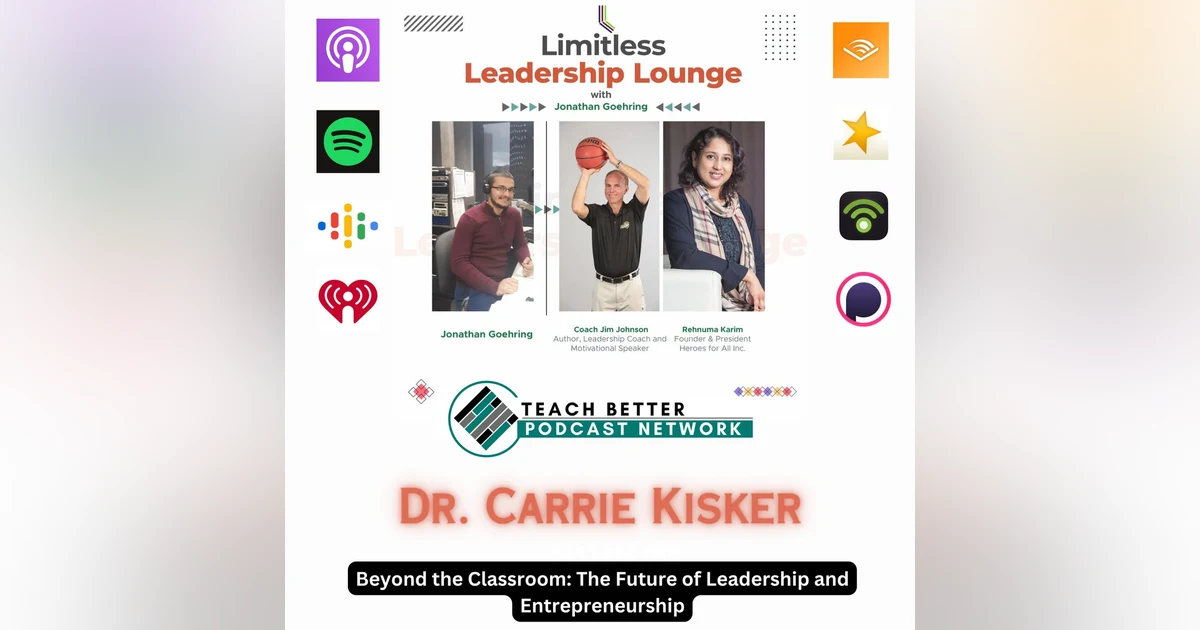

What if the key to thriving as a leader is embracing adaptability, purpose, and education? This week, we’re joined by Carrie Kisker, President of Kisker Education Consulting and Director of the Center for the Study of Community Colleges, for a rich...


What if the key to thriving as a leader is embracing adaptability, purpose, and education?
This week, we’re joined by Carrie Kisker, President of Kisker Education Consulting and Director of the Center for the Study of Community Colleges, for a rich conversation on leadership challenges, community college impact, and the future of learning.
Carrie dives into:
- How community colleges empower students to explore passions affordably and close to home
- The critical pillars under attack in higher education... academic freedom, institutional autonomy, and civic engagement
- Strategies for leaders to balance resistance and innovation amid shifting political and social climates
- The evolving relationship between entrepreneurship and education in career pathways
- Practical advice for emerging leaders on continuous learning, adaptability, and breaking down silos
- How exposure to diverse perspectives fuels inclusive, effective leadership
Whether you’re a leader inside education or beyond, this episode will help you reimagine leadership as a dynamic, impact-driven vocation.
Resources Mentioned:
- Kisker Education Consulting: kiskeredconsulting.com
- Center for the Study of Community Colleges: centerforcommunitycolleges.org
- Linkedin: https://www.linkedin.com/in/carriekisker
- Book: https://www.amazon.com/American-Community-College-Carrie-Kisker-ebook/dp/B0CGKBVWHL?ref_=ast_author_mpb
0:00 This podcast is a proud member of the Teach Better podcast network, Better Today, Better Tomorrow, and the podcast to get you there. You can find out. More at Teechbetter dot com slash podcast. The best ideas can often come from unexpected places. I have seen innovations adopted in community colleges that came from a statement that a custodial worker made saying, I'm noticing that a lot of students are eating lunch and drop in their trash in this area, and what if we maybe beautified it and made this a place for gathering in connection and all of these things can support student success. Do you want to be a leader in a constantly changing world? Our emerging leaders look different, come from various backgrounds and from all different age groups.
0:45 Leadership is changing and it's hard to keep up. But the good news you can be a leader too. You can be an emerging leader. Welcome to the Limitless Leadership Lounge, a try generational conversation. For emerging leaders. Come spend some time with us to discuss leadership from three angles. The coach, Jim Johnson, the professor, Doctor Renuma Kareem, the host, John Gering, a monthly guest, and you get in on the conversation on Facebook and Instagram, and be sure to follow us on Apple Podcasts, Spotify, and Speaker. So come on in and make yourself comfortable. Really excited for our conversation today. I'm the Limitless Leadership Lounge with doctor Carrie Kisker and we'll get to her in just a moment. First though, I'm John Gerring, Doctor Numa Kareema is here and coach Jim Johnson as well.
1:35 This is going to be a fun conversation today, as we always do, try generational conversations for you, the emerging leader, gaining leadership and personal development insights for you, whether you're starting a business, you're a leader in one, or even just as a leader in your family or your community. Coach, go ahead and introduce our guests today. We're excited to dive in. Yeah, we had a chance to connect with doctor Kerry Kissker and I had a nice conversation. Whether we're really excited to have her on our podcast. So let me just share a little bio. Doctor Kerrie Kisker is the president of Kisker Education Consulting in Los Angeles and a director of the Center for the Study of Community Colleges drawing from her own and others' research. She regularly speaks, writes, and consults with college leaders on issues related to entrepreneurship and innovation, program and policy development, strategic planning and accountability, civic learning, and democratic engagement. Doctor Kisker holds a BA in psychology in education from Dartmouth College and an MA and PhD in higher education with the University of California at Los Angeles called UCL. Being a basketball coach, there was this guy named John Wood that did a pretty good job there. Doctor Kisser was also the author of The American Community College, written with Arthur Cohen and Florence brought the shaping of American higher education with Arthur Cohen and creating entrepreneurial community colleges design thinking approach without further ado, Doctor Kerry Kisker, Welcome to the Limitless Leadership Lounge.
3:06 Thanks so much, coach. It's a pleasure to be here with you. Yeah. So I'm going to delve in because we've definitely have had other people with PhDs and worked in higher education, but I know you focused a lot in the community college, which is something we haven't delved into much. I'm going to ask a question is that when students finish high school, a lot of them have no clue what they want to do. I'm interested to is, what would you tell a student that didn't have any really idea as far as why community college might be a great option for them. Sure, there's all sorts of reasons why community colleges might be a great fit for a student. I but let's say, particularly someone who's coming from high school, they don't know exactly what they want to do, but they're a little nervous about spend somewhere between twenty five and eighty thousand dollars a year to explore that. Now, if you can do that's fantastic. There's nothing wrong with going directly to a four year residential university and learning about yourself. That is the heart of the liberal arts model, right, that has worked so well for four hundred years in this country.
4:15 And there are a lot of students who either can't afford that, who can't move away from home, who are maybe taking care of their parents or other family members, or have their own children, or need to work for whatever reason. And so that journey of self exploration needs to be a little bit less expensive and a little bit closer to home. So community colleges provide one way to figure out what we're interested in as a student and where our strengths lie. Right. We know that in this country, a whole lot of students come out of our secondary system, the K through twelve system, not feeling very good about themselves as students and not having a lot of confidence in their abilities, and that is sadly both a true and a failure of our system. But community colleges really provide a lovely second chance for those students to perhaps study something that might be a more applied and therefore of interest to them, So maybe one of the skilled trades where they may be able to graduate in a year, two years, sometimes even less, with training that prepares them to go right into the workforce and potentially earn a six figure salary off the bat.
5:26 They also provide students who maybe do want to pursue university studies the chance to figure out, maybe knock out a couple of those general education requirements, figure out where their passions lie, and then transfer to either a nearby or sometimes a far away university. That happens all the time. The beauty of community colleges is that they have for roughly one hundred years, had this a La Karte model of offering something for everyone. It can also be the downfall of many a community college, right because we're trying to be all things to all people. But there's a real art in that idea that no matter what you want, you can achieve it here. And so most community colleges are really trying to maintain some aspect of that. You can find yourself here, you can find your passion, you can find your path without necessarily having that scattershot approach to doing everything all at once as well.
6:21 And Carrie, I've watched your video on the leadership and existential crisis, and we are living in a kind of dystopian world right now, and those who are in the academics, we are experiencing so many, so many challenges. So you as a leader, and you have been consulting leaders in the field of education, I know that civic learning and democratic engagement is so important for the students and for all of us, but recently we are seeing that those things are discouraged and sometimes being an academic, our values are also we are experiencing conflict, that conflict of how to do what when we are being challenged. So how do you, as a leader, how do you navigate this contentious territory of teaching our students on how to think in that right way, standing for what is right? So how do you do that? Or just we step hup y?
7:23 That is doctor Green, That is the question. We are living through an unprecedented challenge to higher education. The only real parallel that might be appropriate would be back in the nineteen forties in the McCarthy era and blacklisted professors and attempts to stifle free speech and academic freedom. But I would argue that our government, both at a federal level and within many states, have gone much much further than that today to stifle academic freedom, which is the long sherished right and tradition for professors to be able to speak and teach about what they believe is important.
8:07 When they do so, they are speaking for themselves as individuals, not for the institution. Those are two separate things, which is why academic freedom is not always extended to administrators of these institutions, because they often are speaking for their institution. But faculty really have the right and it's protected largely through a tenure to academic freedom and freedom of expression and that is being torn down, and it frankly has been attacked for years. But those attacks have been under the radar, and in some cases we have allowed things protections like tenure, and by we, those of us in academ have allowed protections like tenure to go by the wayside on our own watch. So we are not faultless here either. But to answer your question, I think we're in a time of unprecedented attacks not only on what universities and colleges are doing today with regard to DEI and inclusion practices, or what's being taught in the classroom, but really what is being attacked are the fundamental pillars upon which our entire system rests. And without these foundational pillars, I argue, we don't have the best system of higher education in the world anymore. Right So I give a lot of talks about this, and maybe you've seen a clip online, but to me, those fundamental pillars are number one, and perhaps the one that everything else rests on is institutional autonomy. And this has been established and upheld in
9:37 the courts for centuries now, and it essentially is the right of institutions to make decisions to govern themselves in the way that they see fit. And this is for public institutions as well as privates, even though publics do have to comply more with state regulations and so forth. And the reason this is important is that it protects against government intrusion in saying what you can teach and how students must learn. Right, So it protects exempt against exactly what we are seeing being attempted today. The second pillar is I mentioned academic freedom, protected largely by tenure. The third pillar is freedom of expression, which I separate out from academic freedom because freedom of expression should be protected and encouraged for students as well as for faculty. Right. So, whether you're attending a community college or you're going to an Ivy League institution, our goal as educators is to help you. I think you mentioned this doctor Cream meant help you think and learn how to think, how to consider a problem or a challenge from multiple perspectives. As part of why we ask students to take a course in the quantitative sciences, in life sciences, and the humanities is because all of these different disciplines have a different approach to how they would consider a problem and seek to solve it. So the thinking goes. By exposing students
11:08 to all these different ways of approaching and solving problems, we are teaching them how to think. I have very rarely, if not never, seen or experienced a classroom where the teacher tells a student what to think. I think that's a real common misperception in our higher education landscape right now. There's a lot of people, especially on the conservative right, who see universities and even community colleges as these places of liberal and doctrination where they're going to send their students and the students are going to come out believing something completely different than than what they were taught, maybe in the home or how they raise. Now, we do know that there is a period of cognitive and intellectual growth during the high school and college years where young people start thinking for themselves, really for the first time.
11:58 But coach, I'll ask you this, how many of the young people have you coached or taught who have been easily brainwashed and just accepted whatever you told them is truth without pushing back or questioning it. I think anyone who's taught young people know I see you nodding that they are very unwilling. I have two teenagers, right now very unaccept what I should as gospel right and then just to go we can come back to that thought because that's a biggie right now. But then we also have stuff like protecting access and supporting all students through our colleges and our systems, and that was not always. We were not founded as an egalitarian system of higher education, but we have worked hard to become one, and in art I believe that's why our institutions are being attacked right now because they threaten the preservation of a I would say, racialized class order that some people may be trying to protect. And then the fifth and final pillar is a real commitment to working for the public good.
13:03 And I would be interested in all of your thoughts on this as educators as well. But our system of higher education was really founded, and community colleges are perhaps the clearest example of this, founded to give back to the community, to teach students how to think for themselves and become, if not politically engaged citizens, at least civically engaged citizens, and recognize a problem in their community and identify ways to solve it that work for them and their families and the people they care about. So unfortunately. To get back to your question, I think that we are being attacked at the foundational level in all of these areas, and we can talk about why that might be.
13:46 But I think you've started the question by ask what can leaders do? And I would include faculty leaders in my answer. I gave a talk recently to let's see the acronym is NISAD, the National Institute for Staff Organizational Development, and I answered this question and I said, I think we can fight back. Maybe fight back isn't the right word. That we can work in three different strands. The first is we need to be connecting. Harvard is fighting the battle with the federal government on its own, but Harvard is Harvard, and that can afford to do that. They are perhaps the only college in the world who can afford to do that. Everybody else and certainly are broadly accessible. Institutions and community colleges need to work in concert with one another. So I've been really encouraging faculty associations within disciplines to talk with each with one another, community colleges within regions, to form alliances and to work with one another.
14:41 That we've seen faculty in the Big Ten and the university sectors start to do this, and we're now starting to see the associations across the US step up and help in this way. The second strand is resistance, and resistance is tricky, right, because when we hear resistance, we tend to think that means everything we ca have been doing is absolutely right, and they're attacking us, and we're going to fight back against everything. And I think we are under attack, yes, And at the same time, we're not perfect individuals, and we're certainly not perfect institutions, and we don't always get everything right. So even though we may resist the attacks at the foundational values that we hold as institutions and as educators, I think we also have to be really willing to look at mistakes we may have made, or how we can do things better, or are there alternate approaches to accomplishing our very noble objectives that maybe do not raise the ire of some people who feel like that's that we're going bad things the wrong way. And then the third strand, which you know that sort of self reflection leads to, is innovation.
15:47 I think we're in a period where if we can recognize that when we're under attack is the biggest opportunity for growth. We can really innovate. We can find ways to serve students, new ways to serve communities, new ways to protect things like freedom of speech and the student's right to self expression and activism on our campuses, and recognize that must be done in a way that does not threaten any constituency on campus or off, or preclude anyone's access to their own learning and development. I think there's a real chance for innovation here. Unfortunately, a lot of what I do is innovation coaching directly with colleges and universities, which you might think of as fireproofing your home right here, trying to lead ways to protect your home in the future. But unfortunately fireproofing has to take a back seat when there is an active blaze raging through your kitchen. So while I'm encouraging leaders to act in these three areas, I think it's understandable that there is a lot of Okay, I understand, Carrie, but we need to focus on the blaze that is happening right now and deal with what is really threatened us, threatening us today in this week.
17:00 Yeah, Carrie, it is. This might be more anecdotal, but just this concept, right now and I feel is really catching on in society. Again, I don't have any statistics to back this up, but just from what I've seen is this whole idea of hey, college isn't for everybody, follow your path, And while I don't disagree with that statement, I also think that we've turned that into college isn't for everybody. Therefore, maybe it's actually for nobody. And I couldn't disagree more with that. At what point do we have to because certainly we have to encourage maybe high school graduates who aren't ready to jump into college at this point, we have to encourage them to follow their path, maybe consider an education, further education down the road, but for now, maybe enter the workforce. Everybody's path is different, right, So I'm not saying college is always the answer right out of high school. But at the same time, it feels like obviously with like the federal and state governments, like you mentioned, there's a tax there, But then there's also seems to be from my perspective, like this overall cultural narrative, it seems to be going against colleges and more to working right out of school. Yeah, tell me if that's actually hit on.
18:12 You've hit on one of my biggest pet peeves, which is that statement you said that we hear all the time that college is not or should not be for everyone, and that rakles me for two reasons. And the first is that when people say college is not for everyone, nine times out of ten ninety nine times out of one hundred, they're referring to that four year residential college experience. So they are saying the four year residential bachelor's degree attainment route is not for everyone, and that drives me nuts. I work most of the time with community colleges. I write most of the time about community colleges and community colleges college. In fact, I have a T shirt that I made that literally says community college is college on the line of everyone watches women's sports, because I get really upset when people do not include community college in that notion of college. It is college. It often leads to a bachelor's degree, It leads to other degrees and certificates that prepare you for the workforce. It is college.
19:16 It is a slightly different way of approaching college than a four year residential college experience, but just Colgate University looks a lot different than you see Santa Barbara, Your local community college is going to look a lot different than both of those, and they are all college, they are all college experience. So I hate that college isn't for everyone statement because I think it really ignores the places where forty percent of undergraduates in America start their education. Wow, forty percent. And the second reason I hate that is to your first point, I think, John, which is that it is a slightly underhanded way, potentially at least in some people's mouths, saying college should not be for anyone, or attempting to tear down the public trade in our institutions.
20:02 So I agree with you one hundred percent. I do not think that every single student coming out of high school needs to go directly to college. If that is not the path for them, no problem. If community college is the path for them, great. If it's not the path for them and they need to get out into the workforce, great that's another beauty, Coach. To get back to your earlier question, that another beauty of community colleges and frankly many more institutions these days as well, is that you can come back for upskilling and retraining. There are not a huge number of students, but there's way more students over the age of sixty five coming back not to study basket weaving and personal interest courses, but to actually learn new skills and trades in our community colleges all across the country right now. So the statement college is not for everyone drives me nuts. But I agree with you also that it doesn't have to be the path directly out of college for everybody. And if you can can go get a certificate and become a solar panel installer in a year or two years and make one hundred thousand dollars, that is still going to college.
21:08 Let us not exclude that or take that really elitist view of what college is. Hey, Carrie, I got to ask you because I know you've done work with entrepreneurship and our podcast focus on trying to help young in emerging leaders. So what can you give us two or three piece of advice for a young person or even a person that's in mid range in their career and now says, you know what, I don't want to work for someone else. I want to be an entrepreneur. What's your thoughts on giving them some advice of taking the entrepreneurs ship journey. I think maybe the three of you will agree with me.
21:48 I think the skills and mindsets that it takes to be an entrepreneur are going to be increasingly necessary for all of us, whether or not we want to start a small business, especially in a time of AI and just that the pace at which our technological powers are growing, it's going to become more important. Those jobs where you go sit at a desk and work for eight hours punch your clock are already almost gone, right and so and rumor this goes back to the point about learning how to learn maybe in college being the most important thing, and I think the entrepreneurial skills and mindsets go right along with that too. That the pace of change in the labor market is so fast these days that whether you want to start a small business or you just want to be able to survive in whatever industry you are currently working in, you're going to have to be able to think entrepreneurially and in an innovative way, because that's what we can do that the machines cannot. The machines are trained on human learning, but they are not thinking beyond human learning yet. So we have to be able to continue learning and coach, I think you're right.
23:05 I think if you're wanting to start a small business, you have some measure of control over your own life and your own destiny, and you maybe if are able to pivot faster than if you are cog in the machine, going along and doing what your boss tells you to do every day. I think you're going to be out innovated. In that second example, I know that I didn't set out to be a small business owner or an entrepreneur. Neither did my husband. We both worked for other people early in our career, and now we both work for ourselves and our own companies. And in his case, for example, he works in entertainment, and the entertainment industry is yeah, it is changing really fast, and the only way he could see to maintain some longevity in that business is to design a way to do it differently. And I think that's what we all need to be learning.
24:00 And you talked about design thinking approach as entrepreneurs, and I also took the path. I started working at unisf and then nine to five job, and then I moved into academic. So after ten years, I start to reinvent myself. And then I decided to start my own nonprofit and working on some startup industry, thinking about some startup industry, and I think we gen xers are a little bit challenged now because things are moving so fast with the AI and everything. There is no certainty in our career like where we're sticking to and this shift of change, I think is so important for us to have that mindset of learning to unlearn. Also, so the adaptability. So how like from your point of view when you are counseling the leaders, do you see this area that need to be explored, like the adaptability and flexibility and how do you get that?
25:01 How do you teach that to people? Yeah, that's a really good question. I think there are probably lots of exercises and ways that you could teach that. I typically come in and have one two sometimes three maybe half days with a group of college leaders and faculty and staff, and I'm very limited in what we can do. During that time. So what I often try to do is focus on the front end of the design thinking process, right, which is really identifying what your stakeholder's needs are in which of those are not being met, And I think that leads into so we often go through a lot of exercises, to do market research, to talk to students, to talk to faculty, community members, what are the workforce needs in our areas? Go back and really identify what are the needs, Where are we meeting those needs? Where can we do better? And where are the unmet needs?
26:00 And to me, the unmet needs are the key there, because that's where we have to say, Okay, we're not doing this or we're not doing this well. What needs to change so that we can serve this need? And sometimes it's we're not the best organization to serve this need, so we're going to collaborate with somebody else to do that. But I think that's where the adaptability comes from. The hardest thing to do in higher education and potentially most places to really to sunset programs that are meeting and need that no longer exists as strongly as it once did. And the reason it's so hard is that oftentimes that translates into real consequences for real people, either lost jobs or asking them to pivot or shutting down a program.
26:46 And even if there's only one student who wants to take that program, that's one student who now is not able to do it. So it's really difficult. It's much easier to add right in order to meet an unnet net need is much more difficult for college leaders than probably everybody else to say, Okay, we're going to stop trying to meet and need this way because we need to put our resources in another area. But really that comes down to being responsive and adaptable and listening to your community members and what they're asking of you. And it's definitely we have so much resistance, like I see so much resistance like when AI was introduced. There is a generational difference in adapting to AI. I am not going to even I have I mentioned to many of my friends, I'm not going to use AI for writing things that I don't want to jeopardize my skill of creative. But now I'm like, Okay, let me try this, and then I find out, yes, I can keep my voice, my emotion, but AI could also facilitate. It can be a tool for me to go into another level.
27:53 I hear you, I too, have pushed back on using AI for writing because I'm a writer. I have books that I have written and that's my work product, that is my thought. I sit with every sentence and it's creative but it's also this physical challenge because it doesn't work to wordsmith and have it say exactly what I want it to say. And then so if AI can do the same thing, I'm wondering what good am I anymore? What is the utility for me in my career and what I have to say? But I agree we have to be adaptable, and there are ways that all of us could use a There are also ways that us that we can all adapt and either incorporate or change the way we do things to respond to other technologies or students who are coming into our classes who may learn differently than the students of thirty years ago or the athletes of thirty years ago. We have to be adaptable in all kinds of ways. I think we're AI is the big scary elephant in the room right now, But there are all kinds of things that should be forcing us to adapt. Yeah, and they're all scary for us olds.
29:04 Oh no, and for old twenty six year olds too, because it's terrifying. It's really terrifying. I would argue that Carrie, to your earlier point, I don't think AI can replace you as a writer. I can certainly help to renew MOUs point. But I certainly think that your writing is still valuable and that thought leadership is so important, and that's ultimately really who we are as educators, as thought leaders and I'm an adjunct, I teach one class. I can barely count myself in with you guys, but still we're all educator. We're all educators and as far as staff, faculty and staff. This is one question that I had for you as someone who because maybe it's a personal question for me, I don't know, might consider going down in increased role in education in the future besides what I currently do. What would you advise? Because I feel like a lot of again this is anecdotal. Again, I don't have any evidence for this, but colleges, universities, and high schools and below too, there's a lot of need for educators. The role seems to be under attack. Isn't as lucrative or maybe just attractive of a role as it once used to be, And now everybody's hiring and looking for people. So, first of all, what went wrong?
30:22 And second of all, is this still should this still be an exciting career for people who want to make a difference in the lives of youth. I'll take that last question first. Yes it is. I think it is the most important career and frankly can be the most rewarding career. And coach. I'll look to you as perhaps our senior most of the generations represented here. But I imagine you have not stayed in coaching and teaching and working with young people because it's lucrative. I think you've stayed in it because you make connections and you can see you have on young people's lives and in many cases, and I know this to be true about you, and I assume it to be true about all of us, have made a real change in the trajectory of someone's life based on your interactions. And sometimes that's as little as just seeing them and recognizing that they may be going through something difficult, and hey, I'm here.
31:21 If you ever want to stop in my office or talk about anything as a faculty member, maybe that's as simple as hey, is everything okay going on in your life? If you need an extra week on this paper, let me know. And sometimes there's nobody else in a student's life who takes the time to just stop and say, I see you. It looks hard. How can I help you, and it's important that I help you, and it's important that you continue regardless of whatever's going on, and we'll find a way to help you do that. And I see smiles and nods from all of you right now. I think that's why we get into this. We're not going to retire on a yacht as educators. But I do think, oh, yeah, yeah, exactly. But I do think that when we think about what we had written on our tombstones at the end of the day, it's not I made enough money to retire on a yacht's I changed some people's lives. So I would encourage you to continue your work in education, John, it is your first point in question. I think it's perhaps harder than ever.
32:29 I think teachers in particular and faculty members in colleges have been undervalued and underpaid for years, especially teachers in the K through twelve system. And we can talk all about the reasons why for that, even though that's not really my area of expertise, I of course have opinions, but I think that administrators too have been blamed for all kinds of things. Over the past couple of years. There's this whole concept of administrative bloat in colleges and universities is the reason why tuition has gone up thirty percent over the past two decades or whatever it is. And part of that is there is true there are more administrators, but there are more administrators for two reasons. Largely one is to comply with governmental regulations, and the second is because we have recognized that we need to do more as institutions to support the students who show up on our doorsteps every day, and that it is not okay to open our doors say come here, teach a class and send them home. That there is all kinds of work we need to do to support all students who come from all kinds of backgrounds and different experiences.
33:33 And so there has been growth in the administrative side, especially related to student services. But I have a really hard time accepting that hasn't been a good investment. Anyone I think who runs a for profit business would know that you spend a whole lot more money trying to get a new client through the door do keeping the current client involved through completion, and it's the same in education, and yet we have a hard time spending money to do that, especially at our publicans tay stitutions. Yeah, and you had a good point. What does that look like? Because you your point earlier was that we need to get higher education institutions more involved in the community. So what does that often look like. Is it the fraternities and sororities doing more community service, because that's something that we see. But is there more than that that you're referring to when you say that.
34:22 Yeah, So as I work mainly with community colleges, and it is intrinsic to the mission of those institutions to be responsive to their communities. So you see this in all kinds of ways. Training programs developed specifically for businesses in the area, and oftentimes this is done in concert with metropolitan areas or regions in order to bring company headquarters to that region and say, if you can bring State Farm here, we will develop an insurance administrative degree program to educate their workers. Or if you bring Boeing here, we will develop an aeronautic engineering program that transfers directly into the VA program at our nearby institution, and that provides technicians who can graduate in six months or less and go write and work for them. So community collegests have forever for the past hundred so years that they've been around, worked really closely with chambers of commerce, with local businesses and industries in order to provide some cases direct training and then other cases develop programs where incumbent workers can come up skill and reskill and further their education.
35:33 So that's one way of working with the community. Other ways are offering English as a second language courses for community members. This is not leading toward a degree year program, but just providing those resources for skills, maybe holding daycare on campus. Santa Monica College, near where I live in La has a gorgeous pool that is open to the public, and there's all kinds of s Antamonica also has an emeritus college where they invite retired folks to come take a class on I don't know World War two history or None of these courses lead toward degree, but they certainly provide engagement for the community and intellectual stimulation for a population who maybe lacks that to some degree. Sporting events is another way that we all interact with our communities, right, and that's a big source of community pride. And I'm speaking specifically about community colleges, but you could draw parallels.
36:26 I also think that what we don't understand too is how much educating students at all types of institutions and at all levels contributes to local revenue and economic growth. When we took students off college campuses during the first year of COVID, local businesses died. There was literally nobody to go to those stores to buy those sandwiches. And then also we're graduating students and they're staying. In particular, international students who come to the US for college like to stay and contribute to the economy and take jobs that further our own workforce very frequently. And there's a recent report out saying that we are going to lose something like sixty billion dollars as a result of the drop in international student enrollment this fall as a result of that. So the community give and take is enormous and often invisible in terms of how it keeps certain communities.
37:28 If you think about some of these college towns in the middle of nowhere, they would not be alive. They would look like old mining towns if the college or university were not there to keep it Afloat. Garry, we really appreciate and I have one final question. I'm sure my co hosts do as well. But I'd like it because I know you work with a lot of leaders, and so if you are advising a young person to zero win on a couple ideas on how to be a more effective leader from all the work you've done with leaders, would be one, two, or three ideas you would share with that person to become a more effective leader. That's a good question.
38:08 The first thing that's popping into my mind is that the best ideas can often come from unexpected places. So I think we all run into the patterns of thinking that this smart person in the room, or the most degreed person in the room, or whomever, is going to have the best ideas. And sometimes that's the case. But I have seen innovations adopted in community colleges that came from a statement that a custodial worker made saying, I'm noticing that a lot of students are eating lunch and drop in their trash in this area, and what if we maybe beautified it and made this a place for gathering in connection and all of these things can support student success, and so be open to ideas from wherever they come. I think that's one thing.
38:53 Don't care just say one thing, because you really hit a good thing there, because this is one of the hardest things it is in my leadership journey. Is then I think it became a much better leader. And just to reinforce what you said is I believe the most effective leaders are trying to find the best answer, not necessarily their answer. And boy, you said that quite well, so I just wanted to share that. So yeah, I like the restatement. I think that's exactly right. The second thing I would say and do say all the time is expect failure and embrace it and sometimes even celebrate it too. I think sometimes I see in my children today are so afraid to fail because they think it brands them as a failure or unable to do the work. And what I try to impress upon them, and I think probably what most educators do, is how else are you going to learn if you don't fail?
39:44 And ideally you fail in small ways and adjust and make improvements. But sometimes we fail in big ways too, and that is okay. That it does not mean that we are a failure. It means that idea needs some more work, or we neglect it to take something into account, or we needed another round of edits, or maybe we needed to study harder. So I think that advice I could give to all students, but especially to leaders too who are trying to incent innovation on their campuses or in their companies that don't expect people to get it right the first time. In fact, if they got it right the first time, you'd probably be leaving something on the table. Right that there is further innovation that could come out of that idea if you just accept the first iteration of it. And I think the final advice I would give is that we tend to see entrepreneurship and education as two separate things. And you either go through an education system and get a job and go into a career, or you are an entrepreneur and you do things yourself in your own way. And I think it's a false dichotomy. I think that there are incredible entrepreneurship training programs at nearly all colleges and universities these days, and I think that we can all utilize the skills and mindsets of an entrepreneur, even if we aren't starting a small business, even if we aren't trying to go our own way. And on the flip side, if you do start a business. If you are trying to come up with something and do it your own way, it
41:16 doesn't mean that education, to go back to your point, John, is not right for you. There may be all kinds of things that you can still learn and give back to our education system and still be an entrepreneur and still do things differently. Education is not in doctrination. It is teaching you how to think and exposing you to the ways of thinking, the tools, the analytical approaches, and so forth. It may be useful, So don't separate those two. I think that we can have the best partnerships between entrepreneurs and academics and students if we stop drawing those lines. It's either education or starting my own business.
41:56 I think that, and I can be walking evidence of that because I have six years of higher education and I'm an entrepreneur, and without at least some of that higher education, I would have had no chance forget it. I wouldn't even know what I was doing. And part of that certainly is life experience too, because that's part of the beauty of college, whether you choose the community college path or the traditional four year path, or a combination of both. Right, like, just that life experience and the responsibility that you get. Going from high school to college is such a big jump. I can imagine going from high school straight into entrepreneurship is I can't even imagine how monumental of a jump that is. I just would have had no clue. So I definitely networking.
42:39 I think the college universities they also provide you with the network because I would not be able to run my programs in if I did not have my alumni base. So both the Penn State alumni and the Bangladesh University alumni both helped me to raise funds for the programs that I've to run. So I think networking is also so important when we are working as entrepreneurs. Yeah, even Penn State can turn out some good alumni. Come on, sorry, yeah, Ben Stater. My seventeen year old daughter is applying to both those institutions this fall, so I will let you know where she ends up.
43:23 And then, wow, Ben State is the five years I was there for my PhD, it like it is the most happening place, and I met some amazing faculty and people there who really helped me to grow as person. So that's and the environment Happy Valley they call it value. Yea, our mascots cuter renewma, come on orange is a mascot that's as cute as it gets. But No, both great institutions and both hills, both with a lot of hills. She'll get her exercise in no matter what. Sid Yeah, Carrie, where do we learn more about your work and potentially get in touch with you? Sure? So my website Kisker ed Consulting EDS being short for education, you can reach me. There's a contact me button on there, and you can learn all about the different strands of my work and my writing and speaking and so forth, as well as the workshops and consulting I can do directly with colleges. I also am the director of the Center for the Study of Community Colleges, which is a nonprofit organization that promotes both our own national research on community colleges, but we also support others' research on community college leadership practice and policy, and that is at Center Forcommunitycolleges dot org. And I'm also on LinkedIn under Carrie Kisker Kisker and I'm happy to hear from anyone at any time.
44:49 Wonderful All those links down in the show notes and we learned a lot from you today, Carrie, both about higher education, entrepreneurship, and I think no matter if you're an entrepreneur or not, or no matter if you have kids in college or you yourself are thinking about going to college, this was still very valuable conversation. So doctor Kerry Kisker, thank you so much for your time today in the Limitless Leadership Lounge. My pleasure, and thank you for such wonderful questions. All three of you appreciate it. Thank you for joining us this week at the Limitless Leadership Lounge. To listen to this episode again and to find previous episodes, check us out on Apple Podcasts, Spotify, and Spreager. You can also get in on the conversation find us on Facebook and Instagram.
45:30 Then tell three of your friends to. Join it as well. Coach Numa and John. We'll be back again next week for another try generational leadership discussion. We'll talk to you then on the Limitless Leadership Lounge


