Lead with Purpose: Ignite Significance and Impact with Mosongo Moukwa
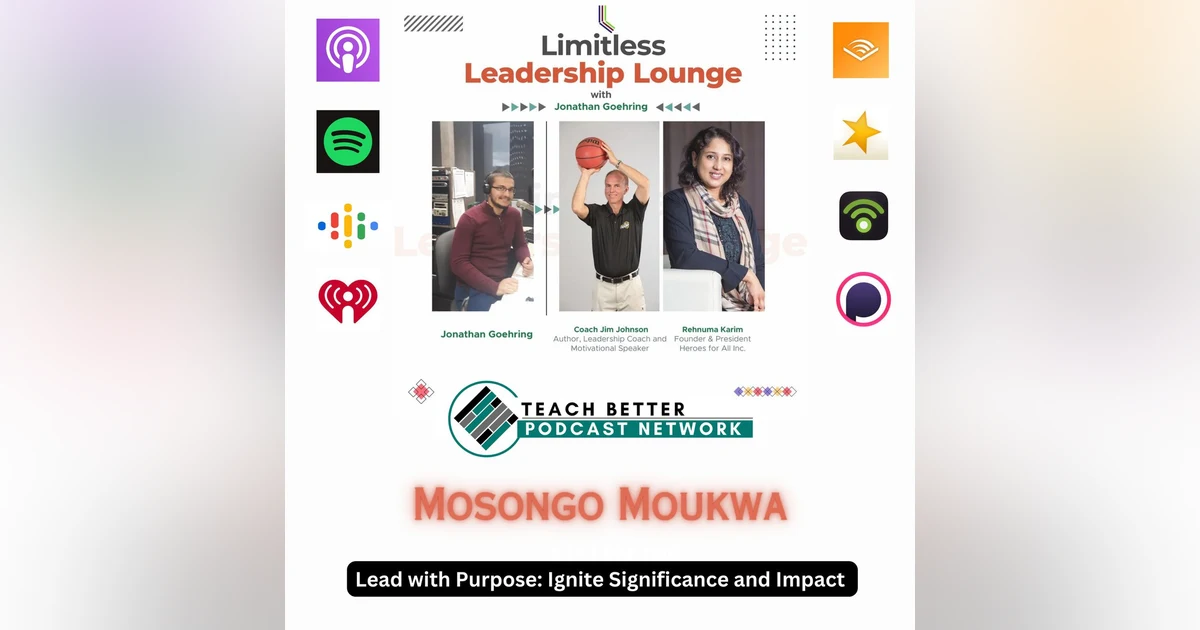

What does it mean to be a leader of significance living a legacy beyond titles? This week, we talk with Mosongo Moukwa, experienced leadership mentor, senior executive, and author of Be a Leader of Significance, about building trust, fostering...


What does it mean to be a leader of significance living a legacy beyond titles?
This week, we talk with Mosongo Moukwa, experienced leadership mentor, senior executive, and author of Be a Leader of Significance, about building trust, fostering psychological safety, and creating teams that thrive.
Mosongo shares these powerful insights:
- How to lead up by standing for what you believe despite pressure
- Creating shared vision and belonging that energizes teams
- Building psychological safety through visibility, authentic connection, and open dialogue
- Choosing team members by attitude, value alignment, and growth potential over mere skills
- Leading teams with empathy and adaptability amidst multigenerational dynamics
- Embracing mistakes as stepping stones for renewed leadership effectiveness
- How true leadership impact is measured daily in moments of significance and human connection
Resources Mentioned:
- Website: https://www.mosongomoukwa.com/
- Linkedin: https://www.linkedin.com/in/mosongomoukwa/
- Book: https://www.amazon.com/Be-Leader-Significance-Legacy-Impact/dp/154454216X
0:00 This podcast is a proud member of the Teach Better podcast network, Better Today, Better Tomorrow, and the podcast to get you there. You can find out more at teefbetter dot com slash podcast. Try to be yourself and by looking inside yourself and drawing upon your own energy, you're actually going to deliver much much more than trying just to monkey other peoples around. Do you want to be a leader in a constantly changing world? Our emerging leaders look different, come from various backgrounds and from all different age groups. Leadership is changing and it's hard. To keep up. But the good news you. Can be a leader too. You can be an e merging leader. Welcome to the Limitless Leadership Lounge, a try generational conversation for emerging leaders. Come spend some time with us to discuss leadership from three angles. The coach Jim Johnson, the professor, Doctor Renumah Kareem, the host John Gering, a monthly guest, and you get in on the conversation on Facebook and Instagram, and be sure to follow us on Apple Podcasts, Spotify and Speaker. So come on in and make yourself comfortable.
1:11 Leadership is something that we have the ability to get better at and that's what we're talking about here on the Limitless Leadership Lounge, and how powerful of a conversation we're going to have with our guests. Who joins us today from Chapel Hill, North Carolina. I'm John Gering, joined us always by coach Jim Johnson. Coach, you introduced us with the Massongo and we've gotten a chance to speak with him briefly, and we're excited to have him on. So let's dive in and get going on our leadership conversation today. Absolutely so, Massogo Moqua and I got a chance to talk and I read his beautiful book, which I'll share a little bit more in a second. But Massogle has held various leadership positions and now he impacts people by helping them with their leadership and be able to inspire them to become better leaders. His measure is to elevate leadership capability by equipping individuals with high impact leadership skills.
2:05 These skills empowered them to engage, empower, and mobilize employees, fostering an extraordinary difference. He also assists business in scaling sustainably by nurturing their true wealth the collective passion of their people. That's music to my ears because I know how important people is in leadership. He has also written a wonderful book called Be a Leader of Significance for our YouTube audience. That's what looks Like, which I had the opportunity to read and recommend to my network. It was well done. So, without further ado, Masango, welcome to the Limitless Leadership Lounge. Yeah, thank you so much. I'm happy to have the conversation and I'm grateful for the opportunity.
2:48 Let's start because in reading your book, you had a lot of high level leadership positions, but you were most of the time not the CEO. And a lot of our leaders that were listening to show are people that are in the traditional we call middle management. They have people that they're under their supervision, but they're also working with people that would be above them and the organization. So my question is is, because I think often when someone gets promoted in leadership, I'm the leader, but how do you work with the leaders what I call leading up? How do you work with the leader that are above you now that you're in a leadership position.
3:29 Yeah, this is a great question, coach. Actually, let me just tell you a bit of my story how I get to be in the leadership role. So I just finished my PG actually at that time, and I've taken a job with a specialty chemical firm in Ohio. I was excited to be part of the research group and I was just looking forward to settling into career as a rich societist. And long after I started, the vice president of R and D called me for one on one meeting and then after a few jokes and so on, I sat forward in his chair and it said one more songo. What I would like to do is we're going to make you a manager. And then I was a bit taken aback because I was hired as a principal societist at that time. And then I was just wondering, what the hell is going on here?
4:18 I just started here. So I I told him, I said, sir, I've never managed anybody, and I'm not too sure how this will work out. And if it doesn't work out, please just put me back in the lab. Don't worry. Everything will go well. I was spoken with the other manager. They think you'll be a good manager. So that's really how I started. So I was a bit but nevertheless, suddenly I was a brand new manager with no management experience and have to figure things out. When I completed my research work back then at Northwestern University, I expected to design products, develop strong IP and whatnot. And in those days, the company did not have any mentorship program of any type like we have today and so on, so I have to figure out things on my own.
5:09 A few people help me fill in various gaps, but I was more or less on my own. So one year led to two to three, and eventually that led to a very interesting career which I including senior leadership leadership role in various companies. But throughout everything, I've never regretted being in a leadership role. What it crystallizes. For me is that, hopefully for your listeners out there is this thought that my growth and comfort would never coexist. I think if one closes his eyes and we think about what when we learn the most in our life, it's probably at times when you were in risky or uncertain situation. So that crystallization made it easier for me to take on risky changes in different jobs, and some of them were actually very difficult, but really a coach.
6:06 The truth of my own career is that I denote a vision becoming a leader, but find myself in a leadership position in my earliest professional days. So that's really what my story is. Uh. Yeah, your story is similar to to so many of our audience members who we've heard from, who say I was a great individual contributor, and now all of a sudden, I'm a leader because I was the best, say, salesperson, now I'm the sales manager. It seems logical, but it's a totally different skill set. What were some of the early challenges for you going in as someone who took on this new role that seemed like a logical step for you, but still presented a whole new set of different challenges.
6:48 Yes, absolutely, because right away I faced a choice, uh, to do what other leaders around me were doing, or to do what I felt was best for the people I was leading and for your organization as all. So I chose the latter and I never looked back. So along the way, I discovered a number of behaviors and action that the leader must take to operate at personal best. And so that's really what it was. There. For example, I. Remember in the early days the vice president of R and D, he gave us a project. So he has signed me a very important project for the company. But in the organization, the way he was running the organization is like it was ultimately the one who will decide not to need a project, but will decide who from which group we should be.
7:36 Working on the project. So then he said, They asked me, he said, and go, who do you have in mind for this project? So I told him, I said, what I'm thinking of a fellow Frank. And then and then he said, no, actually, what I would like is for you to put Mike. I'm just giving some names, yet I would like for you to put Mike. And I knew this fellow Frank, actually he had the skills really to run the had a project and we can make real impact. And also he had come earlier to me, and they expressed the idea that that perhaps if he's given the opportunity, that really bit tremendous. And then I remember at that time when I answered the VP, I could look around the room all those the other guys they had their face down and because and the VP was red and of anger or frustration or disappointment, and I was actually thinking, seriously, this guy is going to fire me. Actually, so at the end. At the end of that he called me back in his office. He asked me if I would reconsider my decision. So I told him, I said, with all your respect, I really think that this fellow is really the best one to do. So his answer, if I recall, was something like suit yourself. But then now working with this fellow, he had the skills and with my support and so on, actually with the liver beyond the expectations in that particular project, because the fellow knew the dynamics that was going on in the department. So we locked arm in arm and with deliver so much
9:07 so that later on this particular fellow became one of the highest performing individual in our department, and some of the key projects now went to him, actually because we knew he was a very talented individual, very focused, and he could deliver, was good getting along with people and so on. So what I'm telling that story because we'll find ourselves in a situation where you're in an organization and you're trying to emulate other people's behaver there somebody who all of a sudden, people are wearing the same jackets, and you also feel compelled that you should wear the same jacket as the boss, and so on. The boss is living in some neighborhood, you feel like you should also buy a house in that neighborhood to be close to the boss, so to speak. So what I'm saying is that try to be yourself, and by looking inside yourself and drawing upon your own you're actually going to deliver much much more than trying just to monkey other peoples around you.
10:06 It's a great thing you stood for what you believed in, because you know that's part of going to someone above you and saying no, this is the right person and sticking to your guns. I'm going to divert very quickly. But my assistant coach came to me with j Mac Jason mcgillwaan, and said, he's not a very good player, but he has the right ingredients what we look for and someone we want to keep in our program even as a manager, because he had great passion for the game of basketball, and he was a great we over me. He cared about the team so much and ended up being a great decision for our whole program. And then he ended up staying in our program after that as a volunteer assistant. So I admire your sticking to your guns and that working out really well, because it doesn't always work out well, that's for sure. I'm curious as you took over various leadership positions. I know something you talk about is the vision or the mission. How do you get people on your team to really around that mission?
11:03 Now, this is a great question. What I've learned a coach is that is that in the organization, what people are looking for, they're looking for a sense of belonging. I had this this this chemist we used to work for me, and then going by the coffee machine, I asked him, I said, what is it about this place that you like here? I thought this individual was going to tell me, oh, you're giving us a great project, and we know we're developing good products for the company and so on. He told me, no, I love this place because I can play ping pong during lunch. Oh okay. And then they say, yeah, because I can talk to the other fellow. We get a chance to talk with each other taking a break. And so when I said, that's really something that I look forward to when I come in here in the morning, and it was a very bright fellow. And but that's what it told me.
11:51 So that sense of affiliation, so for this individual was extremely important. The other one I would say is a also the idea of psychological safety, so people have to feel that. I had this young lady, she was in marketing before, and then they transfer her into my group. What she was telling me is that in the beginning, whoever was her boss speak highly over her. She would be invited in meetings and so on, and then over time so she was invited less and less and less and so on, and then eventually they moved her to my organization. So I told her, I say, why did you not just go and say, hey, why are you not inviting me in any meetings anymore? Ther answer was that, well, I did not feel safe even to ask that question. Wow, So psychological safety is extremely important. The third one I would say is that people have to feel value. To feel value. The reason I'm saying that because it's not something extraordinary that you need to do. There was this gentleman as I was working in the corridor. I told him, I said, hey, listen, I have not had a chance to talk to you for a long time, but be assured that I've not forgotten you, and I did not make any big deal of that. Now, a year later, this individual told me said that that comment actually energized him.
13:13 It made this day, and I did not realize it at the time. So people need to feel to feel that, to feel value, because obviously it's a fact of life and the leadership. I believe that when people are noticed, they know that somebody cares. And when they know that somebody cares, then they feel value. And when they feel value, they believe that they indeed part of something much bigger than themselves. So those are the things that I would say that you, as a leader of a team, whether it's a smaller team or bigger team, that you need to create that create that safe place for the people. You have to create a space so that people they can feel that they have some kind of affiliation. They may have different affiliations, but they should feel that there is something there and then they have to feel that they're value so because then you can really trying them to get them around the major project, so to speak.
14:08 Yeah, I can ask you one more, just a Delvin, because we hear this a lot and I fully agree with you, But go a little bit deeper. How do you build psychological safety for your team members, because it's something I think there's been study and box about it, but do a little bit deeper. Give us some examples of how you build the psychological safety. Yeah, first of all, you have to you have to be visible. I've gone into some companies where you see all the managers they have their door closed, meaning that I don't want to I don't want to interact with anybody. You go through the corridor, all the doors that closed. So you need to be visible and you need to be present. We have lots of opportunities for us to engage people coffee shop or what have you, so for that.
14:54 So this really it's a good opportunity for you, first of all, to get to know the people, not just about the project, but to get to know them as individuals. You can inquire about about what Rather than asking, hey, how is the project going, you could inquire and say what is it there that was the most exciting for you this week? And then people will open up and then you say, oh, you'll remember you said you spoke to me about your son last week. It was in the hospital. How is he doing now? How is your mother doing now? And that's how you begin to create little but little, those those connections which are very important that because then there's something that then you begin to create actually a bit of trust, right because if you are invisible, why should people trust somebody was invisible? So we have those everyday junctions that allows us to talk to people and shape those junctions as moments really that matter, right, because you can set the tonal conversation, So that's something there, so be visible and because people will trust somebody that they see. And also you need to authentically connect with others because when they see the real you, then you begin now to create those bonds. And finally you have to ask. You have to ask powerful questions. I'd have to send the individual in somewhat of reflective mode that that.
16:21 Would say yeah. And then so many leaders I think they're so reactive in the way that, oh, I have to build a team culture. All let me organize a picnic or a Christmas party, and let's just do it to check the box so that we can say that we have a good team culture. And all the team culture photos on websites seem to just be the team bonding with Santa hats on, and it's like there's so much more to team culture than this. Team culture is not an isolated event. Team culture is a day in and day out practice. But you got to be proactive with that. You can't just be reactive. Tell us a couple of steps that you did to be proactively build a strong team culture that went beyond just one day of the year, but that your team experienced every day.
17:09 Yes, I would say, as you're engaging those people there and so on, then you have to you have to you you learn from people's stories. There is one exercise that I did a few years ago where I was asking individuals to interview each other rather than just in introducing oneself, Oh I'm so, and I'm blah blah blah. I said, no, let me actually pay people, and let's have a brief conversational interview with one another. And then when you come back, then you can share what you've learned about the other person. And then to frame that, I said, ask the individual questions about times when the other person felt most alive at work. So then people came back, and then one story was one older gentleman.
17:58 He had actually he developed the process that. The company was using chemical process, but nobody knew that this individual actually created that process, which he did many years earlier in his younger days. But when this fellow was introducing this older gentleman, what he told us is that is that when this individual was sharing his story, that he could really see that there was a great deal of energy that was really that this individual was really alive, so to speak. It took him maybe ten fifteen years early and so on. And then what we also learned is that is that when he started this project, it did it because he felt that at the plant people trusted him, and because of that that really gave him the impulse to even do more. So investing time in solving problem that was a big energizer for you.
18:55 So as a leader, when you pick up the energy of others, you create now new ways to engage and give people new chances and to do their best. So that's at the individual level, but you can also do it at your organization level, where you can now ask the question, what is really bring this organization alive? Because there are some activities when you want to do in the organization people excited and there are other activities where you don't see them excited. So you want to encover what those activities that really bring the organization alive and then tap into that. But you also want to know what are those activities that also the energizing the organization that you may perhaps trying to reframe it differently and so on. So that's how really you begin now to begin to pull people together and then knowing that now you can then define what the organization should look like because that will now become something that the people actually living it, so to speak. So that's how then you can review your processes system to see in fact, if this is something that actually that is energizing the people here or not. So that's how That's how I approached it, and that's what I would encourage many of the managers to do with their own team. However, whether it's five people, ten people, and so on.
20:16 Masago, how about as far as as a leader, can you give us two or three what you believe are very important characteristics of people that you want on your team? Okay, what's most important to you? Because I think in having clarity in picking the right team members, you really got to have what's most important to you. So what are those characteristics for you? Yeah, look, look for a number one. Like when I'm interviewing people. They have credential, they have gone to school and so on. So their skill set that one, it's almost like a given and they have done that and so on. But then I'm looking for their attitude. I'm looking at it. Do they have the ability to learn?
21:00 Do they have the ability to work with others? So that's really a number one there. So that's what I'm looking for. And then I'm looking for if this is a new comedy coming into the group, they can I have a sense of their own value whether in fact, this is something here that that aligned very well with what we are trying to achieve. But that's what I really look at beyond just the skill sets. Yeah, those are sometimes difficult to evaluate because you think about coming into an interview. Of course, many people are going to put on their best self, and I've heard of instances sometimes where leaders misjudge somebody based on what might be a great interview, but that doesn't translate into their day to day work. Are there any tips or tricks that you have for leaders to see through the facade a little bit in the interview process and be able to tell what might be the right fit for their team.
21:56 No, this is a great question, John, because I myself. So some people say, oh, man, that was really I made here because as you don't know at that time, and then you could not pick up some signals and so on and and and I would say, if you want to do it really, perhaps by asking good questions. I always thought that when you're asking a good question, you're actually adopting a posture of humility. You are you are confessing that I don't know and I want to learn. So that's a way to start. Now, you can you give us an illustration of a question you often using in an.
22:38 Interview, Yes, yes, yes, So for example, close questions, those are the band ones, huh, because if you just say what school did you go to? I went to this school. But but if you ask you said that, can you give me a sense of your school, what experience really impacted you? And why? Then now the person can can now can now speak, and then you can see now through that experience, what kind of value perhaps this person may have, may have express and so on. So those are the types of questions there, And you can also ask obviously many of those open handed questions. For example, you can begin a phrase which I often do, how did you go about doing this? Yeah, what was it like? Tell me about such and such in what ways did you do such and such? They tell me about the last time you went to work, to work after it, for example, or whatever.
23:36 So then people can now describe and then you can really try to gauge who are these people? You know? And then during the interview many of my colleagues that they're always wondering why I'm not asking all the questions related to their skills. It's because the skills I can ask one or two. I know they can do those things, they have a patent, or they have been leading a great program. But I'm trying to understand how did they go about doing that? Did they seek help? What kind of one of the fast challenges? How did they how did they how did they deal with that? So these are the types of questions that that I would ask coach. Now, what about flipping it to the other side from the leader to the team member who's looking to join a team that's the right fit for them without just mass blasting one hundred different teams resumes and cover letters, what is the best way to actually find that right team that they know that they're going to be a good fit for and is going to be a good fit for them in return.
24:36 Yeah, there are similar types of questions. Uh, and and for example, you can ask you said that those open questions, how do you go about doing work here? You can ask who are the heroes of this organization? You can ask the interviewer, can you tell me why did you what made you join this company? And then they will talk and so on. Those are types of ended questions. Then you begin not to know from the interviewer or the interviewers. Then you can see where there is any types of pattern there and so on. And most of all, when you walk into a building, you can sense the level of energy. And then I know that because I felt too many times you go to some organizations you just feel it's cold there, there's no warm there. And then is this the place that you want to be?
25:22 Other places you go you can see energy. People there talking with each other. Other place you go, people in their cube, nobody is talking to anybody. They all seem to be busy, and so on. You go get a cup of coffee there in the cafeteria, there's nobody there. So all of those are clues for you because that tells you what the culture of the place is. Are people in that place they interact with So is this a place that you want to go in or not? Good boy? So I go, how about can you tell us a story? Because you have a number of leadership positions when you were hired to create some kind of change for the company, what was the process for you?
26:04 The process the processes are defined before. First of all is for me to get to know the people. So if this is an existing group, are to come there trying to get to know the people to see what is really energizing them, what is energizing the organization and so on and then and then now you begin to as you begin to work with them, then you begin to have a good sense of what is really what those people are really looking for or what they think is missing there? Could that become then the basis as you are thinking about the vision that you want to put that the vision has to be a shared vision because it has to be to include elements of the hopes and aspiration of the people. Because then it becomes a shared vision. Because once you have that and then you articulated. Now, then then the organisations they feel like this is also my vision. Once you reach that stage, then you're able to execute, execute, and have all this all the masses now rally around you and push it forward because now they're identifying themselves into that vision.
27:11 Yeah. I think one of the biggest lies about leadership and successful leaders like yourself and even leaders who have written books about leadership, is that you didn't make any mistakes. But I'm sitting here guessing, actually just assuming Masongo, that you've made a mistake or two in your past. Tell us a little bit about maybe one mistake that you've made and what you've learned from the leadership mistakes that you've made. Yeah, one mistake that could could remember here was a higher one manager and for the manager to lead a group, but the manager, the manager, it turned out that you wanted really to manage the group more as a micro manager, which I felt that was just preventing the development of the people because my style of management is that you have to develop others and leadership is not a solo adventure.
28:06 You have to multiply those those those nucleus of leadership as well. What happens in that case, then you call the individual and you give feedback. Now, when you give feedback. You're not attacking the individual, but you're giving feedback by looking at the behavior. So you give specific examples and whatnot, and then you explain then how those how those specific behavior is affecting the team and how it is affecting the organization. And in this particular case, the manager just had a hard time trying to shift to shift the gear, and then we decided to go separate ways. But so those mistakes. We all make mistakes, but there is there is certainly one thing that one CEO told me many years ago. It said, when you're signing people in projects, for example, you can also make a mistake. You give a fellow project then it turned out that I did not have really the energy to carry it through or whatnot.
29:05 Then you can move the fellow and then, hey, things are not working out. I'm going to put you in another project. But if you're going now to fire somebody, then the CEO told me, and I think he was right, he said, you have to think twice, because once you make that decision, you cannot go back. But as manager, we are hired to make decisions. So you put John working on this project. Yeah, things are not working out, and usually we know it. We have a gut feeling that no, things are just not working out. Yeah, with this fellow, we know it, but sometimes we are reluctant to bring it to the surface. So I've learned over the years that hey, if things are not working out, to raise it immediately. If there is no change, of course, Hey, Paul, I know you're a great fellow, but things are not working out in this project. This is a reason ABC and have made a decision to move you here. But obviously for some of the people I spent some time trying to help them develt while they are going through their struggle, or if I still think that they have the potential, I would help them along the ways so that they can achieve. There are the people depending upon the context that we just said, No, maybe I should just move them now because we already way beyond the project.
30:16 I should put really somebody else. Yeah, great points. Ago. I read your book be Leader of Significance, and I really enjoyed it. I think you had some wonderful stories in it going through Yes, so curious is what was the genesis, why did you decide to write a book and what do you really want people to read the game from reading the book. What message are you trying. To share with them? Yes, the book, Yes, yes, the book be a leader of significance coach. I was inspired to write that book because I really believe that the core of what people expect from organization has not really changed even today certain times, because at the heart of every organization is the human experience, our need to connect, to belong and grow. So I've seen the first hand that one leader really taping those basic human human desire that can help others achieve extraordin the readings and create a meaningful, meaningful impact. In fact, Dave David brook Brooks in his book The Social Animal, reminded us of that that you need for human connection. Now, I spent my career leading teams and working with various organizations across industry and across the continent. What I've learned is that the measure of leadership is not in the numbers.
31:39 It's about those daily actions that really create ignite potential in others that could inspire others to overcome challenges. So you have to develop them sometimes and then help them achieve more than they thought possible. So the book, in the book, I wanted to share my own journey, some insight a learn or along my own leadership journey, and then offer some actionable practices that show our leader can actually create those moments of significance for those they are leading. So that's how I wrote the book. And I know your message too, is one of legacy. I mean, there's significance to leadership. It's not there's something deeper here beyond just results and numbers. Tell us a little bit about the legacy. Ultimately that you encourage leaders to strive to leave behind and the personal legacy you want to leave behind.
32:34 I think leaders they have to leave many of the senior managers that have come across over the years, is that when they leave, actually we don't always remember them. If you ask what happened to to mister Swan's, people remember vaguely it was a senior VP there, but nobody really actually know what exactly did. But yet he was there being promoted promoted along the way many times. So people don't really remember, but they will remember you if actually you touch their heart. They will remember you if you have created a situation that they felt that was really was really significant significant to them. So when I say significance, is that what makes our life worth living is actually that feeling. Because when you look at your own treasure memory, the times where you share something and that made you feel special and value, and the amount of significance you feel and how you feel that need as a major effect on how you view your work and over all your life, your life purpose. So that that feeling significance for that matter, feeling for that matter, that feeling is important because of the emotional well being and happiness. It increases your self worth and your motivation because when you feel good about yourself and you want a people to feel the same way, and that comes true in your lives, in your life's purpose. So I feel that the need of significant is sometimes forgotten. It's
34:07 easy to overlook our own ego when bills need to be paid and family needs to be careful. But maintaining that sense of significant, I think is important for us. But obviously it depends upon the people around you, because for that fulfillment is really a group effort. Not only do you need other people to help you feel valued, but you also help the people around you feel valued. And appreciate it. That takes introspection. So for me, really my purpose and It's taken me a long time to really to be able to articulate it is really to make a difference in people lives and then to help them really unleash their potential. So that's why I came to that realization. Uh, but it was a long process. It was a long process.
34:59 Yeah, Masago, I want to thank you. I have one final question and John I'll wrap up the show. Is that, first of all, we really value your insights as we've progressed through this podcast. I'm curious because you've talked a lot in your book and through this interview about creating an opportunity to help your people develop in personal development. You wrote a book. I know you mentioned David Brooks and one of the other books and you mentioned David Brooks is the Second Mountain. But I'm curious if you were to recommend to an early leader one or two books you would highly recommend they read besides yours, of course, what one or two books would you recommend to them?
35:41 I would say there is one there Good Boss, Bad Boss. That's by Robert I think is Tattan that would be That would be another one me you think here there is another one by Jeneman, thinking Fast and Slow. That was also a great book that I would recommend. So those are two there they read. There is a one third one which was a book on appreciative inquiry by David Cooper Reader. So that's also a good book there the idea of using appreciative inquiry positive psychology and so one trying to build now organization from the masses what they want and then create that overall vision. So that was a great book as well. So those are books that come straight to my mind. I'm sure there are other books out there.
36:27 Yeah, good resources to know of as well as the song Goes book, which you could check out with the links down in the show notes. Song go How do we find that book? And then how do we learn more about you and your work? Yeah, the book is on Amazon is actually when it came out, it was a best seller that the book can be found there hardcover paperback. It's also on Audible and on Kindle. I could be found on LinkedIn for my name or some I think I'm the only one with that name, so I could be rich there and welcome feedback and people would have to continue the conversation. That's Robby, the best place to contact me.
37:08 The song of Mukua on LinkedIn linked down in the shoutouts bull Form songos LinkedIn to check out and continue the conversation with him, as well as his book, you could check out on Amazon, which is down in the showout So Songo, thank you so much for your time today and for your insights on leadership. We really enjoyed the conversation. No, thank you so much for the conversation and I'm grateful for the opportunity. Thank you for joining us this week at the Limitless Leadership Lounge. To listen to this episode again and to find previous episodes, check us out on Apple Podcasts, Spotify, and Spreaker. You can also get in on the conversation find us on Facebook and Instagram. Then tell three of your friends to join in as well.
37:48 Coach Bernua and John. We'll be back again next week for another try generational leadership discussion. We'll talk to you then. I'm a Limitless Leadership Lounge


