Leading with Intention and Resilience - Amy Pechacek
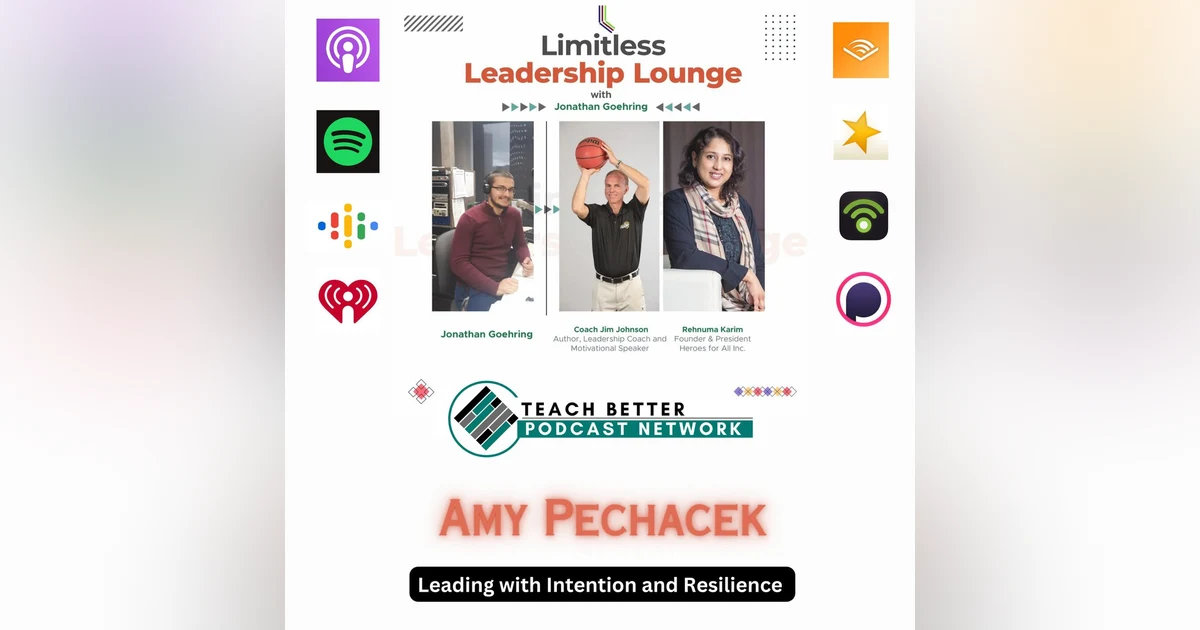


This week we dive into a heartfelt conversation with Amy Pechacek... international speaker, leadership expert, and author of Built by Lessons.... who shares her journey of overcoming profound personal loss and burnout to lead with courage and purpose.
Amy discusses practical strategies for:
- Choosing happiness daily through intentional decisions
- Managing time and priorities with reflection and planning
- Building emotional intelligence and positive feedback loops in leadership
- Delegating effectively by aligning tasks with team members’ goals
- Embracing vulnerability and faith as pillars of authentic leadership
- Creating safe, trusting environments that foster team growth and resilience
Learn more and connect with Amy:
Website: https://www.amypechacek.com/
Lead With Impact: https://www.alpstra.com/
The Shift Podcast: https://www.alpstra.com/podcasts
0:00 This podcast is a proud member of the Teach Better podcast network, Better Today, Better Tomorrow, and the podcast to get you there. You can find out. More at teechbetter dot com slash podcast. If you're never going to give anybody feedback, and you're going to give them anything less than a ten out of ten on their performance review, then you've truly failled them as a manager and as a leader. Do you want to be a leader in a constantly changing world? Our emerging leaders look different, come from various backgrounds and from all different age groups. Leadership is changing and it's hard to keep up. But the good news you can be a leader too. You can be an emerging leader. Welcome to the Limitless Leadership Lounge, a try generational conversation for emerging leaders. Come spend some time with us to discuss leadership from three angles. The coach Jim Johnson, the professor, Doctor Renuma Kareem, the host, John Gering a monthly guest, and you get in on the conversation on Facebook and Instagram, and be sure to follow us on Apple Podcasts, Spotify and Speaker. So come on in and make yourself comfortable.
1:12 It's another weekendside the Limitless Leadership Lounge. We are skoked that have our guests today here, but I want to remind you first if you're getting value from the show, we would love it if you would share it with others. And one of the best ways to help our show reach other people is by leaving a review upon wherever you play it on your podcast platform, whether that be Apple Podcasts or Spotify. We appreciate you having us on today and let's dive into some more leadership insights and Coach is as always going to introduce our guests today. Go ahead. Coach Amy is an international speaker, leadership expert and follunder of ELSBA, known for equipping leaders with tools to rise not just professionally but personally. Her journey hasn't been easy.
1:53 Amy's personal story includes overcoming unimaginable loss, navigating burnout, and making the decision to rebuild her life around purpose. She speaks from the heart and is drawing from real experiences, not just research. Whether she's on the stage, coaching a team, or writing for her desk with a strong cup of coffees. Amy is committed to one thing, helping people lead with intention, authenticity, and courage. And Amy's greatest joy is found with quiet moments with her husband Larry, adult children Nick and Aaron, and grand baby Rainey. Without further ado, Amy, Welcome to the Limitless Leadership Lounge. Hey, thanks for having me. I'm excited to be here today.
2:34 We usually dive into leadership questions, but I know, in getting to know you a little bit, your journey's been pretty remarkable and you've had some real difficulties and challenges in your life. So I love to you just to take us through a little bit of your journey of how you got to where you are today. Sure, when I left college, I was a teacher, and so I taught for a while, went to for a software company, eventually worked former Girl Education, and so my career at the time, my career was starting to move up like an upward projection. At the same time, my personal life was a disaster. The first marriage I had was incredibly abusive in any way that you can imagine, and so out in public, it looked like I had it all together. I was even at one point teaching at a private school, a Christian school, while I was in an abusive marriage. But then fast forward about ten years and my second husband, so I left my first husband got remarried and he ended up exhibiting some of the same things that my first husband did, not the physical abuse, not some of the other forms of abuse, but some of the emotional and anger issues that were inside of the home that I never saw when we dated and nobody. They say a lot of times that it's different behind closed door, and it absolutely was with him who he was night and day, with how he
4:04 was in public, very charismatic, very charming, life of the party, always smiling, a huge smile, and then behind closed doors it was you just never knew what would happen. My son actually said one time, we would know how the evening would go the moment he walked in the door after work. So either everybody would go to their rooms and split up, or we would all be in the kitchen as a family. So it was a very unpredictable environment and it took a toll on me, but also I saw how it was impacting especially my daughter, and I made the choice to leave him as well. Less than a month after I left, he broke into the apartment I was renting and ultimately took his life. Oh in front of me. Yeah, And so during that evening when he burst in through my door. At first I thought, okay, let's talk. What's going on? I saw some wild wildness in his eyes. But then he pulled out a gun, and at that point the survival just kicked in. And all I can tell you is I tried to get out of the apartment. I tried to go out the front door, of the back door, of the windows, and then he ended up trapping me in my apartment bathroom, and I there were moments where I thought he was going to take my life and I was praying, and anyway, he took his life that night.
5:36 Wow. But Amy, you are a symbol of strength and sometime the best ones and those who are in this business of helping others are the one who has traveled that. Path, and probably you are. You'll broke into pieces and then you will become a new jube. You are now transforming so many lives. So thank you so much for being here and sharing your story. And I think so many other listeners are in this kind of situation and they might be getting some strength from you seeing where you are. And I have to say that you look amazing as the grandmother, so we would never guess that you were a great thank you.
6:18 I'm actually gonna go see her later today to send her off to school in the morning, so that'll be very sweet. Yeah, oh, you are amazing. I was going through your video, the one of the happiness video that you have you have on YouTube, and there you mentioned that you talked about fourteen percent of Americans are being not being happy, only being happy and the rest are not and you were talking about like how to take steps to find our own happiness, and I was coincidentally, I was reading through Martin Seligman's book Like and he was talking about he was emphasizing that happiness is a skill that we need to learn, we do not have, not all of us have the skill.
7:01 So my question is, what are the things that you advice. What are the tips you advice when you are going to the scarpor setting because they are bombarded with stress, competition, they have to be worried about being judged by others. And from my point of view, once I broke free of all those things, that is when I reclaim my happiness. Not caring about what other people think is not being in that race and everything. So what are some of your advices on that? Yeah, So, first off. I truly believe happiness is a choice. We get to choose if we're going to be happy or not, and a lot of people don't buy into that. You can have the head knowledge but maybe not the heart knowledge. But I believe it truly is a choice.
7:45 But along with that comes all of the small choices you make along the way. One of the things that I do personally is I don't watch TV, I don't watch movies, and there's a specific reason for that, and it's because I believe that there is we are intentionally being divided as human beings, as Americans, men against women, the races, gender, all of it. There's intentional division happening to keep us stirred up, and why would I want to subject myself to that. One of the examples I use a lot is I know some people who watch twenty four hour news all day, every day, and it doesn't matter which side of the aisle they're on. Every single time I talk to them, they are hissed, and they're pissed about a new topic or a new subject every time I speak to them. Things that they didn't even care about two weeks ago, they're mad about today, right because they're the people in the media are trying to tell you what to think, how to feel, who to be mad at, who you do not like, and it just is this division and it's this drama, and I believe a lot of people get addicted to that.
8:56 So I have intentionally set myself in a place where I don't allow them to dictate my thoughts. Right, so I have my own thoughts, my own beliefs. Stopped watching TV fifteen plus years ago, so it's been a while, so I do a lot of reading. Another thing is I believe that the status quo that we're taught you go to high school, you go to college, you get married, you buy the house, you have two point five kids, a dog and a cat, and then you retire. Right, that's what's taught. But along the way, what a lot of people do is they just they go to work, they come home, they watch TV and that's it. They spend all of their time on social media or watching TV.
9:41 And so one of the things I recommended people do, and I give as an activity in my workshops, is what I call an input assessment, where they can literally see on average, how many hours a day they spend doing productive versus non productive activities, and then I have them add up all of those activities in all those hours per day, multiply it for the weeks, and then fifty two for the year, and you can really see how many hours you're spending on mindless, numbing activities like TV versus things that are moving you towards your goals and your dreams. And I have yet to meet somebody. I actually have met two people and the thousands that I've given this to who actually had more hours on the productive side than the non productive side. So back to your question about happiness. If you're spending all of your time numbing out, not doing things to create the life that you want, that would make you happy, that would bring you joy, then you are going to be happy. Right, You are going to be unhappy, You're not going to be happy. So happiness is a choice, yes, But I also believe it goes back to making intentional decisions and doing the things that will lead you to living the life that you want.
10:55 Yeah, how much of this came out of the trauma that you experienced? Actually I stopped watching TV before that, But what happened in that moment was I myself I realized I wasn't living my life with that type of intention. So that part of it absolutely came from that incident. I realized that I was, I guess you would say, a workaholic, not an alcoholic, but a workaholic. I still work a lot, but a lot of my work now is creativity. At night, instead of watching TV, I will write or read or reflect. But when that happened, I did realize that I literally I say that family is important. I say that my friends are important. I say that I want to have this great life, but my actions were not aligned with that, which is how I came up with that input assessment.
11:48 So that's a big part of it. But the year after it, I made a complete change. Of course, you have healing to do along the way, but I made a complete change, and I decided to do stuff to prove to myself that I wasn't scared and that I was worth it and that life was amazing. So I went skydiving. I actually was one of those weird people who walked on fire. It and it sounds wooy or whatever, and I'm fine with that, but it wasn't. It didn't hurt at all. Like I tell people, it hurts worse to walk on hot sand at the beach than it does on hot coals. But that was really scary. And one of my favorite things was ill Let Lionel Ritchie serenad me, Wow, and twenty thousand others. But whatever, we don't.
12:32 We don't have to. We don't have to share that part, I would say, John, A lot of my mindset around living this intentional life came when I realized we have just one life. That's it. We have one life. And even though we can make mistakes and rebound for mistakes, and mistake like that, even if he thought it was a mistake himself, film never come back from that. So instead of wasting my life away, I'm the decision that I was going to stand up and live not only my life with intention but also help other people learn because we're not taught this stuff in school, right, we're actually taught the opposite. But I made it my personal mission to help people understand how valuable they are.
13:17 Yeah, And after so two pieces of two incidents of trauma at least in your life regarding family, yet you're still a woman who's very passionate about your family. How did that happen? How did you get past those things, and you may never fully get past them, But how do you don't turn towards your family with bitterness? You still you see them with the love and the kindness and making them a priority that they are. Liking. It to reading a book. You've ever read a book or watched a movie, and you have the memory of reading that book or watching the movie, but you don't have necessarily a lot of emotions attached to it.
13:57 That's the way I describe the things that have happened to me. Now. Obviously, at times there are moments where that's not true. But ninety eight percent of the time I would say it's literally it's like I'm telling you about a book I read. But I also have very strong faith, and so I leaned very heavily on my faith on God, on Jesus. I literally had to just surrender it all at that moment for me personally, because I knew that I couldn't get through it on my own and that as as much as my friends and family wanted to support me, they had their own lives too, And nobody can say the right thing when something like that happens. A lot of times I will just listen with people because I've been there. Instead of trying to say something, I will just listen right and show love.
14:45 So I just had to really just surrender my healing process in my life to Jesus at that time. Amy, how you talked about one of your research in survey you do and get helping people be aware of whether they're productive or not. What are you teaching leaders right now? Can you give us one two strategies to help people be more productive? So we talk about time management. That's a big one. There's so many people who talk about time management, but how many people are actually using those strategies. One of the things that I do personally is I have appointments with myself and I have found that a lot of high level executives don't necessarily do that. I schedule out appointments on my calendar pretty much every day, every day where I have a time block of doing the most important things that I need to do for myself. It might be reflecting any number of things, but whatever those priority items are. But not only that. At the end of every week, I make a list of my top used to be three, now it's five things that I need to do the following week. At fair minimal. These are the things that have to get done. These are the highest priority things, and these are immovable, these are non negotiables. So that's at the end of every week.
16:09 I do that on a Friday, and then at the end of every work day, which for me, the workday doesn't end at five, But when I'm closing out my day, I revisit the following day, and this is a daily habit. I look at the next day and I say, Okay, is everything on here important? Is it necessary? And are these the top priorities that I need to do to move myself and mind goals forward. So that's a big one. Yeah, moving the needle that is so important and after and that is an intentional activity. When you have those block times to yourself and putting them into urgency on all those priorities, automatically you are moving the needle to another level. So I think that time management is so crucial for being productive. And another thing I have observed that many of the people who are coming to the workplace or other places, if they are into that not so self aware state, they are not being able to give their productivity or high performance level to the work or to their family so self awareness and I know that you're a big fan of emotional intelligence. What are some of the some of the tips that you have practiced or you are suggesting others to practice to become more self aware, not only individually but collectively, because in workforce is that collective environment and if we are not
17:41 self aware, and it has been shown that the team success is cut into half because there are some people who might be self aware some people who are not who are driving others' productivity down. So have you observed these kinds of phenomenon while. You are you're coaching in the corporate sectors and some intervention that you could advise. Yeah. So one of the things that I've noticed is that the majority of people, when they become aware of their behaviors, they will take steps to correct those behaviors. Now I say majority because not all. There are some people out there who have the mindset of this is who I am, take it or leave it. And it's like the old adage you can lead a horse to water, but you can't make them drink. It's got same mindset.
18:30 And so for those people, there's not a lot of things that I can do with them or that we can do with them, but companies get to make the decisions on how to handle that however are And it goes back to what we said a few moments ago. A lot of times there's head knowledge but not heart knowledge, and so it's finding a way to take that knowledge and implement it in your life. And one of the best ways that can happen is through true, honest feedback. I'm not talking about criticism, talking about feedback, so literally giving and receiving feedback. I truly believe if I didn't care about somebody, I'm just gonna keep my mouth shut. If I don't care about you, I'm not gonna say the hard things to you. But if I truly do care about you and want to see you get better Bennett's, then I'm gonna have to step up and give you feedback.
19:22 And then as the recipient of feedback, I can view that as a gift. I use the analogy of Ralphie in the Pink Bunny Suit. You guys remember the Toy story, the movie, not the Toy story, the Christmas Story movie. Oh yeah, Christmas story. He wanted a bb gun for Christmas, but he got in this pink bunny suit. Okay, now that was the gift. He tried on the gift, it didn't fit, he took it off. Okay. Feedback's kind of the same way. So somebody gives me feedback, then I have a duty to myself, an obligation to myself to reflect on that feedback and decide if it fits or if it doesn't. And if it fits, then I can things to implement it and make it better. And if it doesn't, I take it off, give it away, whatever.
20:06 But when it comes to being able to be more self aware, I think a lot of people just don't know what they don't know, and so we come in and we do activities with them. We teach them concepts, and then we do activities with them to help them become more self aware, and feedback is a part of that process. Maybe let jump in because I'm right with you. Feedback is so important. But the challenge is how do you help leaders so that feedback becomes effective instead of just being pure criticism and getting into blaming the person or what It can get certainly very negative. So can you give us a couple strategies as far as a leader and how you create a positive feedback? Because I think it's essential, but it can really be something. It can be botched.
21:02 So the processes has to be taught. Okay, So we teach the process of that and we look at examples. We do case studies, but we look at examples of what true feedback is versus what criticism is, and we go through all the concepts and so as we're doing that, people are getting to do it in a low stakes environment. Okay, so they're getting to test it with one another. One of the very first foundational things we talk about is trust. So there is this process that we go through with them to build them up to the point to where okay, now it's time for that feedback. But the very foundation of that is trust. And not just trust, but Patrick Lindsayoni talks about vulnerability based trust. So that type of trust where I'm going to open up to you and I'm going to tell you something about me that happened to me, not anything that I don't want to share, but something that I can share. I'm going to tell you something about me and maybe what I learned as a result of that what I did at the beginning of this podcast, right, So share something that happened you connect with me emotionally, now I'm seen as a real person, and having leaders do that with each other within their team, that kind of starts to bring those walls down. But that's just one part of it. And then from there, I tell you something about me, you tell me something about you. Then we have conversations about what trust is.
22:30 We hit all the different topics of it. So we hit the statistics, we hit the case studies, we talk about the emotions, we talk about the neuroscience and human behavior behind it. But that's the foundation. It's to start with trust and some of those case studies. We look at leaders who the entire point of this conversation was around being self aware, and we look at the differences between leaders who are really good leaders, and then the leaders who were bad or toxic leaders. We look at the behaviors that they exhibited and the differences between those leaders. So that's another layer that we take them through. I give my own examples of good leaders versus toxic leaders.
23:11 And then we have, just like doctor Kream said, we go through emotional intelligence. So we look at all the traits of emotional intelligence, both from the perspective of being self aware but also being aware of the emotions and feelings of other people. And that's another layer that we go through. So we're going through these layers getting them. We don't just immediately take them to feedback. You know, from the beginning, it's probably a full day before with starting with the foundation of trust and moving up to the point to where we actually do start talking about feedback. And sadly, so many work environment now we have a problem with trust issues and the toxic culture. Just a few days ago, a young leady was like really away and telling me that I'd be giving my one hundred person and then the leadership they're always trying to find fault in what I do. So there isn't any middle feedback like while I'm working or even in the middle of the year like one on one or something like that.
24:17 There is nothing but the end of the year, the HR calls you and then give the performance analysis, so there is no scope and would just give the feedback that you are batting all these things, so there is no room for growth or giving the feedback in a continuous process. I think, what are your thoughts on that, how important it is to give that feedback environment of trust in a continuous process not at the end of the year just to identify your fault. Oh my gosh. Yeah, we abolutely don't want to cite white people like out of the blue. And if you are only giving feedback for that annual performance review, then I would not want you into the good, productive, effective leader her bucket right. Feedback is something that should be done on a consistent and ongoing basis. And there's an example.
25:08 I give a lot when I talk about my experience with a good boss, I will share it in a different light for you guys here, But the worst boss I ever had was at one company, My very next boss, my very next direct supervisor, was the absolute best boss, best leader I've ever worked with today, hands down. And one of the things he would do is we had, depending on the position I held, because I was promoted at different stages, but we either had weekly calls or buying weekly calls. I would get off the phone with him and I would feel like a flip and rock star. I would feel like, oh my gosh, I am like knocking it out of the park. I'm killing it. I'm doing such a great job. He just praised me for an hour on that call. Life is beautiful, but then when I would go back and reflect on that conversation later that day the next day, whenever I would realize, oh my gosh, he was not complimenting me. He was coaching me. But he would coach in such a way that was felt like it was uplifting and praising me.
26:17 And what he was doing was he was talking about my strengths and he would like give me ideas of how to improve the strength. Where it did not feel like coaching. It felt a brainstorm session. Oh Amy, have you thought about this? And then the areas where I was not as strong, we would have conversations about that, but I never felt criticized or blamed. I'll give you one of them. I am excel. Spreadshoots are my kryptonite. I say, I am not an analytical at all. I'm the visionary, big sinker, doer, pessionate. But those fine minute details like that's somebody else's skill set and not want and I'm good with that, right, they're good with theirs.
26:57 I'm good with mine. But so some of those areas where I wasn't as strong, we put provisions around to take care of that. And one of the things that he did was he said, you know what, Amy, I'm going to look at your reports. You don't worry about looking your reports. You get out there and do what you do. I look at the reports, and if there's ever anything you needed to be concerned about, I'll let me know, Doctor Cream. He never called me. He never called me to tell me there was anything to be concerned about. And I give this example because that was a constant, weekly or bi weekly feedback session. But it was a feedback session in a way to help me move forward. And that's that type of feedback. Even the things that he felt I needed to work on, we would talk about it. But it was such a safe conversation that anytime he ever did coach me in a way that was to build up a weakness, it wasn't scary.
27:52 It didn't feel like I was in trouble. It felt like he truly cared about me. And I believe that's the difference. So those people who wait and till once a year to give you feedback, they're doing a grand disservice. There was a leader in my life who I used to ask pretty consistently for feedback or areas where he felt I can improve. And I'll tell you he never did give me one as many times as I asked. If you're never going to give anybody feedback and you're going to give them anything less than a ten out of ten on their performance review, then you've truly filled them as a manager and as a leader. Yeah, and we're talking about building trust in the workplace and giving feedback. But then there's also in personal life too, because you've been through some really toxic relationships and also some good personal life relationships too. So tell us a little bit about how to build trust some of those good things and bad things you've seen when it comes to trust in your personal life as well.
28:52 So I am married again. I was a widow and I'm married again. One of the hardest things that I ever had to do was learn how to trust again after that. My husband, Larry and I now have been married for oh almost six years, and we dated for two two and a half years before we got married. He likes to say, then I broke up with him twenty four times in that two years. I think he's exaggerating because he's personality like a funny guy. I think he's exaggerating a little bit. That I did break up with and the reason for that was because I was so scared of being hurt again. Yeah, I was so scared of being hurt again. It was a very long, arduous process of learning how to trust a man, let's just say, a romantic partner again. But what I have found is if we stay knotted up and scared and don't open ourself up and take a risk, yeah, I might not ever be hurt again, but I'm never going to have that really good stuff that we talked about at the very beginning, the happiness and the joy and all of that. So you have to take that risk.
30:08 You have to take a risk if you're going to have a great life, if you're going to be happy, if you're going to have joy in your life. You can't stay tied up and stuck. You have to be willing to take a risk and be willing to get hurt in the process. I'm not sure if I answered your question exactly or not. Yeah, So it sounds like building trust is it's a process, right, And after you've been hurt, it's harder because you have those experiences. How about other relationships in life too, because certainly you've had to build trust with children, now with the grandchild, as well those What are some suggestions that you would give for new parents their grandparents who are looking to build trust in those relationships.
30:52 Oh my gosh. So my philosophy was as a parent that above everything else, the primary thing I wanted to do was ensure my children both knew that I loved them. Every decision I made was around love, every decision. A lot of times when people are divorced parents, you'll see the parents make decisions out of selfishness, not what's best for the child, but what's best for them, and that's human nature to do. But I truly made decisions for my children based off of what was best for them, and that goes for everything that went for. Every decision I made was around what is best for them and how are they going to feel loved? So building the trust.
31:38 It's funny that you asked that because my granddaughter, she's five, and when she was when we found out she was on the way, I remember telling my husband I related it to a lady who was like a grandmother to me. She wasn't a grandmother by blood, but she was like a grandmother to me, and I called her Tadpole. There's a story around that, but I felt more love and acceptance from her than just about anybody else in my life. And the reason for that is because she accepted me for who I was. She didn't try to change me. Of course, teaching me because I was a child and I needed to be taught. But I didn't feel condemned or criticized. I felt truly loved and accepted and appreciated as a person. And so I told my husband when my granddaughter was on the way, I said, I want her to be able to view me the same way I viewed Tadpole. So again, John, that's an intentional choice.
32:38 I made the decision to make sure that she knows that she's loved, that I accept her for who she is, while correcting her as needed right and creating a safe place for her. It goes back to all of the relationships you have in your life, though, whether it's a child and grandchild friendships, it's being vulnerable. It's a give and take relationship, but it's making the decisions to accept them for who they are while correcting and providing feedback needed to help me. If you saw somebody who is just completely destroying, wrecking their life and you said nothing, You're not a good friend. True, So one of this again, the most sincerest form of love you can show someone is to say, here's what I see is happening in your life. I love you and I don't want to see you destroy your life. How can I help you?
33:31 This is what I see. What do you need from me? But it's that vulnerability, it's creating a safe place, it's doing making decisions from a place of love, I would say, And then it's give and take. Yeah, yeah, I know, coaches. One more question, My final question for you today. We're coming off of an event called the Global Leadership Summit, which all three of us were involved with here locally, and faith is such an important theme behind that and the importance of many of all are people of faith here. And I think it's so important to include that in your journey too, because you mentioned it earlier how important it was for you. How does that continue to guide you today in all of your leadership decisions everything.
34:14 Like I pray before our podcast, I pray during our podcast, I pray this morning. I a lot of the because I don't watch a lot of TV, and that's not a faith based or is not based off of my faith. But it does free up a lot of time to read, to listen to podcasts, faith based podcasts, to do things like the Global Leadership Summit. But it is the foundation, and you're absolutely right, there's it's having those conversations with the people that you care about, because if we do care about them, we care about where they spend eternity, praying over them, praying with them. My granddaughter, before she would walk, we say a lot of times she's going to be a dancer, she's going to be a store there's no doubt about it, Like she's just amazing. But before she can even walk, she would have her hand on the coffee table in my living room and she'd be raising her hand praising Jesus, like listening to worship music.
35:10 So it's every part of my life. I don't believe my faith can ever be segmented out of a part of amy. Thank you, we really appreciate it. You have one final question because I'm just curious. It's a broad topic, but I'd like you to zero win because one of the things you talk about is you help leaders build stronger teams, and obviously that's a big term, but if you're to zero win, you're working with a young leader and helping him or her build a better team. Give us one or two ideas that you would advise that leader to get off to a great start. The first thing is, the same skills that made you successful as a doer are not going to serve you well as a leader. You have to have a completely different skill set. And so it's continuous learning, continuous improving.
36:01 It's things like we've talked about. Communication is a huge one time management delegating, but delegating effectively, meaning that when you delegate tasks and a lot of times when new leaders step in, they think they have to keep doing everything. But one of the best things you can do is to find out what are the skilled and talents of the people on your team and delegate those things to those people based off of what their goals are for their career. So what are they good at, where they need growth, how can they improve? Now you're not always going to have perfect alignment, but as best as possible, get to know the people on your team, find out what their career goals and their career aspirations are, and then empower them equip them to be able to grow in their role. So I think the biggest thing is to understand that you have to continue growing, that you can't keep depending on the same tools and skills that you had. That it's communication, it's effective delegation, it's learning emotional intelligence, it's all of these things that we say make a great leader.
37:10 Very well said Amy. We love your work. We love certainly the stories that you've brought to us today. Some things in life they're just they're difficult, and I know you've, like your Numa said earlier, you've given strength to those who might be going through some of those similar things, maybe things that aren't quite as dramatic as what you went through, but still traumatizing in their own way. So thank you for coming on and sharing some of your time and insight here. Finally, is there a way that anybody could learn more about your work, get in touch with you. I know you got some great things going on online. Yeah, I'm on I'm on LinkedIn and also have a couple of the websites. One is Amy Pokotchick, so it's just my name is spelt amibokotcheck dot com. The other one is alpsure dot com. It's a l P S t R A dot com so we also have a podcast called The Shift, but that's on our Oltra website.
37:59 But those are some of the best ways to get in touch with me. And then my email address is my first name, Amy, Amy at Alkstra alpstr a dot com. Very good. Those links down in the show notes. Amy. We can't thank you enough for your time today and all the insight you brought here to the Womenless Leadership Lounge. Thank you, John, appreciate it. Thank you for joining us this week at the Limitless Leadership Lounge. To listen to this episode again and to find previous episodes, check us out on Apple Podcasts, Spotify, and Spreaker. You can also get in on the conversation find us on Facebook and Instagram. Then tell three of your friends to join in as well. Coach Numa and John. We'll be back again next week for another try generational leadership discussion. We'll talk to you then on the Limitless Leadership Lounge.


