E28 - It Takes a League: Bridging Language and Literacy for Multilingual Learners
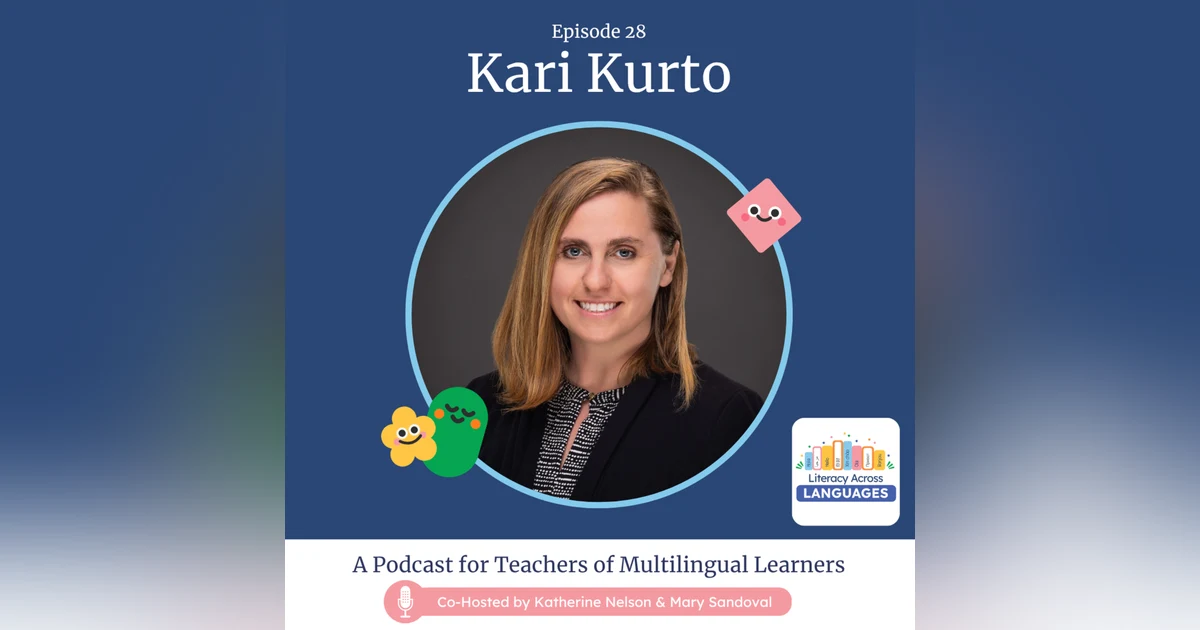


Kari Kurto of The Reading League joins Literacy Across Languages to explore how the science of reading and structured literacy can support multilingual learners and English learners. The conversation examines language as common ground between literacy and EL/EB education, including explicit and systematic instruction, linguistic assets, assessment, contrastive analysis, and how educators can provide comprehensive, evidence-aligned literacy instruction that is responsive to multilingual learners.
Kari Kurto is the Director of Policy and Partnerships at The Reading League. She directs all work related to The Reading League Compass, the Curriculum Evaluation Guidelines and Navigation Reports, and TRL's Educator Preparation Program Partnerships. She supports work related to English Learners and Emergent Bilinguals, Diversity, Equity, Inclusion, and Belonging (DEIB) and also runs communities of practice for state education agencies, faculty from educator preparation programs, publishers, and other stakeholder groups seeking to implement evidence-aligned practices. Kari has presented at conferences both nationally and internationally. She formerly worked as a Literacy Specialist at the Rhode Island Department of Education where she led statewide efforts to implement the Rhode Island Right to Read Act. Kari is an Orton Gillingham trained practitioner who worked at Middlebridge School in Narragansett, Rhode Island, and Rawson Saunders School in Austin, Texas. Before her career in education, Kari worked as a Casting Director in Los Angeles. She and her three wonderful children live in southern Rhode Island.
- Language can serve as common ground across literacy, multilingual education, and special education. A shared focus on language can bridge these communities around student needs.
- Structured literacy builds educators’ knowledge of how language works. For multilingual learners, this helps teachers build on linguistic strengths and identify areas of need.
- Multilingual learner specialists need a voice in schoolwide literacy conversations. Their expertise can strengthen language supports and improve instructional coherence.
In This Episode:
(00:00) Welcome to Literacy Across Languages!
(04:18) Meet Kari Kurto
(09:39) Collaboration and Building Bridges in Education
(10:42) The Science of Reading and Implementation for English Learners/Emergent Bilinguals
(16:27) English Learner/Emergent Bilingual Community of Practice
(19:10) The Science of Reading is Not One Size Fits All
(22:42) Essential Components of Structured Literacy for Multilingual Learners
(26:55) Comprehension: Both a Process and a Product
(31:21) Structured Literacy Implementation with Multilingual Learners
(40:35) The Reading League’s Contrastive Analysis Guide for Understanding Students’ Languages
(44:49) Language at the Heart of It All
Episode Resources:
Explore English Learners / Emergent Bilinguals and the Science of Reading on The Reading League Compass.
Use The Reading League’s Contrastive Analysis Resources to compare languages.
Stay Connected
Visit us at literacyacrosslanguages.com and follow us on Instagram or LinkedIn!
Enjoying the podcast?
Follow, leave a review, and share your favorite episodes with fellow educators to keep the learning going.
science of reading, structured literacy, multilingual learners, English learners, emergent bilinguals, language development, literacy instruction, comprehensive literacy, evidence-aligned instruction, explicit instruction, systematic instruction, phonological awareness, phoneme awareness, phonics, fluency, morphology, semantics, syntax, reading comprehension, knowledge building, writing, contrastive analysis, linguistic assets, home language, dual language instruction, assessment, data analysis, collaboration, teacher knowledge, multilingual literacy, The Reading League