E16 - The Fluency Bridge: Connecting Decoding with Meaning for Multilingual Readers
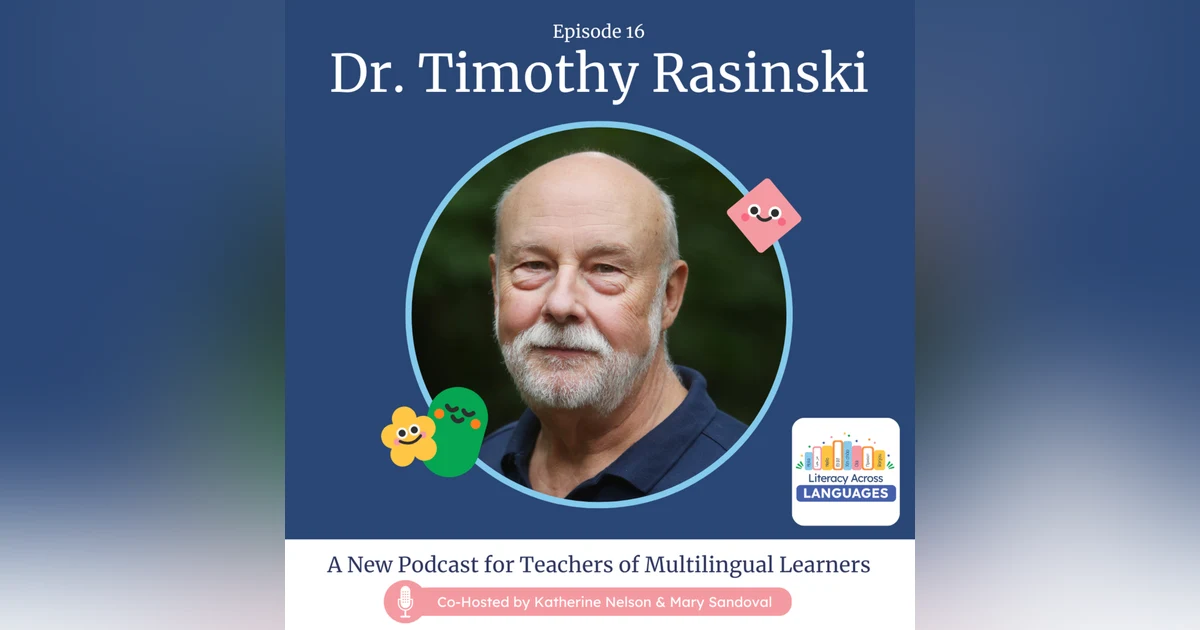


Dr. Timothy Rasinski is a professor of literacy education at Kent State University and director of its award-winning reading clinic. He has written more than 200 articles and authored, co-authored, or edited more than 50 books and curriculum programs on reading education, including work with Teacher Created Materials, Shell Education, and Scholastic. His scholarly interests include reading fluency, word study, reading in the elementary and middle grades, and readers who struggle. His research has been cited by the National Reading Panel and published in leading literacy journals, and he has served in major leadership roles across the field, including with the International Reading Association, The Reading Teacher, and the Journal of Literacy Research.
In this episode, Dr. Timothy Rasinski reframes fluency as the essential bridge between decoding and comprehension rather than a matter of reading speed. He explains how automatic word recognition and prosody work together to support meaning making, and he shares classroom routines that help multilingual students develop fluency through modeling, assisted reading, repeated reading, phrasing, and performance.
Key Takeaways:
- Fluency is the bridge between decoding and comprehension. Both automatic word recognition and prosody help students cross that bridge to meaning.
- The goal of phonics instruction is automatic word recognition. Automaticity reduces cognitive load and allows students to focus on comprehension.
- Repeated reading builds fluency, strengthens decoding, and improves comprehension for multilingual learners.
Timestamps:
(00:00) Welcome to Literacy Across Languages!
(01:32) Meet Dr. Timothy Rasinski
(09:31) Understanding the Components of Fluency
(13:12) Fluency as a Bridge to Comprehension
(19:24) Fluency and Multilingual Learners
(23:02) The Fluency Toolbox
(23:34) Tool 1: Modeling Fluency
(24:54) Tool 2: Assisted Reading
(26:38) Tool 3: Wide Reading
(27:13) Tool 4: Deep Reading
(29:31) Tool 5: Phrasing
(34:04) Implementing the Fluency Development Lesson
(35:12) Selecting Texts for Fluency Instruction
(38:04) Integrating Vocabulary Development with Fluency Instruction
(40:54) Assessing Reading Fluency with Multilingual Learners
(43:35) Becoming Better Teachers for Multilingual Learners
(45:31) Takeaways for Teaching
Episode Resources:
- Explore Dr. Rasinski’s free literacy resources, including the Multidimensional Fluency Scale and word ladders, at timrasinski.com.
- Read Dr. Rasinski’s article, The Art and Science of Teaching Reading: Embracing Evidence-Based Practice and Teacher Expertise.
- Discover a classroom example from Dr. Rasinski’s website showing how reader’s theater can support older students developing language and literacy.
Stay Connected:
- Visit us at literacyacrosslanguages.com.
- Email us with questions or episode suggestions at literacyacrosslanguages@gmail.com.
- Follow Mary and Katherine on LinkedIn.
- Like, subscribe, and share this episode with fellow educators, or share a review to help others find us!
Keywords: reading fluency, Timothy Rasinski, multilingual learners, multilingual literacy, automaticity, prosody, repeated reading, assisted reading, phrasing, orthographic mapping, word ladders, word chains, reader’s theater, poetry, song lyrics, comprehension, phonics, word recognition, oral reading, expression, reading rate, fluency instruction, fluency development lesson, cognitive load, high-frequency words, sight words, literacy instruction, elementary reading, struggling readers, reading comprehension