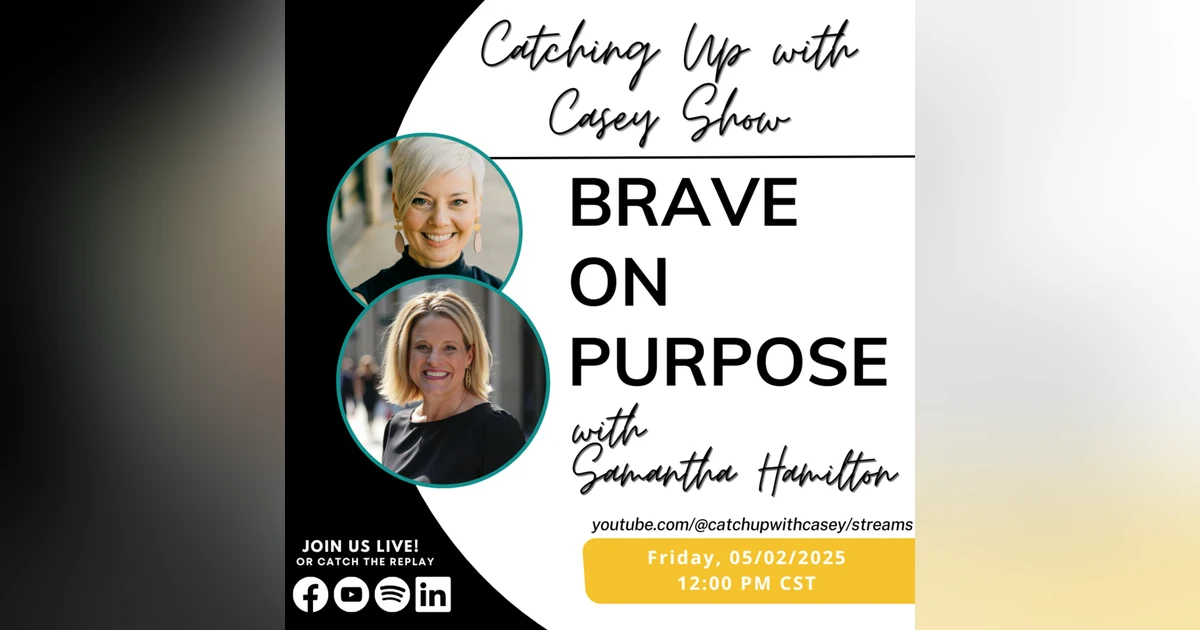
117: Brave on Purpose with Samantha Hamilton


 RSS Feed
In this episode of The Catching Up with Casey Show, we dive into the heart of effective leadership with Samantha Hamilton, award-winning principal, national education consultant, and author of "Brave on Purpose."
With over two decades of experience, Samantha shares her insights on creating clarity as a leader—whether you're an administrator, instructional coach, teacher leader, or team facilitator. Join us as we explore how to lead with heart, turn chaos into culture, and build joyful, resilient communities, all while ensuring leaders don't lose themselves in the process.
Important Links:
Access the Podcast Gift Vault:
https://www.catchingupwithcasey.com/giftvault
Give teachers what they want WITHOUT spending more or micromanaging: https://www.catchingupwithcasey.com/clarityoverclutter
Need help getting your leaders trained in a purposeful way? https://www.catchingupwithcasey.com/identity
Ready to build the habits of a clarity-driven leader? Get The Craft of Clarity book!
0:00 Hey leaders, quick question. Do you really need another shiny new program to fix your campus? Yeah, I didn't think so. If you're tired of throwing money at every solution and hearing dogs in the background that bark a lot that promises to save tier one, it's time to try something smarter. I've got a free 30 minute training replay where I show you how to give teachers what they actually need without buying another product or adding more staff or micromanaging the people people you already have. In this training, you're going to learn why most new programs don't deliver the impact they promise, the real reason teachers keep asking for more, and how to solve it without spending a dime, and how to strengthen Tier 1 instruction with what you already have on your campus. You're also going to get instant access to free resources and a sneak peek at strategies from my book, The Craft of Clarity. So go grab the free replay and resources at catching up with kc.com slash clarity over Clutter, because better leadership shouldn't cost you another $50,000 and a $60,000 additional position that you didn't really need in the 1st place.
1:15 Let's dive into today's conversation. Hey there, welcome to the Catching Up with Casey show. If you are tired of chasing buy in, frustrated by teams who just can't seem to get on the same page, or over the constant struggle of holding people accountable without feeling like you're micromanaging, this is the show for you. I'm Casey Watts, team leadership expert and the host of this show. I specialize in clarity, collaboration, and character, and I help leaders just like you take teams from chaos to cohesion, from frustration to alignment, so teams can actually work together toward a common purpose instead of against each other as though they are functioning in different organizations.
2:04 Whether you lead a single team or a team of teams on this show, we talk about strategies that are going to help you create a culture where accountability and autonomy go hand in hand. Now, with all of that said, let's dive into today's conversation and learn how to lead clarity driven teams. Well, hey there everybody, and welcome to the show Samantha Hamilton. I'm excited to have you here. Thank you, me too, super exciting. Yeah. And today's episode is titled Brave on Purpose, which I love so much. And what we're going to be talking about is a lot of stuff that comes from the book that you have recently published, right? Yes.
2:53 Yes, Awesome. OK. And so just as we get started, let's go ahead and tell everybody they can find the book on Amazon today. Yes. Yes, yeah, Amazon. I think it's on Barnes and Noble now too. But yes, for sure, Amazon, yes. Awesome, that's fantastic. I can't wait to hear more about it. But before we get started, as per usual, we have to let our audience know who you are and the work that you do. Yeah. So yeah, I'm Samantha Hamilton. I am lifelong leader, like it or not, my family had to deal with that, but I really want to support people and, you know, transforming from places of survival into places of thriving and and places of doing it in purpose.
3:36 So through leadership and consulting or coaching or anything I can do to try to support, hopefully through the book, help leaders and teams just build some some sustainable systems and get those strong school cultures that are super important and create environments where everyone can thrive and want to stay and want to do the work 'cause you know, any leadership and role that you're in is a lot of work. So everything I do is kind of rooted in the belief that leadership should be about people and be purposeful in that. Yeah, absolutely. Anywhere people are involved, there has to be purpose and intentionality. So we're going to talk more about that and because I think there's some more to unpack there, but let's let's first tell our audience something that's super relatable and human about you.
4:23 That's just authentic. Oh well, I think I don't know if it's relatable, but I do have a lot of Christmas trees, something that is people remind I right principals day stuff. Yesterday every kid drew Christmas trees. So I have 27 themed Christmas trees that I decorate at home. I know it's it's I don't know if it's a sickness hobby, you decide, but and I get really excited about planners and school supplies have since I was like 5-6 years old. I really love it, and there's something, I don't know if it's right or wrong about that either, but there's just something good about fresh paper pens that make me feel like I can accomplish anything, at least on that first sheet, you know, and really get a lot done. Do you think that you have a lot of empty journals or notebooks and stuff?
5:13 No, they all have a little bit of stuff in them. Yeah, a lot of little of the things. But I do have a lot of them. There's no doubt about that. And pens everywhere. Yeah. But I really love. I like, Yeah, there's something I when I get a new pen and a new notepad or something out, I can accomplish the world for a hot minute. Yeah, at least for 30 seconds minimum. Yeah. Yeah, I don't know about you, but when I go to it really can be anywhere, but usually it's like Walmart or Target or, I don't know, Hobby Lobby, not even really Hobby Lobby. They don't have a whole lot of journals, but I find myself going down the journal aisle and Oh my gosh, I love them so much. And I have no need whatsoever for these journals. I don't even use have to.
5:56 I use them for, like you said, just a little bit, but it's like the first few pages I've got some behind me to they're just like. That I'm with you, I'm with you. I've got a lot, but just in case. Just in case. I've got one for every outfit if I need it. Yeah, today's journal is going to be a peek. I love that. OK, so we're talking about being brave on purpose. And what I like so much about this is that you're using two really powerful words together, and that's brave and purpose. We're doing it on purpose. So I want you to tell us about what led you to write the book Brave on Purpose.
6:42 Yeah, you know, and that that title changed too, as as I was writing the original title that I have as as I kept writing, I was like, Oh no, that's that's not what this is really about, you know? So the book really came. It was just boring out of the real experiences that I've had so many times. People be like, you've got to tell people these stories because you can't make them up. Like, yeah, it's kind of crazy, but but really everybody has them. And so I think it was just through leading through literal and figurative storms and just really tremendous professional and personal challenges that I realized that leadership isn't about perfection. It's about, you know, more being present and being resilient and choosing to lead anyway. What?
7:23 That's the on purpose part that you have to just be intentional about choosing to do that. And so I wish I just wanted to share some, you know, real things that I've done. And do I do them all the time? No, but have I used them? Yep. And some strategies that to remind leaders that you're enough even when it doesn't feel that way. Yeah. And that's so hard to wrap our brains around that sometimes, especially when we are in the thick of the challenges of school and school leadership and our community that's kind of relying on us. It feels very, very heavy. And so it can be really hard to lead, to be brave on purpose, to be brave is is a challenge in and of itself to do it on purpose. It's another level.
8:06 And I think a lot of that has to do with leading with the heart, which I know you talked a little bit about. So, you know, on this show we talked about building clarity, driven teams, really creating clarity for people. Where does leading with heart and being brave on purpose fit into that? OK, so I think and for me, leading with the heart means like staying grounded in your values, being really true to who you are. When it feels yucky, it is yucky. And when it, you know, when you're asking people to do things that you know isn't what's right, I think that's what my thing leading with the heart is and choosing your values and the humans over a lot of things when the work gets tough. But I think it's about like, like you're talking about the connection over control and purpose over perfection. So when leaders lead, when you know, when you see people leading with their heart, they, they create spaces that people feel that safety and the value and they feel belong like that belonging.
9:05 And that creates clarity, I think because there's that unity. So when you've got the clarity and the, you only got the foundation that creates that clarity. And then that's when change can happen. Man, that is so fantastic, so fantastic. And you don't hear a whole lot of people talking about like using the words clarity and connection hand in hand. Because I think so often we think about clarity is like this accountability piece and it's communication and clear as kind. But, and I believe, I believe Brene Brown's statement clear as kind, but it doesn't, it doesn't necessarily have to be a serious or hard conversation. It doesn't have to be that we are holding people accountable in micromanaging. It can be that we're creating a community where connection is valued and important.
9:54 And in that, because they feel that trust and belonging there is, it's a whole lot easier to be clear. And it doesn't have to be a surprise. I think the clarity also, you know, it doesn't have to, it's not a shocker like when you hire with clarity and when you're intentional about that and you hire the like the, the clarity is kind of natural, you know, because you are, it's, it's not a surprise to people if you, if you have that clear foundation, you know what I mean? Right. Yeah. And when we feel when there's not clarity in our organization, sometimes it can feel kind of chaotic. So what are what are in your experience, what are some common sources of chaos that leaders often face? And how do you feel like they can combat that and create positive cultures instead?
10:40 So I mean a, you got to be out and about. You got to be able to know. So I mean, I can walk into the hallway and be like something's not right and I don't have to talk to anybody. You can feel it. So, and, and that comes from the lack of clarity, you know, so that chaos comes from something has been feared, whether it's true, Typically it's not, but people create some truth when they don't have it. So that, you know, so I think it comes from lack of clarity, some decision making that it was reactive or something that has happened or that they fear has happened. And so I think you can counter counteract that by like bringing everybody back in. Whoa, whoa, whoa, whoa. You know, let's have a conversation. Let's make sure we're on the same page and communicate really consistently. I had a conversation yesterday with a teacher and I said, OK, listen, this is this is Sam talking and thinking, not deciding. So I need you to open up that part of your brain because I'm not saying we're doing this.
11:29 I'm saying this is an idea that I'm throwing out. What are your thoughts? Because otherwise it's Oh my gosh, Sam said, we're doing this. No, no, no, no. That's always said, you know, so, but I think you can, you can turn that chaos around really quick by seeing it as an opportunity to reinforce that mission and seeing it as an opportunity to model what I, oh, you know what, here's what I should have done and here's what we what we need to do to fix that. But that strong culture can really save that those chaos moments too. They can. If you have a really strong culture, I think those people can do it for you, you know? Yeah, you said so many great things there. One of the things that I wrote down was people create their own truth when they don't have clarity, which is so good, so good and so true.
12:12 Yeah. And then also just, I think I love how you're almost showing our listeners how we, when we've experienced chaos or we're in a situation where we're leading a school that feels a little bit chaotic, it a little more simple than we give ourselves credit for to rectify that. And I think in the moment it can just feel like I I recently talked about how it's almost like opening that closet door to that closet that's just a hot mess or like your garage or something. And you open it up and you look at it and you're like, today's the day I'm going to clean it out and organize. But then you look at it all and it's like, I don't know where to start.
13:00 And this is overwhelming. So you close it and then you walk away and save it for another day. And another day never comes until it's time to move. Yeah. And I've got I've got so many room like junk drawers and things like that in my house. But to a point, sometimes I start thinking, well, is it really even going to matter if I clean it out? Because it's just going to become the junk drawer again. And then sometimes I think what can happen is we open that closet door and we we don't we don't have a plan for the chaos that's in front of us and just kind of like shift piles from one place to another. But we're never really making any progress. Yeah.
13:41 Yeah. So I I think what you're saying me says to me, we can take a step back and just simplify it by letting people know, hey, here's here's something that happened or here's something I said. Here's how it was interpreted and here's what I meant instead, or here's what's going on. This is what I know that it's causing for you and our culture. So here's what we're going to attempt to do. These are some ideas I have, so that's perfection. What you, what you shared there, that's true. Yeah. Let's let's talk about strategies then. And I'm assuming that you probably mentioned these in your book. So tell us, based on the book, what are some strategies they can they can use?
14:32 Yeah. So in the in the I started thinking through like things that were would be helpful. So there's these mirror moments and then there's practical strategies and each chapter of things that you could do to, to apply some of those pieces. But really they're just things I either ran across or have tried. And I think again, my goal is to, to, to bring joy, to, to be. And I want people to love what they do, whatever they choose to do. If this is it, great, wonderful. If not, let me help you find something you do love, because I think that brings joy. And if we work with other humans, you've got to be in the right position. So my goal is to try to build joy. So we, I really think it's important to celebrate those small wins, but celebrate them big and celebrate them often and usually some glitter.
15:12 That's important. You've got to have some sort of glitter involved always. So I think that that's, I mean just just taking turns to be like, hey, you know, it's kindergarten. Teacher comes in and said every kid took I ready and every kid grew. I'm like, yeah, let's celebrate that. That's big or every kids here today great. You know, I mean just small things, but some of them have to get really small. But but either way, make sure those are big and everybody feels that that's important. And then create those rhythms of gratitude and reflection. But you also have to model that. So build those into your systems. Each, each faculty meeting, each team meeting, each collaboration. Give me some gratitude, give me some reflection, give me some gratitude, give me some reflection.
15:53 Find the good, find the good. You know, there is good, but it's easy to focus on the bad, the shared leadership, giving them, giving people a voice, giving some ownership, I think is important. There's a real big difference between the original definition I had of servant leadership and shared leadership and know what I have now. So giving people a voice in ownership but also knowing where the line is, is important. But make joy. Like I said, make joy your priority, not just a bonus. Like, oh, there was something joyful today. But like, you know what? Where am I going to create that joy? Where am I going to build that joy? And if it's with kids, if it's with humans, if it's with adults, if it's with parents, whatever it is, find it and make sure you create it.
16:35 And then just be real honest about the challenges and be real. I think that's one of the things is stay rooted in that hope that, hey, it's OK, that it's normal for it to be messy, but let's find a way out. And you got to dig, dig your way out sometimes. But when you have all that culture building, it's so much easier to organize that closet because sometimes it's done for you when you open it. You don't realize that people are taking care of a lot of that, you know? Oh. My gosh, what a great analogy. Thank you for extending that. So good, I tell people sometimes. Sometimes when I'm working with my clients at schools, I really try and I tell them before I get started. I'm like, listen, I really am not good at creating analogies and metaphors.
17:18 It does not come naturally to me like it does to other people. And so it's not I try too hard and then it becomes like just awkward, doesn't make sense. So anyway, that's. How I end with mood phrases like they don't make sense to me. Like the bull in the China closet. I'm like, why would that cause a problem like, and they're like, no, it's not a bull, It's a bull. I'm like, why would a bull be in the China like that? You know, So it yeah, I, if they, I, I get you. I'm with. You yeah, yeah. So I'm stealing things from people every time I hear somebody say something like can you write that down for me so you better believe I'm going to be going back and listening to this episode again to like add on. So we've you've talked a lot about culture and the people in the school and you know that it it creates a lot of demand for leaders. So I'm curious about how you feel like leaders or even how you yourself have prioritized well-being but while also meeting those really challenging demands. Yeah, it's tricky.
18:25 That's definitely one of those things that you know it. It's so much easier to do what you say than what you do and it's so much easier to tell other people to do, to do the things because you know it's important. But man, it's so hard to find that time. But I, you know, putting your own oxygen mask on 1st I think is, is important. And as I've gone through scenario and troubles and craziness year after year that I realized they, they are modeling and mimicking me. And I'm like, if, if you're, if our demeanor and our building is being successful based on my level of sanity, that's a thing for us. That's frightening on a good day, right? So when I am struggling, when I'm exhausted, when I'm not the best version of me, boy, I see it and I'm like, I need, I need a minute, like let me take a minute. And either, you know, it doesn't have to be big. I'm going to take a walk around the building. I'm going to go get a drink of water. I'm going to go, you know, it doesn't have to be take a week off.
19:17 But if you need it, you need it, you know, And so for me, God has provided those like, you know, they're just as far as I could go. And then like my, the whole right side of my body started going numb and I couldn't function. And I was like, OK, all right, I see you. Like, I'm going to have to take a minute, you know, because I, I couldn't work. I was trying to voice type and text. And this is ridiculous. So sometimes your brain has to relax. And I think that's when the clarity comes is when you take a minute to do like, oh, that problem's not near as big once you just take a second. And so I think that's the lesson that I have definitely learned is building in that space, but using that as an opportunity for clarity. Yeah, I think about sometimes when I wake up or I'm thinking about something that's happened or my brain sparks an idea that I'm like, Oh my gosh, we need to do XYZ. And typically it requires me to send an e-mail to someone. You know, like, I need to e-mail these people about this. And we need, you know, like all those things start to start to pile up in my mind and I have to really work hard to tell myself. It does not have to be right now. This can wait and it needs to wait until I'm able to successfully and also logically process what I'm thinking right now.
20:42 Because sometimes what I'm thinking right now is probably not the best action to take because it's it, I'm it's in a reactive moment. Yeah. So I I think if, if leaders can hone the habit of even letting their people know, listen, sometimes throughout this year, I'm going to have to push pause and take a quick break so I can just process things, they will respect that so much. And like you said, you are the model. You want people to replicate those kinds of behaviors. And then I think it's also important to ask people to hold you accountable to that. Yeah, and you know, the other thing I had to really work on and this is a definite weakness of me as as a human, I think, but that when, you know, I would found myself so frustrated when teachers wouldn't be gone or not be there and not be at school. And so I had to really enforce that myself too. Like you need today.
21:38 Take I'd rather you be 100% for the kids than be 50% 'cause that creates more trouble for me too as principal, you know. So I need you to be 100% you and if you need to take that minute to do it, yes. And so that has been a change of mindset for me too, is making sure they take that time and building that in, you know, like a gratitude session. There's so much good for your brain on that and making sure that I, I use what I know with with them. And I think that creates that that safety interest too. For sure. We can be people and professionals, you know. We can, Yes. Yes, let's allow ourselves to do that. And I want to know as we start to kind of wrap up today, the some of the key takeaways that you would hope readers take from your. Book So I think people need to know that leadership comes from inside you, not outside you.
22:33 And I think you, everybody has, you know, there's several books that have come out recently about leading from where you are and leading from the position that you're in. And I'm, I think that's something I'm passionate about is somebody did that to me and bested me and helped me find that leadership that was inside me. And I think that is what has motivated me to continue to do that for other people. It doesn't look the same and it shouldn't. We're all different and we all have different. So I think finding that leadership inside you, whether that's home, school, classroom, office, wherever it is, use that and be proud of it. And that purpose in people must be foundation, not compliance and checklist because they mean nothing. And that will, I think there's so nothing to get you on a faster track to burnout than having a checklist and being told what's right and what's wrong when you know already what's white, what's white and what's wrong, you know, but resilient. And then I think resilience is a big one. And grit, that's something that I'm stubborn for sure, but resilient and showing that grit through those brave choices that may not everybody's doing, You know, that those decisions that you make, that you're on the edge of everybody else, but you know it's right.
23:40 And you really can take that and run with it. That's leadership, in my opinion. And that joy has to be a strategy. Not after that. You've got to use that every day and find, find the good. You know, it's life's short not to love what you do. So find a way to love it every day. Yeah. Something about it something. Yeah, something about it. That's right. That's that's wonderful. Yeah. So let's let my last question for you. Let's talk about really practically, what would be a piece of advice you would give to a leader who wants to create some vision driven teams who are driven by clarity? People 1st paper second, that's something that's really and that is.
24:27 And sometimes what I've learned is that the second doesn't have to come. Sometimes when you put people first, all the other things can work themselves out because they don't need you to solve every problem that you empower them. You build them up, you do things and sometimes they answer their own emails, sometimes they answer their own questions or they do it for each other. And that's powerful when the building can maintain just like, you know, my classroom as a teacher could run itself and the Subs were like, oh, I like this classroom. I want my building to be the same way. I want it to be able to maintain with or without me. But they know what's right and what's wrong and what's OK and what's not and what's tight and loose. But I think if people know where you're going and they feel a part of it, man, it's unstoppable. So you got to put them first. Yeah, Yep. I can't say it any better, so I'm not even going to try to add to that.
25:10 So, Samantha, tell us where our listeners can find you and the book, even though we already mentioned that. Yeah, the book's on Amazon and on some other social media places, but I know Amazon's where most people are getting it, which is wonderful. Of course, all social media. I'm just Samantha Hamilton on Facebook and the same thing with Instagram and LinkedIn. And I'm definitely loving to connect as much as we can social media and from so many leaders, like I'm, I'm learning everyday and I'm so thankful for that and so loved connecting with people and hearing, hearing their stories and their their way. They're leading with heart and they're showing that bravery because it's something you have to do every day. Yeah.
25:50 Well, thank you so much for coming on the show today, Listeners, We would love to hear from you in the comments. And remember, you can always go to the show notes to find, like get links to where Samantha is and her book. Plus there are some additional resources in the show notes that you can always access. So be sure to look at those. All right, Samantha, have a great one. Thank you too. I appreciate your work you're doing. Thank you so much. Yeah. OK, listeners, I've got another podcast that you might want to check out. If you're looking for practical strategies to strengthen collaboration in your school or organization, then you're going to love the podcast Building a Culture of Collaboration with Curtis and Lorna Houston. Every episode features insightful conversations with education leaders, exploring real world approaches to teamwork, leadership, and building a thriving culture. So whether you're a teacher, administrator, or leadership enthusiast, you're going to walk away with ideas you can use right away.
26:55 Hey there, thanks for joining this episode. I would love for you to do ME3 solid favors before you head out. Number one, subscribe to this show. I've got a lot of great guests and content coming up and I don't want you to miss any of it #2 share this show. Share it with your like minded colleagues and friends who want to learn how to lead clarity driven teams. And finally connect with me on all the social media platforms you can find me at. Catch up with Casey on Instagram, YouTube and LinkedIn. Until next time, go off and create teams that leave people feeling inspired, empowered and eager for more each day.

