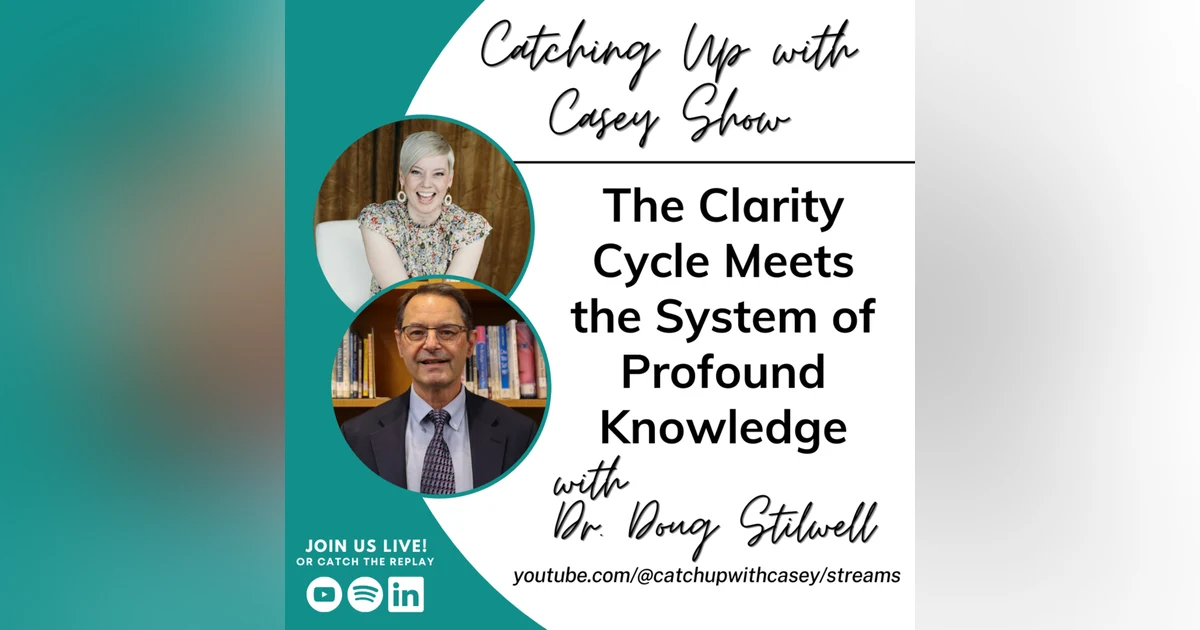
130. The Clarity Cycle Meets the System of Profound Knowledge with Dr. Doug Stilwell


 RSS Feed
Schools don’t fail because people don’t care—they struggle because the system isn’t clear. In this episode, I’ll talk with Doug Stilwell about how the System of Profound Knowledge connects with the Clarity Cycle to help leaders move from compliance-driven change to true continuous improvement.
Doug Stilwell is a retired superintendent, university professor, and longtime advocate for continuous improvement in education. With over four decades of experience in teaching and leadership, he brings a systems-thinking lens to school transformation. Doug now focuses on coaching leaders, writing, and sharing insights from Deming, Baldrige, and beyond.
0:03 Welcome to the Catching Up with Casey show. If you are tired of chasing buy in, frustrated with teams who can't seem to get on the same page, or over the constant struggle of holding people accountable without micromanaging, this is the show for you. I'm Casey Watts, speaker, author, and the creator of the Clarity Cycle Framework. I help leaders just like you take teams from frustration to alignment so teams can work collectively toward a common purpose in a committed way instead of against each other as though they are functioning in different organizations. And we do it all through the craft of clarity. Whether you lead from the middle or you are the front facing leader of your organization.
0:46 On this show, we bring clarity to the seemingly small things in leadership that make the biggest difference because clarity precedes capacity. Now, with all of that said, let's dive into today's episode. OK. Hey everybody, welcome to today's episode. I'm excited to have you join us for this conversation, and I am joined by Doug Stillwell, who is going to be talking to us about how the clarity cycle meets the system of profound knowledge.
1:30 We're going to dive into this topic in just a little bit, but Doug, welcome to the show. Can you tell our audience a little bit about who who you are and the work that you've done? I sure can. Thanks, Casey, and really a pleasure to be here with you today. So I'm a retired educator. I spent 35 years in public education as a teacher for 13 years, a principal for 12, associate Superintendent for five, and Superintendent for five years. So I really felt like I had a nice, rounded experience. I don't know if I could have planned it any better. When I retired from public education, I went to work for Drake University to teach in their educational leadership program, preparing Future Principles, and that was really a wonderful experience.
2:15 One of the things I appreciated was meeting so many new and upcoming educators and also having a lot more flexibility in my day than I had as a Superintendent. So for the past couple of years, I'm, I'm now in my second year of retirement. A colleague and friend of mine, Jim Berlin, and I do a little bit of consulting. Not on your scale. We do just enough to keep us busy in retirement. We would do some coaching of principles and strategic planning with folks. So enough to keep busy. So it's, it's been good. It just, I say, I know education had a lot of challenges right now, but if I were to go back and decide would I do this career again? And the answer would be absolutely yes. And you obviously would agree.
3:00 This is a very important profession and I'm glad to have been a part of it for so many years. Yeah, awesome. And you and I met through Hunter Flesh. So listeners, if you're not familiar with Hunter Flesh, definitely check out his at Essentials podcast and you'll actually see an episode with Doug. And is it John Dews who wrote the book Win Win? And they talk a little bit about Deming's work, which is actually what we're going to dive into today as well. And so he and I connected through podcast and he connected me to you and you and I have been visiting off and on for the last couple of months and just had had some great conversations.
3:43 So I was thrilled to have you come on the podcast to continue that conversation just in front of everybody where they can hear what what we talked about. So before we dive into the things that we're really going to talk about, tell us what's something that makes you just uniquely and ordinarily human? Well, there's a lot of things I'll just mention. A little friend of mine sitting behind me, his name is Landry, is my 9 year old golden retriever and he and I have Landry is named after Tom Landry as a matter of fact of Dallas Cowboys fame. My wife is a huge fan, so he and I have become the best of buddies and daily walks with him or a joy. And it's fun to play with him.
4:29 So I think that that's one thing I've always going to mention to you, that about 25 years ago, I started writing a children's book when I was a principal and I put it away when I started my doctoral work and never really revisited it. And I was getting ready for a presentation at the National Superintendent's conference in the spring, and I took this old thumb drive and I found my story. That was back in March. So I thought, I'm going to work, continue to work on this a bit. And I worked and, you know, change, add, change adds. And I finally got to a point I thought, oh, this is, this is a story now. So I looked and I looked and I looked and I finally found someone who was willing to serve as my editor. And she said, Yep, I've read, she read my first chapter, said I'm, I'm interested in working with you.
5:13 And so I finished up my, my work and sent it to her and she sent me 14 pages of notes. Oh my gosh, which I love. You know, you can always tell. She said one of her comments was, I don't want you to think I don't like your book. And I really loved it because it will put me back in the place of a learner. And it, it helped me to feel what my doctoral students feel when I give them feedback on their dissertation. So I'm looking forward to dig in and doing and following some of her feedback. What I learned was I don't know a whole lot about writing children's books other than a basic story. So really humbling experience with that, but it'll be fun to finish. Oh, yeah, it is definitely like writing anything. Like when I was writing my book, it was a humbling experience, too.
6:03 And it's funny you talk about a children's book. I have thought about. I had this novel in mind for the longest time, based on a song that's been one of my favorites for so long. And I mean, I had like characters mapped out and everything. And then when I started really getting into it, I, I found that it is definitely not something for me to do. I need to leave that to other people who are novel writers. It's just so it's so much more complex than what you imagine. And even even writing a children's book, like there are certain things you have to a certain way you have to shift your mindset and thinking that you're just not accustomed to. So I applaud you for that. That's awesome.
6:45 When you've been writing professionally, right? Like we do for 40 years, switching that gear. But she gave me some books to read, to give me some examples. And again, I look forward to it. But I think a piece of it is giving me empathy for what my doc students feel when I give them feedback, and helping me think about how I can give them feedback that is both honest and yet caring. Yeah, yeah. Love it. So today we are bringing clear, as always on the show, we're bringing clarity to something. Can you specify what we're bringing clarity to today? So we're bringing clarity. I think one of the things is how clarity in my mind as I've, as I've read your book it, it connects to everything.
7:33 And so specifically today we're going to be talking about a gentleman by the name of Doctor W Edwards Deming and how his work, which is really well known to a lot of folks, not a lot of educators honestly, but to the world of manufacturing, particularly how those two connect. And it was just really amazing to see how they do connect. Not surprising but but always amazing how those things work. Yeah. Can you tell our listeners, for those who are not familiar with Deming Deming's work, do you have like a just a quick summary that that would describe his work for those who aren't familiar? Yeah, going back very, very quickly here after we destroyed the Japanese economy in World War 2.
8:18 Deming had worked in Japan before that, but they asked him to come back and have him teach them some of their some of his principles. And back then, you know, and I remember even sometimes as a kid, if you saw something that said made in Japan, you thought, well, this isn't quality. Well, after they worked and I think Deming worked with 90, about 90% of the manufacturing base in Japan. After he worked with them some 50-60 years later, we know what happened, right, especially in the car industry. So I thought if Deming can transform an entire economy, maybe can help education. So he very deep man. Some actually, we claim him as an Iowan. He was born in Sioux City, IA, lived here for a few years.
8:59 But he is well known for something called the system of profound knowledge. And it's made-up of four interrelated components, which is why he calls him a system. One of those parts is an appreciation for a system. Yet another part is understanding variation. And then there's a piece about psychology and then the final pieces, theory of knowledge is how we know what we know. And those four pieces are interconnected. They stand alone to a degree, but their power really is how they interconnect. And again, I found so much connection between your work and particularly the appreciation for a system. And, and I can talk about that right now or I can let you ask me questions about it.
9:40 Yeah, I would love for you to talk about that now, just and truly what a system of profound knowledge can be, how it can be applied to today's schools. Well, one of the important things to think about and I and I think I understand that you're reading the 5th discipline or you've read it. And So what we begin to understand is that the school district is a system, a building is a system, and a classroom is a system. And so when we start to understand the fundamentals of how systems work and that the system is in charge of so much that we can anytime we can improve the system, will improve the performance of the system.
10:23 So in a classroom, if I can improve how my system functions, if I understand that as a teacher, then I can help every student to achieve as well as they can. It's not about helping one or two kids. It's about how can my system meet the needs of every student. So it has application in in at every level of a school system. Yeah, that's powerful. And I don't know that we, I don't know that we give enough thought or emphasis to the power of systems in our schools. Like I don't know that it's something that we specifically consider as we are developing our, our district level systems, our campus level systems, our classroom level systems. So I was super excited to talk more about this. So let's talk about clarity precedes capacity. How do you think it aligns with Deming's beliefs, specifically with like constancy of purpose and systems thinking? And can you talk a little bit more about constancy of purpose? And so Doctor Deming, in addition to his system of profound knowledge framework, he created what he called his 14 points for managers.
11:34 And when he says managers, he really means leaders. And one of those points is a constancy of purpose over time. I think I even heard, I can't remember your book or your podcast. I listened to today about how we jump from one thing to another to an, oh, I know that's it's a part that actually I highlighted in the book today to talk about how we jump from one thing to another. Well, leadership's role is to make sure that we are on a steady course. And while there may be some variation along the way that we keep our eye on a North Star. So that's why constancy of purpose is important. But you have to have constancy of purpose around something clear. It can't be nebulous. So if I go back to the way that Doctor Deming defined a system, a system is made-up of interdependent parts, meaning they all work together to achieve the aim of the system.
12:22 So if there is no aim, there is no system. If there's no parts working together, there's no system. So the clarity comes in. You have to have a very clear aim, right? So you and you talk about that so beautifully in your book. And I love, I love how as an aside, I love how you wrote the book about something that's really deep and technical, but you made it easy to read by using such really nice examples and talking about yourself. And that was a piece I was going to when you talked about. If you're anything like me, you have gotten on the bandwagon working out or eating healthy. And you just, I love how you connect things back to your own life. I think that's really important. But this whole idea is, if the aim isn't clear here, it doesn't matter what we do, we're not going to achieve anything. So that's where I really connected with your clarity piece.
13:09 In fact, I kept thinking about different parts of my life and where clarity wasn't important and I couldn't think of one. If I can give you a quick funny story about clarity, why it's important if you've read through the 5th Discipline, Dr. Sanghi talks about this to a degree, understanding current reality, right? We have to have clarity on what current reality is. If we don't really know what's happening, we don't really know what to do that will meet the needs. Well, my, my funny example is last year when I was at the optometrist, she said, well, I think you've got some cataracts happening in your eyes, but it, you know, you probably won't have to worry about it for a while. I thought rats.
13:55 So I could tell after a while, not too long after that, my eyes are starting to get real fuzzy. And so I went to the ophthalmologist and they scheduled me for my cataract surgery. Well, I had to wait about four months for that surgery. And as time went on, my eyes, I could tell we're getting less and less clear. Well, when I would look at myself in the mirror in the morning, I think you don't look too bad for a guy who's 67 years old. And I hear about all these products for men to take away the wrinkles. I looked at myself and I thought, I don't need that. Well, Casey, I had my cataracts taken care of. My lenses were finally clear. I looked in the mirror and I thought, Oh my gosh, that who I am.
14:38 All these wrinkles showed up and I saw more of the Gray hair. And it just is a good reminder. Not that I've gone full born to any of these lot of products, but unless you see reality with clarity, what you do may be totally wrong or you may not do anything. So what's really important? Clarity. And again, until I was reading your book and talking to you, I never thought about it in that way. But clarity is required in just about every aspect of our life. Yeah, absolutely. I love your simple relevant example of that. And and that is one of the reasons like as I was writing the book, I wanted it to be something that you can see yourself in it. And it's not so complex that it's just feels like theology, you know, or ideology.
15:28 And so, yeah, I, I love that you brought that up. Clarity definitely does perceive capacity. And what you're talking about is the is capacity. And so we, we have to, in order to be people who are able to function at their fullest capacity, we have to have clarity. I think about all the time, I was telling someone this the other day. It's interesting to think about how often you hear people talk about clarity and it's either after the fact when they've gained clarity, they say, I just, I'm glad I now have clarity or now I have clarity and it feels so much better. Or it's before they have clarity and they're complaining that they don't have clarity. And you don't hear a lot of people talking about how they're going about gaining or creating gain clarity for themselves or creating clarity for other people. So let's talk about what it means to focus on improving the system instead of blaming individuals, because that can happen a lot too, especially if there's a lack of clarity. So how do we just focus on improving the system instead to make that shift or impact on culture? Yeah, I think it's really important. Doctor Sangay has switched his thinking. He doesn't call IT systems thinking as much anymore. He calls IT systems intelligence, and that's just really having that mindset that I look at the system he talks about, it's not the forest or the trees, it's the forest and the trees.
16:56 So first of all, having that sort of a mindset. So one of the things you mentioned earlier, I think in the video that you showed, you talked about work together rather than kind of working in opposition to one another. And I can give an example of, of how I teach that in class on how important it is. We, it's called the foam ball experiment. And I have this cushy foam ball, it's yellow and I have people examine it. And we talked about what his characteristics are. And then I asked him to pull off a piece and then to make their piece better than it was before using any means that they want. So they take it, they'll cut it up, they'll color it, they'll do all sorts of things. And in the end, we say, I will, I ask them is, will tell me how you improve your piece.
17:45 And yeah, based on what they said, they improved their piece. And then the question comes, what happened to the foam ball? Oh, there is no more foam ball. We have what Deming would say. We have sub optimized the system by focusing only on our own part. And I think that's a piece that we're we're talking about here is, Yep, people can do really great work individually, but it may actually be counterproductive to the organization. So to that point, I think we go back to a clarity of a vision, whereas Dr. Deming would say a clarity of your aim, making sure that people understand what that aim is.
18:25 And I think a part that is missing, this is a revelation I had several years ago about vision and aim. When we write one for the district, it makes perfect sense at the district level. And I got to thinking, you know, my dad put together farm machinery for John Deere for 30 years. And I'm guessing John Deere had a, an organizational mission. And I thought, what would that mean to my dad working on the line? Nothing. It meant nothing to him. So this idea of clarity of vision, wherever we'll call, we'll just for lack of better terms, we'll call at the top or the district level. What is that same vision mean translated to the building level and then to the classroom level?
19:13 And is that clear? Is it still connected? But is it clear? And I, I wonder if that's a point that we don't miss to make sure that we have that because it connects all the levels, but each one is written in its own way that it is clear to its audience. A first grader could care less about what the district vision is, but a good first grade teacher can help children understand why we're here, written in their language, so we can create clarity that way. But we have to have that initial aim and leadership needs to be really clear with that aim, but then we need to find a way that it is communicated in a meaningful way across all the grade levels and all the departments and divisions. Yeah, I'm taking away some things that I think I might even try.
20:00 Next week. I'm going to be working with the school, going through the Clarity Cycle framework or several different schools actually, with one district. And the the metaphor or analogy with the foam ball is so good. And what a great way to showcase the silos that we experienced and how we we get away from. That aim that true that what we're, what we're trying to Orient towards. And then the other thing that I keep thinking about is when I'm working with schools, we, one of the things we talked about is how to cast vision and we, we purposefully create vision statements. So what are vision stems that you are going to create to communicate consistently and regularly to the people in your system?
20:50 And I think one thing that I might change is let's look at all of the different stakeholders that this applies to and effects and what are the different ways you need to shift that language so that it's communicated clearly. That is brilliant. Listeners, I hope you are taking so much from this conversation already. I, I think it's important too, to talk about how lack of clarity creates fear in school systems. And part of that I think comes from just the miscommunication or the, the lack of communication around what we're aiming for. But how do you feel like clarity of like purpose, roles and direction can restore the trust and confidence among all of the people in this system?
21:39 I'll begin that with a question for you. Have you ever had a time, let's say, with your spouse when they wanted you to do something and you might say, oh, I didn't know you wanted me to do it? And they said, well, I shouldn't have to tell you. Have you ever gotten that? Yeah, probably already this week. It's happened a couple of times. Well, I, I think I know I've, I know I've given it, but I've also gotten it. How can you know what to do unless there's clarity? And if and if I don't know, if I don't know that I'm supposed to do what I'm supposed to do and I start doing something, there's, there's fear of reprisal because it will happen. I mean, right. We think that's very fair to say that that happens in schools. So actually another one of Doctor Deming's points is drive out fear.
22:26 So when I think of my top couple of Doctor Deming's 14 points, constancy of purpose and drive out fear, imagine, Casey, if we did not have fear in schools. Some of it comes from outside of our control, like getting thumped by the government for things that we should or shouldn't be doing or our results that we should or shouldn't be getting. Some of it's imposed that we impose on ourself. And I always hang that moniker on leadership that if there's fear in your building, I think the person that's responsible for it is the principle. You may not have necessarily created it, but you've got the positional power to get rid of it. But back to your point, if we don't have clarity, people don't know what they're supposed to do. And so they'll do what they think is best, which I appreciate, right?
23:16 They're going to do that and it may be the wrong thing. Again, there may be repercussions because of that. And think of the culture that's built when that happens. You know, I don't feel like I can do anything. You know, what's going to happen, who's what, who's going to hit me next from what direction? And so I think of my potential as a teacher is stifled because I am so fearful of doing the wrong thing. So that whole piece of clarity, right? And I don't, I'm not, I'm not one to think that the principal should say, this is how we do it. It should be a collective piece where we work together and say, this is how we're going to work and that part becomes clear.
23:58 And so a people have the clarity around it, what they should do and how they can organize or work around that. But they also have ownership. So when I have ownership, I'd like to think that more of the fear is gone because I know what to do. I had a part in it and I'm not afraid of, of doing something. The other part of it is I, I don't know about you, but I made my fair share of mistakes as a teacher and as principal and as Superintendent. The problem comes if we didn't learn anything from those mistakes. The other problem is if people punished us for it rather than looking at it and say, OK, Doug, what did you learn from that? It didn't work. What did you learn? If, if we can have that mindset rather than a punishment mindset or chastising mindset, we drive out fear, but it, it always begins, it always begins with this always. And that's, again, that's been at the top of my mind with so many things.
24:58 I'm going that's clarity. We need clarity, we need clarity. So the other piece is, and I think I heard you talking about this in that podcast today when you were in the car is sometimes there's a lack of creating operational definitions. So and I think you used the was it around curriculum and that and that podcast? Fidelity. Yeah, Yeah. By that, what do I, I know what Webster says it is. OK, but what do we mean by that? And that's come to an agreement on that. That way we're all clear on what that means. So I don't have any fear about implementing based on that because I know what it means. So sometimes we assume, I think you've talked about this too, we assume people know what we're talking about.
25:44 Well, I, I don't know how often that is or isn't the case, but it isn't always the case. So that piece about clarity about what we mean with those terms is really important. It's interesting to hear you talking about this, specifically the fear piece of it, because when I'm meeting with districts or schools for the first time, we have typically what happens is we'll have a virtual strategy session before I meet with them in person. So we do a lot of the grunt work ahead of time. And that way when I come to meet with them, it is extremely purposeful and we can get into the work of planning and creating clarity around specific things. But when we're looking at their, typically we'll start with an area focus and we transition that into a problem statement. And then we analyze that problem. And as we're analyzing it, almost every time something comes out about fear, like teachers fearing systems are fearing that they're going to be judged or some kind of fear comes out in those conversations, or it is students experiencing fear in the classroom and not will not being motivated or willing to participate. And so it's just fascinating to hear you talking about that and the role that clarity plays in it. Can I Can I add to that?
27:01 Yeah, please. Do if there is a degree of fear and of an organization and let's even say a classroom, if it's somewhat widespread, we have to say that that is a system issue. There's something about the system that's creating that fear. Now, here's where it gets tricky. If I'm the principal of the building and there's fear in my building, I have to say somehow I'm a part of that. Somehow I either created it or I'm allowing it. Same thing with the teacher. So I'm not going to blame the people and say, well, they need to fix themselves. I need to ask myself, what is it about the system that we're living in? What's my behavior in that system that's creating that fear? Now the challenge can be if you ask people about it, they're probably not going to be honest with you, right, because they're fearful of what might happen.
27:51 So it, it's a bit tricky, but the responsibility for the system is upon the leader. And of course, the leader always needs to ask the people in the system about it. But if there is fear in a building widespread, the principal owns it. And I, I don't mean that as a criticism because I was there myself as a principal. Same thing in the classroom. If there's fear in the classroom, it's on the teacher. And, and, and that's also a powerful thing, is that teacher can change that. Yeah, when I'm, when we're going through that exercise, so I usually take people through a 1055 protocol to analyze the area focus or the problem statement. And when they it's fascinating. Also, when I'm, when I'm working with a leader specifically on posting data, like facilitating really effective productive data meetings, one of the things they always talk about is the trying to get people to shift so that they are owning that data or owning their contributions to that data. And I know it's a really hard thing because people take data personally.
29:00 We are just complex human beings and that's just a a matter that we have to expect and be proactively planned for. But it's interesting because leaders talk about teachers not taking ownership, but I wonder if they recognize when they themselves are not taking ownership. And it's fascinating to be in some of these meetings where I'm going through this virtual strategy session and I hear from the principal more than anyone else on the team, or I'm hearing the principal step in and justify some things that other team members are saying. So it's just fascinating to recognize when someone has the self-awareness and has the habits, the habits of a reflective reader leader, honestly, in order to go about this work vulnerably.
29:52 And it does take vulnerability. Clarity takes vulnerability. I think I wrote that somewhere in my notes. You asked this leader do that. I think the first thing is they have to have humility to a say. Things could be better if, if I don't believe that as a leader, I might as well not lead because I've never seen any school where things couldn't improve. But that, as you know, that's a hard pill to swallow sometimes when you look back and you say there's a book called the outward mindset and the theory is for the leader is that there's a problem. The problem is me. Well, that's, that's a tough one. So you want to, you want to be kind of tender with that, but it's, it's true. Yeah.
30:34 Are there other things since we're talking about that piece of this, what are steps leaders can take to move from? And I talk about in the book too, we don't want to be compliance driven. We want to be create a culture of clarity where there's continuous improvement. So do you have other thoughts on that? On creating that culture, my first thought would be a, A leader needs to model it. I think we all familiar with they do as I say, how does that do leaders first need to model it, believe it, model it, and then allow people opportunities to practice it? First of all, we have to understand, I mean, there's a whole science, right?
31:17 There's there's the improvement science movement that's occurring now and there's all sorts of pieces to it that get rather technical. So I think we have to make sure to boil it down. So like your book, it makes sense to people. It's highly technical, it's deep, but as you've demonstrated, you can make it very understandable for people. And then I, I just encourage people as much as they can to talk to the people doing the work before you make any decisions. Understand what it's like to be in the classroom. And the principal may say, like myself, I was in the classroom for 13 years. Well, my thought is, and I'm exaggerating a bit, but the minute you step out of the classroom, you don't remember what it's like anymore.
31:59 That's a bit of an exaggeration. So I think when we are clear about getting the clarity piece about what our vision is about what our goal is, and we just set people and we work with people collaboratively and they work themselves collaboratively to do that work. And again, you talk about the term fidelity, which is a, a term I kind of struggle with at times and what that actually means. But we become a partner with them in learning as Prince, as leaders. We don't, I'm not going to sit there again. I felt the minute I left the classroom, I was not the what people think of the instructional leader. You know, to talk about pedagogy today. I've, I've read a bit of Hattie and I really love how you connected to Hattie in your book, by the way. We put people together to work on what we've said. We're going to work on my job then as a leader just to monitor, not to find out what's going wrong, but just to find out where I can support and to say, I walk into Casey's classroom and she said, can you observe such and such? And I can give honest, good, honest feedback in a way that's productive.
33:07 Never hitting someone over the head unless they've done something egregiously wrong with a child. So at some level it's not that difficult, but in some level it's really difficult because I'll get in my little soapbox here. I'm I'm not sure how well we train people to do that work, either as teachers or as leaders. And so you have to relearn it. You basically it's not uncommon for people just to go back to what they saw and experience themselves. So back to the point, lead by example, show these kinds of things. I was just at a school yesterday. A former student had contacted me and said would I come help with some staff development on plan, do study, act model. So we worked collaboratively on it and she did such a beautiful job of sharing it, making clear people knew what they were supposed to do, watching them work, traveling the room to hear what was going on, getting some feedback at the end with and, and always, she was always very explicit about if something that you're trying doesn't work, it's not a failure. What's a failure if you don't, if you don't learn something from it.
34:19 But she just, she took all of the, all of the anxiety for me anyway, as I observed all the anxiety out of the room and gave people that freedom, right. So we, we trust people as professionals. So setting those processes and procedures that are very clear for people and then letting them go. And I don't want them to go to do anything they want because right, that's back to the foam ball. We're pulling pieces apart. But anything that we can do to create progress towards our goal. I, I read a book, it's called the goal. And in the in the book, there's a, it's written in fictional form, but someone asked the leader of this company, what's the goal of the organization?
35:01 Well, once you finally figured out, at least for the organization, it was to make money, anything that didn't lead towards that goal was not productive. So when we set up and we're very clear about what we want, want to have happen and are very clear about this is the goal. We can also determine whether or not things that we're doing are productive. Now, some things we do at times just for fun. I get that, but is what we're doing productive? And if we're not, then a principal can coach, right? That's you're bailiwick. We coach people back to where they need to be. I don't know if that answered your question. That's just the endings of a 67 year old guy here in his basement. Yeah, I love it.
35:42 And here's what I love about what you said. And I talked to people about this so often when you do step out of the classroom, you know, you hear a lot. So let me back up. You hear a lot. And I not going to lie, I've been one of those teachers that have said this, but you have a principal telling you to do XYZ. And sometimes the gut reaction is this principal has not been in the classroom in 10 years. Why we like, why are they speaking into this? Why would I listen to them, etcetera. And you know, that's, I think that points definitely to a culture issue that the leader has to work on. But I also try to coach leaders and in coaching their teams to understand the different perspectives and narratives we have at play on campuses and the importance of each of those narratives.
36:37 So it takes, you're right, I have stepped out of the classroom and I don't know what it's like. And there's a reason for that. I cannot keep myself in the mode of classroom teacher because then I'm not doing the job of the leader of an organization who has to take a bird's eye view. My job is to take a bird's eye view and to lean into that and help you to understand components of that bird's eye view that's necessary for us all to move forward. It is also my job to understand that you have a different perspective and you have a more zoomed in lens that I need to learn and grow from. So it takes all of these different perspectives so we can't see it. As you know, well, they've been out of the classroom for so long.
37:23 Yeah, they have. But they also have these different skill sets that are absolutely necessary to do the job that they're doing. That's different than a classroom teacher. And I just think it's so important for leaders to understand you have to create a culture where you're modeling that all of those perspectives are necessary. So I love that you brought that up. And we think about that. Those all are components of a system. So you got many subsystems in the school. One of those subsystems is people. And so understanding the different perspectives. Again, Doctor Deming didn't always talk about, but I've never heard him speak in person. Says you always need to talk to the people doing the work. So what does that mean in the classroom? Teacher needs to talk to kids to I should say listen to kids to understand so they can adjust instruction appropriately. Your point about not being in the classroom but you need to be away from it is so is so true.
38:21 Again, Doctor Deming would offer that a leader should work about 10 to 15% at most in the system and the rest of the time on the system someone needs to be paying attention to the system. And I will hear teachers say well I wish my principal was in my in the classroom more. I get that principals do need to be in the classroom, but let's remember they're, they're the principles. They're not the teachers. They shouldn't be spending all their time in the classroom, at least I don't think so. They should be working on the system, making sure that all the parts are there so the teachers can be effective as they can be. But yeah, making that step outside the classroom, it is a bit of a mind shift. Yeah. Do you remember? I, I will never forget. Well, I've had some people say say this to me. I don't think I experienced it as much and I feel like I'm fortunate in that.
39:10 But I've heard people say when they came out of the classroom and they started to go in to observe other teachers, they realized, Oh my gosh, not everyone does things the way that I did them. Or I just assumed that everyone understood and everyone was doing things the way that I would expect it to be done. But you're coming out of the classroom as a leader because you're probably a little bit of a high achiever probably and someone who is kind of grounded in philosophy and pedagogy. So it's just interesting to think about that aspect of it too. Not you don't get to see the full picture when you're when you're in the weeds of it. No, that I had that experience because I would sit in observations and think I wouldn't do it that way. Why are they doing it that way?
39:58 This would work better. And then right you have that's that humility and making sure you're not driving in fear to say you did that wrong. Well, you just did that differently. And if you got the get the results you wanted, I'm fine with it, but. There's some self-discipline in that. Oh my gosh. There is some self-discipline. So there's definitely clarity and understanding that. And you mentioned earlier, we are not. I don't think people are explicitly trained in some of the things that are necessary for them to be trained in in order to lead well. And clarity is one of those things. But I lacked clarity around that, that self-awareness piece and the social awareness piece going into classrooms thinking because I was a master classroom teacher, I was really great at what I did and I knew that the things that I did worked. And so I would go into classrooms when I was first an instructional coach and it was just in me to think, OK, I'm going to teach them the way that I did this. And then it's just going to, they're going to do this so well and they're going to be amazed by it. But my goal, I guess unconsciously, I think my goal was let me create mini me's.
41:07 But you have to shift away from that because that you will never make change happen. And that's definitely not the way to build culture. So that is, that is so true and it's so emblematic of what we have to think about as leaders. We are not trying to create reproductions of ourselves. I want my very first supervisor said he never hire someone like himself because if he did, they wouldn't need him anymore. So yeah, I've always liked that. So good. Yeah. OK, that's awesome. And this has been such a fantastic conversation. I have enjoyed it so much. And I know for you and I there are going to be lots more conversations in the future, but for those that are listening, first of all tell where they can find you. I know you are are on LinkedIn, so where where else would might they find you?
41:57 That's about it. To be honest, I've been becoming a little disgusted with social media so they can find me on LinkedIn and that's about it. OK. And if you're not already on LinkedIn, guys, get on LinkedIn. I'm there too. That's where I primarily am just I feel like it is pretty much drama free and I can go there to learn from people and share content. So it's just a it's just a nice a nice breather as far as social media goes. What do you feel like, Doug, you would hope people take away from today's conversation? There's two options we have as educators. We can stay the same or we can get better.
42:37 And we can only get better by having a clarity of where we currently are and a full clear understanding of where we want to be and then build the steps towards that. So the first piece is, do you want to get better or not? And I would say if the answer is no, then I would not want you working in my school. So I think that's the that's the main piece. You know, someone once asked me, what do I think leadership is, right? There's billions of things have been written about leadership. And I say it's pretty simple, make things better, period. But you have to be clear about where you are, right? Got to get your cataracts fixed. And then you guys see that reality and then figure out a plan with the help of others to, to find a way to get better so that students can get better at their work too. So again, your your work with clarity has just been eye opening for me.
43:30 It's been there. I just have never recognized it. And if I could say one more brief thing about that, I'm sorry, I don't want to go over. But when when I have students put together improvement plans, I often find lacks the most clarity are their actions. So they'll say like their main goal is we want to improve the culture in the building. OK, that makes sense. What's an action you'll take? I'll build relationships. That is not an action. That needs to be clear, right? What will I see you doing? How does that work? So clarity, even down to the most specific thing, needs to be in place or we just don't know what to do. So for what it's worth, those are a few thoughts. Yeah, I love it so much.
44:13 And you've given me things to take away today that I'm going to implement. So just be expecting pictures next week. I'm going to work with the school. I'm going to implement some of the things that you talked about. So listeners, please let us know in the comments. Let us know what you feel like has been most useful for you in this conversation. e-mail me directlycasey@clarity-driven.com. I want to hear your thoughts. And of course, as always, and you're going to hear this in the closing, leave a review for the show. If this was not the worst show that you've ever seen or listened to, why not just go, go leave a review? And you can help other people to find at this show as well by doing that. OK, Doug, thank you so much for joining me today.
44:54 Thanks, Casey. It's a great pleasure. All right, we'll see everybody later. Bye, bye. Hey listener, I am so honored that you listen to today's episode and I hope you gained something valuable from it. I'd also be honored if you did ME3 solid favors. First, subscribe to this show. I've got a lot of great content coming up, and I don't want you to miss any of it. Second, be sure you're following me on social media platforms. You can find me at. Catch up with Casey on LinkedIn or Instagram. And finally, if you were looking to book a dynamic and relatable speaker for your next event, conference, or retreat, I would love to bring a message about how the craft of clarity makes a significant impact on both leadership and life.
45:37 Until next time, always remember clarity precedes capacity.

