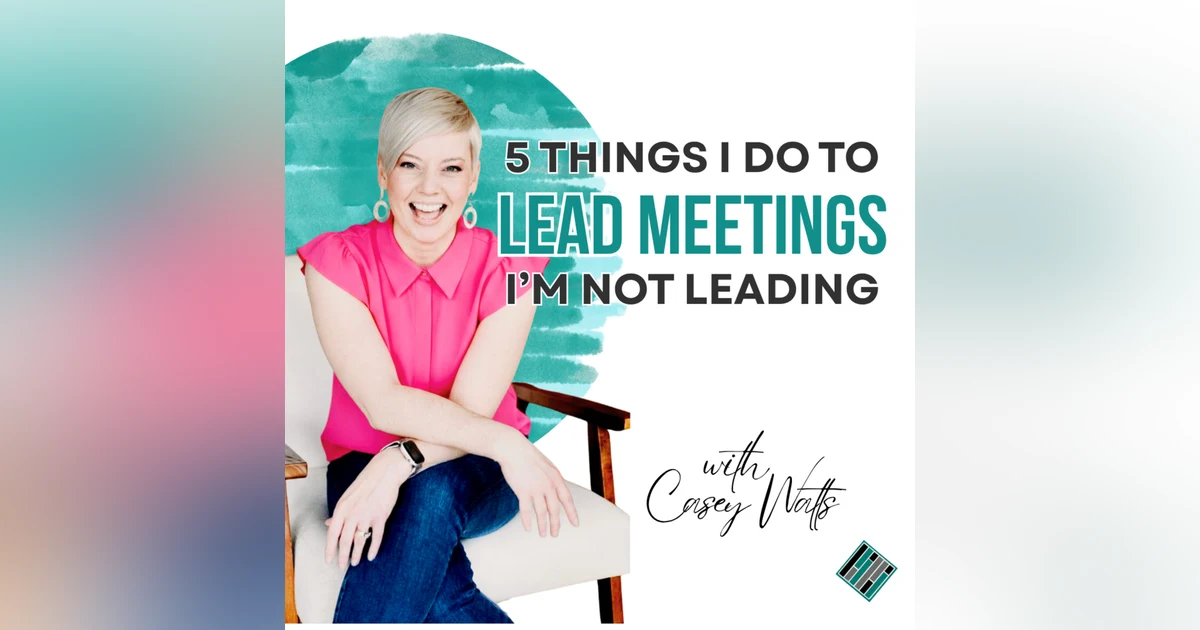
5 Things I Do to Lead Meetings I'm Not Leading


 RSS Feed
My husband came home late from a meeting that, in his words, half of which could have been an email.
Someone showed up late. Tangents were welcomed. The hour on the calendar stretched well past the hour. I have been in that meeting, and I am guessing you have too.
In this episode I share five boundaries I use to get clarity before, during, and after a meeting, including the ones I did not schedule and am not leading.
The five:
- Set the purpose before the meeting and again at the start
- Set a time frame of 45 or 50 minutes rather than the default hour
- Make the start time and the hard stop clear
- State the intended outcomes so everyone knows what success looks like
- Close with clarification so the meeting gets real closure
I also share the one question I use to end my PD sessions, coaching calls, and meetings, and why people answer it honestly even after a hard conversation.
For high-achieving, impact-driven women who want their meetings to feel as productive as they are.
Mentioned in this episode:
- Michael Bungay Stanier's question: "What was most useful for you here today?"
- The Craft of Clarity
Connect with me:
- Website: clearisthenewconfident.com
- LinkedIn: linkedin.com/in/catchupwithcasey
- Instagram: instagram.com/catchupwithcasey
- YouTube: youtube.com/@catchupwithcasey
Leave a review so other clarity-driven leaders can find the show.
Booking a speaker for your next event, conference, or retreat? Start at catchingupwithcasey.com/speaking.
0:04 Welcome to Clear is the new Confident. I am Casey Watts, speaker, author and the host of this show. If you are a high achieving, driven woman who has ever replayed a conversation and 2nd guessed everything that you said, or found yourself saying yes to things that you later regret, or have held yourself back from making a bold decision because you didn't think you were credible enough, didn't have the authority, or weren't quite ready, this is the show for you. On this podcast, we are making space for confidence, and it all starts with clarity. Clarity about who you want to be, clarity about how you want to show up, and clarity about what you want from both work and life.
0:49 Now, with all of that said, let's dive into today's episode and make some space for confidence. Hey everybody, welcome to today's episode. I am grateful that you are here. And today's episode is actually a replay from a previous episode that I wanted to bring back because I felt like the timing was right, especially for those of you who find yourself in meetings.
1:30 And I know this time of the year, meetings can be a plenty. So there's no shortage of meetings. Actually, there's no shortage of meetings anytime. But this time of year, for whatever reason, they tend to seem like a lot. Before we get to today's content though, here's a little bit of an update on just life in general. And by the way, I would love to hear from you about your own life so that I can get to know my listeners better and more and feel like I am having even more of an authentic conversation with you when recording these podcast episodes. So we are in the process of getting our house ready to be put on the market, which there are only a few projects that we have left to complete and some cleaning up to do. But it still feels like a lot.
2:29 And we've only been in this house for about 6 years and we it's a big house. We are ready, ready, ready to downsize and our plan as of right now, which you never know how plans are going to go because honestly, we thought this was going to be our forever home. And then after just a couple of years in it, I started saying you know, when we get our next house or my husband. I remember my mom saying she heard my husband, his name is Cliff, say when we buy our next house where we're going to whatever he said. And she said no, you're not moving again. Are you serious?
3:11 I thought you guys said this was your forever home. And I started then to shift our language to this is our forever for now home. And I don't know that I necessarily believe in a forever home for us in particular just doesn't feel right for us. I really like change. And it's not to say that this is going to be an easy change. We do love this house. We love this neighborhood. We've made lots of memories here. And our kids are all just about when we're about to be empty nesters. So we've got just this year. So my daughter's already graduated and left a couple of years ago. And my oldest son, he's our middle child, but he's our oldest son.
3:57 He is about to graduate. And then we will be left with 115 year old boy who will only have two years of school left. And then he's probably going to go off to college. And we want them to go off and experience their lives. But that means we'll have this big old house to take care of ourselves. And we really don't anticipate grandchildren anytime super soon. OK kids, if you're listening, no time soon would be great. But so this allows us to downsize, enjoy a nice cozy home. I miss that so much. And maybe another fixer upper because we really also enjoy fixer uppers and flipping homes. That's what we've done since we've started buying houses and that will allow us at some point to move to our dream home. Small, still small house, but a view of the lake. I just imagine being at a window and being able to look out at water.
4:59 Writing my next book, whatever it's about, maybe it's the current book I'm writing right now, Clears the new confident, but we'll see. OK, so that's just a little update on life for us. I would love to hear what's going on with you. This episode today, like I said, is a replay and I've retitled it to five things I do to lead meetings. I'm not leading. And the reason I titled it that is because in the episode, yes, if you are a front running leader, front facing leader like CEO, deputy, maybe a director, a supervisor, a principal, whatever that role might be. If you are a frontline leader, yes, this episode could absolutely be beneficial for you. But in the episode 1 of the things that I specifically mentioned are the people who find themselves in a meeting that feels like it's lost clarity, it's lost purpose. And they don't feel as though they have the authority or credibility to set boundaries or to to advocate for clarity. And you.
6:09 Absolutely do. So this episode outlines 5 things that I do to leave meetings I'm not leading. You're also going to hear maybe the term boundaries in this episode because originally I titled it something that had to do with boundaries in meetings. OK, so take a listen, pass it on to that middle level or aspiring high achieving leader who could benefit from listening to and practicing these strategies. Enjoy. My husband came work home from work a little later than he usually does and he told me about a long meeting in his words, half of which could have been an e-mail. So he and three others he works for and with met to discuss this idea someone had about implementing a new protocol that was mandated by their organization. And the meeting time frame for this, for this meeting they had was just the standard link that Google assumes unless like they if they use a Google Calendar, it assumes an hour meeting. So if you schedule that meeting, unless you change the settings within your own Google Calendar, it sets itself at one hour. One person was late, so they waited a little bit to get started.
7:34 Once they finally began, they were sharing ideas, questions were being asked, tangents were welcomed, and once they finally got to the end of the meeting, it was well past the hour for which it was scheduled. And this is definitely not unique to his organization. You have probably experienced exactly what I've described. I know I have experienced that as well. And these situations where in we find ourselves in the throes of this unproductive or inefficient meeting are due to, of course, you're going to hear me say it, a lack of clarity. And I want to use today's episode to talk about some boundaries that we can set to help us to gain clarity, but also to help us have super beneficial meetings that leave you feeling successful, competent and help the people that you're meeting with to feel that same way. I have about 5 different things I want to share with you that might help you to set boundaries and have a very productive, clear meetings.
8:53 We're going to go through these five and as we're going through these different strategies that really they, a lot of these are going to think, well, that's common sense. For whatever reason, we don't practice these things. We don't put them into practice. And I think sometimes that's because we are not like if you, especially if you are not the person that calls the meeting, you feel as though you don't have the authority or power to do some of these things. Let me challenge you. You do absolutely have the authority and power to do some of these things. This is where you can step up in leadership and it doesn't necessarily have to be that you were taking over the meeting as a facilitator. It could be that you're doing these things for yourself because you need clarity.
9:43 Let me say that again. You could be doing these things for yourself because you are seeking clarity and it is OK to come at the situation with that phrase ready to go. I am doing XYZ, whatever it is. We're going to talk about those things because I want to gain some clarity. OK? And you're going to hear me give some examples of that as we go into this episode. So let's talk about the five things and I let me just briefly state them really quickly, and then we'll go through each of them. Number one, set a purpose #2 set a time frame #3 make clear. Sorry, I thought I was going live there for a second. Make clear that you're starting on time. Even if you're not the one leading, you could do some things to support starting the meeting on time #4 state the purpose and discuss the intended outcomes, and then #5 close with clarification.
10:49 OK, here we go. Let's dive into each of those. Set a purpose before the meeting and at the beginning of the meeting. Set a purpose before the meeting. I can't tell you how many times a meeting has been scheduled and when you look at either like let's say it's a Google, I'm most familiar with Google Calendar, but I also know a lot of people schedule meetings with Microsoft Outlook. It doesn't matter which platform you use. Think about how many times a meeting is scheduled and it is so broad and unclear what the meeting is about that you are left wondering and pondering what is this meeting about? What do I need to bring with me and how do I need to prepare for this meeting?
11:36 If you are the facilitator of this meeting, if you're the one conducting this meeting and sending the invite out, be super clear about the purpose of the meeting. But dig a little bit deeper than just saying I'm. I'm trying to think of an example that what comes to mind because I've most recently been talking about this is data meeting. If you label on the Google Calendar invite data meeting, that could look different for any one person that comes to that meeting. Be super clear what's happening with the data. So it might, you might say in the description data meeting, during this meeting, we are going to analyze this data and walk away with these things. Be extremely explicit about the purpose of the meeting before the meeting happened so people are coming to it with a very clear idea of what the intended purpose and outcomes are. But then also state that purpose again when you all sit down together.
12:37 I just want to remind everyone the purpose of this meeting is XYZ, whatever it might be. The purpose of this meeting is to brainstorm ideas for an upcoming event that we have. That's the purpose of our meeting. We'll be successful if we walk away with three to five ideas for this upcoming event. It takes no time at all for you to state the purpose and intended outcomes of a meeting. No time. And the time that it does take will save you time because it will limit the tangent tangents that people go on. If you are not the person that is conducting this meeting, you're not the one who has called this meeting. Guess what?
13:21 You still can make that bold move when you all meet together and you can say, I just want to be clear, our purpose of this meeting, is this correct? And what would be our intended outcomes? Like if we walk away from this meeting successfully, what will that look like, sound like, feel like you can be the person to do that. So that's number one. So the purpose before the meeting and at the beginning of the meeting #2 specifically if you are conducting this meeting like you've, if you've put it on the calendar, my challenge to you is to change your settings in whatever calendar you use. Do not let it, do not set it for an hour. Set it for either 45 or 50 minutes, not the full hour, just 45 to 50 minutes.
14:13 This can do do a couple of things for you. First and foremost, it's going to give you a little bit of wiggle room at the end if you do go over a little bit. It also saves you some time if you have another meeting coming up coming up. It gives you a buffer at the end of this meeting, but also it gives everyone a very significant outlook on the time frame that we have. And we recognize, OK, we don't have an hour for this. We've actually got less time. So we want to be sure we're using our time super efficiently, very wisely. Otherwise we're going to take that full hour. If I know I'm looking at the clock and I'm like, oh, we still have 10 minutes left, well, guess what?
14:58 A lot of people are going to try to extend the conversation so that they're using that 10 minutes because they said our meeting would be this long. It would be an hour long. So an easy way to break that bad habit and to make things a little more efficient is to just go ahead and set your time frame for the event or the the meeting 45 or 50 minutes and let people know we have 45 minutes. Now that leads me to my next point. I used to be so great at this and for whatever reason, I think I've kind of gotten away from it. And this is this is a reminder to myself that I want to start practicing this again.
15:40 Make clear that you are starting on time and then also make clear what the hard stop is. So even if let's again, I'm going to go back to even if you are not the person that has put this meeting on the calendar, you can say, I know we said this meeting would be this long. I have a hard stop at this time. So let's say someone has scheduled a meeting. It's 45 minutes long. So that starts at 1:00, it ends at 1:45. You could even say if you know you have something coming up at 2:00 and you need a little bit of wiggle room in between to take care of your needs or grab some other resources and you know, OK, we probably might go a little beyond 145. You could say I have a hard stop at 1:47 so I can give you like 2 extra minutes, but that's it.
16:40 Then watch your clock. Now, I said earlier, start the meeting on time. Make sure that there is a clear starting time. If we say the meeting is starting at 1:00, we should start at 1:00. If you are the person who's conducting the meeting and you know, because this just happens, it just does like there, there's no way of getting around it. Sometimes. Sometimes you're just going to be late. Sometimes something's going to pop up and it's going to make you a few minutes behind schedule. Instead of texting everyone and saying I'm a few minutes behind, I'll be there in just a little bit and they wait on you.
17:27 You could say I'm running behind. I will be there in a few minutes. Go ahead and get started without me. Now. That also means that people have to have the autonomy to get started without you. They have to know exactly what it is that they can do to get started without you. So if you are a person who is not leading this meeting, you're not facilitating. Here are a couple of ways you could potentially begin the meeting without the facilitator of the meeting. There. You could begin with any adjunct things that really don't have anything to do. Like you know, these are things that we might want to talk about, but they don't have to do with the actual purpose or intended outcomes of the meeting.
18:09 So you could start, start with the adjunct items. You could also say, you know what list list 5 to 10 questions that we have before we get this meeting started. Or you could say, you know what, I know that our leader is going to be late for this meeting. Why don't we so that we can be efficient in this meeting and really productive. Why don't we set some roles like who's going to take notes, who's going to be our time keeper, etcetera, right? Or you could just begin with a meeting, depending on the topic of that it is and and what your role is in that meeting. So just because someone is late to a meeting and you can't, you can't, I use that that word loosely.
18:55 Can't start on time doesn't mean we can't utilize that time effectively as we're waiting. OK, so that's number three. Make sure you have a clear start at the time. And then also make sure you have a hard stop. There's nothing wrong with people saying we have a hard stop at this time #4 state the purpose and discuss the intended outcomes when the meeting begins. I've already talked about this, but this is actually going to lead into the very last thing. So I want to be sure that I mention it again. Really that first point that I made was set the purpose like before the meeting and during the meeting you also want to say state the intended outcomes.
19:37 So that could look a couple of different ways. It could be that you say, you know, what are our intended outcomes at the conclusion of this meeting. You could say, what is it that we're hoping to accomplish during this meeting? What is it we are hoping to understand better at the end of this meeting? What are the decisions that have to be made by the end of this meeting? Just be really clear about the intended outcomes or the success criteria at the close of the meeting. Which brings me to point #5 let's get to how we close with clarification. We, it's so interesting how many meetings I went to where we closed, but there was really no closure, right?
20:26 And there's a big difference between ending the meeting and having closure to a meeting. When we do not have closure to a meeting, which means we haven't we haven't gained clarity at the end of a meeting, we run the risk of everyone walking away and muddying the waters further, right? So this happens a lot when we don't set clear boundaries. We go overtime, we talk in circles, we leave with different understandings of the topic at hand. And so we leave the meeting potentially feeling that we didn't make any progress at all, or maybe we actually feel less clear than we did before the meeting even began.
21:16 Closing with clarification can really help rectify those things. And this is what it sounds like. It's just so simple. You could use a couple of different phrases #1 this is one of my favourites. And I typically end, I'm definitely in PD sessions with this. I am coaching calls with this and I often end meetings with this and I use Michael Bungay senior's question. What was most useful for you here today? What was most useful for you? Simple question leaves everyone thinking about the most useful piece of that meeting, making it feel productive and successful.
22:01 Even if it's a small thing, even if it was a hard, like we had some hard conversations and when, and I will tell you when I've had hard conversations within a meeting or those have been, those have taken place, we get to what was most useful for you here. And a lot of people say it was most useful for me to be able to talk about this and have an open, honest conversation. So that's one question you could ask, but you also could simply say just to clarify and then clarify whatever it is you need to clarify. So you might say, OK, so just so we can be sure we're clear, what we're walking away with is XYZ or just to clarify our purpose was this. And today we're ending with these next steps. Or just to make sure I'm understanding, here's what we said the decision was.
22:58 Am I correct in that or do I need to? Or is there a way we can clarify this more? End with clarification. We need closure to meetings. It's so incredibly important. OK, so those are a few different ways that you can set boundaries to help you have productive meetings. I would love to know what was most useful for you here in this episode. Where could you see some of these boundaries being helpful for you and your teams that you meet with regularly? OK guys, I have enjoyed this episode with you. Hey, don't forget, go and leave a review so that I know how you feel about these episodes, but also so other people can find these episodes and learn and grow as a clarity driven leader.
23:47 We'll catch you in the next episode. Bye everybody. Hey listener, I am so honored that you listen to today's episode and I hope you gained something valuable from it. I'd also be honored if you did ME3 solid favors first subscribe to this show. I've got a lot of great content coming up and I don't want you to miss any of it. 2nd, be sure you're following me on social media platforms. You can find me at catch up with Casey on LinkedIn or Instagram. And finally, if you were looking to book a dynamic and relatable speaker for your next event, conference, or retreat, I would love to bring a message about how the craft of clarity makes a significant impact on both leadership and life. Until next time, always remember clarity receives

