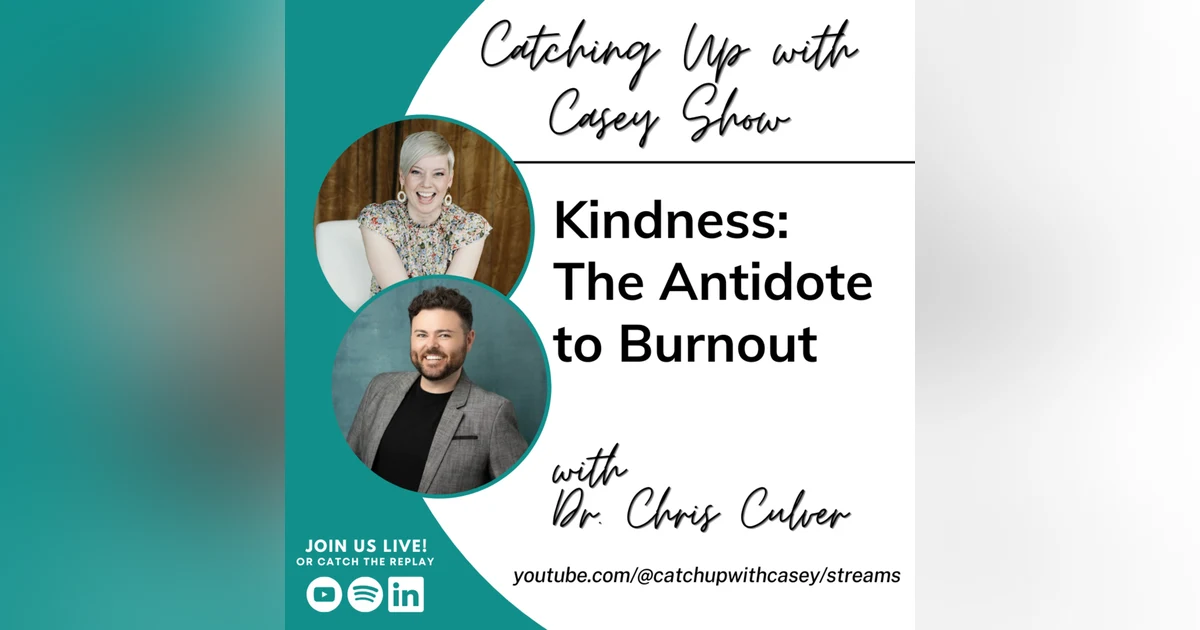
Kindness: The Antidote to Burnout with Dr. Christ Culver


 RSS Feed
Stress and burnout don’t have to define your leadership. In this episode, I’ll talk with Dr. Chris Culver about how clarity of identity and the practice of kindness can shift the way we lead ourselves and our teams.
Dr. Christopher Culver is a highly sought-after, dynamic, and engaging speaker. He is a proud product of Oklahoma public education. Raised in a divorced family, he split his time between Tulsa during the week, a 300-acre farm in Wyandotte, OK, and several times throughout the year in Fayetteville, NC.
For more than a decade, Dr. Culver has served educational communities as a classroom teacher, secondary principal, and, most recently, as a cabinet-level administrator. He is the former President of the Oklahoma Association for Bilingual Education and currently serves as Vice President of the Oklahoma Citizens for Education nonprofit. Today, he works as a speaker and leading thought partner on the Science of Kindness, a consultant with expertise in culture and Gen Z/Gen Alpha understanding, and a part-time college professor where he teaches future teachers and leaders.
Earning an EdD through research on culture and the collective impact on motivation, Dr. Culver is dedicated to spreading kindness, improving mindsets, and creating spaces where everyone is seen, heard, valued, and respected. He believes that if you cannot find the light, be the light!
Website & Resources: https://www.orangesparrow.org/all-resources
Important Links:
Give teachers what they want WITHOUT spending more or micromanaging: https://www.catchingupwithcasey.com/clarityoverclutter
Need help getting your leaders trained in a purposeful way? https://www.catchingupwithcasey.com/identity
Ready to build the habits of a clarity-driven leader? Get The Craft of Clarity book!
0:00 Hey, I'm excited about today's episode. We are talking about kindness, the antidote to burn out. I am so thrilled to have Doctor Chris Culver with me today. And Doctor Culver, or can I call you Chris in this episode? OK, wonderful. So let's start by you telling our audience a little bit about who you are and the work that you do. Absolutely. So I am a kindness researcher and I'm a kindness advocate. And people ask me all the time, how did you even get there? Right. How did this even come about? And so I grew up in a divorced family. My mom and my dad separated when I was 6. And so I split time between Oklahoma and North Carolina, and more specifically, I read I grew up on a 300 acre farm on the weekends and during the city during the week.
0:44 And so as humans, we're naturally wired to belong, wanting to know that we fit in, we've seen, we've heard, we're valued and respected. And I and I was wanting those things too. But floating from space to space was the norm. So unfortunately, in middle school and high school, I was picked on, I was bullied, I was made fun of, and I almost took my own life. And I share that vulnerably, not for sympathy, but for solidarity because I know there are folks out there who probably have navigated similar situations where they've supported folks in something of that nature. Teachers saved my life, really changed and gave me hope. And so there was really this profound impact of kindness and Fast forward through my life, I've always tried to been a really positive person. See the see life through rose colored glasses, if you will.
1:26 And in 2019, I reached the lowest point in my career where I had to call the employee assistance helpline and seek the medical professional help that that is free to educators. And for so long I was embarrassed. And I share that because that's really where I found and was reminded of the power of kindness. And since then I've been on a mission and trying to make kindness go viral to understand that kindness is not one more thing. It is the thing and it's a choice we make every single day. It's not a personality trait. We get to choose to be the light and we get to choose to be kind. And so since 2023, no 2024, sorry 2024, I have been working as a consultant and speaker in the space of kindness and now really full time and kindness advocacy and research.
2:09 Yeah, I love that so much. There's so much to impact there and we're going to do that here in just a little bit. So before we do that, though, I think it's really important for our audience to connect with you, to connect with people that come on as guests. So tell our audience what is something that's just so uniquely but and authentically but also very normally human about you Well. One, I love the color orange. Like obsessed with the color orange? And that's in your brand, right? That is, yeah, everything. I even take this with me on the road, like I've got my own orange Stanley, the big old cup, right? It's going with me. And the other thing is I love to do dishes and I like to do laundry, but I hate putting them away.
2:53 I will wash them, but I'm not putting them away. I struggle like there are stacks. I'm like, I just need to do the last step. I wonder if it comes from working in retail. I don't know, but that's the that's. So funny. Oh my gosh. So I in our household, my husband does the he's just known for doing the dishes. I'm known for doing the laundry because I despise doing dishes. Like I will watch them pile up and it does not bother me one bit. And I'm like, well, I guess I'm going to have to go get some paperware, some plastic utensils because we don't have any more dishes. And he's like wash the dishes. But that is just a known thing. Like he does the dishes and I do that and I love doing the laundry.
3:34 And I think part of it is I can just, I it, I don't know, it's kind of intermittent. So you do a load of laundry and then you have to wait so you don't have to really be there with it. And then when it comes out, I can take that whole pile of laundry and sit on the couch. And it's my excuse to do nothing except watch TV. There you go. There you go. Yeah, that's what it is. I'm lazy. Look, let's what it boils down to is I just want to sit down and watch TV. You're. Value your time and energy. You're not lazy. There we go. Yes. That's a good way to put it, yeah. So tell us what? What is it we're bringing clarity to today? What's the hot topic? I mean, I think clarity around, let me let me say this.
4:14 So often we think kindness is fluff, right? It's rainbows and butterflies and sunshine. But I think what we have to be clear about is kindness, deep kindness, as I've been reading, is really about being intentional with our choices, being empathetic, assuming positive intent, asking questions. And so really that's that's the bridge I'm trying to help people understand in the work that I do everyday is kindness isn't fluff. It really is a solution. It really is a KPI driver. It is a culture creator, It is a retention piece. So really, when you think about it, in the grand scheme of life, it's not one more thing. Kindness is the thing for every aspect of our life. So I think we're bringing clarity to the impact of kindness and that it's not fluff.
4:56 Yeah, yeah, that's great. You're going to see me pause for like every now and then because I think of these situations I've been in or just experiences that I've had that I'm like, Oh my gosh, the times that we have made kindness either fluff or we have made it like a Wednesday thing that we do a Wednesday thing that, that we talk about, right? So we're gonna, I, I definitely want to talk about that here in a little bit, but, umm, tell us, how did you gain clarity around kindness being the thing over your span of your career or your lifetime? So in 2019, I worked in a school culture that was really toxic. I described the leader as Hitler and Satan mixed. And it's really tough, right?
5:41 I think the individual's a great person. I think as a leader, they had missing attributes. They were really good at logistics, really bad at people's skills. And so when you think about that, and there's a lot of other moving pieces there. So we worked in a really toxic culture. We lost fifty teachers out of 80 in a year. And the response was we have a teacher problem. And I knew that's not true. I was like, we have a leadership problem, we have a culture problem. We have all these things. And it was kind of falling on deaf ears. And so as I shared, I, I went to employ mental health counseling therapy for six sessions and kind of found the power of kindness, but it also led me to my doctoral research. And so I researched culture, climate, motivation, and the impact on employer retention at the middle school level since that's where I was serving.
6:25 What it came down to was people want relationships, trust, empowerment, autonomy, recognition, and clear and transparent communication. So that's kind of the work that I was doing from a building level leaders lens and even at the district level where I served on a superintendents cabinet. But in like I shared, I I walked away from that work and do this full time. But in 2023, I had the opportunity to go serve at the university, working with new teachers and new leaders, going into the field of education and in full vulnerability. When I went back into the classroom, I hadn't been teaching for several years. And so my tool belt from then was not equipped to serve the students of today. And it was a train wreck, a total train wreck. And so I was like, I got to figure this out.
7:05 And so I went on a deep dive around today's learners to figure out who they are, who is this generation. And they too wanted a lot of the same things that I found in the teacher retention research that I had done. So as I dug deeper, what I found was a lot of these stem back to or point to kindness, treating folks the way we'd want to be treated, treating folks the way we think folks would want to be treated, really leaning into that empathy. And so as I dug deeper, I realized a lot of the research that I had and I'd been doing and a lot of the work that I had, I was partnered with or working with students, whatever was really rooted in that science of kindness. And so when I would hear people share frustrations, share stress, share concerns, I could find that kindness was a solution. And here's the research to support it. And so that's when I realized it was like this aha moment that it's not, it's the thing.
7:51 And two, I was on a on a back to school tour, but I had businesses and nonprofits reaching out to me to come help educate around today's generation. But also, what is this kindness piece? And so saying I was on a back to school tour didn't work. And so I rebranded to the Kindness Tour a year ago and it's been taking off and really helping people understand that kindness is it's pivotal, it's critical, it's the thing. Yeah, I love that man. The kindness tour, what a great, what a great title for that because it is applicable outside just the education space. And I think we are, we are faulty for making it so focused on just the education space.
8:35 Like we, for example, we in schools, and I'm just thinking about some schools that I've been in, in the past where we play so much focus on students being kind, but it doesn't necessarily have a trickle effect into the adults on the organization. And so there, like for example, there's a, a campus that I worked with at one point and every Wednesday was kind of shirt day. And so you wore a kind of shirt. Everybody like there's tons. I have probably 4 different shirts that say something about kindness, but the shirt doesn't do anything in and of itself to promote kindness. And not only that, I don't know that we have a have clarity around the actual definition of kindness and what it looks like in action.
9:25 So I'd love for you to speak a little bit about that. Like where does the fluff idea come for come from around kindness? And why is it that we designate like one day for talking about kindness or we only get to surface level or sorry, I'm giving you way too many thoughts, but or why? Why is it that we we dedicate it to teaching students, but we're not we're not intentionally practicing it or thinking about it as adults? So love all these questions. So many thoughts come to mind. The first one is oftentimes the people who need kindness the most show us in the most unkind ways.
10:06 And in that moment, we're less likely to show kindness. But what is necessary is in those moments, we need to demonstrate more kindness, which is hard, which is hard because we put ourselves out there for for judgement, for embarrassment, for all of these things. And oftentimes we think what we give folks as the form of kindness that's going to be the solution may not be the actual solution, right, for that individual. And so if they don't receive it the way we want them to, we internalize a false dialogue and false narrative. And so we've confused, in my opinion, we have confused nice and kind. And nice is people pleasing essentially, right? Avoiding conflict, being very surface level, saying things that you want to hear.
10:46 But kindness, being heart centered, being very honest, being empathetic, seeking to understand. And So what we have to realize, and I shared this earlier in our conversation, is kindness is not a personality trait. It's a choice you make every single day. And to be honest, until we can be kind to ourselves and wake up every day with a kind mindset of saying, I'm greater than great, I'm going to do my best today. I'm trying my best, right? That stuff's not delusional. You're actually rewiring your brain. You're telling yourself that you're doing your best. It's rewiring the internal dialogue you have. And when you do this continuously, just like working out, it's going to demonstrate your results over time. But what I think happens is we allow the day-to-day stressors of life. We allow social media and technology. We allow the amount of information we're consuming to take over. That doesn't allow us the time to pause and reflect or or to pause before we have really harsh and critical conversations.
11:34 And so, so long kindness has been seen as a weakness. It's been seen as that fluff piece. And what I, I combat that with, I think kindness is a strength. It takes real courage and heart to lift yourself up and other people's and other people up, especially in a time that's incredibly dark. We can't combat darkness with more darkness and even flicker of light can guide people. So that's why I always challenge us to be the light, no matter what. It is absolutely a choice. And I that word comes to mind. That's my word of the year, ironically, but so, so many different things. You, we have a choice. We have a choice in just about everything, especially our mindset, our approach, the words we use, the actions we take. It is all a choice.
12:17 And that is really evident in my parenting. Like that's something that we talk to our kids about, but we as adults too. And, and it is practice like we create these habits out of out of practice. So I think almost we could say that we've created the habit of seeing kindness as equivalent to niceness instead of seeing it, instead of transitioning that idea of it being bold and vulnerable and courageous so that we can either lead people well or we can follow people well, honestly, you know well, I think. To your point there just you don't need a title to lead, right? I think that's the biggest misconception around leadership is you have to have this fancy title or a big desk or a name plate. That's not true.
13:04 I think that when you choose kindness, the right people will follow because you're demonstrating the attributes and values and characteristics that you just, you just mentioned that are so critical. The right people will follow. The right people will be in leadership. But if we're if we're holding on to a title that that's not a leader, yeah. Absolutely. Yeah. In one of the leadership trainings I do, one of the statements is everyone leads someone. Everyone leads someone, whether it's your, it's your friend, your colleague, your, your son, your daughter, your partner, whoever it might be, everyone is leading someone. And sometimes a lot of the time actually, because we haven't developed kind leaders who have practiced those skills, they're still leading, but not in a positive way that multiplies the intelligence of the people around them or multiplies in this case, the kindness of others. Right.
13:57 You, you talked a little bit about just the, I kind of talked about building that habit of kindness. What are some other strategies that you suggest for either adults and leaders on campuses or students or really any organization? What are some other strategies to understand this term and then practice it? Yeah, so a couple things come to mind immediately that I even apply in my own classroom still at the collegiate level and I embed in my workshop. So one of the first things I really encourage myself and others to do is when we start the school year, which we're kind of still in that beginning of the school year phase, organizations are kind of going into quarter four. I mean, right, we're in that that transition space here is to do an activity that we've all heard for so long. I wish my teacher knew, but I've changed it to I wish my fill in the blank knew, right?
14:44 And so I always vulnerably share. I wish my students knew. Doctor Culver shares whatever. And I tell my story to students because often times they may have a false perception of whatever they've created in their head about what they think about me, right? And so then I encourage students or leaders or teachers to do the same activity. And what I find is holy Toledo people are carrying invisible backpacks that we don't even realize. And I think when we do an activity of such nature that's non threatening and really reflective, it's and as people are more vulnerable in words, we can see through their writing, through their discourse, what people are carrying and allows us to be more empathetic, to ask questions, to seek to understand and to assume that positive intent. The other thing is we all bring value to this world. And if we ask yourself to write all the negative things about you, you could probably write a list a mile long, right? But if I ask you write all the positive things, people struggle.
15:35 They I mean, they really do. I watch it when we do the workshop, but when we write 18 affirmations about ourselves, the 1st 11 are gonna be super simple. You're gonna be able to fly through them probably easier than the 11th or 18. But 11th or 18 are the most vulnerable ones because you had to dig down deep. You have to really think about who am I, How am I presenting, right? And I think it's important because it allows us to remember we all add value to the space. And so every day, just reminding ourselves that no matter what, I'm kind, I'm caring, I'm compassionate, right? And it might sound delusional, but over time you're rewiring your brain. I think there's power. And I and I've seen it happen when you start class, you start a meeting, you start an org, whatever it may be, you start something. What are three good things right now? What are three things that are happening Great right now? There's a lot of problems that we can pick out, but what are three good things?
16:20 And I'll be vulnerable. I was in a hurry one day when I came into class and I had been late with traffic and all the things happening and I was going to skip over that. And a student raised their hand and said, Doctor culvert, we can't start until we do our gratitude. And I was taken aback. And I was like, you're right. I'm so sorry. And a student had shared they had lost an uncle and there was something, there was another death in the the class week before. And the students shared that through the gratitude, they were able to foster connection that they didn't know that somebody else was going through that. I mean, I had tears in my eyes like a baby because I was like, who would have thought this was happening, right? So just small moments like that and at the end of class or at the end of a meeting, taking 60 seconds to quiet our mind to be reflective. And I know these these things might seem silly, but it gives everyone the opportunity to be successful.
17:02 It resets everyone with competence and confidence and allows us to walk this world a little bit more kindly. And it's 60 seconds for a lot of these things. So we have 24 hours in a day. We can prioritize 3 minutes to be more kind to ourselves and be more kind to the world. Yeah, what we make time for will show up later, right? Yes, there's so much that you talked about. I how do we shift though, especially and I know I keep saying schools, but it just keeps coming to mind because, you know, we have like these SEO lessons or like a dedicated curriculum or whatever it might be.
17:43 And it's happening day in and day out. It's a short piece of the day. But then I think we often probably because we're just overloaded with so many things to do, like our to do lists are endless and it becomes overwhelming and it shadows the important things, the character building throughout the day of our students and ourselves. But I would argue and I would love for anyone really that's listening to push back on this. And I would love to hear your thoughts, Chris. But I would argue that we likely are teaching a skill on a day that doesn't have follow through later and it maybe doesn't have practicality.
18:26 So like what you're talking about this daily habit of just for a just a minute, we're just thinking about gratitude. What are we grateful for? What is positive, what is good? But again, and this just goes back to habits, how are we building habits in students so that they can carry that on when they leave the classroom? Because I feel like that could be a significant piece that's missing. OK, dump your thoughts. What are you thinking? Yeah, it makes me think of the book and I can't think of the author. The Atomic Habits, right? We have to have all we we do it in threes, right? What is it? Cue action and reward? I think it's the is the process. So, and it goes back to that daily thing. Whatever we do daily is going to become a habit. If we if we wanna, if we wake up every day and check our phone at 6:00 AM, that's become the habit. We continuously check our phone, right? If we the intention to put our sneakers out, our alarm goes off, then we're gonna put our sneakers on and go outside. We're more likely to go for a walk. It's the same thing.
19:22 We all do bell work. We all have some kind of warm up that we do, whether it be in a staff meeting, whether it be in a data meeting, whether it be in a classroom. So again, what can we do? I agree with you 100%. I think we have a lot of fantastic curriculum out there. I applaud states that are implementing SCL. And I say that because I said in a state that it's taboo to talk about mental health and SCL and it's almost illegal, right? You're almost coming. They're going to come after you. And so it, I, I applaud the work that's there, but it's not if we're doing it one day a week. It's like we know to be true when we see words on a wall. There's simply that they're words on a wall. But what daily actions, what daily reminders are we helping students? And I, I push here because we know to be true.
20:03 We've really moved away from a play based childhood to a phone based childhood. We've really moved away from learning those executive functioning skills outside how to problem solve, how to communicate, how to get along, how to win, lose, all those pieces, right? And so I know that teachers and educators, even myself included thinking about college students. I'm teaching time management that we usually taught in middle school, right? So we've, we've got a big disparity. We think about all the things we have to teach. And really, when we pause and we consistently daily teach these character skills, these soft skill habits, kindness, gratitude, reflection, empathy, whatever that looks like, every single day, we're making a larger impact than we are that one day a week for the full school year. Now, I'm not negating and I'm not discrediting the work that's there. I'm super grateful here.
20:48 Like I want that to be the through line and be very clear. But we have to be intentional. As you shared, what is our daily practice so that when student or adult, I love how you've been, you've been referencing adults because teachers have said the same thing to me. Like you talk about students, but our teachers or our colleagues don't always have kindness to one another, our leaders, right? So it's been really a great push for me. So when we do these things daily, we have strategies that we can apply in our real life outside of our classroom, outside of our office, that when the crap hits the fan, which we know it's going to at some point, we can pull out of our toolbox and say, OK, I know I did this on Wednesday, but I'm going to apply this on Thursday too, right? Because I have this strategy, I have this skill. Yeah, there's a lot to unpack there.
21:28 But what what I want to say just popped into my mind is we if we cannot build the habits and put into action kindness, then it's impossible for us to be exemplar models for the people around us. And, and also it is fascinating to me. I talk about this all the time when I talk. I talk a lot about collaboration and bring clarity to collaboration because we live in a state of foe collaboration where we think we are collaborating, but it's really just so surface level and not true collaboration. But the kicker is we assume that because we are adults, we're working with other adults. We all inherently possess the skills that are needed to authentically collaborate.
22:12 It's the same with everything else. We don't inherently have these strategies or skills that you're talking about. And yet we are expecting adults to teach children or other people about kindness and strategies. And I think that's where a lot of the fluff comes from is because we only see what's been modeled for us. We only see what we've been explicitly taught. So why weren't, why are we expecting adults to turn around and teach these SCL concepts when we haven't, when we haven't learned it ourselves essentially? And I, and I think, I think a lot of us are missing some of those skills. When I think back to the this, I was reading a book yesterday and it was talking about how we are so busy, right?
22:57 We're all so busy and we can make a list of all the things we're busy to do and that we become so busy doing all these things that we forget these other aspects of our life or these strategies. And so then we just come to departmentalize that, OK, I'm going to stay busy doing my list. And I hope that I become a human that is kind, that's generous, that's compassionate. And if I don't, well, I did my best, right? And the reality is, is we're all busy. We all get 24 hours in a day, but it's what we do with our time, even for 60 seconds, how we can be intentional. You're right. Well, we don't practice. We can't, we can't put into practice for other people. We got to do it ourselves 1st and I think a lot of us, like you shared, are missing that skill or that habit. Yeah, 100%. Tell us what?
23:41 Like, is there something that I haven't asked you about this thing you're so passionate about that you absolutely have to share on this podcast? I think people are so confused that kindness is good for the doer and the receiver, but the research is clear. It's also good for the observer and when someone witnesses, receives or give kindness, there's 75% more likely to give kindness out, right? That's the power of the ripple. But I share all that because if we are not kind to ourselves, waking up being kind to our mind, saying I'm greater than great, not being rude to ourselves, being staying rooted in shame, we're less likely to be that ripple out there. So I always say, wake up every day saying you're greater than great, smile at a stranger, say good morning, hold a door for someone.
24:22 And I know those are small, small aspects, but that's the start. We can go deeper once we get there, right? But it's just taking those small actions and when someone sees you being kind, they're left. They're more likely to be kind to somebody else. Yeah, how if someone's listening to this and that, they see it as something that could absolutely shift the culture in their organization. How could they, number one, work with you? Like what does that look like and how can they find you? Absolutely. So I've been doing work, I'm supporting with culture climate and had really great feedback. Testimonials are on my website. I do staff development, I do keynote, I do long term consulting, whatever that may look like. I'm all about meeting the needs of the organization to provide them support. And I'm very, I never want money to be the hindrance to it, right?
25:06 So I'm flexible to ensure that we are providing support rooted in kindness, that it's not about anything else. I operate under Orange Sparrow, LLC because orange is my favorite color and a Sparrow teaches us to be bold and humble in our endeavors. And that's what we're doing by trying to be the light. So everything is www.orangesparrow.org or I'm on all social media platforms at Doctor Chris Colbert. Feel free to reach out, connect, whatever, happy to collaborate, brainstorm, problem solve, and just excited to even have a conversation. Yeah. And all of that that you just mentioned will absolutely be in the show notes. This has been such a fantastic conversation. What do you want? Like, if there's one thing that you want people to take away from this conversation, what would it be? Be the light.
25:50 No matter what's going on in this world today, I hope you choose to be the light for yourself and for others. And remember, a small spark can be everything. And if you can't find the light, be the light. Often times the light you're looking for is one that you carry on the inside. Yeah, I love that. OK, Thank you. Thank you. Thank you for coming on. There's as always, I feel like I get on a podcast and I'm like, wait, but we could talk about this and we could talk about this and we can talk about this. There's just so much to unpack, which is why, guys, you need to look into every place that Chris is. So look into all of those places that he just mentioned. Chris, lovely to have you on. Thank you so much. Thank you, So grateful for you. All right, guys, have a great time and we'll see you in the next episode.
26:32 Hey listener, I am so honored that you listen to today's episode and I hope you gained something valuable from it. I'd also be honored if you did ME3 solid favors. First, subscribe to this show. I've got a lot of great content coming up, and I don't want you to miss any of it. Second, be sure you're following me on social media platforms. You can find me at. Catch up with Casey on LinkedIn or Instagram. And finally, if you were looking to book a dynamic and relatable speaker for your next event, conference, or retreat, I would love to bring a message about how the crash of clarity makes a significant impact on both leadership and life.

