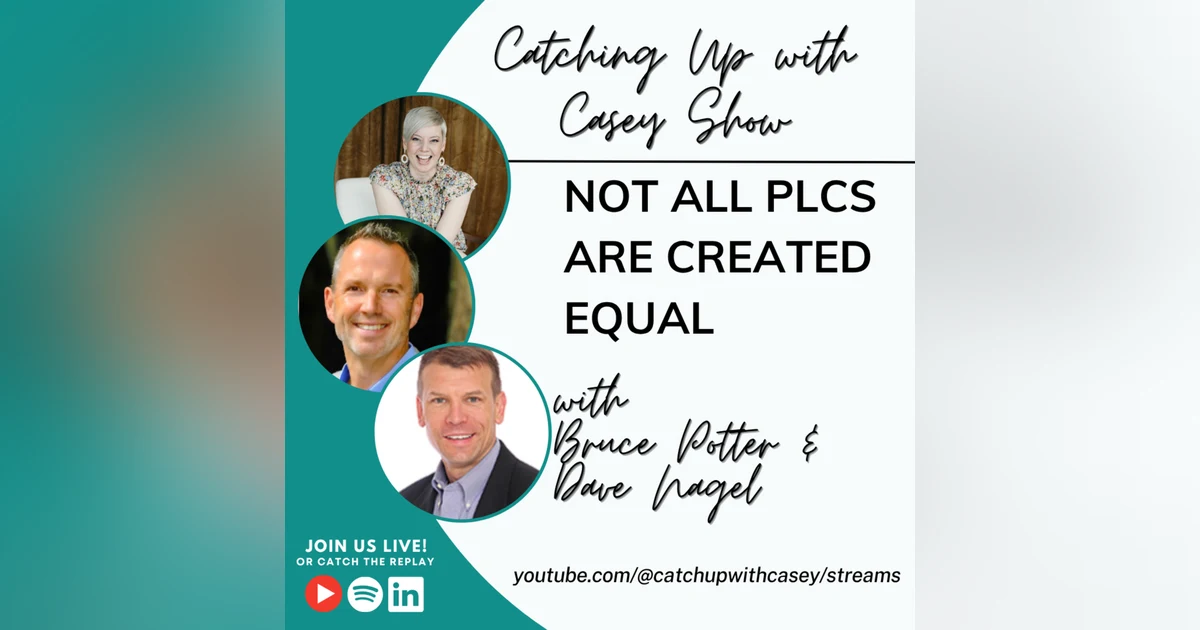
Not All PLCs are Created Equal with Bruce Potter & Dave Nagel


 RSS Feed
Not all PLCs are created equal. Some go through the motions, while others truly build capacity and improve learning. In this episode, I’ll be joined by Bruce Potter and Dave Nagel, co-authors of Grading Visible Learners: Learning with Fluidity, Not Finality. We’ll dig into what collaborative expertise looks like in action, why coherence, belonging, and consistency matter, and how leaders can create the same kind of clarity for adults that we expect teachers to create for students. Be on the lookout for their upcoming book mentioned in this episode!
www.centerforcollaborativeexpertise.com
Your teams are itching for CLARITY! That can be a complex thing to provide. But I have a framework that guides you to do just that– gain and create clarity! www.catchingupwithcasey.com/claritycycleframework
Need help getting your leaders trained in a purposeful way? https://www.catchingupwithcasey.com/identity
Ready to build the habits of a clarity-driven leader? Get The Craft of Clarity book!
Subscribe to my newsletter to get the resources mentioned in podcast episodes! www.catchingupwithcasey.com/newsletter
0:02 Welcome to the Catching up with Casey's show. If you are tired of chasing buy in, frustrated with teams who can't seem to get on the same page, or over the constant struggle of holding people accountable without micromanaging, this is the show for you. I'm Casey Watts, speaker, author and the creator of the Clarity Cycle Framework. I help leaders just like you take teams from frustration to alignment, so teams can work collectively toward a common purpose in a committed way instead of against each other as though they are functioning in different organizations. And we do it all through the craft of clarity. Whether you lead from the middle or you were the front facing leader of your organization.
0:45 On this show, we bring clarity to the seemingly small things in leadership that make the biggest difference, because clarity precedes capacity. Now, with all of that said, let's dive into today's episode. Hey everybody, welcome to today's episode. I have with me Dave and Bruce. I'm just going by first names here. We're going to make this super personable to get started, OK? And we are talking all about PLCS.
1:27 This podcast episode is going to go on the All Things PLC podcast playlist that will be included in the show notes. So you can access that and see all of the episodes that I have that have to do with PLCS. So the title of the episode is Not all PLCS are created equal. So before we get started diving into this conversation, I'm sure people are wondering, who is it that I'm really talking to? So, Bruce, why don't you start off and tell us a little bit about who you are and the work that you do? Fantastic. Thank you, Casey. And 1st off, why? You know, I'm a big fan and I think you're an awesome follow. And so Bruce Potter, I'm a retired school administrator from New York State. I've been an independent consultant with Corwin Press for five years now.
2:14 Dave and I are the co-authors of Great Invisible Learners and our latest work, which we believe you know why we're here today, is developing collaborative expertise teams, also published by Corwin. And we really center our work on clarity and from personal lessons. I lacked clarity as an early administrator. You know, I'll be vulnerable and humble and say I've learned more from my errors. Was really excited in the mid to 2000s with attending a conference with Rick and Becky Dufour. And I ran back to my district and just started running with it. And I knew where I was going, but the the my school in the district did not have the clarity of where we were going.
2:54 So when you don't have clarity you you tripped often. Yeah, yeah. Not only that, other people tend to trip also. OK, thanks for sharing, Bruce. Dave, what about you? You're on mute, Dave. Yeah, we can't hear you. For some reason, we can't hear you. We heard you before. I'll tell you what, Dave, you might have to pop out and pop back in. OK, it's funny. So Dave came on and he had like no background at all. And then he started changing his backgrounds and I was like, wow, we're we're getting some really cool backgrounds.
3:36 When you, if you are watching live, like on YouTube or LinkedIn, you'll see the different backgrounds that he had. But I want to be in the. I want to be in the background that he has right now. That's a good look. There, Dave, can you hear me now? Yeah, we can hear. You I know what I did. So I I had the so much more information than anybody listening, but I had it and I created a new window and I think that's what pumped me out. So yeah, that's just a screen background that I grabbed. So that's not exactly where I'm living. But case of your question again, honored to be here. And and when you talk about clarity, it's something that respectfully in our profession, whether I'm a leader or I'm a classroom teacher to realize that it's for us, yes, we want to share clarity with our staff. We want to share with our students. But when we have clarity, we're so much more effective and efficient at what we do.
4:20 So my background was kind of brought us together today. I was a administrator, a very large district in Indiana, and I started working with a guy named Doug Reeves at the Leadership Learning Center and in 2003 started partnering with him and in 2008 became a full time consultant. So I've been working with schools now coming up about 18 years, authored several books, one with Bruce on grading visible learners, which I'm exceptionally proud of. That has a lot to do with clarity. I was a thought leader on the PLC plus work. And I've always had a passion really about two things, grading practices and PLCS for several reasons. One, respectfully, I think grading practice is the one place to either augment or derail everything else we do. And secondly, if we're going to build a culture of expertise or in a lot of the schools that I work with, having done visible learning work hand in hand, working with John Hedy and that that piece, visible learning is never going to come to life unless there's a collaborative structure.
5:09 So what Bruce and I put together here are what are the elements that are clear in the empirical research that are independent of any model. You could have the Rick Deforest model, you could have ARM or PLC plus Steve Ventura has them. There's a lot of models and all of them are great. But what are those elements that go back to what you said that really aligned to clarity of our norms, clarity of our instruction, clarity of how we're going to build and monitor relational trust? So excited to be here today and looking forward to the conversation. Yeah, I cannot wait to get my hands on this new book. We're going to talk more about it, but before we do that, I, I want people to be able to relate with you guys on a very human level. So what is it that just makes you just authentically, uniquely you as a human?
5:57 Can I go first? Go for it. It's right there. Ah. The Colts are four and one in the AFC. I'm going to have some fans who are not fans of the Colts, but season ticket holder, which my wife likes getting me out of the house on Sunday. Doesn't like the cost. But I was thinking about that when you said what makes me unique. What makes me unique right now is I got a team that's actually in first place, not in last. Nice. All right, So it's football, right? That's how much I know about sports. Yeah, you know what for call you sake, you're right there. That's. That's baseball, right? So for me, AC, honestly, I'm humbled to know that I'm not the most important person in my home. I have a beautiful wife, two boys I'm incredibly proud of that are college athletes and and student athletes. And you know, I've had some some successes throughout my career that I'm incredibly proud of, but when I walk back through the door, I'm humbled.
6:56 My wife is a kindergarten, first grade, special education inclusion teacher and every single day I live vicariously through her. Yeah, yeah, that's awesome. It's so interesting to to know so many people who are in your positions, that so many family members are doing something, something inside the school. And I think it, it keeps it really honest and real. For us. The conversations are just life giving. OK, We're we're talking about how not all PLCS are created equal. And this show is all about bringing clarity to the seemingly small things that make a big difference. So I want to start off by you guys explaining what we mean by not all PLCS are created equal.
7:46 Let's bring some clarity to that. Can I start, Dave, with the fact that I want to pick up on a podcast that you had recently, Casey, where you had your quote, UN quote rant about meaning of I think this at the time you were referring to fidelity and I what we focus on is we can't have anything if we can't, we don't have a shared language of learning that's Co constructed by the people we're working with. So Matt, when we say something, everyone involved needs to know what that means. So that's really at the the heart of our work. And I'm going to I'm going to hand it off to my buddy to talk about our three components. Uh oh, Dave, we can't hear you again. Wait, what are you doing in the background there? Well, we now have two commonalities. He's played with the background twice and at both times he's gone mute.
8:46 So I'm not going to let that hang. So we we talk about strategic coherence, belonging through empowerment and consistency of action. And it you know, to to give credit where credit's due, coherence, belonging and consistency gain what was learned through the new teacher project of all of the schools. So there's 51,000 registered elementary and middle schools in the United States, 28,000 of them, the students aren't proficient. So when they dug deep into the research, 5% of them had a commonality of how they were what we would call visible learning evidence. They were accelerating student learning about a year and a third for every year of instruction.
9:30 And they had three things in common, coherence, belonging, consistency. And what we've, what we and Dave and I have done is brought that down to the, to the PLC process of the strategic coherence is how are the district goals, the building goals, your PLC goals aligned to what I do as a classroom teacher each and every day. There's there needs to be an alignment. And it has to be we do you are X public school, you are X private school. We do this whether it's teacher clarity or a specific curriculum, but you work here, you get the check from us, you do this. The blogging through empowerment is all the stuff that teachers are empowered to make the decisions. Administrators don't teach. So there's so much ownership where teachers have have say. And Dave and I, one of the things I think that's I don't see and that's so unique, but what we really have brought to life throughout the book is we've looked at all types of fields.
10:25 So it, you know, whether it's Google or, or some Zappos or some other company, they work in project teams and those teams are high functioning because they're invested and have say to how things go, but they do it within what the company says. And then it's the consistency of action. How are we monitoring anything we say is important. Otherwise we're just leaving it up to luck that it's going to get done. Hand it off to you, Dave can. You hear me now? Yeah, we. Can hear you perfect. So I I I was my microphone was showing up on my phone and they were connected and I was like, I don't know if that's good or bad. So I turned my phone off so I'm not touching anything. So we good the rest of the time. I'll just pyramid a little bit off what Bruce said. This goes back to the point case you were talking about in our in our pre session around leader clarity. As leaders, we need to communicate this to staff and I've seen it in Bruce's school.
11:14 I've seen it in others because you mentioned teacher clarity. It's one thing to say that it's another thing to say that we're going to use the exact same terminology and we're going to share it in a similar way and make it accessible to kids in the in the similar format. And that's critically important at any school that has any type of departmentalization and and Bruce's building that he just left, they were departmentalized starting in second grade. Some schools that doesn't happen until 5th 6th, etcetera. Even it's in the self-contained environment. It matters, but if kids are having teachers literally and metaphorically touching them over the course of the day, we have different terminology we're using or different methods of how we share things. We are just asking for an additional piece of cognitive load. And I use a lot of sports metaphors not because I I think that it's a good place to go because I think that makes sense.
12:01 We would never allow at a high school that a freshman football team or JV football team would have different terminology or be communicating certain ways to how we instruct on how to make a certain block or a move different from one coach to another because it's their independency. Now there's a certain thing that we align with and I've seen it happen. I heard Bruce's teachers mention this in several other schools I'm working with. When teachers know their colleagues are following through on things, they follow through on it. I think 1 not just because they feel like they need to keep up their out of the bargain, but because they know what's being supported. If I know the kids I'm going to get second and third period are getting the same terminology around clarity, They're using the same learner dispositions, then I actually feel like my efforts are meaningful.
12:44 It's just like when a teacher says, why am I finding the cell phone if my colleagues aren't it's, it's a fairpoint. Why am I following through on this clarity of my colleagues? Aren't it it absolutely it's it's it's a just it's that tipping point that Malcolm Gladwell would talk about is that at that point, right when we know there's a certain amount of my colleagues that are following through because it's been made clear. I still get the empowerment to do it on our own and we as an individual PLC, but there's a consistency that we count on with each other. I think that tremendously takes a load off teachers minds and at the time where teachers have always been overwhelmed, overworked. No one's questioning that. But I think even more today, it is a breath of fresh air and I think just an opportunity for them to see how this collaboration around these points is really effective because we know our other colleagues around the school are doing the same thing. Yeah, I worked in a charter school for a long period of, So I think I was a teacher there for 11 years and phenomenal school.
13:43 And we had interns, like college interns come in and they would come in four days out of the week to observe. And then during their classes, during their lab classes with professors. A lot of the time what they would say is, well, yeah. But in a real school, well, yeah. But when I go to a different school, it's not going to be the same. It doesn't work that way. But what made it, what made our school so dadgum successful is the consistency and the clarity from one classroom to another and from one grade level to another, kinder all the way up to 5th grade, same language you're going in and seeing the same practices. We had autonomy and how we brought ourselves to at the instruction and the lessons and how we interacted with students.
14:26 But my goodness, our learning was so focused on those commonalities that the practices that were happening in our classrooms, that there was no questioning what our school was about or what it was that I wanted to focus on as a teacher in my improvement. It made just such a massive difference. But I'm so curious to know where you see people pushing back on this, like specifically PLCS, because there's always a different idea of what are PLCS and different ways that people are pushing back on it. Why do you feel like that exists? Well, Bruce, if I can speak first, I think it exists because of the lack of the things that we've talked about so far, which is 1 lack of coherence and a clear expectation of what things need to be part of your collaborative efforts and, and your collective efforts as a team.
15:17 I think secondly, then to your point, and you use the word autonomy, we use empowerment and belonging. There's either too much micromanagement or it's for lack of a better term, the wild, Wild West. And in both of those situations, teachers cannot be effective and efficient. When we have and, and, and I've often used this and I did it as a leader, I think it has to start with a boatload of expectations and a boatload of front of what the expectations are and expected and then three to four boatloads of support. So here are the things you have to, I'm going to support you, but you're going to get the time and the ability. And there isn't a perfect system, but there isn't an expectation that as you guys develop clarity, we're going to use this terminology in this hour and share it with kids. I think when teachers know that path, rarely will you get pushback.
16:02 Now there's always going to be a handful of folks. Don't tell me what, don't tell me what to do. Would you please just tell me what to do? So sometimes that happens, but I believe that happens because they haven't been in an environment similar to what you described. They they haven't seen how it can be nurturing and empowering. But I believe even as adults, because I know I'm the same way, I want to know what the expectations are and I actually don't push back on them as long as they're consistent. Bruce. So again, I just going to keep leaning on the word clarity. So what we have done, we have a, a framework model Casey and and one of the frameworks is relevance to role. Why am I here? Because for some folks going to APLC meeting might be like going to the dentist.
16:46 It's like because teachers, I haven't heard a teacher anywhere say I have extra time. So, but really the PLC meeting done correctly should be the best meeting of the week. We're, we're, we are learning from our peers about student learning and we're learning interventions and strategies and we're moving learning forward. But there's a lack of clarity as to what are we doing here. So one of the things that's, you know, coupled with this is not only having a relevance to role as to why I'm here, because there needs to be an intention, rationale and success criteria for every adult meeting too. So it's not just for the classroom, it's for the adults. So we talk about that in our book. We've instituted a lot of these things with schools we work with, including the, the school I recently retired from.
17:27 But also what's the success criteria? Meaning, what does it look like to work collaboratively in an, in an effective and efficient manner? Because we only have X amount of time or who's doing what. So we, we found it very effective to Co construct, you know, for lack of a better word, the rules of engagement. So what does professionalism look like here in this building? What does communication look like? What does trust look like? What does feedback look like? Because we're going to need those 4 components for us to really roll up our sleeves and do the work. But it can't be well, why so And so got a face on or I can't believe they said that to me or I didn't. I thought I just had needed to show up. I didn't know I had to bring this.
18:07 So we, we really talk about those types of things to define what it is to be effective in APLC to basically just every level playing field as to what's expected of us. There's, there's an entry point for everyone and I, I talk a lot about in my book and, and when I'm working with people, the the master experiences that we have to develop over the positive master experiences that we have to develop over time to, for lack of better word, negate the negative master experiences that people have developed because of their past experiences and things like that. But I so tell me a little bit more about I want to know again, the title of the book.
18:52 I just we're just going to repeat the title just so people it is like really clear in their minds and when it's available, it's the first thing they're going to purchase. So title of the book first is. Bruce. Developing collaborative expertise teams through coherence, belonging and consistency. It's for WordPress, and it'll be available anywhere between Valentine's Day and Easter. OK. And you've mentioned those 3 terms multiple times here. Can you give us a little bit of insight into who you wrote this book for or who you wrote it, who you wrote it for and what, how they might approach the book?
19:35 Are they approaching it just individually as a reader? Are you thinking they really should approach this book with like, their instructional leadership team? Yeah, So I'll go ahead and, and take a stab at that. First, Bruce Casey, appreciate the question. I I think to your, to your point, it's that second one, it, it is a leadership book, but I want to stress that that that is not administrators as an individual teacher who's working on APLC, is it a bad resource? I would say no, but it really would be designed to say how do we look at our whole school improvement plan structure with collaboration needing to be an element of it. And then when we talk about what our coherence is, what are those main things that we're going to establish around one of our frames is what we call Tier 1 instruction. And so we kind of set up because for there are some things that should happen on a regular basis within APLC meeting, like we should on a regular basis examine student work and evidence that didn't say we bring student data every meeting, but with that should be a part of it. But what has to be a part of every meeting is that the adults are learning.
20:34 And what are the current professional learning initiatives, professional development initiatives in your school or district? Because a big mistake we have made as a profession is not aligning professional learning to professional learning communities. And I know that seems like such a novel idea, but how often do we have yourself or me or Bruce come in and we're working on feedback or clarity or scaffolding or fill in the blank and not one aspect of the next six or seven PLC meetings ever comes back and addresses it? I feel that's like, you know, I, I teach my kids a lesson on, on fractions, but the next day we talk about sharks like we would never like we have to look at the PLC as a classroom. So one other point then I'll let Bruce jump in again, though, anybody that's in that role of leading regarding the work, it could be obviously district leaders, building leaders, but sometimes those instructional coaches and those folks that are touching a lot of different teams and a lot of different groups to help them build in.
21:29 Because you described a second ago authentic norms that move well beyond on time, prepared, respectful. No, it's how we interact with evidence. It's how we build trust with each other. But one of the point, I don't want to get off off task. Tier one, professional development are the ones that we don't have to overthink. We don't have to do any analysis. No, we should have teacher clarity. We should have feedback. We should have high level scaffolding practices. We should have things that help students belong in our classrooms. Those things are a given, and one of the things we talked about in Chapter 1, or What are some of the highest level effects from John Hannity's research Tier 2 professional development is when teachers need a little bit more support, and we talked about the difference between blame and ownership.
22:13 Just because our teachers aren't implementing things at the highest level or with effectiveness and correctness doesn't mean they're doing anything wrong or that they're trying not to do that, just like in a classroom. So we have multiple supports to help teams and teachers get better at the things that we said, like teacher clarity, etcetera. What we would call Tier 3 professional learning is very specific. For example, if there's a new methodology to how the next generation sciences assessment is going to be given, I don't think the art and English teachers need to go there. So we make sure, as Bruce mentioned, related to relevance, we look at the professional learning that should happen in our buildings and how we build it in systemically and systematically through that PLC structure.
22:56 Bruce. Thanks, Dave. And picking right up off of that is being a leadership book, not necessarily administrator book, is how does your school improvement plan and your collaborative structures get implemented? So in one of our frames, teams of significant impact, like so there has to be Shirley Hoard German. You know, the first characteristic is it structural conditions. When, where, when is that time and space? But sometimes we just get caught off because administrators and school leaders, they're very, very busy. We have teams by default, it's the third grade team or it's the math department. And when we talk about teams of significant impact is someone being of a conductor of the orchestra being able to move and manipulate schedules and or staff members to get the right people in the room for the right topics so that there's that flexibility, not that you're switching teams every week. No, that's, that's the last thing we would suggest. But sometimes in order to, to move learning forward, it's not just the team by default.
24:01 So when is an interventionist going to meet with with certain folks or the school psychologist and but you only have one, so they can't be in everybody's meeting. So organizing those different faculty for so that we can construct teams of significant impact is really important. But that would be a leadership function. And then also we, which I think lends nicely to one of our other frames, cognitive diversity. When teams are struggling with analyzing the data or being creative in solving a problem, they just keep doing the same thing over and over. That's really not necessarily their fault. We've dug into it. John had he turned Dave on to it and I'll allow him to expand upon it.
24:42 But thinking processes is something is innate to us. You have a team of four or five teachers analyzing that data, but if they don't have the analytical thinking processes, then they're not going to be effective in doing it. We can get frustrated with them. We can say you haven't made decisions based on the data, but that's an actual thing, Dave. Yeah, So Reynolds and and Louis and there was a 2017 Harbor business review study looked at the most effective teams in in industries and they found cognitive diversity needing to be paramount. They, they solve problems faster, they're more innovative. And So what we developed is a simple instrument that at least gets people to think about what are their strongest and maybe what are some of their areas that they're just not as strong with when it comes to thinking and solving problems. And I want to stress a very important point. It is completely unrelated to anyone's age, millennials, Gen. Z, Gen.
25:38 XS. That has nothing to do with how we might solve problems. So as Bruce mentioned, we might have a group of five individuals that they just lack analytical skills. That doesn't mean we tell them you guys don't have to examine your data, but we might support them a little bit more. We might have a team that has analytics and everything else, but they really struggle with they just they don't have the creativity process as a strength. Well, no wonder they sometimes think, struggle to think outside the box and sometimes, and we've already worked with a few schools where it's like, OK, that makes sense that that is why they hit that roadblock and they're the most well intended people. They would do anything for kids, but we now know where their strengths are and it's no different than an assessment with our students to go, OK, I need to support this group of kids just a little bit different with some front loading scaffolds when we jump into a reader, etcetera.
26:24 Because I know when they have that they've got a better chance to be successful. So we've designed an instrument that could help teams be aware. I do want to speak just for a moment because Reynolds and Lewis followed up their study. What they found is that cognitive diversity is absolutely critical, but it doesn't mean anything unless there's relational trust and relational trust will kill all of it. And a quote from their Harvard Business Review study that we cited in the book is you can eliminate and diminish relational trust for a long period of time with an I'll time. Sigh. The body language that we give to our colleagues. And then we consider that like Maslow's hierarchy of needs, food, shelter and safety. You got to have it those bottom level behaviors that are absolutely that doesn't mean Bruce, come on, I'm I'm struggling with that. Tell me more that that that doesn't make sense. That's not what we're talking about. We're talking about Bruce shares an idea and I'm rolling my eyes and I go here we go again.
27:14 If that is not addressed, doesn't matter. You could take Hattie research the best to set all those things. So we kind of model in in two chapters back-to-back about the need to examine cognitive diversity in a very intentional way. But be reminded, if we're not monitoring relational trust and psychological safety, which we know matters, and that matters even more teacher to teacher, that it even does admin to teacher, we're going to we're going to miss the mark and all the other things really they don't matter. And that goes back to, you know, the, you know, why we're talking about this, Not all PLCS are created equal. And it's not meant to be like this, this giant hurdle to overcome. But it's these little nuanced things that really just get in the way of moving the the work forward to improve student learning.
28:03 So, but unintended, whether it's relational trust and psychological safety, the tier one professional learning, any one of these can really inhibit the types of results we want to get. And then again, if folks feel like you're just wasting my time, I have so many other things to do. And then it's it's like going to the dentist. Yeah, go ahead, Dave. Well, I was going to say, I feel like we, we almost to a certain degree, buried the lead in some of our conversations because the the premise of the book is all about how we develop collaborative and collective expertise within a school. One of the examples we talked about and John had, he wrote his paper back in 2016 about the politics of collaborative expertise. As adults, as humans, we, we see people out with expertise all the time.
28:49 We might seek out a plumber, we might see got a landscaper. We want them to have expertise, but what we pay for is the result. You have a legal issue or a medical issue, you cannot pay for a result. You pay for the expertise. And that's where we need to move in our profession, that we are taking the expertise that is there in certain pockets, in certain areas and make sure it doesn't stay in the vacuum and expand upon it. Because we're not guaranteeing the result. Which is why when we leaned on the New Teacher project, we saw schools that are making 1.3 years on average growth for all their kids sustained for 10 years. That wasn't a flash in the pan, but what they were doing was making sure they were harnessing the level of expertise that was in their building. I thought, Casey, about your opening question about PLCS not creating equal.
29:33 I think we have to face an honest reality and it's not a critique. Not every teacher is created equally and we sometimes kind of have this, that we all teach third grades for all of us. We're all proficient to a certain level, but we probably wouldn't be in the buildings we are, but we don't have all the same level of expertise in an elementary setting. I could have a group of teachers that are phenomenal at supporting kids if they struggle in math, but not if they need to be enriched. And maybe language arts, it's, it's different, but the next grade level, it's actually a mirror opposite. So how we create those intentional opportunities to #1 identify it, but also scale up the expertise that's in our buildings. And that has to be done to some degree in our collaborative PLC structure.
30:14 And it has to be super intentional. And I would assume that that's what your book is bringing to the table is a certain level of intentionality behind how people are collaborating. And I so often when I'm working with teams, one of the things we talk about, oh, this is this is a fascinating piece. I'm always fascinated by this and I'm always, I'm not surprised by it, but I guess fascinating is the word to lean into because I'm not shocked when I hear the response. But when I go for campus analysis visits, one of the things that I'm doing is interviewing staff and I'll interview teachers and say, tell me about how collaboration looks amongst your team. And almost always I'm getting the same responses.
30:56 It's usually, oh, we collaborate really well. And then I've heard further and say, tell me more about what that means. Well, we share all of our resources and we really, we, we get along really well. But that is vote collaboration, which is to say fake collaboration. That's not true collaboration, especially from what I'm hearing from you guys is like Dave, you were talking about, we've got to be able to have the deeper, more meaningful conversation. Sometimes that requires us to push back a little bit or to question things or to share an opinion that's maybe a little bit outside of what we're hearing from other people. And also, I think as leaders, sometimes we assume that because we're working with adults, because they're adults, they inherently possess the skills to collaborate well, but we don't. No, everything's surface level.
31:54 It's, it goes back to isolationism and just things are well enough, you know, we're OK. And I think, you know, that's that's a horrible spot to be in. You know, mediocre is the enemy of excellent. And but without the conditions for that to happen, none of it's going to happen. So Dave was talking about scaling expertise and I think that directly ties toward our Tier 1 and Tier 2 professional learning, but also directly impacted if there's no psychological safety and relational trust, like why are they in my room doing my walkthrough? Why? Why would that? You know, so all of these things have to be in place and but we have to have the clarity of what high quality looks like.
32:40 So what does high quality teacher clarity look like? Whether you're a what, why house school or a learning target and success grade here, wherever it may be, what does that, what's what's high quality look like? And then we have to, you know, using student voice as evidence of this happening and being implemented with, with fidelity and effectively, it's not just, well, I had all of mine up. Well, what is the colleague next door doing whose students can articulate at a conversational level what they're learning, why it's important today and how they'll know they're successful in their next step. And only 20% of your kids can. So that's the consistency of action. So how are we following up to, because it's not just, oh, everybody's getting teacher clarity training at the beginning of the year and great, we did it. So how do we know it's actually being done effectively? Because all of Hattie's influences are wonderful if they're implemented effectively.
33:36 Otherwise it's just busy work. Yeah. And and that got me thinking, one of the value adds we we created was many different examples and instruments that schools can use to just see where they are with certain pieces. And we tied several back to Shirley hordes. 6 elements of an effective PLC and the biggest one that sometimes schools mess respectfully is structural conditions. So how much time you actually have? And I've been using the metaphor and Bruce knows it, but but we moved a couple years ago to get closer to the high school and we have a similar square footage, but we just have an older home that has a lot of, it's got less open spaces. And so we will look at something. We can't do that here. You can't have that in this room.
34:18 It just doesn't fit. That's just is what it is. And what I'm getting at is helping leaders and individual PLCS be empowered to say, when we look at our calendar and schedule of what we really have for collaboration, what makes sense to fit and then what's most important. You know, there are some schools we work that have collaboration every day and they're not effective. So more time in and of itself doesn't lead to that. But making sure that what we have in place, what we want to accomplish fits into the structure we have and fits into the structure where people are. Like a lot of the schools, if we have early release, late starter, there's just non student time that opens things up because Casey could be on a different team and say for the 1st 20 minutes, we wouldn't need you. But gosh, if you could be in there in the middle part of that meeting.
35:03 If we're meeting during the school day that that that just changes things, which is not a problem. But then we react and excuse me, we respond, we don't react. So we build a plan that is conducive and aligned to the structural conditions that we have. The other thing I wanted to mention is we really believe passionately in Deep Inquiry PLC Plus has five guiding questions. We didn't create 5 because of the four model only had four. Steve Ventura has questions with his model achievement teams, but what we created was an element of how you use those guiding questions, whichever they are to drive dig deeper, to dig deeper into inquiry. And so we've really created no matter what your PLC structure is Brick Force PLC plus you have created your own. How you use that structure to dig deeper into inquiry to think about your structural conditions. So nobody has to unlearn or think that they have to recreate the wheel or throw the baby bathwater, toilets, toilet seat commode out.
35:59 No, where are you that these are the pieces that would need to be in place anyway That is independent of anyone true model. Yeah. Can I ask you guys a question that I feel like I get from a lot of listeners or people that I'm working or specifically if when I go to present at work or conferences, one of my breakout sessions is all about aligning PLCS. And I've gotten to a point where I have to say in the beginning, there are certain things we're not going to talk about in this session that I think you may assume we're going to talk about. One of those things is agendas. I just would love for you to share whatever comes to mind when you hear people asking about agendas and and I think that kind of goes to the point of it can't be a once like PLC is not a one-size-fits-all. They're not all created equal.
36:55 But I think people want to try to fit it into a box because it makes it easier. It's just like a box curriculum. I want to be able to pull it out turn page by page, but I just want to hear your thoughts about that for our listeners. Yeah. So Bruce, I'm going to take a quick stab and then you can jump in. The first one is, is prioritizing what's most important. So for example, I was just in the school last week. Teacher clarity is a big piece. What I challenge the leaders on is to say, OK, your teams have X number of meetings between now and Thanksgiving. I would highly recommend that they they submit their agendas and at least 35% of their time is devoted to teacher clarity. That could involve creating them, examining them, critiquing them against an assignment, trying to create them for surface deep in transfer or setting a timer for 15 minutes and the conversations around how's clarity working.
37:45 But we don't do enough of those very productive meetings where we learn and gain insight because we didn't produce the tangible product. So that's one piece is this. That doesn't mean 35. We got a big assessment on that one, but we look as a whole of how we build that in. And then the other thing that I've done, because we've all been in meetings where the agenda either isn't created or we haven't revisited it, but at the start of that meeting, we look at our agenda topics and we actually devote, This is a novel idea What, what amount of time should that take? That should take about 15 minutes. That should take about 12 minutes. Fine, set a timer. The timer goes off and we feel like, yeah, we need a couple more minutes, but don't just create a task list, create a learning list of accomplishments that you want to have. And every once in a while there's the nuts and bolts pieces.
38:30 But how much time should that take? And then prioritize that. So we're at the end of the meeting, come heck or high water, what was most important we accomplished and the timer goes off with 7 minutes to go or some we recap. We don't rush. All right, Bruce, get your thought out. What did we learn? What's our next step? So there's a sense of closure, which was back to my point, something like as simple as an agenda can be so empowering. But we have to remember that PLC teams cannot be all things to all kids for all standards, all with if time was limitless, fine. But since it's not, that agenda needs to be an empowering document, not just something that we check off or we throw into the Google folder and say, see, we did it, Bruce. Honestly, to Dave's point, that's, and again, well intended folks, but it, but it begins with, you know, we talked about Dave and I were in a district a couple weeks ago together. The principal was supposed to be the instructional leader. That's all well and good until the front door opens and then it's it's mayhem.
39:34 They're they're a manager, they're dealing with kids. There's somebody's parent called and how can so to really be an instructional leader, they have to be the conductor of the PLCS. The principal and instructional leaders need to be the teacher of teachers or teacher of teacher teams. So what is it? They are learning and doing or learning by doing with the work so that we all know if they're moving the learning forward. So again, it keeps going back to that clarity. But one of the things with the school that I locally that I'm invested in is we really broke it down because of the folks with a lack of clarity think things are just one more thing. So everything's been aligned from Nope, this is our focus. So we talk about teacher clarity. Well, OK, well, it's clarity of organization. All right, well, what are what are your priority standards? What are we teaching?
40:29 Then what are the learning progressions? What are the temp holes? What are some potential misconceptions? OK, now let's get some learning intentions and success criteria. Now you're going to teach. So now we're going to gather what's the evidence of student learning? So those are actual topics. But to Dave's point, they may need 5 minutes to talk about the field trip, but you're going to set certain time for housekeeping or what have you. But the bulk of the time needs to be on your learning about what your students are supposed to be learning. And they may be organizing, it may be determining assessments, it may be analyzing evidence of student learning. You know how we're intervening, whether it's win time or MTSS, but it's all about moving the student learning just through that process.
41:16 But if we don't back to something Dave mentioned earlier, it's got to be through an inquiry process and having those strong guiding questions to go through the work. But as far as the agendas go, the bulk of it's got to be on the focus. Otherwise the drift again, well intended people. And then you get the add on about, oh, what about this? And then next, you know, it's what are we going to do about those school pictures? And no one. And we didn't, we didn't talk about anything. So if I could just add one, one element in there because it really caught my attention. And this is where we think we're hoping to empower leaders that they know how as Bruce mentioned, some degree they don't have to play the instruments. They got to be able to conduct the orchestra.
41:58 If you take my kid on a field trip without a permission form, that's a tort liability. So to so to say that should never be a part of APLC conversation, I think is insane. But encourage the nuts and bolts pieces to have a place. So no, but you know, that has to happen. But something that I hear because Bruce, I, I thought when you said this, well, PLCS aren't supposed to be planning meetings. The heck they're not. They should be instructional planning meetings where we talked about the learning intentions, success criteria, do our tasks align? Is that the right amount of rigor? I would say that we shouldn't use our, our limited PLC time to cut and staple and paste and those kind of things. But what happens is that message is, well, it's not a planning meeting. Well, hold on a second. It should be an instructional planning meeting. What I did with my PLCS and I coached, this was the point I want to make out is I wanted continuity. So I would say I need to know your next 4 PLC meetings and you can't change them.
42:50 You can't change your plan without my approval. I always approve changes, but I wanted to make sure that they thought intentionally about, OK, not just today's meeting. All right now would have like there's some continuity just like you would ask in a Lesson plan. And as a leader, it helped me be involved because they grabbed me in the hallway and say, hey, we, we're doing expires, we're going to move. Sounds great. It actually gave me the ability to be more involved. I didn't say in perpetuity, but I didn't want them just creating a schedule that they didn't really think through because sometimes I would respectfully push back and it was guys, you got too much on your plate. I think it's awesome that you're doing that. But let me help you prioritize, but have some to your very simple question, Casey, but a very important one, agenda. I, I think it's more our instructional Lesson plan for PLCS.
43:38 Just like ask teachers to do a agenda for their classroom. No, we want you to have a Lesson plan. I think it should be viewed with the same lens and sometimes it's the same lesson that's going to take a six day and 23 hour break. So it's this week and next week's meetings that are really kind of connecting. One of the things I just want to add quickly, not that you don't have a, you know, necessarily a plug for our other book Grading Visible Learners, but you talk about the planning. One of the components we talked about in Grading Visible Learning is using success criteria as the catalyst. So a team of teachers, teacher collaboration is a core practice. Well together, whether it's the third grade or the math department, they should be mapping success criteria as to what does success look like for mastery. You know, everybody's different and somebody may participate or versus not or their homework was late, but you can't argue that this is mastery work.
44:35 So it's B plus to an A like that that, but if you're not collaborating on that, then it then you don't then you lose the fidelity of what success looks like for our students. And then that should all go back to how we organize our stuff to then instruct what strategies. So it's all tied so. You know, I thought of their there was almost a moment like like in the Truman Show when remember it was like you would pull out a book and say, just letting you know we have this product too. If you really want good coffee drink folders. I always live my life and I know a movie that that reminded me of anyway.
45:17 That's how I am with songs. I, I live through music, so I have a song for everything. You mentioned, Dave, I think this terminology is really important because we talked about, so you talked about lesson planning, like the idea that lesson planning doesn't happen in PLCS, but OK, they do. It does. It's we're a professional learning community and we're talking about lesson, but you use the term instructional planning meetings. And I think that's the big differentiator that needs to be communicated to leaders and staff is what the difference is between lesson planning to come around, just all of the resources that you're going to use and lesson planning, thinking about the actual instruction that's taking place.
46:01 For sure. And like first mentioned what, what to just add just an ounce of clarity there. What we're saying is we're going to create our success criteria and then we're going to examine our tasks. Like when I have an example from when my kid was much younger and the teacher asked to write another name for 1/2 and he wrote half HALF. And the teacher said, we talked about this. I was looking for a fraction. It's it's a nice fun example. Teacher wasn't trying to do harm. But my point I make is I'll ask teachers if they like to be told what to do or how to teach. And I never see a hand go up. Then I said, we got to be careful of letting Houghton Mifflin or Pearson or teacher pay teacher tell us how to assess, thinking about our true criteria and our learning intentions, lining up with our tasks and saying, we're going to use that worksheet task assessment. We're going to tweak that.
46:48 We're going to take those those elements off. We're going to, we're going to tweak that rubric because it doesn't fit our needs. That's instructional planning. And then when Bruce mentioned success criteria mapping, I use the metaphor, if I, if I ran into you coming out of the store on a Saturday and listen, as a teacher, it's your free time. But I quickly asked, hey, what does my kid got to do in your next unit to get an A or AB plus? And the only answer I will not accept is, well, he has to complete his work and do it on time. I won't accept that he has to understand phenotype what whatever those then that goes into OK, if they can do those things and that should equate to a certain grade. Do our tasks and assignments line up to that with their mind around the rigor? And do we have enough differentiation and scaffolds? Because far too often we confuse can't do it, can't do it yet at a grade level without prompting and support. In fact, that term that I just said is what a lot of kindergarten and 1st grade teachers have in their standards and secondary people need to bring it in. Don't say Bruce can't cite textual evidence. He can't.
47:47 He cannot do it at grade level. He's not ready for varsity yet, but he could do it with prompting and support. So we become better at making quality inferences. And James Popham has always said there's no such thing as a valid and reliable assessment. It's the validity of the inferences we're making. So case it, to your point, that to me is true instructional planning, or we're actually looking at the tasks and assignments before we put them in front of kids. Collaborative scoring after the fact is important. I would say looking at the tasks ahead of time because football coaches do it. Here's what we want out of this practice. Here's some drills. You know what? That drill's not going to work. Why would we waste our time doing it if PLCS get to that level? And quick story, I was working in West Dubuque, IA a few years ago. So their secondary folks and the contact came over and pointed at the chemistry teachers and they literally were crossing off questions and their teacher guide to say we're not going to ask that.
48:38 We went like just their ability to realize you have permission to do that and you have now saved yourself time and you have not given kids more unnecessary cognitive load when they're already overwhelmed themselves. And most of them care about Fortnite more than fractions anyway. So let's not waste time the instructional planning to your point when that's happening in APLC meeting, I just know you're having a lot less pushback and you're going to have a heck of a lot more productivity on the back end, which is students progressing more towards achievement. Can I ask you guys? We're going to start to wrap up I every every episode I have with guests, I typically say, yeah, we're trying to stay about 30 minutes.
49:19 I don't think I've met that mark ever with guests because I guess just get so wrapped up in the conversation and I love where where we go with it. But I, I want to end this episode asking what you might say to the people or the leaders who say we don't, we just don't have time to do this kind of work, meaning like we don't have time to set up or learn about collaborative teaming, etcetera. Bruce. So 2 points to that. You can't afford not to. You can't afford not to. So part of what and Hattie's research, but it was Vivian Robinson leaders investing in their faculty's learning and productivity has a .69 effect size. That's that's your job.
50:17 Then how can you make your faculty better because no teacher, no principal, assistant principal instructional coach is teaching. How do we maximize the talent that we have? Well, as Dave mentioned earlier, we need to scale that that success. We can need to develop that collaborative expertise. I'll tell just very quick one, I've been Superintendent two different districts. When I landed on my second one, I was on the job two weeks I had was inundated. There's five third grade teachers. I was inundated with emails and phone calls so that to request that they wanted this one specific. Well, not everybody could have missus solo.
50:57 And so so my job was to make sure everybody was as good as missus solo. And so, so as far as the leaders go, we had I think maybe 10 people do a peer review overwhelming the feedback was this is awesome stuff. Where do we get started? So Dave and I, we've created an online implementation guide that is free of charge that will go with every book. And it's a how to for every one of these frames, but it's more of a self-assessment because not everybody struggling with any of all of them or they're not excellent in all of them. We're it is your biggest entry point for to, to gain a yield and but it's, it really walks through and makes it, you know, we both lived it.
51:44 So something can't be a best practice if it's not a sustainable practice. So we feel this is very user friendly. Less is more. What's the highest yield? Yeah. Yeah. And I, I would just say a couple thoughts that are very congruent to Bruce's. The first thing is, do we want a school that's a bunch of independent contractors united by a common parking lot? No. Do we want teachers that feel overworked, overwhelmed and always stressful? Of course not. I've been in schools, in fact one recently, where the plan was teachers overwhelmed and let's just skip the PLC meeting. That is the antithesis of what we should do. What happens there, I think is a leader possibly who has a lot on their plate, doesn't necessarily know how to leave this work. And so number one, teachers need to use each other as when we do school capability assessments through the the visible learning structure.
52:32 One of these news, we ask kids questions about being visible learners and I'll always ask them, you know, what are you doing when you get stuck? And the answer I don't want to hear is I asked the teacher that should not be the first go to. We want them to use their peers. Other things. Well, it's the same thing with teachers when they see their peers as resources that is getting us way ahead of the game. The other point is, I said it last week, where do you want your PLCS to be by May of 28, even May of 27, but don't think of May of 26. And if you are starting and you haven't had things in place, then some of the incremental gains early are going to be around the affective side. And we put in a lot of very simple actions and strategies to get people going. OK, that makes sense. For example, a give one get 4, let's say there was one other person on the our group and we all taught biology or we all, even if we taught something different, we all teach middle schools, English, math, science, social studies. We could find.
53:24 What do you use to teach students how they if they struggle with how to cite evidence and argumentative writing or if it's the same content, What do you do for everybody? Bring a strategy. Everybody brings something. They do model it to give one get 4. And the whole point of that part of the book is we want people to feel like they are getting more out of these meetings. And also, I just think the more we create isolation and an already isolating profession is bad. Same time, if we put people in the room, they're overwhelmed, we give them a bunch of tasks to complete and it does lead to more work than it is detrimental. So it's not an or, it has to be in place, but we need to set up the right structural conditions. And what is an incremental game between now and the end of the year that gets us towards that target, whether it's mid 2728.
54:08 But I think in our profession, we often think way too often of every year as a hamster wheel, we're going to take a break because teachers work 80 hours a week. It's just they're paid time off in the summer. How is this going to expand over the next couple years to get to where we want to go? And we've created instruments with measurements and targets that are very realistic, so they are able to monitor progress and also know where their starting point is. I love it. OK, so the title of the book again is. Developing expertise teams, transforming schools through coherence, belonging and consistency through Corwin Press. Again, like Bruce said, Valentine's Day, possibly. I would say I'm going to guess closer to mid to late March, but before we change the clocks for the states that do, I think it'll be in print.
54:55 OK. And listeners, if you are part of my e-mail list, you will get notified about not only this episode, but you'll get notified about when their book comes out. So you can go and purchase it because that is a actually a perfect time to start planning for the school year ahead and how you're going to get this collaborative work started. And Casey and I was typing it into the chat, but I typed it wrong. Right now, they could go to the Center for cloudofexpertise.com and see elements and pieces and excerpts and elements related to the framework. Obviously not the whole book. So certainly resources. And we would be happy to entertain any kind of conversation as folks are just thinking about moving their PLC journey together. Bruce and I, obviously we love talking about this and it's been an honor to be on here today with you. Awesome.
55:42 Yeah, Thank you guys. And the everything that has been mentioned is going to be in the show notes. So you guys can catch all of those links here in the show notes to be sure to look for that. OK, guys, tell our audience like one thing that you hope they've taken away from this conversation, conversation today. Bruce, we're going to start with you. Pick your priority, let everyone know with the clarity, depth, Make sure everybody's on the same page and understands what it means, and then monitor its implementation. What does success look like and how do you support those who are struggling? I'm. Going to steal 2 quotes, one from one of my dear friends and colleagues.
56:23 I think one of the most brilliant men on earth, John Alma Rd. Too much, too fast, it won't last. So when we are teaching students, we're teaching adults. What is the right amount of information? And then when I got my masters at Butler and I've been using this as a mantra. Amateurs react and repair. Professionals prepare and prevent. So how you think about the things that are in place in your school like curriculum and there's a new learning on like there's things that have to be embedded into our only collaborative structure. We're thinking ahead of that. And so we're going, we're going to respond to things that happen, not just react. So yeah. Awesome guys. Thank you, thank you, Thank you for coming on the show and everybody that's listening, man, I hope you enjoyed it and let us know what was most useful for you here in this episode.
57:10 OK, guys. Thanks for coming. Thanks. All right. Bye everybody. Hey listener, I am so honored that you listen to today's episode and I hope you gained something valuable from it. I'd also be honored if you did ME3 solid favors. First, subscribe to this show. I've got a lot of great content coming up and I don't want you to miss any of it. Second, be sure you're following me on social media platforms. You can find me at. Catch up with Casey on LinkedIn or Instagram. And finally, if you were looking to book a dynamic and relatable speaker for your next event, conference, or retreat, I would love to bring a message about how the craft of clarity makes a significant impact on both leadership and life.
57:53 Until next time, always remember.

