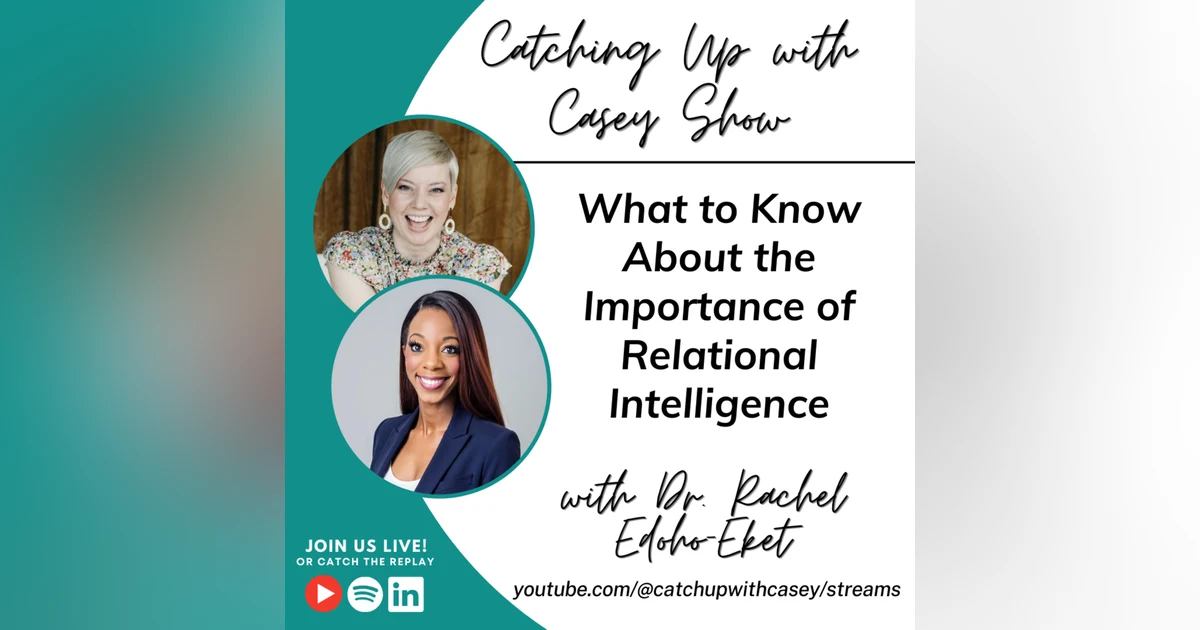
What to Know About the Importance of Relational Intelligence


 RSS Feed
**Sustain.** Are you struggling to maintain energy and connection in your leadership role? Dr. Rachel Edoho-Eket, School Principal and President of MAESP will dive into the vital connection between relational intelligence and long-term educator and leader sustainability. She shares strategies for cultivating meaningful connections and a practical takeaway: the 100-day upward staff feedback survey to build a supportive, thriving school environment.
Connect with Dr. Edoho-Eket at http://www.racheledohoeket.com
Your teams are itching for CLARITY! That can be a complex thing to provide. But I have a framework that guides you to do just that– gain and create clarity! www.catchingupwithcasey.com/claritycycleframework
Ready to build the habits of a clarity-driven leader? Get The Craft of Clarity book!
Subscribe to my newsletter to get the resources mentioned in podcast episodes! www.catchingupwithcasey.com/newsletter
0:03 Welcome to the Catching Up with Casey show. If you are tired of chasing buy in, frustrated with teams who can't seem to get on the same page, or over the constant struggle of holding people accountable without micromanaging, this is the show for you. I'm Casey Watts, speaker, author and the creator of the Clarity Cycle Framework. I help leaders just like you take teams from frustration to alignment, so teams can work collectively toward a common purpose in a committed way instead of against each other as though they are functioning in different organizations. And we do it all through the craft of clarity. Whether you lead from the middle or you were the front facing leader of your organization.
0:46 On this show, we bring clarity to the seemingly small things in leadership that make the biggest difference because clarity precedes capacity. Now with all of that said, let's dive into today's episode. Well, hey everybody, welcome to today's episode. I love our topic. Today we are talking about relational intelligence and I've started to title each of the episodes with either how to, what to, or when to. So when you're digging through these different and episode titles, it'll be really easy for you to decide like what is it I really feel like I need to listen to you're going to be able to designate that by the beginning of the title. So our title is What to know about the Importance of Relational Intelligence.
1:47 And I am joined by Doctor Rachel. Eddo. See, I'm trying, Rachel. I'm trying with the last name Eddo. Eddo Ekkit Eddo. Ekit yeah, yeah. I got it right. OK. And it's funny because I asked people intentionally before the show starts, how do you pronounce your name so I don't mess it up? And then inevitably it's like you're getting on stage to play the piano or something, and it's like, oh, my gosh, my brain just went blank. So there's some, there's some sort of, yeah, there's some sort of psychological something happening in my brain with that. So, Rachel, tell us a little bit about who you are and the work that you do. Awesome Casey, thank you for having me. I'm so excited to be here and thank you to your audience for listening today.
2:35 My name is doctor Rachel Edwicked. I currently serve as a principal in the state of Maryland. I also am the president of our state organization for elementary school principals. And I love both of those dual roles because I get a chance to interface with so many amazing teachers and leaders and students and families every single day. So I love both of those roles. In addition to that, I'm also an author and a keynote speaker. So again, I just love meeting and connecting with lots of great people like Casey and some of the other. So I'm just very blessed to do this work. That's awesome. And guys, if you go to and I'm going to try it again, Doctor Edo Eckert.
3:17 Perfect. Yes, if you go to her social media, so LinkedIn, Instagram, you'll see her in both of those places. That's where I'm most familiar with you. But you'll see all of the great things that she is doing. And it's just amazing to me to see all of these things that you're doing because you are an acting principle. So it is truly amazing the work that you are able to do. Tell us a little bit about how you're able to make all of that happen. Because I'm, I'm imagining that some people from the outside looking and it's like how in the world? So how in the world? Yeah, a couple of things. First of all, I love my school community and this is my 21st year in public education. So as I've learned a lot of things and as I have been writing a little bit more and speaking more, that has bought new opportunities to continue to share the great work. So I think they both go hand in hand actually pretty nicely. And I also have an amazing assistant principal and amazing school.
4:19 So I might be out a day or two and that allows me to meet with other school leaders across the country and really connect on what's happening in our schools. And I think having that on the ground experience makes a difference because I can say to what I'm keynoting, I will be back on a plane tonight and return to school in the morning to see our students. And I think that that's a level of credibility that speaks to people. So I'm very, very fortunate to be in a wonderful school in an amazing district where I have the opportunity to grow not only in my space as a principal, but other spaces too, working with national organizations, meeting with lots of different people. I was just in Capitol Hill with 200 other working principals, and we were advocating on behalf of our students, staff and families.
5:06 And that's the work I want to continue to do. Yeah, I imagine this really doesn't, but also does have to do with this episode. But I would imagine that you must have a discipline like disciplined routines, healthy habits to help you to continue to pour into all of those different buckets of work. And and it sounds like to all of those like you said, go hand in hand. So you're really working toward 11 common purpose with all of these different avenues? Yes, definitely. I think that's a great way to describe it. It does take a lot of discipline, but I also have an amazing family. I have a great husband who is supportive of this work. I have great kids.
5:49 As we talked about, my twins are in high school this year. They help me with my social media management of like mom, this looks great. Try this differently. So I love that. So it's great to have like the the younger influence. When I wrote my first book, which was a self published book called The Principal's Journey, my husband and kids worked on the cover with me. So it really was like a family project together to get that done. And so I'm extremely thankful for the family support. But also, yes, I do have some pretty strict habits. My friends and family that normally know I'm a little bit peculiar with certain things. I do workout everyday religiously, but I also am a very picky eater. So they're just some like weird things that I have going on that helped me to keep everything together. But I am an organized person so that helps me the most I think. Yeah.
6:37 So you mentioned your first book, but I know that you have a second book out called Relational Intelligence. Tell us about this book. And that's what the topic of today's show is we're going to dive into. Yes. So tell us about the book. Awesome. So I had the great fortune to meet Doctor Brad Johnson several years ago at a conference that we were both speaking in, and we just connected right away. He does. I mean, he's a legend in the field and he does such amazing work around teacher staff morale. And that really spoke to me because as principals, sitting principals, that's a challenge for all of us right now. You know, it's hard to be an educator. It's hard to do that daily grind and teachers have a lot of choice on where they want to work. So I like to think of it in terms of a buyers market and a sellers market.
7:28 Right now, this is a teachers market and teachers have choices on where they want to be. And so the reason why Doctor Johnson and I Co wrote this book is because we want to share some strategies that school leaders can use to help not only recruit teachers, but to retain them and keep them in our buildings. And so we talk about our three pillars, which are trust, communication and connection as drivers and ways to do that. We also focus on work life boundaries, which as you mentioned, KC is really important. That's something that has driven my I worked for several years as someone who was truly burned out as a principal and almost left the field. So we also dedicate a whole chapter to how we can encourage not only our personal boundaries, but our staff to do those as well so that they can take care of their own well-being too.
8:17 I love that. Do you have a working definition of relational intelligence? Yeah, I think relational intelligence really is about people. It's about serving other people, and it's some of the skills and knowledge and behaviors that help us form strong relationships with other people. You know, when we think about different kinds of intelligences, a lot of them are around emotional intelligence. And I remember EQ and reading books about emotional intelligence, and that's really about the science of learning that ourselves, our inner motivations, and then how we can use those in service of other people. Relational intelligence is similar to EQ, except it has a other person's focus. So we're focused on the people around us and what behaviors that we can have that positively influence those relationships.
9:05 So when I think about relational intelligence, I often like to use in a reference to EQ because I think people have heard of emotional intelligence and they have a background for that knowledge already. Yeah. What? When you think about your own experience and when people read the book and what you want them to gain from it, what do you feel like is a crucial component? Like when they read this or when I talk to them about relational intelligence, this is what I want them to walk away better understanding. What is that? Yeah, I think relational intelligence is something that is in all of our control. You know, sometimes when we take these Myers Briggs tests or our strengths finders, sometimes we have, you know, a thought that, oh, someone has this different level of strengths or that, and I don't. I wish I had this.
9:54 I wish I had that. And I think for relational intelligence, this is a skill that all of us can develop. We're never going to be at a place where we have this skill all together. And that's what I want people to walk away with. You might be doing some incredible things in the classroom. A principal may be doing something incredible things, but there are also things that other leaders are doing that can benefit. And so that's why we wanted to put a book together to share some common sense strategies that are not going to break the bank. Because we know schools don't have a lot of funds and budgets, but are going to be actionable things that we can all do to make the working conditions in our schools just a little bit better. And that's really where we want to focus because if we can make it a little bit better, we have a better chance of our staff staying in our schools.
10:43 And that has implications for generations to come. Because when I think about staffing every year, this is going to be the time where we're getting ready to principals are getting ready to get our staffing for the coming school year. And just think about how disruptive it is when we lose a teacher. Even 1 teacher cut makes a significant difference across our schools, and some of us are going to be facing multiple cuts depending on what our budgets look like. And so that's where the relational intelligence really comes in because we have to have strong relationships with everyone that we're serving because we're going to be asking people to do things they have not had to do in the past. And that is really hard. There's some really hard conversations that are likely coming for school leaders this springtime, and so we hope that our book helps in that area of communication, figuring out where people's strengths are and then really playing to those strengths so that we have the best schools possible. Yeah.
11:37 Tell us about a moment where you realized that relational intelligence was like the thing that was important to focus on. Or maybe it wasn't a moment, but just what brought you to think this is the thing. Well, this book is personal to me because I'm someone who served at my previous school as an administrator for 9 years. I was an assistant principal for four and then served as principal for five and our district transfers and moves school leaders. And so last year was my first year in a different school being a principal. And I can tell you it is a challenge to step into a new school as a principal, especially when you are following a beloved and wonderful leader. You know, it's one thing if you are a principal and you're coming behind someone where it may not have been the best situation.
12:25 So you kind of have that ability to step in and bring some new things. But I think when you are a leader and you're coming into a building situation with a great school culture, with a beloved principal, you know, that's a different lift. And so for me, I wanted to come in and establish trust and also acknowledge to my staff that we know that you've lost someone that you love. He's now principal of a different school in our district and he is a phenomenal leader and principal. And So what I wanted to do to come in was just to help repair some of those feelings and also to establish myself as someone who also is caring and someone who also has the best interests of students and staff. And I used relational intelligence to help me do that. And so one of the the things that I'm most proud of is we have retained our staff over the past two years. And that was something that being transparent, I was afraid of.
13:23 I was afraid of people leaving because I was the new leader in this building. But the skills from this book really did help me to forge really strong relationships. And it's a process, of course, again, you never arrive. But it is important that leaders spend time putting in the work into relationships because we cannot move programs, initiatives. You can't come into a new building and say here's what we're doing. That is not a good way to lead. And So what we want to impress upon leaders is to take a step back and focus on what is most important. The people would you suggest? So it's interesting. I've had a couple of people e-mail me recently. I ask my e-mail list like, hey, when you think about podcast episodes, what is it you really want to hear about? And a couple of people responded talking about transitions, either them transitioning into a new school or the school going through transition.
14:24 So for example, a campus shifts from being a grade kinder through 2nd grade campus to becoming AK. One second moves over to like a third, fourth campus or you know, whatever that transition may be. I'm wondering if this book is like when you wrote it. I know you were probably thinking definitely about your own situation as a principal and so many other principals, but could you see it being beneficial for other leaders as well who are not in that principal role? Oh, definitely. This is a book for everyone. You know, I like to tell people when I think about all of the transitions that I've had in my career because I started as a kindergarten teacher and I've been early childhood certified my whole career. I love early childhood, but the toughest position that I ever had was being a team departmental leader. That was the first time I was responsible for my own class and seven other teachers on my team's classrooms and the support staff that was supporting me. We have a large team and let me tell you, that was a harder transition than being a principal. And it was because it was the first time I ever managed that level of a transition.
15:35 And this book would be perfect for that as well because again, the focus is on serving other people. And I think you don't have to be a a principal or assistant principal or someone in central office to benefit from this book because we all rely on building trust. We all rely on strong communication skills. We all need to find ways to connect with those who are on our team and beyond. And so yes, this book, I believe, really functions well beyond the scope of school leaders. We did focus on school leaders because I think school leadership has a very specific and different dynamic as a job. But I also know this as educators, department heads, you can also benefit from this too because we all need each other and it's tough right now.
16:22 I don't see that changing anytime soon to be honest. Right. And I, I would imagine it's also very, very beneficial for those who are moving into a new position on their own campus where they've been for many years potentially because that's a unique situation in and of itself is. Yes. It is figuring out how do I move into this leadership role among these people that I have been. We've been in the same position for so long and have shared so many stories and so many moments. So then you move into a leadership position. I would imagine picking up that book, reading through it, because you really do have to think about your role through a different lens and your relationships through a different lens as well.
17:07 Yeah, and that's a transition. I didn't manage going from teacher to assistant principal in the same building because that is a different lift. But I did manage being the assistant principal to a principal. And again, that is different too, in the same building because like you said, you're in a different role. And for me, I tried to think about, oh, my goodness, my former principal was principal of our school for 13 years. I referred to her as the mayor of our school, our previous school. And so when she left, there were such high expectations for our school and I felt a little bit of pressure to differentiate my self as a assistant principal to a principal. And I remember spending time all summer thinking about how I want to communicate myself as the new sitting principal and distinguishing myself from assistant Principal Rachel, because they're two different roles. And I remember one of the things that I landed on our first staff meeting, reintroducing myself as this is my role as principal. These are my guiding beliefs.
18:13 This is how we are going to work together. I believe in collective communication. I believe that students should be at the center of all of our decision making. I believe in honest and transparent communication, even when it's uncomfortable because they're going to be some uncomfortable times. But I've always said if I can choose between having an uncomfortable conversation or having people sitting at a table being silent with each other, I'm going to choose the uncomfortable situation because that tells me we still have hope and resolving and working together. You know, sometimes when you're at the point where you're not speaking to each other, the hope is kind of lost.
18:54 I like to think of it like a divorce. You know, if you're in a relationship and you're not talking to each other, pretty much the relationship is over. But if you're in a relationship and there's still a willingness for two people to come together and talk, there's hope. And so I'm OK sitting in the discomfort of some of those conversations because that, to me, signals there's hope of resolution there. Yes, I love that you said that. That's one of my favorite things to talk about is really kind of getting over the hump of feeling like we're having difficult conversations and shifting the narrative on that to realizing maybe we're having productive conversations and it just seems to be a little bit uncomfortable, but there is growth and discomfort. So love that you mentioned that.
19:37 Is there a particular strategy in your book that you're like, oh, this gets people every time they love it? This is what I hear about so much. Or one that you are really, really drawn to. Yeah. I mean, I think for me, this is something that I do in my practice as a school leader. And it really is like a 5 to 10 minute gratitude walk. And in that, you know, I think it's differentiated from a walkthrough in the sense that when we have walkthroughs, we're usually looking for something instructionally to improve. When you do a gratitude walk, you're looking for what is working, you're looking to highlight what is right. We're retraining our eyes. And so that's something that's in our book that I think is very powerful.
20:17 It takes 5 minutes and I would say the time to do it is when you need a personal morale booster because there are some challenging phone calls we're going to have to make throughout the day with families. There are some challenging staff to staff situations we're going to have to manage. There's some challenging student to student situations. And so when I need a pick me up, I go walk the school and I look for what is right. I take pictures of that. I highlight that for our staff. I put it in a newsletter at the end of the week. I want the community to know what are the fabulous things that are happening in our schools. Because we also talked about in the book, you know, as a school leader, you're the ambassador and you want to tell your story, your school story.
20:59 You don't want somebody else to tell your school story. So it's important that we're putting out information that shows the great work that is happening because each of our schools have amazing things going on every single day. We just need to highlight them and share, share, share more about them. So good. I was. When I was a district instructional specialist a few years ago, I remember going to classrooms, I would take pictures of the teachers teaching their kids, sitting in front of them, and I would text them one of the pictures that I took. And I remember someone saying, a teacher said, I don't know that I've ever, I don't have any pictures of me actually doing the work that I love. And she appreciated it so much.
21:40 And it just was like an awakening for me to be so mindful about how to highlight for them the great work that they're doing, the work that they love to do. I mean, how often do we get time and space to be able to show up for people in that way? And so, yeah, that that's reminds me of that. What is what's a myth like when people think about relational intelligence, What do you feel like is a myth that we sometimes are led to believe or something that maybe is inaccurate that we you often hear? This is a great question, and I think one of them is around extroversion versus introversion.
22:21 Sometimes people think if you are extroverted, you have relational intelligence down, and if you're introverted, you're at a disadvantage for relational intelligence. But Doctor Johnson and I want people to know that it has nothing to do with extroversion or introversion or a combination of the two. Relational intelligence is a set of skills that can be learned. Just like good communication skills can be learned, so can relational intelligence. And it has no bearing and whether or not you are, you know, a big personality or if you're someone who is thoughtful and methodical in your work, right? We know as school leaders, we have introverted leaders, we have extroverted leaders, we have leaders in between that have both sets of skills. And so that is a myth that really has nothing to do with relational intelligence.
23:04 Relational intelligence is a set of skills that can be learned. It doesn't matter what your personality is. Now, in the book, we do address some people who have said, like, there's a Superintendent that's referred to in the book where some of his feedback was he didn't feel as comfortable giving public praise. That wasn't his style. And that's something to be considered, right? We all have different ways that we like to communicate. And our advice in the book is to find out how people want to be recognized because that's important. Sometimes if we recognize people in the wrong way, we turn them off. And so doing a survey and asking people how they want to be recognized. Maybe they want a quiet, like a personalized note that only you and them see. Maybe they want to be shouted from the rooftop. Look at this amazing work and put it in the newsletter. And maybe they're somewhere in between, like they want to treat instead, like just give me a Diet Coke that's cold and ice cold and that'll show me that you care about me. So we encourage the use of a survey to find out how staff like to be recognized and then that school leaders look at that survey and then follow what is the preferred way. That goes away a long way in building trust with our people. Absolutely.
24:18 That's when I take schools through the Clarity Cycle framework, which is what my focus is. We get to a piece where it's all about feedback and celebrations and being super intentional about that. And one of the things leaders often say is I never thought to ask people how they want to be celebrated or in what ways we should celebrate when we notice growth or progress or success. And, and it is something that I think it can so easily be bypassed if you're not thinking intentionally about it. But that is the point of books like the book that you have written on relational intelligences. We, we want to become intentional about this.
24:59 We don't want it to be something that happens by chance. We don't want it to be something that we think, well, it's doesn't come naturally to me or it does come naturally to me. We want to really hone the skills of a relationally intelligent leader because that's where you are not only going to retain your best people and hire the best people, but you're also going to experience joy in your role yourself. Yes, that's so important. I talk a lot about joy. I'm someone that likes to go into work every day and I can't say it's always been that way. And I, I like to reference my first year of the principalship, which was during COVID-19.
25:40 I really struggled those first few years for obvious reasons. I was stressed every single day. And there was a time where I was really questioning whether or not I had the skill set to even continue on in the principalship because the way that my skills were being used was totally different than what I was expecting myself to be doing or what I saw my former principal doing. And I remember entering therapy and, and really thinking through, should I quit public education? And I'm glad that I didn't. I'm glad that I landed on the fact that I love serving kids as a priority. I love being a part of school. I tell people I love elementary school so much. I never left elementary school. I've been here for most of my life in pre-K through five. In this environment, I absolutely love seeing kids every day and they are the ones that bring me the joy. But what I've had to learn is beyond the students, it is the adults in the building that also need to feel that way so that they can continue to provide those learning experience, that welcoming and belonging environment for kids so that kids also want to come to school every day. So it's more than just the students, it's actually how are we treating the adults in the building? How are the adults in the building? Who are the closest to the students in the building? If you when you think about relational intelligence and some of the things that we've talked about in the strategies in the book, what would you say to someone who is thinking, this all sounds great, but I don't
27:15 have time, I don't have time to do all of that or I don't have time to invest in myself in that way? What would you say to someone? Yeah, time is always a factor and that's why we wrote the book. That's why I was sitting principle because I try to think of things that are manageable for principals to do. So a lot of what I, what we share in the book in terms of strategies are things that take 5 minutes, like making a Google survey. You can have AI do that for you. That will take 2 minutes and you can send that out, right? You can even have AI interpret the results for you and sort into the group. So who likes what in which way, right? So I think that we can utilize some tools, particularly AI, to help with our workload as school leaders. But what AI cannot do is replace human to human interactions we can utilize as a tool to make more time. So that's what I always impress upon leaders. I'm a busy leader just like everybody else. But I do know that there are tools that we can use that will give us more time on the back end to spend cultivating relationships with the people that we serve. And that is ultimately the most important part of our jobs. Not the tasks, not managing the tasks. It's the people.
28:31 And I know you're very centered on the people as well, Casey. Yeah, absolutely, 100%. And I think too about I, I watched this video yesterday and they were just talking about like we, we wait, this was not about education at all. It was about, you know, just retirement and enjoying your life. But they're like we have been, it's been ingrained in us to wait until we are 60 to start enjoying life. And it just made me think like, there are so many of us who you're working day in and day out. How can you get as much joy and and spark as much joy as possible in the life that you are living right now? So that when you look back, you are filled with such pride about the work that you did and the people that you spent time with and how you poured into them.
29:24 So yeah, what are final thoughts or words you have for our audience? What's something that you hope they take away from our conversation today? Well, first of all, thank you for having me, Casey. I really love your last point about not waiting until the future to enjoy the gifts that we are given right now. That's something that I hope people do walk away from is this is the time we have one life and unfortunately, we don't know when our lives are going to be over, right? Not to be morbid, but it's true. And so this is the moment that we have to impact people. This is the moment that we have to invest not only in people, but also to ourselves, to our families, to the people that know and love us.
30:11 And so I want people to walk away knowing that it's OK to create some boundaries in your life where you have time to spend with your family and your friends and your children and your pets and all the wonderful things that you like to do. It's OK to invest time and your hobbies. It's OK to invest that time because you're going to show up in a better way to serve other people. You know, sometimes what happens is we, we get into these positions where like me, I got into a, a tough negative headspace and I was not leading in the way that I wanted to lead during COVID-19 because I was overwhelmed. And so coming out of that, just making some new commitments to myself that I'm going to find the joy in every day.
30:57 It may be that I'm having lunch with kids. I love my lunch bunches. You know that about me. It may be that I'm going outside to play at recess for a couple of minutes because I need some fresh air and a mental break. I'm OK doing those things because I know when I come back into my meetings, I know when I come back and I face some challenges, I'm going to be in a better mental phase. Yeah. And so I want teachers to feel thing before you return back into your chain. That's totally fine. Yeah, I love that. OK, where can people find you if they're looking for you after this episode? You're breaking up a little bit and it's probably on my end, but did you say where?
31:50 Yeah, where can people find you? Yeah, it's like at the very end, what? What, what did you say? Sorry. Oh, yes, yes. So I thank you again, Casey, for this opportunity. And you can find me at racheledoeket.com. That's kind of a hub for all of the work that I'm doing. But also you can find me on socials. I'm at Rachel edoeket across LinkedIn, Instagram and Twitter. And so I'm looking forward to connecting with all of you. Awesome. And guys, all of this will be in the show notes. So be sure that you go to the show notes, get the book, pass the book on to another leader who you believe could benefit from this book and also connect with Rachel, which will be in the show notes as well.
32:32 OK, Rachel, thank you so much for for coming on. It's been a great conversation. Yes, thank you, Casey. I loved it. Thanks so much for having me. Guys, we'll see you in the next episode. Bye everybody. Hey listener, I am so honored that you listen to today's episode and I hope you gained something valuable from it. I'd also be honored if you did ME3 solid favors. First, subscribe to this show. I've got a lot of great content coming up, and I don't want you to miss any of it. Second, be sure you're following me on social media platforms. You can find me at. Catch up with Casey on LinkedIn or Instagram. And finally, if you were looking to book a dynamic and relatable speaker for your next event, conference, or retreat, I would love to bring a message about how the craft of clarity makes a significant impact on both leadership and life.

