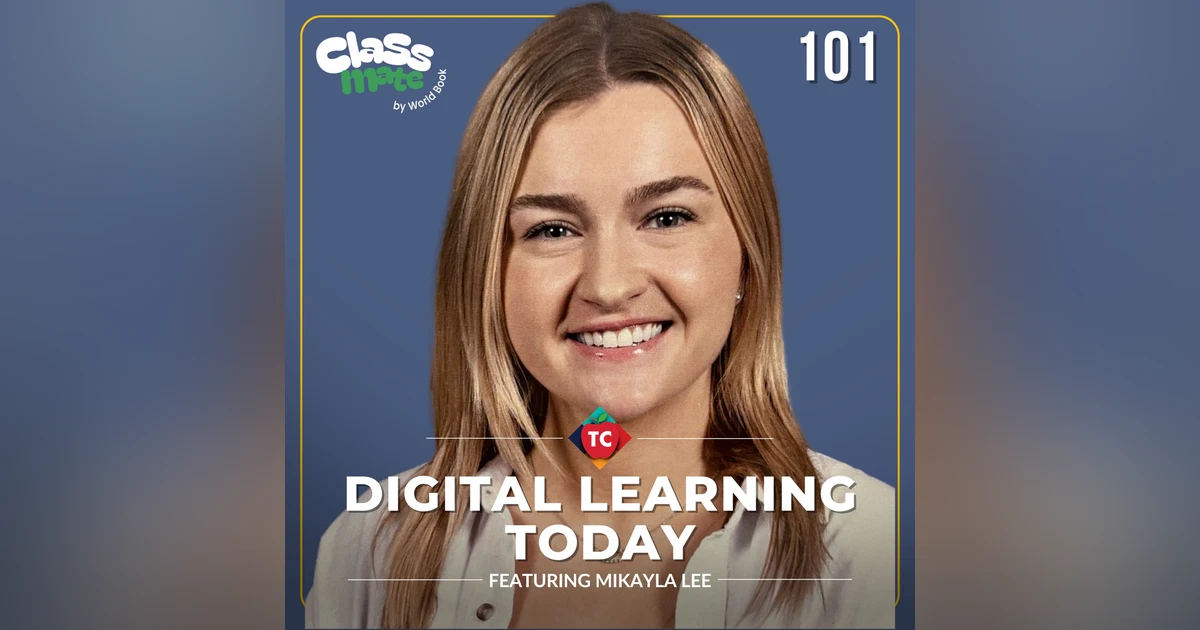
Literacy Built in the Middle with Classmate (Featuring Mikayla Lee)

 Apple Podcasts
 Spotify
 Castro
 RSS Feed
 Welcome to Digital Learning Today. In this episode, Jeff Bradbury explores the strategic systems that shape the future of education, focusing on Instructional Coaching, Artificial Intelligence, Professional Learning, and the latest Educational Technology Trends. In this episode, Michaela Lee from WorldBook discusses their new platform Classmate and how it supports literacy in middle school classrooms. The conversation covers the importance of integrating literacy across subjects, resources available, and strategies for teachers to enhance student reading skills.
Become a High-Impact Leader:
This episode is just the beginning. To get the complete blueprint for designing and implementing high-impact systems in your district, get your copy of my book, "Impact Standards."- Strategic Vision for Digital Learning:Learn how to create a district-wide vision that aligns digital learning with your educational goals, transforming how standards-based instruction is designed and supported.
- Curriculum Design and Implementation:Discover practical strategies for integrating digital learning into existing curricula, creating vertical alignment of skills, and mapping digital learning across grade levels.
- Effective Instructional Coaching:Master the art of coaching people rather than technology, building relationships that drive success, and measuring impact through student engagement rather than just technology usage.
Purchase your copy of “Impact Standards” on Amazon today!
In This Episode …
- Get a quick look at howWorld Book is evolving in the digital age—and what “multimodal” content means for student engagement.
- Learn whatClassMateis (a teacher-led reading + learning platform) and how it differs from World Book Online.
- Explore whyliteracy can’t live only in ELA—and what content-area teachers can do to support reading without losing instructional time.
- Hear how ClassMate supportsdiverse learnerswith built-in scaffolds like read-aloud and translation.
- See how teachers can use ClassMate forcollaborative planningby sharing and co-managing assignments.
- Preview what’s coming in this5-part series, including the role of AI and the importance of quality texts in literacy development.
Chapters:
- 01:05 Introduction to Michaela Lee and World Book
- 04:02 The Evolution of World Book in the Digital Age
- 07:00 Introducing Classmate: A New Learning Platform
- 09:58 Classmate's Features and Benefits for Teachers
- 12:55 Addressing Literacy Challenges in Middle School
- 15:24 Supporting Literacy Across All Subjects
- 18:10 The Importance of Quality Texts in Education
- 20:59 Looking Ahead: The Future of Literacy in Education
Resources Mentioned in This Episode:
About our Guest: Mikayla Lee
Mikayla Lee is a Curriculum Designer at World Book. She brings seven years of classroom experience to her work, including two years teaching in the Chicago suburbs and five years teaching in Chicago Public Schools. Since joining World Book, Mikayla has been an integral part of the team building ClassMate, drawing on her literacy and curriculum-design expertise to shape the product’s development. Mikayla holds a bachelor’s degree in elementary education from the University of Missouri and a master’s degree in educational policy, organization, and leadership from the University of Illinois.Meet ClassMate by World Book
Meet ClassMate by World Book — the reading and learning platform built for and trusted by middle school teachers! For over 100 years, World Book has inspired curiosity and built reliable knowledge. ClassMate carries that legacy forward. Unlike AI tools built on the open web, ClassMate works exclusively within World Book's expert-written, editorially reviewed content library. Teachers create engaging classroom activities quickly and with confidence. The result: students build knowledge, strengthen literacy, and think critically, while educators spend more time teaching.Links of Interest
- https://classmate.worldbook.com/https://www.facebook.com/WorldBook/
- https://www.linkedin.com/company/world-book/
- https://www.instagram.com/worldbookinc/
Let’s Work Together
- Contact Me Today:https://www.teachercast.net/contact
Follow on Social Media
- LinkedIn:https://www.teachercast.net/linkedin
- Twitter/X:https://www.teachercast.net/twitter
- BlueSky:https://bsky.app/profile/jeffreybradbury.bsky.social
- YouTube:http://teachercast.net/youtube
Subscribe to This Podcast
- Apple Podcasts:https://podcasts.apple.com/us/podcast/digital-learning-today/id546631310
- Spotify:https://open.spotify.com/show/0n6S0WcyzQ1rpKWJ8iZPLJ?si=a1227a7c5e0b48e4
Check Out Additional TeacherCast Programming
- Digital Learning Today:https://podcasts.apple.com/us/podcast/digital-learning-today/id546631310
- Ask the Tech Coach:https://podcasts.apple.com/us/podcast/ask-the-tech-coach/id1067586243
- The Jeff Bradbury Showhttps://podcasts.apple.com/us/podcast/the-jeff-bradbury-show/id519685828
Book Jeff for your Next Event
Jeff Bradbury (ISTE “20 to Watch” Award Winner and ISTE Certified Educator) is available for keynote speaking, workshop facilitation, and live event broadcasting. With expertise in educational technology and professional development, Jeff brings engaging content and practical strategies to conferences and professional learning events.- Visit Jeff’s Website:https://jeffreybradbury.com
- Contact Jeff Directly:https://jeffreybradbury.com/contact/
~ ~ ~ ~ ~ ~ ~ ~ ~ ~ ~ ~ ~ ~ ~ ~ ~ ~ ~ ~ ~ ~ ~ ~ [gravityform id="2" title="true"]
Jeffrey Bradbury (00:00)
Hello, everybody, and welcome to the Teacher Cast Educational Network. My name is Jeff Bradbury. Thank you so much for joining us today and making Teacher Cast your home for professional development. On today's episode of Digital Learning, we're gonna be talking all about literacy with our friends from WorldBook,
Specifically talking about a brand new adventure that they recently launched before the ISTE conference over the summertime. I have a fantastic guest, and I can't wait for you guys to hear the big news today. This is the first time you're checking out the show. Welcome to Teacher Cast. We have all of our great resources over at TeacherCast.net where you can find hundreds of blog posts, newsletters, and podcasts all about instructional coaching, digital literacy, artificial intelligence, and so much more. Head on over to teachercast.net today for more.
Professional learning.
And if you are looking to make an impact this year, check out my new book, Impact Standards. You can head on over to teachercast.net slash standards. Learn how you can take your strategic plan, infuse it with instructional coaches, and have an amazing opportunity to enhance the learning in your classrooms through your instructional coaches. Check out my new book, Impact Standards, today.
Jeffrey Bradbury (01:03)
My guest today is an educator from the great city of Chicago. She holds a bachelor's degree in elementary education, master's degree in educational policy, organization, and leadership. And she's currently a curriculum designer for a fantastic company called WorldBook. I'm thrilled to introduce today, Miss Michaela Lee. Michaela, how are you today? Welcome to TeacherCast.
Mikayla Lee (01:23)
Great. I'm so excited to be here, Jeff.
Jeffrey Bradbury (01:25)
I'm so excited to have you on the show today. Today we're talking all about WorldBook and something brand new.
That you guys recently launched to support K 12 learning. Before we get into all of that stuff, tell us a little bit about yourself.
Mikayla Lee (01:39)
Yeah, I mean your intro was amazing. So I have a background of seven years in education as a teacher and most of that time was, as you mentioned, in the Chicagoland area, mostly teaching fifth grade in Chicago public schools and I did work through a K eight school, which I got to get a great idea of what things are like in middle school, which is really what I've been focused on a lot in this role as a curriculum designer. So I'm excited to talk more about, you know, middle school literacy today.
Jeffrey Bradbury (02:06)
Now, teachers and educators alike all know the company World Book. We all grew up with it. Talk to us a little bit about what's happening with World Book these days.
Mikayla Lee (02:15)
Yeah, no, a world book after over a hundred years, we're still here, we're still doing great, and we're really thinking about how we can bring our encyclopedia into this digital age, right? we still do make our encyclopedia product, but we know we need to make things easier for teachers and students to access in the digital age. So that's really what we've been thinking about and focused on these past few years.
Jeffrey Bradbury (02:38)
You know, a lot of us do think about world book and encyclopedias, but we don't always think about encyclopedias and curriculum design. Take us behind the scenes to show us a little bit about what does it take to actually put a world book together and and where does curri curriculum and literacy kind of blend together in that conversation?
Mikayla Lee (02:57)
Yeah, that's a
great question. I mean, we have so many geniuses at World Book that write every article that you can think of from A to Z, quite literally quite literally in the encyclopedia, right? and so we have all these awesome expert verified, you know, content at our fingertips. But, you know, how do we make that easy to use? Because encyclopedias aren't very easy to use. we of course have online products, but we're trying to think more about how can we make things easy for teachers to just pick up and use.
Teachers don't have a lot of plan time, prep time. That's something that I remember always struggling with. So just making them into these ready to use assignments that are meeting them where they're at, meeting their objectives, meeting their standards, and using this great rich text that we know teachers are going to love.
Jeffrey Bradbury (03:44)
You mentioned World Book having a lot of rich text to it. When we open up our World Book, what can we expect these days? What are some of the things that as a teacher or as a student we can expect when we go to the website, when we open up a physical book? What is World Book all about these days?
Mikayla Lee (03:59)
Yeah, no, and speaking specifically, you know, to the to the digital products at World Book, I think what we have is really cool because our digital articles are multimodal. So you're gonna get that great rich text and our text is great for teaching vocabulary, which is something that not all texts are great at. You know, we we ensure that as we write these texts that they are, you know, written to be assumed that students don't have any background knowledge. So students are gonna gain
that background knowledge. They're gonna get great images, videos, 360 videos, sounds to keep them engaged and to deepen the learning. So we really do a lot to keep them engaged and build that base of knowledge.
Jeffrey Bradbury (04:39)
Now, I'm excited to have you on the show today, Michaela, because we are actually kicking off a five-part podcasting series where we're going to not only tie into some of the great things that World Book is doing, but we're actually going to be launching a brand new platform that WorldBook is sharing with K-12. Talk to us a little bit about why it's important for World Book and and really Teacher Cast here to be partnering together. Talk to us a little bit about some of the things we're going to be learning over the next five episodes.
Mikayla Lee (05:06)
Yeah, absolutely. So one area that we really want to focus on and I think is underserved is middle school. And so that's why, you know, our new platform classmate is designed specifically for middle school content area teachers. And I do mean all content area teachers. We've been very purposeful and thinking about all of them and what we have that supports all of them because we know, you know, the dollars in a district are typically gonna go to, you know, the reading curriculum, the math curriculum.
And so we're really digging into this, you know, what we know is a literacy crisis right now and how we can help support all teachers in, you know, moving the needle and helping get kids where they need to go, not only in the content area, but also to grow as readers.
Jeffrey Bradbury (05:53)
Excited to learn a little bit about this. And you had mentioned classmate. For those who haven't quite heard about classmate, talk to us a little bit about what it is. I had a wonderful time at ISTI sitting at the classmate booth, checking it out, giving a presentation. And
there were so many people that were there asking the same question that I'd love to address up front here. What is classmate?
Mikayla Lee (06:13)
Classmate
is a reading and learning platform by World Book, and it's really gonna help help teachers very quickly access the content that's going to move their instruction along. Whether it's one of those great articles I referenced, we can generate assignments from them or find a ready to use assignment that is going to meet standards. And the beauty of it is we really thought about it from two angles. One, of course, we want, you know.
our social studies and science teachers to have the content that they need to meet their standards, but also increasing that time in text and building in scaffolds and supports that are going to help all students access grade level text.
Jeffrey Bradbury (06:55)
And
for any teacher that out there is wondering, first of all, where do we go to learn more information about Classmate?
Mikayla Lee (07:01)
You can go to meetclassmate.com to learn more. And one thing that's really exciting that we have going on right now, if teachers are interested in signing up for a trial f for this fall to give it a give it a try in your classroom, see how it works, you can find information on that at meetclassmate.com.
Jeffrey Bradbury (07:18)
Now is Classmate and Worldbook similar? Do they do they overlap each other, or should we be thinking about these as two completely separate platforms that just share a a a a parent name?
Mikayla Lee (07:30)
we're all World Book. We have our World Book Online set of products, which are more of like database reach research project. You know, if you're gonna have your students do a research project on an animal or a country, you would probably go to World Book Online. It's more student discovery, right? Students can look up anything they want from Taylor Swift to, you know, classical music, right?
Whereas on Classmate, it's more teacher discovery. So the teachers are going to find the content and assign the content to their students. So I think that's the best way to think about, you know, their uses and how they're different, but they're all based from that same great, you know, library of expert verified world book content.
Jeffrey Bradbury (08:10)
Now we're gonna talk a little bit later on today about how teachers are actually using it in their classrooms, but I wanted to ask you a little bit about Classmate and really what is the motive of all of this stuff? We're here to create help teachers do what with the platform.
Mikayla Lee (08:23)
Yeah, I
think one thing that we've heard, and especially at ISTE, I was there last year and I heard it over and over again that teachers are being asked by their administrators to incorporate literacy into their, you know, in their box, into their time with their students.
And they don't feel equipped with the tools and resources to do so. And, you know, in the midst of this literacy crisis, we need students to be spending more time in tech. So we really wanted to use this great vast library of content that we have.
To make it easier for teachers to do just that, to find the things that are actually going to support their, you know, subject area objectives while also giving their kids more exposure, you know, in time and text.
Jeffrey Bradbury (09:05)
Many teachers these days don't work in silos alone. They work
Mikayla Lee (09:09)
Yeah.
Jeffrey Bradbury (09:10)
in teams. They work in departments. Is classmate designed for a single teacher? Is it something that an entire fourth grade group of teachers should be working together on?
Mikayla Lee (09:22)
Yeah, I mean
it's really great for either use case, honestly. We have different tools in the platform that allow teachers to like
be co assigned as assignments so we can have like an assignment that multiple teachers have access to. teachers can share assignments. Let's say you generate a really great assignment for that really niche specific state standard, right? I can share that with my co-teachers and say, Hey, let's try this on Monday. This would be a great way to address that standard. And additionally, you know, if you're
I w I was a teacher that worked very much in a silo, which was not fun. And so for me too, you know, if you're in that situation too, it can really help you save time because when you are working in a silo, it's very hard to get all the resources you need without that support. So I really think we've we've covered our bases there as far as whether you're working on a team or whether you feel like you're doing it all on your own.
Jeffrey Bradbury (10:13)
Now you keep mentioning resources. Just for those who are still new to Classmate, what kind of resources of are available? Is it written? Is it audio? What do we have available to us?
Mikayla Lee (10:22)
Yeah, great question. So our content, we have our great articles, we have videos, we have sounds, we have images. And so all of those can be the building blocks if you want to generate your own assignment in Classmate. We also have ready-made assignments for teachers, which is something I'm really excited about. Our worldbook at the geniuses at World Book have, you know, put together these awesome, interesting, engaging assignments that are multimodal, that you can also just pick them and find one yourself. So we have
you know, assignments and written and audio and video content that teachers can can check out.
Jeffrey Bradbury (10:59)
We're talking today to Michaela Lee from the World Book team, all about literacy and how they are supporting literacy in the classrooms through a brand new application called Classmate. Now, Michaela, I want to talk to you a little bit today about literacy and why is this important? When you're working with teachers, what are some of the pain points that they have and how are they being challenged to support student reading, student literacy? And then most importantly, how is classmate helping that challenge?
Mikayla Lee (11:25)
one of the challenges to incorporating literacy in, you know, all content areas is that subject demands can't always flex to meet teachers where where they need to be met, right? You know, especially when I think about middle school context, right? I have 45 or 50 minutes with my students and I need them to understand, let's say, self processes, right? I don't always have the time nor resources to
accommodate my students who are, you know, reading at the second percentile or reading at the 98th percentile. And we know that reading is the foundation of a lot of these subjects outside of ELA, it's outside of the ELA classroom. so that's something that we've heard a lot is that teachers, you know, don't have the time and they feel, you know, underprepared to meet meet that challenge head on. And they and they quite frankly don't have the resources. So at Classmate, we've really thought about like how can we help
all students access this great text. And one of the ways we've we've thought about that is having these awesome built in accommodations and modifications, which thinking back to my classroom days, the hours I put into finding the right text, you know, the right leveled text to trans the translated version of something, we have built those tools right built in. We have read aloud, we have translation, things like that that allow you know, that content area teacher that might be feeling hesitant about
How can I make this work in my room? Like this is, this is just not gonna happen. It kind of takes the burden off them and makes it easier for them to incorporate literacy while also having an assignment or, you know, just something for their students to read that's really meaningful to their objectives for their subject.
Jeffrey Bradbury (13:02)
You know, I'm gonna ask this question as a parent of three seventh graders now. Why does it seem like literacy is more difficult
in the middle school years? I mean, I'm saying this as a middle school teacher,
saying it as a middle school parent, but is it just students and finding time? Is it getting the right topics for kids to find their their interests? What is it about the middle school years that makes it teaching literacy so difficult?
Mikayla Lee (13:32)
It's a great question. I think there's a couple, a couple things. One, I think, you know, when you think about a student's schedule in elementary school, moving to middle school, it is such a huge change that students are, you know, we try to prepare them for, but it's hard to.
They're going from, you know, when I think back to how our school did it, you know, my students had in elementary school two hours a day of read learning to read, right? Basically learning to read.
And then they go into middle school and they have 50 minutes with each teacher. And a lot of those content area teachers are expecting them to already know how to read to learn. And so it's a huge shift. And we know that the text that they're reading changes a lot too, from the complexity of it. They're reading a lot more nonfiction than they did they did in elementary school. And they need to because those teachers need them to be able to access the text to understand, you know, the topics that that that
they need to grasp in that subject area. So I think those two things compounded really makes it difficult for students if you're not already, you know, feeling like a super confident reader. It can really trickle down to all these different subject areas that once you may not your that student may not have been struggling with.
Jeffrey Bradbury (14:46)
You know, think about my own teachings. I I teach sixth through eighth grade, and there are times where I'll ask students to read from the board and they say no.
Mikayla Lee (14:53)
Mm-hmm.
Jeffrey Bradbury (14:54)
For any reason possible, they they just shut down, they don't try it. And and you know, I teach digital media, not English. So I'm trying to incorporate these different skills. What advice do you have for somebody who's not an English science math teacher to support students and their reading or students and their literacy knowledge?
Mikayla Lee (15:16)
Yeah, I think that is a very great question and something that a lot of teachers, you know, don't feel prepared for. I think one thing that can really move the needle is when the foundation of a text, and you know, this is easier said than done. I think content area text can be really tricky. but when we start with the base of a really good text that is teaching those vocabulary terms.
And even, you know, incorporating it as whole group reading, right? Like in a perfect world, we'd have some sort of read aloud. So, you know, my students can, you know, at least hear it. reading it out loud, it does it does a lot. And I think that can feel like in middle school, maybe, you know, that's more of an elementary thing. But even, you know, putting them in small groups and having them either partner read, read in small groups, will allow those students who are struggling more to be able to comprehend the text a little bit better.
And again, having a really great text as the base can be a good way to make sure that, you know, that they are learning what they need to learn from that material.
Jeffrey Bradbury (16:18)
know, I do believe, and as I mentioned earlier, the way that I kind of run my classrooms, teaching literacy at all levels, especially in
middle school in my case, is something that all teachers should be doing and supporting kids. Why do you find that some subjects just maybe are harder to do that? You know, maybe a math thing, maybe I I find a lot of this in digital literacy where you have vocab words that have a lot of syllables to them, or maybe don't have a
translation into other languages. It's kind of hard to figure things out. Maybe one word means two different things, bites as an example. Why is it so important that all teachers take the time out of the year to support this? But why do you think some subjects just fall easier than others?
Mikayla Lee (17:04)
the reason that some teachers find it easier than others or some are more, you immune to it than others, is I think there are these subjects like science and social studies come to my mind where, you know, those teachers naturally need their students to learn to read, but they might not have that background of literacy that somebody, you know, who went through school and and actually studied it has. And they might not have any training from their district to support them to do that. So they're, you know.
Hoping and praying probably that those students are coming in equipped to to do that. They don't have those resources. and I like your example of math because I do think math is one where it's a tough sell, right? Like, how do we convince a math teacher that they should incorporate literacy? You know, I need my students to be able to make sense of these numbers and yes, read a world word problem every now and then. but I do think, you know, specifically thinking about math as a as an example, I think.
One thing that I always found myself as a student thinking, and I remember hearing from my students, is why do we need to use this? Like what like what's the point, right? Which is a very annoying question. And we tell students, an X, Y, and Z, you know, but text can be a great way to show students that real world application to allow them, like, let's say we're reading about, you know, we're we're learning about in math, we're doing means and medians and modes, right?
How let's show them what that looks like in sports, right? I love sports. Suddenly I'm bought in. Suddenly I understand why it's important for me to know about this and where it comes in. So math isn't one that I think is tricky, but I do think, you know, it adds a lot of that real world piece that helps kids go beyond the numbers and, you know, plug and play with the numbers and actually understand the application, which
is going to help them, you know, with both math and again in literacy too. So it's doing that double duty.
Jeffrey Bradbury (18:53)
I wanna circle back to some of the things that you mentioned with resources. We've already talked just now about different subjects, different vocab terms. Some things are harder than others. Middle school is a bigger challenge, maybe than elementary school. Haven't talked about high school yet. How
is classmate helping teachers meet those struggles? How are they helping those specific pain points? When a teacher does log into classmate, get everything up and get everything running, how can they feel supported?
Mikayla Lee (19:21)
it really comes in with that personalized support that students get from whatever they're assigned. So as I mentioned before, we have, you know, read aloud, we have translation, which is gonna allow students to receive the information in the way that works best for them. But moving beyond that, we've really thought intentionally about building in scaffolds and supports that are universal in our assignments. So
Student teachers don't have to sit there and say, which version of this assignment should I give to this student and this student and this student? We know scaffolds and supports are things that help students of all levels. So those are universal, and that's going to help students with things like understanding the vocabulary demand. There might be, you know, some instructional text that might point to, you know, a certain root word there and help them understand that, you know, the root graph means to write. now suddenly I can make sense of that really long vocabulary word that I've
once didn't understand. and additionally, one thing that we're really excited about is our AI support nudge, who is really that low-stakes support for students. You know, one thing that always broke my heart as a teacher is those students who would just sit there in front of an assignment and do nothing because they don't want to raise their hand. They don't want the stigma of being the student that always needs help and can't get started. Nudge is going to be there for them to ask that.
quote unquote silly question to or say, how do I get started? And that's gonna empower them to get further on that assignment. And in turn, it's gonna help teachers be able to do, you know, the important things, right? To focus on, you know, building relationships and helping their students and giving those students like the confidence they need to get moving with an assignment and and feel confidence and pride when they can actually turn it in without having to raise their hand because they got those needs met through supports.
Jeffrey Bradbury (21:12)
Talking today to Michaela Lee all about a brand new adventure from the World Book team called Classmate. Michaela, where can we go to learn more about all the great things happening at World Book and where do we get a hold of Classmate? Yeah.
Mikayla Lee (21:23)
Yeah, you can check out Classmate at
meetclassmate.com.
Jeffrey Bradbury (21:27)
Now, I highly recommend you guys check out everything over at meetclassmate.com. We're gonna make sure that we have the links at the bottom of this video. Make sure that they're in all of the descriptions here. Check this out today. And I highly recommend checking this out, especially if you're gonna be teaching middle school like I am this year. Lots
Mikayla Lee (21:41)
Mm-hmm.
Jeffrey Bradbury (21:44)
of great stuff going there.
Michaela, one more thing before we wrap up the show today. As we mentioned, we are actually starting the first of five different episodes. And we're going to be putting these out on our newsletters, on our social channels, and of course over at teachercast.net forward slash classmates. Now, when somebody listens to all five of these, what do you hope that a teacher takes away? Cause this is not just about classmates. This is about helping students and their literacy. What are we hoping to gain out of these five episodes together?
Mikayla Lee (22:14)
What we're really excited to explore over the next five episodes is to dig into these different aspects of literacy that teachers may not realize can really move the needle from their students from things that are might be impacting their literacy, you know, the impact of AI, for example, on literacy and and then these tools that students have access to now, to things like quality text and how can we build knowledge and how can we build literacy at the same time. So
I really hope that teachers that tune in can leave and feel more confident in how would it look like for me in my classroom practically to incorporate literacy and at the same time not sacrifice the objectives and standards I know I need to cover as an educator.
Jeffrey Bradbury (23:01)
We hope that you stick around with this. Of course, we're gonna make sure that all the videos up on our YouTube channel and all the stuff is gonna be over on teachercast.net forward slash classmates. Michaela, thank you so much for coming on. I am so looking forward to having you join us throughout the series. And of course, for more information, you can head on over to teachercast.net forward slash classmate. And that wraps up this episode, the first of five with our friends at World Book, helping you guys in the world of literacy. And on behalf of Michaela and everybody here on Teacher Cast, my name is Jeff Bradbury.
Reminding you guys to keep up the great work in your classrooms and continue sharing your passions with your students.