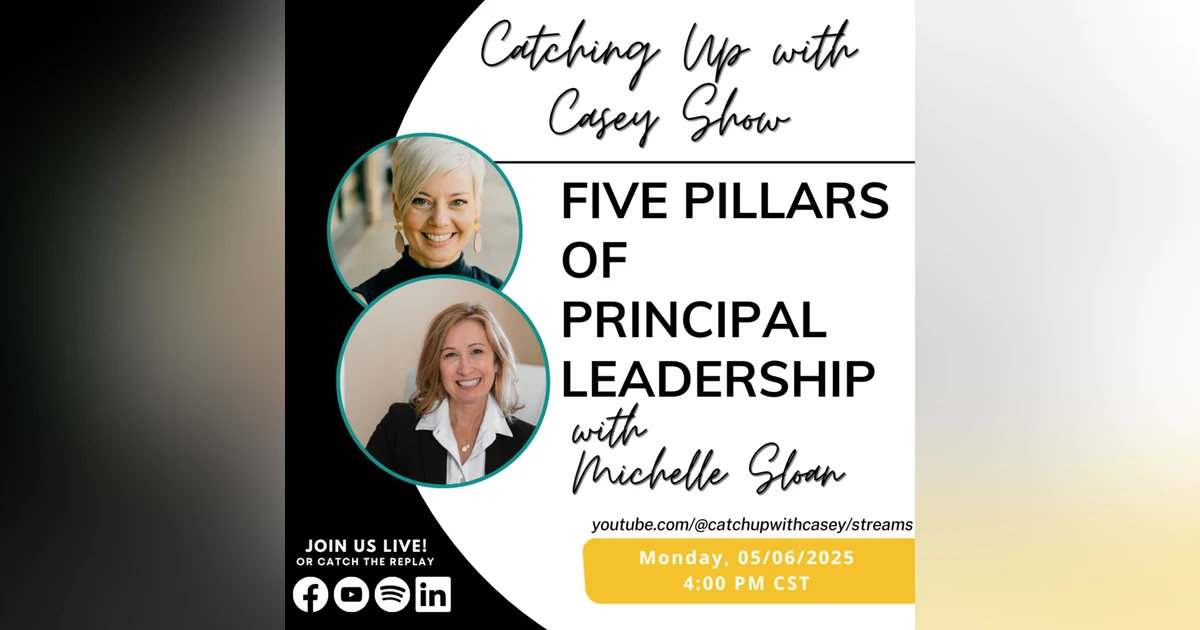
118: Five Pillars of Principal Leadership with Michelle Sloan


 RSS Feed
Ever wonder what really makes a principal shine? Join us as we chat with Michelle Sloan, a principal coach with 25 years of experience as an elementary teacher and principal. Michelle is passionate about mentoring and coaching educational leaders and is a catalyst for change, guiding school leaders toward operational excellence, enhanced productivity, and increased unity within schools. We're diving into the "Five Pillars of Principal Leadership" to uncover the key elements that empower effective school leaders.
Visit www.sloanleadership.com . You can:
-
Sign up for her weekly newsletter
-
Schedule a free discovery call
-
Learn about her summer leadership programs
- Join the VIP Leadership Lounge for monthly mastermind sessions with authors, speakers, and education leaders
Subscribe to Purpose Driven Principal Newsletter
Important Links:
Give teachers what they want WITHOUT spending more or micromanaging: https://www.catchingupwithcasey.com/clarityoverclutter
Need help getting your leaders trained in a purposeful way? https://www.catchingupwithcasey.com/identity
Ready to build the habits of a clarity-driven leader? Get The Craft of Clarity book!
0:01 Hey leaders, quick question. Do you really need another shiny new program to fix your campus? Yeah, I didn't think so. If you're tired of throwing money at every solution that promises to save tier one, it's time to try something smarter. I've got a free 30 minute training replay where I show you how to give teachers what they would actually need without buying another product, adding more staff, or micromanaging the people you already have. You're going to learn why most new programs don't deliver the impact they promise, the real reason teachers keep asking for more, and how to solve it without spending a dime, and how to strengthen Tier 1 instruction with what you already have on campus.
0:46 You're also going to get instant access to free resources and a sneak peek at strategies from my book The Craft of Clarity. So go grab the free replay and resources at Catching Up with kc.com/clarity Over Clutter, because better leadership shouldn't cost you another $50,000 and a six hour training that nobody wanted. Hey there, welcome to the Catching Up with Casey show. If you are tired of chasing buy in, frustrated by teams who just can't seem to get on the same page, or over the constant struggle of holding people accountable without feeling like you're micromanaging, this is the show for you. I'm Casey Watts, team leadership expert and the host of this show.
1:36 I specialize in clarity, collaboration, and character, and I help leaders just like you take teams from chaos to cohesion, from frustration to alignment, so teams can actually work together toward a common purpose instead of against each other as though they are functioning in different organizations. Whether you lead a single team or a team of teams, on this show we talk about strategies that are going to help you create a culture where accountability and autonomy go hand in hand. Now with. All of that said, let's dive into today's conversation and learn how to lead clarity driven teams.
2:22 Well, hey. Everybody, welcome to the show. This afternoon we are going to be talking about 5 pillars of principal Leadership with Michelle Sloan. Michelle, welcome to the show. Hi, Casey. Thanks for having me. It's good to be here. Yeah, it's going to be a great episode. I will go ahead and tell our audience that in in case you haven't already heard it, the weather is booming outside. It is like super rainy thunderstorm firms, flash flood warnings, possible tornado alerts, which I never can get get that figured out if an alert is the bigger deal or if the warnings the bigger deal. I think it's the warning, but we should be OK. But just know if there are any glitches and like sound or video, if you're watching on YouTube, that's probably the reason because it is pretty bad weather here. So, Michelle, I want you to share with our audience about the work that you do.
3:21 So last year I started Sloan Leadership Solutions and as a former principal, former teacher, been in education for over 25 years. And that's really hard to say. Sometimes it feels like it's been 50 years, but just to say 25 years is is hard at times and I'd really just love supporting new principals especially, but even principals that have been in education for a while and they just need a hard reset, want to get back to the basics. I work with principals and one-on-one coaching. We do group cohorts, some are 8 weeks, some are year long and then I also offer a membership which I absolutely love and we meet twice a month around virtual scenario. We have conversations with guest speakers and educational leaders, offers in our industry like you going to be our special guest in July.
4:19 And then the second session is just as having a round table discussion around some of the hot topics, teacher turnover, teacher retention, student discipline, things that we can just collaborate and come together and share our own experiences. So left the profession a year ago and now I love walking alongside principals and helping them dream what they want for their school and put that into. Practice. Yeah, that's so incredibly important and I love that you provide that because as you and I both know, the support that you get as a principal once you're in the role is sometimes really, really limited.
5:01 And I think sometimes it's. I don't know why this is, but it seems to me as though when. People get into this. Principal role, it's like, OK, they've made it, they've made it to the the top of the leadership pipeline. And so they don't need any support, but that's when they need the most support because we don't learn how to be leaders in the classroom necessarily because we're constantly focused on teaching our students and all of the things that we you can see at at the 30 foot level instead of a 30,000 foot level. So I think that's fantastic. And I do hope that some listeners will take advantage of what you have to offer.
5:46 I want to know what is something that's very relatable, very human about you that people can connect with. Oh my goodness. Connect with. Well, I don't know. I'm a very quirky person. I have a lot of quirks. I love technology. I live by my Google Calendar, but I still use a paper and pen planner. There's something about writing it down and crossing it off that brings me satisfaction. So you'll see me writing all of my to do's and my meetings on a piece of paper every morning. I am also a Jeep girl. I love. That's my stress relief.
6:27 You'll find me on a nice hot summer day with the top off, the Jeep baseball cap on and my 80's rock music cranked. And so that's how I relieve stress. And one more quirky thing is I love the good old fashioned black and white Twilight Zone movies. I've been known to binge watch those. I don't know what it is, but I absolutely love those. That's so fun. Wow. That's a variety of things. Yeah. I told you I can laugh. Of course. I love every one of them. It's so great. OK, we're talking about your five pillars of principal leadership. Can you start just by talking about your education journey and what inspired you to focus on coaching and mentor mentoring principals?
7:15 You talked a little bit about it, but what made you decide to focus on that specifically? So you had mentioned when new Prince, when you become, you make that transition from being a teacher into being a principal. I remember what that was like. And people were asking me, do you feel like you're drinking from a fire hose? And that was just something that was said all the time to me. And I would say, yes, I do. It's so much information that it's hard to prioritize what you're supposed to do as a new principal. You're supposed to focus on what's the priority because everything seems so urgent and like it's a priority. And in one of my cohorts recently, I had the new principal tell me she felt like she was drinking from a fire hydrant.
8:02 And to me, that just summarized how unprepared we are sending our principals out there. And you know, the turnover rate I think is something like 80% will leave within four years. And I that's from a couple of years ago. So we've got a better prepare and mentor and coach our principals. And my journey wasn't a straight line. It was kind of a zigzag through a lot of different opportunities and experiences that presented themselves. I went from an elementary teacher to stay at home mom for about 6 years and then I homeschooled for two years. I taught both of my boys how to read, which I'm very proud of. But then I quickly learned that I was not the homeschool mom. So I put them back and joined public school. And my kids have navigated through public school, private school, charter school and I think just understanding their own strengths and different seasons of their life and what was needed.
9:15 So I've kind of seen every angle of education and I know the one thing that unifies us is that we're all trying to help students be the best version of themselves to fall in love with learning. It's it's a lifelong journey. We want them to love that process, discover their little bit about themselves and their purpose, and then go out into the world and make a difference. And that's something that we all have in common. But I'm central, you know, the, my family and faith, that's central to me and my life. And that's what grounds me and what I do. But I I really love being a safe space for educators and educational leaders to share going on and in their life, bounce ideas off of one another and create a place where they can dream and we can collaborate together to make that dream school happen. That's awesome.
10:19 So when you're working with principals and mentoring them, coaching them, you talk about the five pillars of principal leadership. So I would love for you to share a little bit about those and what like I guess how you came to develop those five in particular. So in walking through this process of developing my first cohort last year, trying to think about what have I experienced from starting a school from the ground up to taking over a struggling school and helping it get back on its feet. Taking my experiences and my education and trying to put that into a format that principals could be a simple process for them to a framework for them to use on how to make that happen in their school.
11:14 So I was like, OK, we work. We work on pedagogy. We talked about people and relationships. We have our mission statements. How can I summarize these into a simple and memorable framework? And that's where the five PS came into place. And so we look at purpose and we look at pedagogy, people, processes and professional development. And that kind of emerged from the different observations that I've made, the schools that I consult with, but then also my own experiences. Yeah. Can you elaborate a little bit on each of those? I think what's so important about this is especially leaders, if you're listening, know that you need systems in place for everything even, and I'm not even necessarily talking about the logistics of your school workings, although that is absolutely essential.
12:10 But even just systems about thinking about how you lead is important because it allows you to kind of take all of these things that you like is the fire hydrant coming at you and prioritize and kind of dissected into some main categories that you can then place your focus on. So can you tell us a little bit about each of these? Sure. Purpose is yes. It's your mission statement. It's your vision statement. It's your core values. It defines who you are, why your school exists, what is unique about your school, what sets it apart from the community, and then casting the vision, where are you going and making sure that that's clear and exciting to engage all of the stakeholders.
12:56 But it also goes beyond the mission and the vision. It's about looking at the why, the purpose, the goal behind everything you do in your school, from events to meetings to the way you develop your master schedule. It's every interaction comes back to the goal and and the purpose and the why. So for example, if your school is hosting an event and the purpose of the event is a fundraising event so that you can build your new playground, but everybody's talking about how fun the event was and it was engaging and everybody wants to come back, you can't really measure that success. If you didn't raise any money, you can't build your playground. And it's vice versa.
13:49 And so same thing for meetings. I was sitting in an admin team meeting at a school I was consulting with, and everybody just went around the table and kind of shared what they were working on. And there were conflicts that came up and scheduling. There were agendas wanting to know who was doing what, and nothing was discussed. And there was no problem solving at that meeting, which is fine if the purpose of the hour and a half meeting is just for everybody to share what they're working on. But this was an admin leading where they were planning and problem solving and there was no collaboration happening. So we really need to understand why we're doing what we're doing. And then then we can establish whether it's successful or not based on that goal.
14:39 And then the next piece of people and as principals, we get the joy and blessing of working with a variety of different stakeholders. So we've got our students, we have our parents, we have the staff and the faculty, we have the community leaders, we have board district leaders. We have a lot of different relationships, relationships that we have to navigate and prioritize. And that can be challenging at times. You know, we have to be intentional about establishing trust. And so often principals are running around putting out fires. They don't have time to build the relationships and be intentional about that. The next one is pedagogy, and that's about having strong curriculum instruction, not just evaluating and walking through the classrooms and, you know, creating that checklist. Where can you hear me, Casey?
15:40 I can. Our electricity went out, so I'm trying to use my hot. Yeah. Oh, man. We're here. We're good. I'm listening. Keep going. All right, so put a Goji. It goes beyond the evaluation. It's really being involved in the classroom, setting the best practices, understanding the demographic needs, your teachers strengths and weaknesses and really come alongside them. There's a fine line between setting the expectations and holding teachers accountable. So allowing them to have the autonomy to lead their classroom well. So, you know, we don't want to micromanage, but we want to make sure we know what's happening in those classrooms and giving them the support and the tools and the resources that they need. And then we have processes.
16:31 I think we've all heard the saying that people don't fail, systems fail. Sometimes people fail, but more often or not, it really is an opportunity to look at the gaps in the processes that we need to put in place. I think this said that 35, I think the average person makes 35,000 decisions in a day. And I know it's got to be double for those in education. And we were like closed down probably 100,000 decisions in a day. So when you have those systems in place, it, it prevents that decision fatigue that I call it when your spouse calls and they ask what's for dinner and you just cannot answer one more question. So those systems, putting those systems in place, it can really help.
17:20 And then professional growth is the last P and that's just committing to everybody growing professionally from the teachers to the it's, it's the top down. And that's what I love about the, the membership and the cohorts is that we're all learning and growing and we can't expect our teachers to continue to implement new programs and spend hours in professional development if we're not also doing that for ourselves. And a lot of times, principals are doing the best that they can to implement professional development, meaningful, diversified professional development and differentiated for the teachers.
18:05 They neglect themselves. And and so that's I think is part of the process of, of learning as a leader is seeking out those opportunities. Opportunities, yeah. So Jessica's in the comments here and I just want to post. I want to share something that she said. She said I prefer drinking from a garden hose, not a fire hose. Just kidding. Haven't done that since I was a kid. But yeah, I'm sure that the principles in this would can occur. They would rather drink from just a garden hose. That would be nice. Like, not a big deal, but I'm going to say that I'm certain if you were to really focus on these five PS, it would maybe feel a little bit more like you're drinking from a garden hose instead of a fire hydrant, which is unsustainable. So Jessica, since you're here, I would love for you to let me know.
18:59 Can you hear the Thunder in the background? So just pop that in the comments or anyone who's listening on the side, pop in the comments if you can hear the Thunder in the background. All right. You shared about the five PS and I I know it's probably hard for you to decide like which one would be the top one to focus on, but what do you find is the most challenging for leaders to develop? In my experience of working with, I think over 30 principals this last year and five different schools right now, I think they would say they're most challenging would be working with people.
19:44 And I get a lot of questions about how would you handle this situation? How would you have this difficult conversation with a teacher or I have this parent and I don't know how to respond. I think they would say that people and because because you know, the nature of our job working with students and and parents and the community. But in the cohorts I that I've put on with the printer that I've hosted with the principals, I think for me they get hung up on purpose and processes. And just, they've inherited those broken systems and they just keep doing them.
20:25 They're so busy putting out fires that they don't even recognize the opportunities where they need to put a system in place. And then there isn't clarity in there. Why There isn't clarity in their mission, in their vision, and if they do have a mission and vision and they spent the time to make it very clear, it doesn't drive their decision making. And so it isn't a true why in their identity and where they're going, the vision isn't. So I would say people probably for the principles they, they get hung up on trying to make the best decisions with the people.
21:05 But if they could get the purpose and they could get the processes in place, they would have the time payment to invest in those relationships and maybe not have so many challenges with people. And I mean, so much of that probably needs to happen. Like you need to be thinking about that before the school year begins. But when it does begin, I would suggest, and I'd love to hear your thoughts on this, that you set aside some intentional time for reflecting and thinking about what, what am I missing here? And how can I put some systems into place what needs some adjustment, which is the benefit of being in a cohort like what you? Have. Or having a coach of sorts, a mentor of sorts, is that that time is built in and someone is there to kind of guide you through that because it's hard to do by yourself. Yeah, absolutely.
21:57 And that is one of the benefits of being able to work in small groups with other principals is somebody has been through it and they can encourage somebody's walking through it or somebody wants to get there. And so it's just nice to have that reflection. And you're right, summertime is a great time to to have that. You know, we work through the calendar, we take the summer to plan and prepare. But really, when you look at these five PS, these five pillars to be truly successful, it's about building a rhythm of the reflection and review, you know, having the space daily, weekly, monthly, quarterly and then annually.
22:47 You want to do the best that you can to plan and prepare over the summer and, and, and be intentional about when are you going to connect with the students daily? When are you going to connect with the parents weekly? How are you going to connect and and be intentional? You know, I tried to make it a goal to have a one-on-one connection with every student, have a connection with every parent and meaningful conversations throughout the year with my staff. And I would even go as far as like printing rosters and writing names and being intentional because time just gets away from you. And before you know it that you're down to three weeks left of school. Here we are three weeks left of school and how many people have we not connected with?
23:32 And so just establishing those rhythms and reflection times on a regular basis is is a necessary. Yeah, I in my book, I write a little bit about that. And one of the things that one of the ideas that I gained from a principal is they took a, they gave a student a job or, or it could be your like your administrative assistant or whoever, but they gave a student a job. The student came in every Friday and they would take this box of index cards. The box of index cards had staff members names and they would take the first five or like the the last, maybe it would take the first five and take them out-of-the-box and the teeth, the principal knew that next week these are the five people that I'm going to make intentional touch points with and then put the five back in and then take the five out. So anyway, I think that's just the small things that you can delegate to an extent to someone, but they know it's their job to take care of that.
24:38 It's your job to just follow through with the touch points, but I thought that was something practical and easy and still very, very purposeful. When we look at these five pillars, really I see a lot of operational excellence that comes from it, enhanced productivity, increased unity within a school. So can you speak more to how you think the five pillars contribute to that? So I think when there's consistency in the expectations, the decision making all revolves around the purpose, the why, there's specific situations and processes put in place.
25:26 There's a cohesive unity that happens. People aren't isolated and they're not silos in the school working on what they feel like is priority. There's a unity that happens where everybody's focused on the same goal. So it's it's collaboration, it's understanding the why, it's casting the vision, it's having the processes in place so that you can build those intentional relationships. But we can't forget about what's happening in the classroom. Supporting and encouraging the teachers and making sure they have the tools. We've established expectations. It's not just about having good teachers, it's about having an environment.
26:09 We're learning. We're having the best learning experiences, and unity is a byproduct of that. Yeah, yeah, absolutely. Now, when I hear you say these things like creating collaboration and the unity and like everything that we've talked about, I know leaders probably hear it and they're like, yes, that sounds great, but wow, like sometimes it can feel like it is just too broad and too high level for us to even reach. So what would you suggest our practical strategies or tools that someone could use to strengthen their skills in each of these five pillars? I think they it's about taking an honest inventory of where you are right now, celebrating the growth that you've made are you know, to this point, because it's not necessarily about being perfect or reaching the goal.
27:10 It's about understanding where you are, where you've been and where you want to go. So establishing those wise and taking one step at a time, 1 foot in front of the other and looking at what matters the most and where the gap is and which one of the the gaps and that you want to work on 1st. So it's not necessarily I think to use your word, clarity comes when you are asking the deeper questions and doing a lot of listening and reflection and analyzing. So then you can take that next courageous step, yeah.
27:51 So any as we start to close, any final advice that you would have for the leaders who are listening to this episode? Don't try to fix everything at once. It's collaborate with your team, build in reflection and review time on a regular basis. We even if you have to block off time on your schedule for reflection review for 30 minutes and have no meetings, no interruptions, 30 minutes a day, 45 minutes a week, a couple hours a month. I really feel like that can help you make huge leaps and bounds if, if they're putting out fires and there's a broken system and that is AQ2, like every interruption in my office was OK, what do I need to put in place so that they don't have to come ask me that question. And really just thinking about, but that can happen in your reflection time when you when you have those built in time, so.
28:52 Yeah, that's great. This has been so good. And I'm thinking of so many different stories in my mind where a leader or even myself could have benefited so much from leaning into these five pillars, could have benefited so much or still could benefit from partnering with you. So I'm curious to know where our listeners I can find you and what what you have to. Offer so I have a purpose driven principal newsletter they can sign up for its weekly and that's available in the show notes. They can also become AVIP leadership member and that's where we have about 20 of us that meet monthly and virtually twice a month actually. And we look at just hot topics to discuss around a roundtable discussion.
29:47 And then we also have a guest speaker come in. We've got free content, free systems, free processes in place for them. So we'd love to have them in that. And then also I do the one-on-one and group coaching. So I have a purpose driven principal cohort that's launching this summer and it's for new principals or principals that just want to have a hard reset and get back to the basics and be purpose driven. Yeah. That's fantastic, Michelle. Thank you so much for coming on, I've enjoyed this so much. Thank you, Casey. Yes, absolutely. And and listen, if you were listening to this and there were some things that cut out whoo I tell you what you should have heard. There was 1 moment where it thundered so loud that I know I jumped and it was in the beginning. So you can go back and watch the replay on YouTube or LinkedIn. You can see me jump a little bit. But it wasn't that you're what you were saying was scaring me. It truly was truly was horrid this Thunder. OK guys, we will catch you in next week's show. Bye everybody.
30:57 Hey there, thanks for joining this episode. I would love for you to do ME3 solid favors before you head out. Number one, subscribe to this show. I've got a lot of great guests and content coming up and I don't want you to miss any of it #2 share this show, share it with your like minded colleagues and friends who want to learn how to lead clarity driven teams. And finally connect with me on all the social media platforms you can find me at. Catch up with KC on Instagram, YouTube and LinkedIn. Until next time, go off and create teams that leave people feeling inspired, empowered. And. Eager for more each day?

