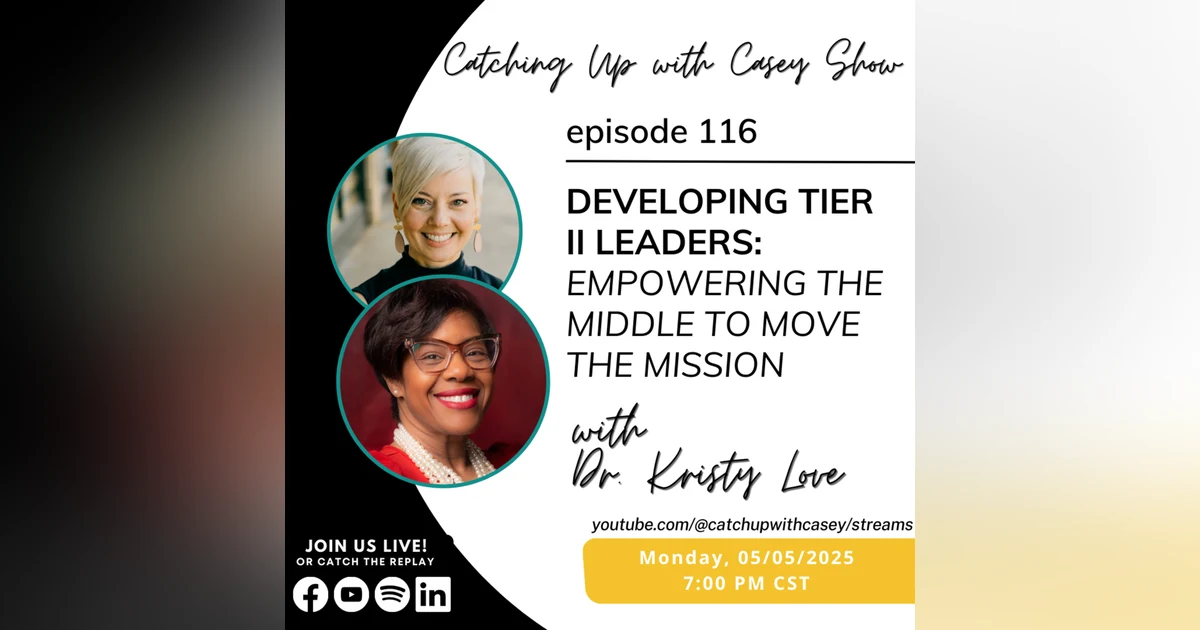
119. Developing Tier II Leaders: Empowering the Middle to Move the Mission with Dr. Kristy Love


 RSS Feed
“Mid-level leaders are the linchpins of organizational success.” That’s what Harvard Business Review found when studying the role of leaders who sit between top decision-makers and front-line staff. And in schools, that couldn’t be more true.
In this episode, I’ll be joined by Dr. Kristy Love , an assistant principal in the Houston area who has made it her mission to grow the leadership capacity of Tier II leaders—those who lead from the middle. Whether you're an administrator, instructional coach, teacher leader, or team facilitator, this episode is packed with insight on how to bring clarity to your role and build the internal character muscles needed to lead with confidence and consistency. If you're ready to elevate your influence and help others do the same, this conversation is for you.
Important Links:
Give teachers what they want WITHOUT spending more or micromanaging: https://www.catchingupwithcasey.com/clarityoverclutter
Need help getting your leaders trained in a purposeful way? https://www.catchingupwithcasey.com/identity
Ready to build the habits of a clarity-driven leader? Get The Craft of Clarity book!
0:01 Hey there leaders. Listen, quick question. Do you really need another shiny new program to fix your campus? I didn't think so. If you're tired of throwing money at every solution that promises to save tier one, it's kind of time to try something smarter. So I've got a free 30 minute training replay where I show you how to give teachers what they want and need without buying another product, adding more staff, or micromanaging the people you have. You're going to learn why most new programs don't deliver the impact they promise, the real reason teachers keep asking for more, and how to solve it without spending a dime, and how to strengthen Tier 1 instruction with what you already have on campus.
0:46 You're also going to get instant access to free resources and a sneak peek at strategies for my book, The Craft of Clarity. So go right now. Actually, wait until the after the episode. Go after the episode, grab the free replay and resources. It's at catching up with kc.com/clarity Over Clutter. Because better leadership shouldn't cost you another $50,000 and a six hour training you'd never wanted. Hey there, welcome to the Catching Up with Casey show. If you are tired of chasing buy in, frustrated by teams who just can't seem to get on the same page, or over the constant struggle of holding people accountable without feeling like you're micromanaging, this is the show for you. I'm Casey Watts, team leadership expert and the host of this show.
1:39 I specialize in clarity, collaboration, and character, and I help leaders just like you take teams from chaos to cohesion, from frustration to alignment, so teams can actually work together toward a common purpose instead of against each other as though they are functioning in different organizations. Whether you lead a single team or a team of teams on this show, we talk about strategies that are going to help you create a culture where accountability and autonomy go hand in hand. Now, with all of that said, let's dive into today's conversation and learn how to lead clarity driven teams. Well.
2:25 Hey everybody, I am so excited to have you join us tonight for this episode, Empowering the Middle to move the mission with Doctor Christy Love. Christy, welcome to the show. Thank. You so much for having me today. Yeah. Can you see it I. Can see it and I love it so much. And I know if you're watching like from YouTube or LinkedIn, you see the joy and excitement and energy without even having to listen to Christy talk. And that's one of the reasons that she's on the show, because actually we met at a TCTOTWCSE.
3:08 TCWSE Texas Council of Women's school executives. Yes, and it was a wonderful all female conference. So great to be in a room full of women who are either currently leaders or aspiring to become leaders in their organizations. And I went to your session and it was on fire. Like I loved your session. It was packed. There were so many who were eager. I mean, you could just feel it in the room, the energy and the excitement about the topic, and you were super real and authentic. And so I was like, you got to come on the show, right? You did. And I said sure, sign me up. Awesome.
3:51 Yeah, and I'm really excited about tonight's topic. I know it is something that you're passionate about. I love this topic too, and I don't think it is talked about enough. And So what we're going to do tonight is just really bring clarity to how you can empower the middle to move the mission. And you're really focusing on Tier 2 leaders. Now, before we get started, let's have you talk about yourself for a little bit. What? Tell us about the work that you do. Oh, wow, that's a, that's a loaded question, but let me let me try to sum it up a little bit. I work in Houston, the Houston area in my high school. I'm an assistant principal. I've had a, one of those careers that's been like just a roller coaster went everywhere, just not straight streamline.
4:38 But I think it's important because it helped me to develop who I am and I try to take every experience and grow from it. So I spent some time and I've been in the same district my entire career, about 20-3 years years. So as a a middle school teacher, I moved to being a middle school assistant principal. I was an elementary school principal, middle school principal. Now I'm a high school assistant principal. So I've worked on every single level in the district from one side of the district to the other. I worked on the north side, the central, the South. I'm in the southeast now, haven't touched the West yet. Maybe that's my next move, but and so, but it's it's crazy because I am I'm I live in the 4th largest city in the nation.
5:25 I think it's still the 4th largest city, but I'm from a town that has about 19116 hundred on a good day people. So we, I grew up in as a small town in Mississippi. So my authenticity like like who I am, it comes from how I was raised. We were just chit chatting before the show and I don't hold anything back. I sort of shoot from the hip and I think that that's just my Mississippi home girl, just like just who I am. And I did it as a teacher. I definitely did it as a principal and as an assistant principal. I said to myself the other day, why do the kids feel like they can come and talk to me about everything that I don't want to hear? And I just look at them and they just want to talk. And my one of the, my clerk was like, because they know when you care.
6:17 And I was like, I guess so, you know, so that's just how I am. And I try to just continue that in everything that I do. So that's me in a nutshell. That's my educational career in a nutshell. Now the other side of me, I don't know if you want to hear about all that. OK, well, tell me about where exactly you grew up in Mississippi. Oh my gosh, if you blink you will miss it. It's a little small town called Lexington, Mississippi. Think some of my family may be watching. So hey y'all. It is north of Jackson. Jackson is the the the capital city of Mississippi. So it's north of Jackson, right on the cusp of the Mississippi Delta.
6:57 And so in the middle of cotton fields and, and soybean fields is where I'm from. Like I said, if, and it's probably 2 hours South of Memphis. That's the only way I can describe it. But exit 144, so I don't, I do know that exit. It's, it's, it's my, it's my home. It's where my mom and my dad are from, my grandparents, aunts and uncles, my whole family is there or is from there. So I just, I love, I love it. I go home 3 or 4 * a year. That's awesome. So small world kind of, but my husband was born and raised in Mississippi, but he's he grew up way far South, so as almost as far South as you can go.
7:39 So Gaucher area. And lives in Ocean Springs. Yep. Yep. So right there. I know, I know. Gaucher. Yeah. My dad lives in Ocean Springs on at the coast, so that's where the other side of my family is. Yeah, and just so you all know, Gaucher, it's spelled GAUT i.e. R OK, go figure. OK, I have to know too, because you you are so fun. But I have to know what is something quirky or like an interesting hobby. So what makes you really relatable as a human? So it's when people walk into my office, my office is like a, a home away from home.
8:20 I have to, I'm a Nestor, so I have a bookshelf and it has and if if someone gave me something, I keep it. And so people know what I like to collect and what I like. I absolutely love Star Wars. I have a lot of Star Wars collectibles in my office. I just, I don't have my, my badge on me, but teacher just gave me a little Yoda key chain. I carry it with me all the time. You know, I got a lot of text messages on Sunday because it was May the 4th. So May the fourth be with you. So I'm a Harry Potter and Star Wars fanatics, but yeah, my office is full of Star Wars memorabilia, some from back in the 70s up until now.
9:04 Yeah, OK, that's fascinating. I, I that's one of my favorite parts of the show is asking people about their, with their unique quality or like just different things that they do that some of us would never even guess, you know. OK, so if you are here with us live, we would love to see you in the comments. So let us know. Are you a Star Wars or Harry Potter fan? Drop that in the comments. So tonight's episode is really all about that Tier 2 leader, which you and I both I'm sure believe are so crucial. So I want to know from your perspective, what is like Tier 2 leader mean to you? Why do you feel like they are critical to the culture and progress in a school? So when you think about Tier 2, in my opinion, it's it's like the right hand and the left hand of the leader. So if you're talking about a school, of course, that's the principal.
9:56 Your left hand has to know what your right hand is doing. They are the buffer also between the principal and the school. So if I and the teachers, I'm sorry, if you think about like my school, which is a large comprehensive high school, we have 2000 anywhere between 1800 and 2000 students. And there in a high school, there are just things that are happening all the time and the principal can't be everywhere. Even though my principal feels like she wants to be everywhere. She's like wants to be superwoman, but she has to have people that are there to, to state to state the mission, who to carry on the mission and not just do what she says to do, but to be the person to speak the same language to, to, to have the the same message that goes across.
10:45 If we have my team meetings, we have to ensure that things are disseminated to all the teams the same way. So that again, a school is a system is a team that has to has to run on one accord. If you don't have effective tier twos or you have tier twos that are not getting the coaching that is needed, then that system falls apart. It falls apart there. So that's where the key is. If the if the leadership team is cohesive and together, then the rest of the school can move move accordingly. Yeah, something you are you've said struck A chord and you talked about these Tier 2 leaders like assistant principals, what have you, getting the training they need.
11:34 And I find that so often we wait until people become principals to provide that training. And then sometimes not even then, it's almost like, it's almost like people get into that position and it's, it's like we assume they've made it to that position so they have the skills that they need, but that's not at all accurate. And they need probably more support now than maybe they need it in the classroom because you're dealing with a whole new set of people who are really complex. And also you're dealing with a whole new set of issues at like this 30,000 foot level that are different than what you would in the classroom. Yeah, absolutely. And that's where the the breakdown can sort of happen. I remember I went from being a classroom teacher to being an assistant principal.
12:22 And when it was time for me to just to to deal with a discipline issue, I didn't even know how to fill out a referral form. I was like, what do I do with this? And I was lucky that my my campus had multiple assistant principals and assistant. He sat down with me and showed me what to do. And so and then he's my my principal. And he was great principal, don't get me wrong. But you know, he was like, you're going to be in charge of keys. And I was like keys, OK, I didn't know there were different keys that did different things. And so I, it was like on the job training. And a lot of times we, we don't know what we're doing wrong as, as tier twos until we do it wrong.
13:06 And it's sort of like just say, I'm sorry and I won't do it again. But if we knew from the beginning what, what could happen? Oh, there we go. My light went out. I knew something was going to happen. If we knew from the beginning of what we, what we should expect. In my district, we had a, a cohort, an assistant principal cohort. And every month we would meet and we would talk through different issues that we were having and how to do certain things. But it was more in general and it was a great cohort. I'm still very close with some of the people who led the cohort and was in it with us. But it was, it didn't teach you how to time management, which is something that Tier 2 that we struggle with. I mean, it's just anything that can happen will happen. Just ask me about the day today.
13:57 So how do you prioritize when you say we need you to spend 80% of your time in the classroom focusing on instruction when you know you're getting called over the radio 50 times a day about something and you have to be able to figure out how to prioritize and jumping into the fire like that. And that's just day-to-day. As a teacher, you only have to deal with your wonderful children in your class, but as a Tier 2 is the first time you get to deal with other adults. Yep. And that's when it even starts. You start to say like, wait a minute, what what is what is really happening? Is this what was going on in your classroom when I was overdoing that?
14:38 That's just a whole another level. Yeah, it is so interesting. I I've worked with, you know, I mean, obviously I've worked with lots of teachers before, but one of the things that especially when you're starting to implement like an initiative or you have an area focus and goals and you start to cast the vision for that. I have heard teachers say before, but don't we already do that? Like we already do that in our classrooms? And I'm like, you see what you do in your classroom. And I think we make the assumption that because you are doing it, it is being done. But when you step out of the classroom, it's like a whole different ball game. You see things that you never imagined you would see. So yeah, I love that you brought that up. So then let's talk about the types of clarity that middle level leaders need to have in order to be really effective and thrive.
15:31 It's one word communication. It it's, it's communication. You have to be able to clearly communicate what you need and what you don't need, right? And that communication. And as a Tier 1, you have to be able to communicate what you need and what you don't need. So that, that's, that's one level of communication. That's a one-on-one. One thing that a lot of schools do is that they have team meetings all the time. We're going to meet about a meeting to meet about the meeting. We, we, we love to meet. This is just a, a side note to my principal. If she's watching, I'm just going to show this, show her this clip because she knows how much I love how much I love meetings.
16:18 But, but if they're necessary, especially when you have a large campus, but we, we meet as a group, but how often are we meeting one-on-one with that, that Tier 2 to have that one-on-one conversation to talk about. Here are the things that I see that you're doing great. Here are the things that I feel like we could work on before that middle of the year conference or before the end of the year conference. Having that time, whether it's once a week, once a month, whatever it is you're having at that time with it, with the person, not because something is going right or wrong, just because I want to, to make sure that we're on the same page. I want to see how to coach you and grow you. And in the meantime, I probably, I'm probably growing and coaching myself.
17:01 In addition to that, when you talked about new initiatives that come along and the teachers need to know what's going on, the team also has to have clear and concise communication. As the principal, as the leader, as a tier one, of course you're going to come up with the plan and you're going to have the vision and set the vision and you may have a plan that you think is all laid out. Being vulnerable enough to sit down with people in the room and say, hey, let me get the I want. I'm asking for feedback because I really want that feedback so that we can now see what clear pieces that we have to we we can put together. And then once we have a conversation about that, package it up in a little bowl and say, now let's look at the final product to make sure we're ready to go that way. When a teacher in on one part of the building, ask a question to 11 assistant principal, the same answers given on the other side. You know, like with me, I'm over one grade level. However, the teachers that I appraise and the content I appraise is a whole nother grade level. So I have two different conversations and they're talking to their grade level principal in addition to other people.
18:15 It is like they want to hear this, they want to hear the the consistency. So that's where the communication comes into play. Yeah, yeah, it's, I think we don't focus on that enough. I think sometimes what ends up happening, obviously we get bogged down by just the everyday, the fire hydrant that's like, you know, spitting out water at you just can't take it. But so I know that there's that element, obviously, but I think we undervalue the importance of packaging. I love the way that you said that, like just packaging this into a little box with a bow on it. It's the same for everybody. But we as a leadership team have to get really clear with each other before we can start pushing that out. And I think we we lose that part of the communication piece. You know, one of the things I was talking about recently with a colleague is we talk about clarity all the time and we use the phrase like clear as kind from Brené Brown. And I, I can get on board with that. But we think about clear as kind so often as like hard or difficult communication or conversations, but it's not necessarily that clear as kind is I am creating or putting action to my clarity.
19:31 We're putting action into are clear forms of communication and I think we lose that piece a little bit, but. It is the action. It's the action piece. Sometimes we, we move so fast. They're like, OK, we have to get this done. We have to move. We have to move. We have to move. I get that. But I promise you, if we just take a couple of minutes to make sure that it's perfect and now we're on the same page. We have a thing that we, we, we talked through when we, when we coaching teachers, you didn't get an opportunity to stamp the learning. You ask the question, a student responded. And then you move to the next thing. You know, we have to do the same thing with our tier twos to make sure. OK, now I get what you're saying because I, I can't read your mind.
20:13 And I think a lot of times we think that you can read my mind and I make the joke all the time. I was like, oh, my bad. I thought you could read my mind. Like I'll, I'll start talking about the sentence and they're looking at me like, what, what are you talking about? And you know, I make a joke about it, but I have to come back and say, let me start from the beginning and then talk through it and then ask the question, are we clear with it? And as teachers, we want the students to repeat back to me and make sure we're all on the same page. Sometimes we move so quickly and things need to happen that we say it, we say it, we say it and I break and then I'll go to my counterpart, my work, my work best besting. And I said, now what we do, she was, I don't know. We don't figure it out together.
20:55 We won't figure it out together though, you know, so, but that, that, that is just a, a day-to-day. And I get that, but when we're doing something that really can impact because not everybody can handle change And, and, and especially teachers, they're so just, you know, and kids as well. You know, we, I made a joke that one of our assistant principal, she loves the intercom in the morning time. That's her thing. And so every Wednesday you hear that commercial. It's what day is it? It's hump day. And on Friday, it's Friday. I don't know where that song came from. And I was like, what if she didn't play it? The first person to complain are going to be the students. And I work at a high school.
21:36 They're like, why isn't she playing the Friday song? Because we like the consistency and we want to see the structure consistency. You got to think about, we do that for students, we try to do that for teachers, but we lose the people in the middle that are the leaders, but they're still learning. That's the piece that that when when tier twos fail, that people don't realize they're still learning. So you still have to coach them to do the job. Yeah, absolutely. There's so much. There are so many good Nuggets of gold and what you just said, But I think what stands out to me most is when you mentioned how you approach those kind of faux pas that you run into, for example, when you haven't been completely clear and you're making the assumption like, oh, well, you know what I mean? But then, oh, wait, you're kind of making like, it's that what do they, what do they call that like self, how self deprivation. I think, right, like I'm just going to make a little joke about this faux pas.
22:39 And now we're going to back up and I'm let's kind of map out what I should have said instead. But that speaks to how you have intentionally developed your character for this leadership role. So I'm really curious about how you support character development or how you feel like other people can support character development in those middle letter level leaders like confidence, resilient, self-awareness. Because what you said is like you are super self aware. So you when going into this position, a lot of times we don't know what type of leader we are. We know what type of leader we want to be, but we don't realize what type of leader we really are until we do it. So as a Tier 1A principal, especially on the campus level, you have to, by that time, you've pretty much developed when you become a principal, you've pretty much, you pretty much know what type of leader you are, right? So what you have to do is now pull that out of the person that's around you, right?
23:44 And so being able to see, oh, they think this way. So this is the way that I need to approach, approach, approach them. You know, we've heard of those Northeast S, the West. Are you a West or east or north? The colors, you know, that type of thing. My favorite is through I learned it through Deloitte courageous principles. It was, it's called the business chemistry. That's my that's my favorite way of the personality quizzes. And because what it does, it doesn't just say this is who I am. It teaches you to look at your team and say what this is what this person is and this is what they need. This is what this person is and this is what they need.
24:25 This is what this person is. So when you know who's on your team and what they need, you're not just saying, oh, that's how she thinks, that's how she acts. No, let me figure this out. An example is after the first time I did that, I had a, a leader on the campus when I was principal and he would come and come, come to me with this great idea. And every time he came with the idea, I was like, well, how you going to do that? What's that? How, how many people it's going to take? Well, are you really going to? I asked like a gazillion questions, right? Because that's the way my brain works. I just want to map everything out. And he, his feelings would get so hurt. Oh, he would get so upset at me and he was like, you never want to hear what I have to say.
25:07 And I'm like, dude, I'm just trying to make sure that when you do it, we don't have to redo it because you're trying to do all these grandiose ideas and you just jump into it and you not you haven't thought through it. So when I learned that we were polar opposites on this spectrum because he's like a let's go and initiate it. Let's get it done. And I am a, you know, I need to see The Who, what, when, where and how before I go through it. But in order for him to feel valued, all I had to say was that's a great idea. I like that. Now for me, you know, I have to think through how this is going to work because I really want to execute your plan knowing who they are. So when you do that, going back to building that confidence, it gave him the confidence to be able to come to me with more, with more ideas because he just thought that I was going to shoot down every single ideal he had. It's not what I want to do.
26:01 What I want to make sure of is that things are done decently in order. So on the flip side, they know that if I'm asking the questions, it's not because I just don't want to know. It's just because I'm, that's, I'm an analytical person. I, that's the way I think. That's where my brain operates. So we just had to understand each other. And when that happened, it was, you know, we, we, I love him to death. We're still really close, but he knew that I wasn't just shooting him down. We have to be able to learn how to build that confidence in, in, in, in people to know it's OK to push back, it's OK to ask a question. It's OK to. And as a tier one, we have to be able to take that and run with it.
26:43 I was just had to talk to some teachers today and they were mad about something and I just sat there because I know my teachers, I know that they like to vent and then when they finish venting, OK, now what? Now here's what we're going to do because you can get mad at me all you want to you can get mad at whatever once you finish and I'll ask them, y'all finish or are y'all done like now we can move on to the next thing. But but they tell me all the time you get how we are because you know once we finish this, we're going to go and we're going to do exactly what you need us to do and how you need us to do. That builds the confidence to make you feel comfortable sharing your frustrations, sharing your ideals, being I'm confident because again, you don't know what type of leader you are when you step into this role. Yeah, it and so much of it is exploratory like that. I mean, you, you're go, there are obviously going to be pitfalls and mistakes that you make, but we've got to learn how to grow and learn from them instead of just allowing it to keep us stagnant.
27:46 So I wonder what are some other, I mean, I'm sure that's a common pitfall, but are there other pitfalls or patterns you see in that middle level leadership? And how do you help people to move past that? Other than that piece, the biggest one I, I mentioned it before is time management. We don't know what's important. We, we, when you get into that role, you're trying to prove yourself and you want to prove to everybody that you should be there, right? And you start drowning because you've just spent an entire day and entire week at work and you haven't done the things that you know you're supposed to do or that's most important because you've been, excuse me, putting out fires all day long.
28:31 As soon as the radio goes off, you're running to it like I can do this. I'm, you know, but is this something that you are putting a pause on for this or that, You know, like they don't understand that when it happens. And I, my life was changed and I, I didn't figure that out when I, my, in my first round as an assistant principal. Oh no, I would just do everything that needed to happen and we'll go home and take a bag of work home and come back with that same bag of work. But it was as a principal, I learned the ideal of the time matrix. It's like the four quadrants and understanding what's important and what's, what's important but not urgent versus things that are urgent and important. What causes you to drop everything and run? Is this something really for me to drop everything that you run for?
29:20 Is this something for me to to, to switch up what I will, what we were planning on doing? It's the whole ideal of the big rocks versus little rocks, right? When you fill a try to fill a jar with rocks and sand, If you put the sand in, which are the little rocks, which are the minute things that you do. When you put that in the jar 1st and you try to put the big rocks on top, it's not all going to fit. So you're not going to be able to fit everything that you want to do within a day or a week if you start with the little fires that you're putting out. But if you start with the big rocks and you put those in that jar 1st and then you pour the sand in, you can fill the jar up because the sand is going in and feeling it's just filling in. So that's, that's how you look at your day, your week.
30:01 I try to make sure I map out my week and say I know the the most important things. My week this week is getting my 6 spots done. Those are the observations that we have to do. And this is EOY conference week. So I got to make sure that I schedule those out. Everything else, if I have an EOI conference scheduled for today, I'm doing the EOI conference, you know, unless the building is on fire, then I'm going to stop that. And then we're going to do the EOI conference in, in, in the parking lot while we're waiting for the waiting for them to come, right? Because we have to, I have to make sure that these things get done because what's going to happen is Friday, it's going to hit.
30:41 I'm looking sideways because I haven't gotten these things done. And then you have a compliance deadline and then it stresses you out. So with tier twos understanding and figuring out how to prioritize, that's going to look different. If you're working at an elementary school, a middle school, a high school, it's going to look totally different. I had 9th graders last year. I have 10th graders this year. It looks totally different depending on the grade level. My the ones that are over the seniors, it is prom and graduation time. Their priority levels are different, right? But understanding what's the most important thing that must happen this week, today, and how are you prioritizing everything around it?
31:26 If I know that I have something to do and the only time I can meet with the teacher is during the time that I have lunch duty, then my question is which one is the most important? That could, OK, I'm going to be 10 minutes late for lunch duty because I need to make sure I prioritize this. Then you're stressing out because, oh, I got to stop because I have to do this. Do you really have to do that or is it someone that can take over for you during that time and you could tell them, OK, now you can leave 10 minutes early because I got your spot. That's, that's also building a relationship with the people that work with you because you're not doing this in isolation. You're not doing this in a silo. You have to be able to work with people. And that's that time management piece. We don't know. They don't know how to sort of juggle that.
32:08 And then you get lost in the compliance and you get lost in what what you haven't done. Yep, and then you are not able to move the mission which is in the title of this episode. Y'all just so you know. Yeah, yeah. And that mission is, again, spending the time that you need to spend in the classrooms, you know, to move, to move instruction to, to meet with, to be with the teachers, to coach the teachers, to talk to the teachers. You know, if, if, if your day is spent doing all the other things and not coaching and like I said, I set the six spots, though, that's opportunities for me to be in the classroom. If I'm not there and doing that, if I, if I answer every single call that happens while I'm in POC, then how am I coaching the teachers? How are we doing doing the at best the things that are needed to be done if we're not prioritizing our time correctly? Yeah, 100%.
33:05 So earlier because one of the things that I wanted to talk about, but I feel like we kind of we've talked about it already. So I think I want to move on. But what I was about to ask is the principal's role in developing those Tier 2 leaders and what support actually looks like. But we've talked a lot about like just the intentionality of meeting regularly and the coaching behind it and developing those leaders. So I really want to know success stories where you feel like a Tier 2 leader grew into becoming a clarity driven leader or they developed character traits and it had a ripple effect on teams. Wow, that's a that's an interesting loaded question, but you know, I'm going to I'm going to do what I can do with that one. So I because of the type of person that I am, I can be a little, you know, chew from the hip and brash. Sometimes you, you don't realize that you're helping and supporting people until it happens, right? And then they say, you know, I learned this from you, I got this from you.
34:07 So that type of thing. So I'm going to utilize, I'm going to talk about one person that worked with me, a couple. There were a couple, but I'm just going to focus in on one. And she came in as a first year Tier 2. I didn't have assistant principals on the campus. So she was a teacher specialist and coming in, I didn't realize it until like it happened, but she latched onto every single word I said, how I said it. So if I walked into her PLCS, if I said it in the meeting, she said it in her meetings like that the exact way. And that was the confidence that that she needed to be able to successfully to talk to if I were, if my, my boss came on campus, she was able to walk with them and have the same conversations, just like if I wasn't there. And so with that, I left, went to another school. She stayed and continued on those processes, understanding I, I had a little board in my office. And on the on the board, I had two things that were written. One was the word focus and I had it big because that was where I put my big rocks.
35:28 And the other one was what's the plan for that? So if you came and we didn't have a plan, then we're just talking where, what's the plan? How are we going to execute? Because I'm ready to execute, but what's the plan? And so her thought process with everything that she does is I need a plan. What is it going to look like? Do we have a plan already? How can I tweak the plan that we already used on at this campus? So she's taking things that we did on the campus and now she's in a what you call a principal apprentice program where they they coach Tier 2 leaders to become principal so that you would be ready to go. Our district does that. It's a great program. And that's what she is. And they, when, when people mention her name, they were like, Oh my God, she's amazing.
36:13 And she tells us all the time what that she got, that she learned this from you, things like that. And but she just, she really had it innately in her. It's just about the confidence to know I can handle it. So I know that I'm looking forward to seeing her become a campus leader, which I know it's going to be happening sooner rather than later because and, and taking that and building that confidence and, and then also being comfortable with asking for help, calling and saying, Hey, I, I need this or relying on others to be able to do that. I think that I'm, I'm most proud. I have a, it's a couple of stories that can say about that, but I'm most proud about her because, you know, we, we move together in other circles and it's the same way.
36:57 We rely on each other, we lean on each other, But she's not afraid to say, I got this, I learned this from you and I'm pushing forward. And so I just like to see like just others winning. That's such a powerful story and I love that so much. And it shows how important our actions are on a day-to-day basis because people are learning from us. I mean, the the good, the bad, the ugly, they're learning from us. And so they're going to implement the systems that they've been a part of and the experiences that they've had. So that's so, so special. So if someone today is listening and they want to better I I actually want to say this two ways. If they want to better support people to step into Tier 2 leadership or they themselves want to become a better Tier 2 leader and know like the impact that they have as Tier 2 leader. What would be the first move you'd recommend? So if you're going to support a Tier 2 you that's you got to do that.
38:04 It has to be true support that I got you, not Oh my goodness, what are they doing? It's true support, you know, and that means courageous conversations, being able to be vulnerable and say, hey, you know, you did this well, but here's where you need to grow and work and I'm going to help you do this. And it's in a non threatening environment because the word that you used was support it, it aligns with communication. But being being a true support, you got to be open for that. Open to just to be honest and let them fly and flourish. Understand that we can both win together. I can win and you can win.
38:51 This is not a competition because when I shine, you shine. When you shine, I shine and we're going to shine together. That's, I think that's a song. Maybe it is. Are you going to break out in song? Yeah, I, I and I will. So I'm trying not to because I was about to sing it, but it's a Yeah, but but that's the that's the first part. If you're supporting A Tier 2, if you are a tier, if you want to get into this role and you're feeling unsure, first of all, you got to be willing to step out on faith. And second of all, you have to be able to be vulnerable and not be afraid to show what you know.
39:31 You got to be not afraid to show what you know, to go out there and prove and show that I can do this. If we're sitting in a meeting and your boss says, OK, we're going to do this presentation and I need some support and help with presenting this area, I'll do it. I don't know what's on that PowerPoint. I'll do it because guess what I'm going to do? Go learn it and be able to present it and support and say, let's meet together, let's do it. Be OK with that I and be OK with stepping outside of your comfort zone. My first year as an assistant principal, my background is science. I taught science. I was a science department chair. I knew everything about it. I got to the school and he put me over speed.
40:15 And my feelings were hurt because I'm like, why are you doing this to me? I don't know anything about this. And I talked to my past assistant principal and I said, you know, he put me over SPED and what is he doing? And I know that she said, who do you know in the district that works in the science department? And I started naming off people. How long do you do you know how to do this? And she started talking about the science stuff. She said, what about SPED? Who do you know? I said, nobody. What do you know about? She said, well, use this as an opportunity to learn everything you need to know about SPED. And you said, and that's what I did. And the next year I said, hey, can you give me reading? And then the next year I asked for math so that when I was there, I was over every content area.
40:56 And guess what? I'm over now. Social studies and visual arts it and it broadens you. So don't be afraid to step outside of your comfort zone. I've only worked in elementary school and now there's a middle school that's open or vice versa. It's OK. It's OK. Show them that you can thrive on every single level and move, move what you need to move. And that that person I was talking about, she ended up becoming a principal apprentice at a high school. She's never worked a high school and went over there and killed it was doing what she needs to do so much. So they said we need you at another school to help do the same thing you're doing at this high school. She knew nothing about high school. But they didn't know that, you know, So don't be afraid. Yes, I love that so much.
41:42 You're limiting yourself. When you start put, when you start saying those phrases, they become limiting beliefs in your own mind. They become your own narratives. You can't let that happen. Otherwise, you are stifling what you're able to do as a as a true leader. Absolutely, Absolutely. Yeah. OK. So we have a comment that I have to show you. Love this, Christy. Do you see it? Yes, I see it. I love it so much. My auntie, she's watching from California. Hey. Hey, Betty. It's so funny my, I posted a video recently of a keynote excerpt that I'd done and I just shared it with people and I was like, you know, comment, I would love to see your thoughts or whatever.
42:30 So I look at comments and my mom's in the comments and she says something, but she's like, and that's my daughter. And I was like, all right, mom, trying to keep it a little more professional here, but it's fine. You, you're proud of me. I love it. Absolutely, your parents are always proud. My mom has called me 15 times and I was really just too trying to make sure she has the right link to get on and I hope she got on. I don't know, she's not texting me so I guess she's on there. Oh, that's awesome. Well, thank you so much for all of your raw vulnerability knowledge, encouragement. I've loved every bit of it, and I knew I would after having gone to your session at TWTC.
43:12 No, don't, don't, don't. Hold on. I don't know why I struggle with it. TWCSETCWSE that was it. TCWSEI need to, I need to make a rap or something. I don't know anyway, but this has been so great. Where can people connect with you? So I am on Instagram at Doctor KKKAYL UV1913. I am on X under principal love at principal love. I don't do X as much as I used to do, but I'm there and I I check every so often.
43:54 But and but I am definitely on my social media with Instagram at Doctor KAYL UV1913 so. I love it. OK, well, thank you so much for coming on guys. I hope you have so enjoyed this this session tonight and we will catch you next time. Thank you, doctor. Kristy Love this has been great. Thank you so much and I enjoy catching up with Casey. Yeah, bye y'all. Hey there. Thanks for joining this episode. I would love for you to do ME3 solid favors before you head out. Number one, subscribe to this show. I've got a lot of great guests and content coming up and I don't want you to miss any of it #2 share this show, Share it with your like minded colleagues and friends who want to learn how to lead clarity driven teams. And finally connect with me on all the social media platforms you can find me at.
44:55 Catch up with Casey on Instagram, YouTube and LinkedIn. Until next time, go off and create teams that leave people feeling inspired and powered and eager for more each day.

