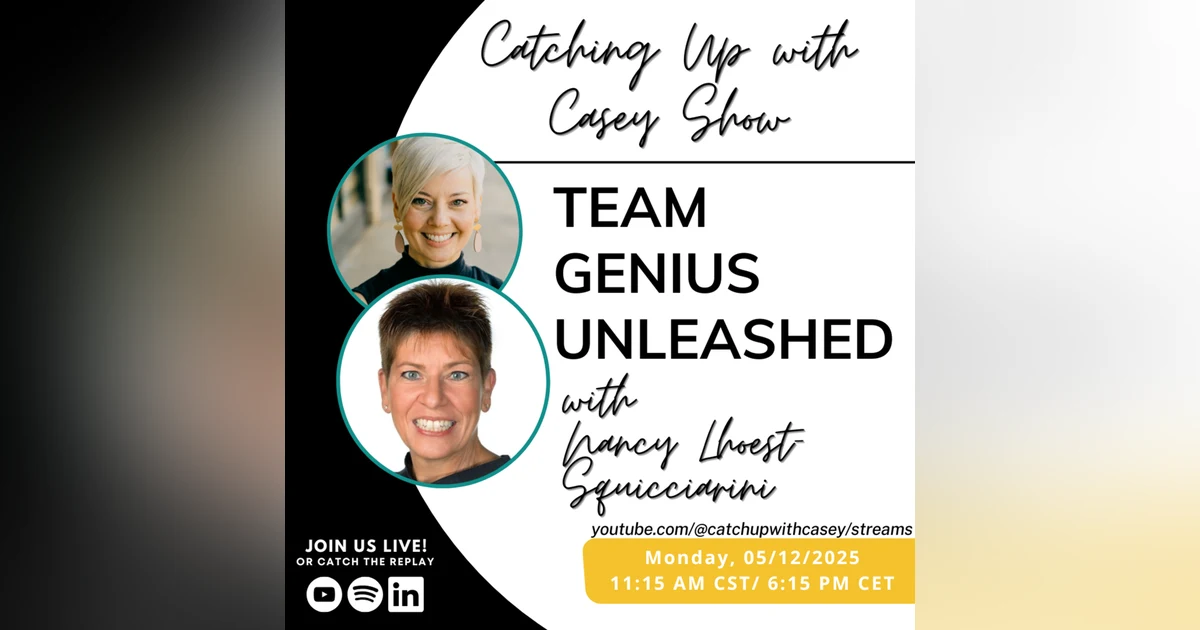
120. Team Genius Unleashed with Nancy Lhoest-Squicciarini


 RSS Feed
Ever feel like you're the only one holding the team together? I’ve been there—and so has my guest, Nancy Lhoest-Squicciarini. With over 30 years of international leadership experience, Nancy brings a powerful perspective on what it really takes to create clarity and unlock a team’s true genius. In this episode, we dig into what makes teams thrive, why middle leadership matters, and how you can shift from carrying the weight alone to building something truly collaborative.
Connect with Nancy on LinkedIn
Find out more about ECIS: https://ecis.org/about-ecis/
Important Links:
Give teachers what they want WITHOUT spending more or micromanaging: https://www.catchingupwithcasey.com/clarityoverclutter
Need help getting your leaders trained in a purposeful way? https://www.catchingupwithcasey.com/identity
Ready to build the habits of a clarity-driven leader? Get The Craft of Clarity book!
0:02 Hey there, welcome to the Catching Up with Casey show. If you are tired of chasing buy in, frustrated by teams who just can't seem to get on the same page or over the constant struggle of holding people accountable without feeling like you're micromanaging, this is the show for you. I'm Casey Watts, team leadership expert and the host of this show. I specialize in clarity, collaboration, and character and and I help leaders just like you take teams from chaos to cohesion, from frustration to alignment, so teams can actually work together toward a common purpose instead of against each other as though they are functioning in different organizations.
0:46 Whether you lead a single team or a team of teams on this show, we talk about strategies that are going to help you create a culture where accountability and autonomy go hand in hand. Now, with all of that said, let's dive into today's conversation and learn how to lead clarity driven teams. Well, hey everybody, happy Monday. First of all, if you're listening to this on a Monday, if you're not happy, whatever day it is, I'm really excited to have you guys listen to this episode because as you know, talking about teams is one of my very favorite things to do. That's why I have the podcast anyway, is because leading teams can be a really unique thing that not everyone is comfortable with. And I aim to bring a little bit more comfort and confidence in these conversations that I have.
1:40 And that's why I'm so pumped about today's episode. We're going to be talking about Team Genius Unleashed. You heard that right, Team Genius Unleashed and I am joined by Nancy. And Nancy, I'm going to give you a chance to introduce yourself and more importantly share your last name that I am no doubt going to butcher if I try it myself. So, Nancy, welcome and tell us about the work that you do. Thank you so much. I love being here. Well, my name is Nancy Lois Kuchrini. So, and right now I am living in Luxembourg and I'm really privileged because I work for an organization which is called ECIS, which is the educational collaborative for international schools. And my focus is on really group dynamics, effective teaming and working with middle leadership and how they make a difference in bridging, let's say, senior leadership team with their teams. And I love that intentionality of working with these leaders. I also do a lot of leadership work doing summits. And I don't like the word retreat because I feel like that's going backwards, but some leader, you know what I mean? Like you think of a retreat not to go back. So I think of leadership.
2:47 I would say celebrations that I also work to ensure that there's an alignment between the middle leadership and the senior leadership in terms of approaches and practices to elevate all voices within their school. Oh my gosh, I could not love that more because so much of the work that I do with helping leaders gain and create clarity is really just bridging the gap between the adults of an organization. And I think man, the importance of these middle level leaders and the leaders that they work with, I'm not going to say under, but with is imperative to gain clarity and bridge that gap. And often there are so many different narratives at play and we don't even realize it. So let's I want to ask you before we dive into our topic about unleashing Team genius, what is something that makes you just uniquely you and human?
3:42 OK, that's I thought of two things. The first was professionally most people see me on like facilitating or they see me being working with a group of 500 in a room, but yet they think I love going out. Like I'm not an extrovert and once that sessions over, I actually need time to just come in for myself. That quiet time to recharge and I enjoy sounds horrible staying home. So when I'm not traveling, I want to be in yoga pants, I want to be watching Netflix and I'm really happy not going out, though most people like you want to go up. That's not me. Not me. And I think my second because I do travel. I am the person who goes into a gift shop at an airport and buys we use a French word known as kitsch. We're the cheesiest, cheesiest souvenir of the country. I love that I collect them.
4:37 So I'm going to podcast my table of the kitsch or cheesy souvenirs. So I think that makes because people think, oh shit, you know, our house must be. I'm super neat. I'm very organized. Everything's labeled, but except this one table. It is the cheesiest souvenirs you can find and I love them all. That's so awesome. Listen, I'm gonna, I might have to pick up that habit because I do go into those stores when I'm traveling. But oftentimes in my mind, I'm, I first think, should I get something for my family, like my family members, But I've got 3 kids and a husband and I'm like, wow, that's going to get pretty expensive if I keep doing this. Or I think, man, they're everything in a in a gift shop, especially in an airport is just too expensive. But if you could find those little like cheesy things. I love them.
5:25 Or what we do is every time we travel, we always buy something that can be put for a Christmas ornament. So every year when we, you know, it's just a lovely. So those are my, that's my weak side. Gift shops in airports with really, really cheesy ornaments. That's for me. I'll go every time. I love that and and we also are kindred spirits because I too am I. I guess some people could say I'm an extroverted introvert because I can I just can light up in a room when I am presenting, but it does take all of the energy out of me and so I have to retreat after that so. No problem with that. I love going into the room and just having that private time. Yeah.
6:09 OK. Let's talk about this topic and what I've started to do with this show because I am so on clarity. I want to, I want to kind of give our audience a lens through which to approach this conversation. We want to bring clarity to something in every show. And what we're bringing clarity to is how to unleash Team Genius. And I want to ask you first about, first of all, when you think about Team Genius, what does that mean to you? Just so we can kind of come to a common definition with our audience team. Genius always foundationally is psychological safety, but that word is used so often it is almost becoming white noise. What does that mean?
6:58 So for a leader it's that intentionality and not even mentioning the word psychological safety. How do you make explicit you want diverse ideas? How do you make it explicit that you're going to gather feedback at the end of every meeting? How you can make it explicit that we can engage in cognitive conflict that's healthy, which promotes innovation and creativity. And then how do we create a space for new ideas to be introduced? And that doesn't just happen by bringing a group of people into a room and having tea and cupcakes. The leader needs to and and I love Amy Evanson's work, but sometimes when you have staff here, there were psychological safety.
7:40 They think, oh she must have been on a course this weekend and now we're using that term. It has to be embedded within the school by that intentionality of the even those five areas that I mentioned, the feedback making explicit promoting diverse ideas, cognitive conflict, those that to me is what creates a dynamics of effective teaming. Yeah, that's fantastic, man. There's so much to impact there. So, so let me ask you this. What do you feel like has learned? What have you learned about what makes a team really effective beyond the surface level collaboration, which I feel like you just touched on, because there are so many components that we have to implement if it's going to be a truly effective routine. I would say as a leader of facilitator, the use of protocols because number one, that becomes a data point. It's not about you, it's not about me. This conversation, each person only has one minute and you're trying to provide equity in terms of sharing perspectives. And equity doesn't mean everyone has to be speaking, but you're providing a platform to share.
8:50 So the use of protocols is a great book by Andy Buck, leadership 3 Point O, and he talks about the idea cultures, how we do things around here, but the protocols, practices and structures you have in place, behaviors evolve around it. So if you want a team that promotes that type of behavior, have those structures and protocols and it becomes embedded within the culture of that school or that organization. So protocols and a term that I don't think is used enough is a facilitative leader. How are they elevating the collective wisdom in the room? And that is the structures and protocols you have in place, because again, it's a data point.
9:32 It's not that. And you communicate all these structures and protocols of how you want to elevate the thinking of that meeting prior to the meeting. So if you know you're using a certain protocol, that would be the agenda, how many minutes you're going to spend on that item. And that then becomes part of that organization, that type of thinking that happens during that collaboration time. Yeah. And when we think about, I always when I hear people talking about protocols, which I agree are so imperative for authentic, effective collaboration as a leader, we have to really consider how we're bringing clarity to those protocols. Not only thinking about the how, like the what, why and the what, but also the how, like how, how are we going to implement this and how are we going to know that it is successful? And that takes follow through.
10:26 So we can't just say this is what we're going to implement, this is what it looks like, and then let the people go. Instead, we have to be really intentional about providing feedback regularly and celebrating systematically over time so that it does become a part of the culture. It does become a part of your habits as a team. Yes, well, it depends on I, I think of facilitation. You have your psychological safety and then you're focusing on relationships process and results. So it's great that you're sharing the process as you said, but what are the results because of that collaboration. So the relationships is making that sense of inclusion, having people feel like they're part of this learning community, that connection. Then the process is the thinking. What you just said, what are we trying to do here? What's our objective?
11:14 And then the the results, what is the meaning? What will we what would be the applicable the takeaways from this collaboration. So, and many times when working with teams that's they usually just jump into perhaps they forget to #1 promote the sense of community, even if it takes one question as soon as you walk into a room. What made you smile today while working with a child based upon a learning outcome? Because I'm not a big ice breaker person. To me, Ice Breakers have no sense of it Doesn't It's not along with a learning outcome. I love the idea of you getting people connected as a community based upon one of your learning objectives.
11:57 That then is the foundation to get into your conversation. So as soon as you walk into the meeting, the leader should have that provocation either on the table and they start talking because you know, most meetings are after school or they're exhausted or in between two periods where they're going to be, what, 50 minutes to the Max and then getting ready. So how do you really utilize every minute? And as soon as they work in, they should know what's that? What's the mind thinking that's expected from them? Yeah, I would love to hear your thoughts on this. But you know, so Peter DeWitt, if you're not familiar with him, he does a lot. Yeah. Oh, my gosh. He's just being favorite.
12:37 I love him so much, but he does a lot of work around like de implementation and really thinking about how we approach team meetings and faculty meetings and things like that. So he really does promote a lot of flipped meetings. So we're doing at least a portion of this or at least preparing people ahead of time for here's how we're going to connect, be thinking about XYZ, you know, So tell me about your thoughts on that. Well, it, it, it almost goes back to, I don't know, Harvard Graduate School has a, it's called meeting wise. I don't know if you're familiar with their template, but they have the five PS and one of the PS is purpose and then process and the other one is preparation. So every meeting should include one of these five PS. And that goes back to what Peter's talking prior to the meeting.
13:28 How are those individual your colleagues preparing and how are you preparing? So again, it goes back to the flip. What do they need and you never provide reading time during a meeting. That's a professional obligation. I'm sorry, you know, and and if they and you have to make then accountable for them, don't ask a reading and then don't follow up on it. Either have some type of structure or sharing to let you know they're unpacking. I hate the word unpack. It's always used, but it's but the meeting wise template. There are five PS1 is preparation and that would actually align with what Peter. I actually used Peter's quote in my presentations about. Sometimes you have individuals who are going into a meeting or a workshop and they have no idea why they're there.
14:12 Yep, Yep, exactly. In in fact, I can attest to that on a very kind of personal professional level. Oftentimes when I work with schools. So I typically will work with the instructional leadership team, but there are oftentimes where I will also meet with either teachers individually or groups of teachers to do listening tours. And just, it's kind of gaining insight on their perspective about a leader's instructional focus or their, their goals. And I have had this happen on more than one occasion too many actually, if, if I'm being honest, where I pull them in. The first question I say, I, I ask is tell me about what you know, the purpose of this meeting is. What do you, what, what's been conveyed to you about this? And too often I met with, well, I don't, I don't really know. Or are we in trouble?
15:08 Or, you know, like there's just that, that lack of clarity around the purpose behind things. No one's been prepared for that. So man, I love everything that you're saying. And imagine their mindset going into a meeting, not knowing why are we here? What's our purpose? And you actually get some apprehension. Some people are anxious thinking, like you said, am I in trouble? And Can you imagine if there was that clarity, intentionality of having that meeting communicated, use the five PS from, you know, meeting wise use, you know, Michael Wilkinson's work of, you know, the head, heart and the hands, whatever, but that intentionality is necessary. Yes, OK, Clarity is a word I think we've already used quite a bit in this episode. I know we both use it often.
15:55 What does clarity actually look like in a thriving team and how? I mean, can you go beyond what we've already said to talk about how leaders cultivate it? When it comes to clarity, it also comes down to the one word. It's communication. We forget, especially within international schools. We have to remember that you could have in my school, I was at the International School of Luxembourg for 31 years. We had approximately 57 nationalities, 38 to 40 as staff. So think about their previous experiences. So when it comes to the communication, I always use Aaron Meyer's work, the culture map of where you talk about low impact and high impact communication. Low impact is necessary when working in a global organization.
16:43 So therefore our leaders providing that clarity with low impact communication where you don't need to know about who I am culturally, that is the clarity is provided. And I especially when thinking about the compositive International School staff, their experiences range. You can have someone for the French national system from the Singapore nationals that they've been in seven international schools. So you need to make it clear according to what aligns with your school's mission values. But applying that low, low context communication. And I love her words. Everybody's going to read a word. She's brilliant. Love the book? I think often we hear the term from, and I've mentioned this in several episodes by now, but I just keep saying it so clearly it is resonating with me.
17:28 But you know, we, I think we often hear the term clarity and we equate it to Brene Brown's clearest kind. And while I can totally get on board with that, I think there's so much more to it then I think when we hear the term, the phrase clear as kind, we immediately start to jump to difficult conversations. And I don't know that that's always necessarily the case. And I think there's action that you bring to clarity. And so it has to go beyond just clear as kind. We've got to think about the action of communicating and what that looks like in the various levels of communication and everything that you just shared.
18:08 I. Mean the low, I think it's a low impact but slow context. And that is just providing that transparency that there's not like the group that you just mentioned, they thought they might have been in trouble. Let's say they're in trouble. It's the gotcha moment. So clear as kind, yes, but it goes to the point is who are you as a learning organization? What even with our students, don't we expect that with in terms of educators, don't we expect that's clarity with our students? So we should be doing the same when we're collaborating with our own peers as well. Yeah, I would love to see more research. We, there's a lot of research on teacher clarity I would really like to see and I'm sure there is research that's just not been collected into one embodied piece of work like teacher clarity has.
18:57 But what, what does leader clarity look like, sound like? Where's the research behind it? And yeah, Speaking of leaders, you and you mentioned this earlier, those middle level leaders are people that you often support. So, and they are, and I don't think we give them near enough credit that they are the glue in a school system. What are some common challenges that they face and how do you feel like we can better support and empower them? What I've seen from the schools I've worked with is #1 very usually at this time of the year, March, April, May, they get appointed to a new position. Then some schools, because it's so busy at the end of the year, they almost lose the focus that they need some training prior to navigating a team in August.
19:46 And suddenly they are responsible for a team. They're responsible for creating an agenda. Have they been given an agenda template? Do they know what norms are? Are they cold norms? Are they working agreements? Are they working principles? They don't have that training to know suddenly. And also their job is, as you know, they're now working with their peers. So suddenly they have a different relationship. So that goes to the next challenge they have is navigating. I don't like saying a hard conversation. I love Jim Knight's work. Oh my God, Jim Knight is brilliant navigating a better conversation. They are not suddenly appear that's been to their home for pizza on Friday. They now have to have a conversation, perhaps not meeting there or following their norms. They don't have this tool kit yet of how to have that conversation.
20:37 So anytime I worked with middle leaders, the first book I always recommend is Having Hard Conversations by Jennifer Abrams. She's brilliant. I love her work. She worked with us for many years at the International School. So you have the no train, lack of training, navigating a better conversation. And then it's the clarity of their role, their job profile. Sometimes it's so open, like you're in charge of facilitating the curriculum. What again is what does that look like, sound like, feel like? What am I supposed to be doing? And that lack of clarity to the leader then provides a lack of clarity to their team. So when they do make take a step, for example, I'll give evaluating peer observations, suddenly the middle leaders in the room and the team might say, why are you in my room? Like what?
21:25 I don't understand why are you here? And you're going to, And you're like, well, it was in my job profile. Was it in your job profile? So one of the recommendations I say with schools is #1 ensure that you've worked with your middle leaders, but they understand their role #2 middle leaders share your job profile with your team. I'm not saying go through it, build point, but let them know I am thrilled or have the organization do it. The school states we have these all new middle leaders. We want to share their job profile. It should have already been promoted when look advertising for the position. These are their roles and we're thrilled for them to move forward. But their neat clarity, communication, so when they do have a certain expectation, the team is in question. And between those three, those are the most common when it comes to the middle leaders I work with. You were dropping some truth bombs here and so many that I, I feel like, Oh my gosh, I have such a connection to the things that you're talking.
22:24 I mean, obviously I love when people talk about clarity because it is so imperative, so important. We just kind of, we skim right past it. We make assumptions. We make assumptions about so many leaders, instructional coaches, instructional specialist, curriculum department, assistant principals, associated principals, and so much of it depends on your prior experience with people in those roles. So if you're coming from a different district or coming wherever to a new school, you're bringing with you the narratives that you already have developed. Unless we address those narratives with a common definition, guess what?
23:09 There's going to be a lack of clarity and there's going to be a sense of chaos in our school because people are expecting things that maybe are not accurate to expect of someone in that position. And I've lived that experience and it is it's, it's defeating and it happens. International schools, I always mention that common vocabulary is common understanding. So let's first start looking at the job profiles and regardless of what you might have experienced in your previous school. This is why I tell schools, even when it comes to the curriculum, have a glossary. Have a glossary A. Basic glossary just to, again, that common vocabulary becomes a data point that if someone disagrees with you, you go back to this document, which belongs to the organization, and this is what it means in this context. Remember, culture and context is everything to have that common understanding.
24:01 And for these middle leaders, I think the fourth challenge is also they're still teaching. So within the context that I worked in Luxembourg, we had middle leaders, rather than having five classes, they had four. So they would have maybe 80 students, eighty parent parent conferences, 80 report cards, and they would still expect it. Now I know things have changed at the school, but when I was at, that was the expectation. So balancing what comes first, students or teams? Well, it's always students, it's student learning. And then then be realistic with the job profile. If you know that middle leaders and I've been in some schools where they have no time off.
24:44 So. Looking at the workload and expectation that you want from these middle leaders is essential if you want to make an impact that's transformational. We don't want transactional. If you want someone to do purchase orders, let's let somebody in the office do it. They don't need to be spending their time when their time is split between working with students and also elevating really the teacher efficacy on their team. Yeah. I I have this idea for my future Ted talk and it is it's time to revamp your onboarding processes and in service because we spend so much time on transactional things during in service instead of transformational things that focus on our people, our humans that are expected to work together for the rest of the school year and, and no one like teams cannot unleash their genius if we are not putting time and energy into them upfront we.
25:45 Run out of time? There's a great. Book from Andy Hargreaves, Professional, Professional capital I think it is. And he talks about the first thing we need to do is elevate the human capital on our team. That's elevating their experiences, their diversity. Once you have human capital, that then builds into social capital where they start working collectively. And when you have strong social capital, you're then moving to decision making capital. And right now, with many schools, we're forgetting human capital. And that intentionality. Of elevating their expertise, them feeling validated and invested in that meeting. Like when you do it quote, why am I here?
26:29 Or couldn't this been an e-mail? Like I've just been spoken to for 45 minutes? Couldn't this been an e-mail because it was more transactional? And I'm not saying sometimes that's transactional. We know is a healthy part of leadership. So we don't want to say that one is -1 is not. But when looking at there's a great, I saw this on Harvard Business Review, which was a link to calculate how much money is spent. So you put in the average salary of one of your employees, multiply it by how many there? That's how much this meeting cost. Wow. That's powerful to think about. It was. Interesting you've dropped SO. Many, I mean, some of the books that you've mentioned I have, some of them I don't have. And so now you're adding to my to my bookshelf, which is already way too full.
27:16 You can never have too many books, right? I agree. I want to kind of start to close with you said so many wonderful things. I've loved this conversation and I hope those of you that are listening something has resonated with you. There have been lots of yes, yes, thought we bring to you thought leadership on this podcast. But in every episode, there is something that is very like a very applicable thing to take away. And you've mentioned several of those from different resources. But I want to ask, as we close, there are leaders who just feel like they are carrying the team on their back.
27:58 What is a mindset or a shift that you would encourage them to make to to just get started not feeling that way I always. Referred back to the I love the work of Alma Harris, she's from Bath University in UK and she always talks about the idea of for leaders to start focusing on when looking at interactions, that they have interdependence and interactions rather than individuals and independent actions. So how do you start getting a shared collective extended leadership practice that actually builds capacity to have improvement? So going from, as I mentioned, interdependence interactions rather than those individual.
28:47 And when you start thinking of that mindset of that distributive, distributive model leadership that suddenly you realize you don't need to be the individual. You have so much expertise, you've hired them for a reason. So move to interdependence rather than individual. And that to me is a mindset that people I'm like, let's look at and again, it goes back to Hargreaves work, human capital, elevate their expertise, experiences and that can then move towards interdependence when looking at distributed leadership. Fantastic. I mean, I don't know that I can add anything to that. You said it so, so well. OK, man, I feel like we've got another episode together at some point, so we're just gonna make sure that you are. I love this.
29:39 OK, so we're gonna make it happen. So if you're listening, just know we've got another one coming. We'll find. We'll figure out a really, really like, I don't know, like I was thinking salty topic. Like, you know, we're gonna push the boundaries a little bit. OK, so where can people find you so. Right now I, I think I've shared on my LinkedIn would be the best way to connect with me. And then also if you go to the ecswebsite.org there you can see all the trainings that I do and also my colleague Helen Morgan and Cam and Sarah. We just have an amazing team facilitators. We also have great, we have Abby and then we have Muhammad and make sure I'm and then we have James and Joe. We just have a great team.
30:27 So definitely the ECS website or my LinkedIn would be the best place to connect. And really my passion is middle leadership and supporting who they are and what they can do to change. Really it's everything about student learning and to elevate who they are and what they can do to impact the teaching and learning at their school. Yeah, that's. Fantastic. Actually, everybody, if you're listening to this episode, you might want to jump back an episode. My very last episode prior to this was all about middle level leadership. So it's got you pair these two together and you will be set for a long drive or your evening dinner or your morning coffee. So we've got you covered.
31:12 OK Nancy, thank you so much for coming on. This has been absolutely wonderful. I love it. Oh, I forgot. One, I don't get Mitchell before I go, Caroline. Can't forget Caroline as well and part of the team. I have to make sure I had all night. I was like, did I have all night? I have to make sure I have Caroline. But thank you so much. What a privilege to just be here. I love this conversation. We could have gone on for another hour. I feel connected. I have my soul mate now in Texas. That's right. Exactly, maybe we'll have to make a connection like in person one day. Yes, I would love. It so thank you so much for this conversation. Absolutely. OK. Guys, we'll catch you in the next episode. Bye. Hey there, thanks for joining this episode. I would love for you to do ME3 solid favors before you head out.
31:54 Number one, subscribe to this show. I've got a lot of great guests and content coming up and I don't want you to miss any of it #2 share this show. Share it with your like minded colleagues and friends who want to learn how to lead clarity driven teams. And finally connect with me on all the social media platforms you can find me at. Catch up with Casey on Instagram, YouTube and LinkedIn. Until next time, go off and create teams that leave people feeling inspired, empowered and eager for more each day.

