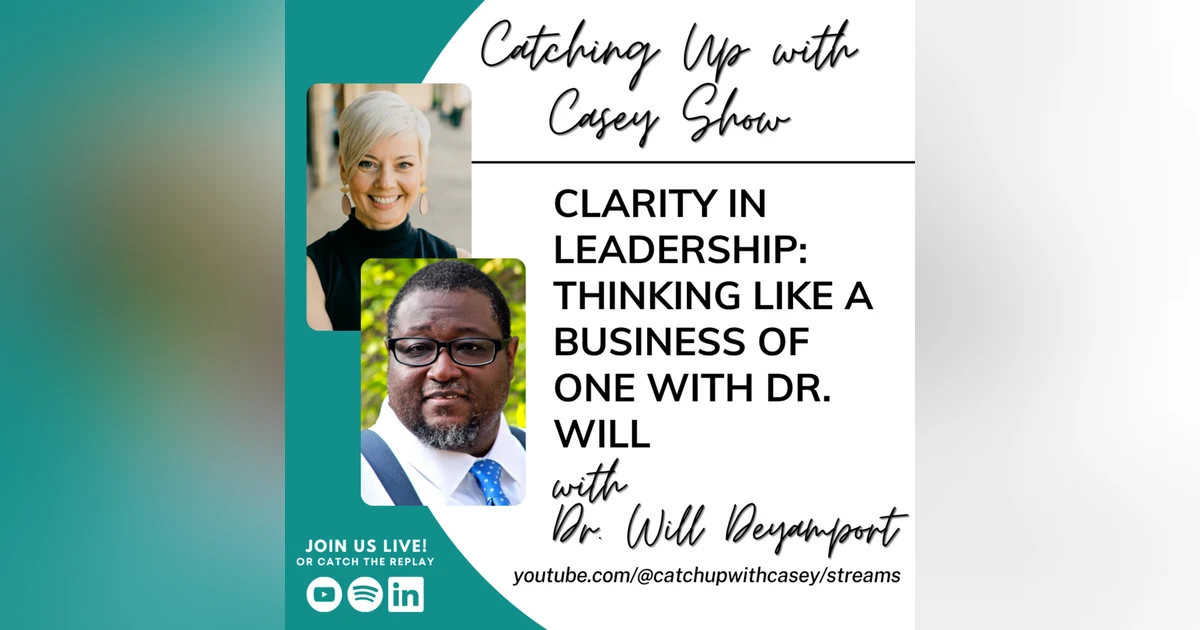
121. Clarity in Leadership: Thinking Like a Business of One with Dr. Will


 RSS Feed
What if every educator led with the mindset of a business of one? In this episode, Casey is joined by Dr. Will Deyamport—edupreneur, author of The Edupreneur , and host of The Dr. Will Show —to explore how personal clarity around identity, value, and purpose transforms how leaders show up in their schools and beyond them. If you’ve ever wondered how to align your impact with your income, or how to lead without losing yourself, this conversation will leave you clearer and more confident in your next move.
Watch the film: [Vimeo OnDemand] https://vimeo.com/ondemand/edupreneur
Get the book: https://edumatch-publishing.myshopify.com/collections/new-releases/products/the-edupreneur-by-dr-will
Listen to The Dr. Will Show Podcast https://thedrwillshowpodcast.simplecast.com/
Connect on LinkedIn https://www.linkedin.com/in/iamdrwill/
And Don't Forget!!
Give teachers what they want WITHOUT spending more or micromanaging: https://www.catchingupwithcasey.com/clarityoverclutter
Need help getting your leaders trained in a purposeful way? https://www.catchingupwithcasey.com/identity
Ready to build the habits of a clarity-driven leader? Get The Craft of Clarity book!
0:02 Hey there, welcome to the Catching Up with Casey show. If you are tired of chasing buy in, frustrated by teams who just can't seem to get on the same page, or over the constant struggle of holding people accountable without feeling like you're micromanaging, this is the show for you. I'm Casey Watts, team leadership expert and the host of this show. I specialize in clarity, collaboration, and character, and I and help leaders just like you take teams from chaos to cohesion, from frustration to alignment, so teams can actually work together toward a common purpose instead of against each other as though they are functioning in different organizations.
0:46 Whether you lead a single team or a team of teams on this show, we talk about strategies that are going to help you create a culture where accountability and autonomy go hand in hand. Now with all of that said, let's dive into today's conversation and learn how to lead clarity driven teams. Well, hey everybody, welcome to another episode. I'm excited to have you guys here and I am even more excited to bring to you an episode all about clarity and leadership and thinking like a business of 1. And I've got with me none other than Doctor Will. Hi, Doctor.
1:28 Will. Hello Casey, How are you doing? I'm great excited to have you and I would love for you to start by telling our listeners a little bit about who you are and the work that you do. Well, I am a author, podcaster, consultant, and my 9:00 to 5:00 I guess. I am an Instructional Technologist for AK through 12 school district where I work to help teachers get over the overwhelm of integrating technology in the classroom, specifically when it comes to working with an LMS. Nice. Love it. And when you go out to work with other districts, like as a consultant and as an author, tell us about what specifically you focus on in those realms.
2:20 For me, it's about simplifying the process, understanding that when you are teaching with in elements or any technology, you know, first it's about just, you know, breathing, right? And not getting overwhelmed with, OK, this is a new technology that we are having to do or just something else to do, but figuring out how you can create your own secret sauce on how you implement what you're doing. And so I like to come in and say, OK, we're going to streamline how you build your courses, how you add the content to your courses and how you teach and integrate all of the tools that your district has purchased into it.
3:09 And not look to every shiny new thing that you may come across on Internet or you may see at a conference and then understand that certain things you just have to let go. So I give one example. I went to a school working with to see a teacher, and the teacher was like, well, I'm not good with technology. And then she had on an Apple Watch and it was an iPhone sitting right there. And I told her, I said, we're not going to have that conversation because apparently you're using technology. So what I need to know is what do you need help in? So why? So when I leave, you'll be ready to go. And so, yeah, sometimes, you know, it's a mindset issue of I can't or I don't like, you know, I can't do this or this is so much.
4:02 And for me, it's just about we're going to simplify this thing. We're going to throw out what does not need to work, what you don't have to do and really get you to see how if you use the tech, it really does give you back your time, right? Like, so putting stuff in the LMS versus spending an hour in the copy room one gives you time. It won't takes away time. Yep. You know, and so that's sort of things that I try to do with working with teachers. Yeah, and you also have written a book called The Entrepreneur, correct? Yes. And tell us a little bit about that book for those who might be interested in in that. Well, it is a business book for educators who are thinking about becoming an entrepreneur.
4:53 And what I call it entrepreneur is an educator who is using the skills, the experiences, the education, everything that they've done in the classroom over the years and monetizing that outside of the walls of your classroom. Be that consulting, speaking, leading a mastermind, creating consumables and that sort of thing. So I wanted to put together a business book that spoke to our people because there are a lot of business books out there that are written from the perspective of people outside of the field. And I wanted to give, give them a real business book that, you know, spoke about unique value proposition, MVPS, getting business insurance, business structures, branding, marketing, even, you know, using AI to make your business better.
5:52 All of those things are in the book, plus narratives from other other entrepreneur entrepreneurs who are doing the work. So, so you can kind of feel their story and see the journeys that they've taken. And so that was the purpose of me writing the book. Yeah, that's awesome. And listeners, just so you know, the link to that is going to be in the show notes. So if you are watching on YouTube, be sure to go over to the podcast on Apple Podcast or on Spotify or wherever it is you listen to your podcast. You'll see it in the show notes. So I want to get into the topic of today's episode. But before we do, can you tell our listeners something that is just very relatable and human or unique about you? I am really simple and when I say really simple, I am just not into a lot of flash, a lot of pomp and circumstance. And you know, you know, my wife will say, wow, you you're not like very adventurous about certain things because you know, we'll go vacation, we'll go to restaurants and I am not trying to do the whole menu.
7:14 There are certain things that I know that I eat right. So I just like some just real simple in that. And I'm also cheap, so, you know, my wife says I have a cheekbone. So yeah, I'd rather save and build, you know, then then to just go out there and spend a lot of money. It's so funny, every relationship has typically one or the other. And that's for my husband and myself. I am the, the frugal one in the relationship and he is the big spender. He's he's the Yolo in our relationship. And I'm like, yeah, you only live once. Let's let's try to live a little bit more frugally. Frugally.
8:01 All right, so today we're talking about clarity and leadership and I love this title of thinking like a business of 1. And we're really curious to hear all of your thoughts about this. But this episode, I feel like really could be for the person who is in the thick of it day-to-day, just like you and I have been, right. And also for the person who maybe is starting to think about what how they can use their skill set outside of where they are right now. So let's talk about what it means to lead with the mindset of a business of one. Talk about that a little bit. Well, when you think of yourself as a business of 1, you are taking ownership of who you are, how you want to show up in your career.
8:47 So you are not putting that in the hands of your school district. So I know people who won't go to that conference, they won't buy that iPad or they won't buy that live laptop. They won't pay for this program because their district won't pay for it. And I tell them that you are not seeking out professional development opportunities or these tools for your school district. Now, they may benefit, of course, you know the goal is for your students to benefit. But you are seeking out these things for yourself to, to, to be better at who you are. And so when you are putting that as a focus, I am a business of one.
9:29 I control what I would have learned. I control how I want to show up. I control the trajectory of my career. That is a different mindset shift because again, you're not going well, I'm not going to go to this conference with my school district, not going to pay for it. If you have those PD days or some personal days, you can take if you have the money now, I'm not in your pockets. But if you have the money, then go to the conference because again, this is about you getting better at what you want to do, seeking out opportunities to get you get you where you want to go to at the next level. And this is where taking ownership of who you are, what you are and what you bring to the table and how you want to show up. This is where a big becoming a business of 1 is paramount. Yeah, I, I want to kind of dig into that a little bit more and maybe even step on some toes, which, you know, my feel like my listeners are, are accustomed to me kind of pushing a little bit because this is a podcast about growth and we don't grow if we don't get a little bit uncomfortable. And so and I always say there's growth and discomfort, but I think it can be easy, especially nowadays. I think we've gotten into that mindset of if it's if I'm not getting paid for it, if my district's not paying for it, I'm not going to do it.
10:50 And you know, I mean, for some people, that might be just how you function. You might be the kind of person that wants to just show up for work at the time that you're supposed to show up and leave at the end of the day and turn it all off. But I know that people listening to this podcast are probably not those kind of people. They're probably the go getters. They're probably the runners of their organization and it's, I think we can get caught sometimes in buying stuff versus buying time with the people we need to surround ourselves with. I heard someone say recently, I pay to be in rooms with people that I know are going to make me grow. And that was a huge mind shift for me. Like, wow, I had never really thought about it that way, but it's so true.
11:41 And when you go to conferences or when you're trying to grow yourself, really you're investing in the people that you're surrounding yourself with, not always necessarily the content. So I love that you brought that up. And I think it's so important and something we, I mean, it's we're quick to spend money on Teacherspayteachers, but are we quick to spend money investing in our growth? Not always, yeah. Yeah. OK, let's talk about this business of one. It's so important to grow as a leader and to gain those leadership skills.
12:22 As a leader, you have to get really clear on your identity. Yes. Why do you feel like clarity around identity is so essential for school leaders who are primarily listening to this podcast? Because you cannot be all things to all people. And I don't believe in fake it till you make it. I believe in making it till you make it. Mm hmm. And so that means you have to do the work and you have to understand who you are. And you know, it's interesting that people talk. You know, you can talk about the why and yes, the why does matter, but the what matters more and the what is what are you doing right? The the work that you show up and you do everyday. So understanding who you are and how you actually show up and what conditions that you need in order for you to show up at your best, right?
13:18 Those are important because, you know, sometimes you may need to shift a position that will allow you to show up at your best step. That means you may need to go to school or you may even need to to go to another school district because the school district you in right now is not providing the environment that is allowing you to show up, you know, at your best. And so having that, you know, self-awareness, having the ability to understand, you know, who you are as a person and what motivates you, what intrigues you, what triggers you, what gets you excited about the work that you are doing. All of those things are about you understanding, you know who you are.
14:07 And you know, my wife and I were having this conversation of, you know, it's human for you to wake up sometimes and be like, wow, I really don't want don't want to go to work today. But if that's your everyday, you need to re examine why this is happening, right? And so this is where, you know, I don't like, you know, when people complain a lot about their current situation because I, I'll tell I, I have told my wife, I'll tell the teachers, You have a teaching license.
14:49 You have so many years of experience. You hold the key to your future. Yep. If this ain't working for you, get out. Yep. You know, get out or go somewhere else. There's no need for you to complain every day. There's no need for you to be miserable every day. And again, going back to your identity and who you are, if you can't show up as yourself to do your best work, then that is not the place again you need to be. Now. Again, it may not be your school district. It may be well, my time as a teacher is done and my best self is being and academic coach or an interventionist, or maybe, you know, I need to go back to school to become a psychometrist or whatever.
15:44 Because certain environments allow you to be your best self and show up in the flourish. And you just need to do that homework and understanding who you are so that you can actually do the work that you would put here to do. Yeah, Well, it's so good and there's so much I could, we can have so many ways we could continue that conversation. But I think what you just said leads so well. And what I want to talk about next, and that is educators owning their expertise. And what often happens, and I see this all the time, I'm sure you see this all the time, is that they are, they're stopped from owning their expertise. I'm just curious what you believe causes that, How they move forward? People can get comfortable because, you know, again, you know, the wife and I have all these conversations about I told, I said education is awesome. How you can show up at 2021 years old and by the time, you know, you are depending on your school district, you could be 50 and retired, you know, with a full pension and, and, and if you are blessed to live another 25 years, there's a whole new career that you can start.
17:03 So, you know, people can get comfortable with where they are. It could just be someone's temperament or mindset to not want more or to do more, or they could have just been raised. Hey, you go get you a job, especially if you have come from maybe poverty beforehand, right? And it's like you were told, go get an education, go get you a nice government job or job with a pension and that's life. And you are in a situation where, hey, my bills are getting paid, I can do a little vacation, I'm not struggling to eat, I'm not struggling buy clothes, what have you, You know, you can get comfortable with, you know, my situation is nice, right?
17:50 I don't necessarily need to, you know, rock the boat, but you need to own your expertise because they're yours. These are your strengths that you were born with that God gave you. And you need to take ownership. You need to put it to work at cultivating them, right and getting better at them, right? One of the best career advice, best career advice I've ever heard is your job is to get better at being you, right? And so if you have this natural talent, right, so we've also heard with Proverbs, your gifts will make room for you. Then you, you have to, you know, you got to put in the work. You have to own this expertise and not just sit on it. Yeah, yeah.
18:40 And that goes back to really getting clear around your identity. Like if you don't have clarity around your identity, then you're not going to be able to recognize your expertise or your natural gifts that you've been provided and you're not going to be able to hone them either. And I think that also plays into what we talked about too, with like just growing yourself and thinking about how am I going to invest in myself either financially, time wise relationships, how am I going to invest in myself in those ways to be able to grow and own that expertise. That's fantastic here. Here's something I want to I think this is a perfect time to shift into like if you are someone who is owning their expertise and you're ready to move into entrepreneurship, what are some shifts that you have to make to start thinking like an entrepreneur and not just an employee? A1.
19:44 You need to know that you have to make an investment in what you're doing like there. There is no ifs and buts with this. There is no, I'm going to wait on my school district to provide this PD for me. You are going to have to take ownership of your professional learning and whether that is you getting a business coach, which is sometime with at some point in time someone is, you're going to have to do that whether that is you. Getting a Google certification if you want to do that type of work or understanding these different things that come with, you know, owning a business and and thinking, well, I need to get me ACPA because y'all, you can't go to H&R Block once you get in step into this RIM because the type of tax deductions that you're going to be doing, that's a lot more complicated than what HRH and R block does and you need someone who's going to educate you on this is the tax code and these are certain deductions that you can make You also, I'm going to need to wrap your head around money and pricing because none of us got into this field to make a lot of money because we wouldn't have been here in the 1st place.
21:09 But when you say, hey, this is what I want to do now you have to understand market trends and what the going rate is on the market and be willing to charge what you are worth. And then be a be willing to walk away from when people are low balling you and you know they are low balling you. And to get out of the, the mindset of I need to make, you know, if I make this kind of money, you know, I'll be OK. Try to negotiate with yourself when the truth, the truth of the matter is when you're doing this, you're not having that school funded insurance and life insurance and all those other things that you may have. Now all of that is on you.
22:01 So what do you need to make in order to not just live, but to thrive? And again, you know that that money mindset of asking for what you want and then being able to say no. So if, if, if your rate is $8000 for the day and someone comes to you and they say, well, we can pay you 4 be willing to say no. Now there's nothing wrong with you saying, well, I understand it's 8. You know how you know what about 7 or whatever? I mean, that's on how you negotiate. But to get low ball to four, yeah, you got to be willing to say no to that. Yeah.
22:42 And be OK. So it's that sort of mindset shift, you know, now we, we got to be be serious about this, especially on that money piece and then understanding what it takes to actually build and develop and sustain the world business. Yeah, it's a totally different type of learning that you start to do and when you start, when you move into your own business outside of education especially. And I find that I it's probably more difficult for educators than other people in other sectors because we are so accustomed to helping, helping, helping. It's just in our nature to support and help because that's what we've done in this career as an educator.
23:25 But there's a lot of shifting that has to take place as an entrepreneur. What, what do you feel like was the moment that you realized your work could make an impact beyond the classroom? And how did that change your approach to education? It was me presenting at conferences. So I think I came about this like a lot of educators do, where I was just on the conference circuit and presenting at these different conferences, you know, making a name for my, in my state.
24:06 And I had a, you know, a couple of people, you know, reach out to me about, hey, is this something that you do? And I had never really thought about it, you know, and then someone saw me and I just kind of joked like, hey, is this a job interview? And the person was like, yes, OK. And I did my, I did my thing. And then afterwards we'll be in touch. And I did my first gig and the, and the cool thing about it was I did it. I had a great time, six hours of, of my life doing the work that again, I normally do at my school district anyway, right? So again, an entrepreneur means you are taking the skills that you are normally that you have and doing the work that you have done already using those receipts and building up business around that.
25:11 So it was, you know, I great time. Then I got the check and I looked at the check and I was like, this is about $500 off of what I make in a whole month and I made this in six hours. Yeah, this. Yeah, I can do something, you know, like this, right? I can do something like this. And, you know, there was a budget scare as well at the job. And so me and a colleague were told our positions may not even be available. So there was another thing that made me go. I got to be ready so that those two things launched me into the the idea of it wouldn't be bad to now get out there and start consulting, building the business.
25:57 Yeah, especially, you know, earlier we talked, you talked about if you find yourself in a position where you just, you're going to work every day and you don't want to go to work every day and you're complaining if that's where you're finding yourself. Maybe not necessarily entrepreneurship is your gig, but it could be, you know, like you could find yourself where you've reached your maximum potential within a school district and you have done the hard work of honing those skills and your expertise. And now because you get so much joy out of that specific expertise, you're ready to take it and share it with other people who are ready. Because I'm going to tell you what, sometimes you can utilize your expertise in your district only to a certain extent. And then you've got to branch out because you're just going to reach that glass ceiling.
26:49 And I could attest that Doctor Will and I probably have been exactly the same spot if that's where you're finding yourself. And I know that either one of us, if you wanted to reach out and talk about like, man, here are some ideas that I have, or here's an expertise that I have that I feel like could benefit others. And this is something that's just, you're just scratching your head a little bit about it. I'm sure either one of us you could reach out. So with that said, Doctor Will where can our listeners find you? They can find me on Blue Sky and they can find me on LinkedIn. So, you know, look up doctor will the import you will find me and so reach out.
27:30 I'm always again trying to learn and get better at what I am doing and still trying to learn right. I've been doing this job for a while and I'm just trying to, you know, do it and, and, but it's hit me more, I would say this past couple years is understanding that where do I need to be at that next level and fine tuning those skills and that expertise to, to get there. Because like a lot of educators, you know, we are responsible for doing so much on a daily basis where you can find yourself, you know, being, as they say, a Jack of all, all trades, which is cool.
28:17 And there's nothing wrong with you building that type of, of, of skill set in a toolbox. But really when you're when you are saying, hey, now I'm trying to reach that upper echelon of what is next, you want to then fine tune, be very specific in where you want to grow and then making that investment and put in the work to get there. So, you know, that is definitely where I am right now. I love it. That's awesome. And guys, you can find all of the information about Doctor Will in the show notes, so be sure to check that out. Be sure to share this episode with others who are like minded. That's how we reach a broader audience. I would love for you to leave a review as well. OK Doctor Will, this has been great. Thank you for joining me.
29:01 Thank you. I appreciate the invite. All right guys, we'll see you in the next episode. Hey there, thanks for joining this episode. I would love for you to do ME3 solid favors before you head out. Number one, subscribe to this show. I've got a lot of great guests and content coming up and I don't want you to miss any of it #2 share this show. Share it with your like minded colleagues and friends who want to learn how to lead clarity driven teams. And finally connect with me on all the social media platforms you can find me at. Catch up with KC on Instagram, YouTube and LinkedIn.
29:41 Until next time, go off and create teams that leaves people feeling inspired, empowered and eager for more each day.

