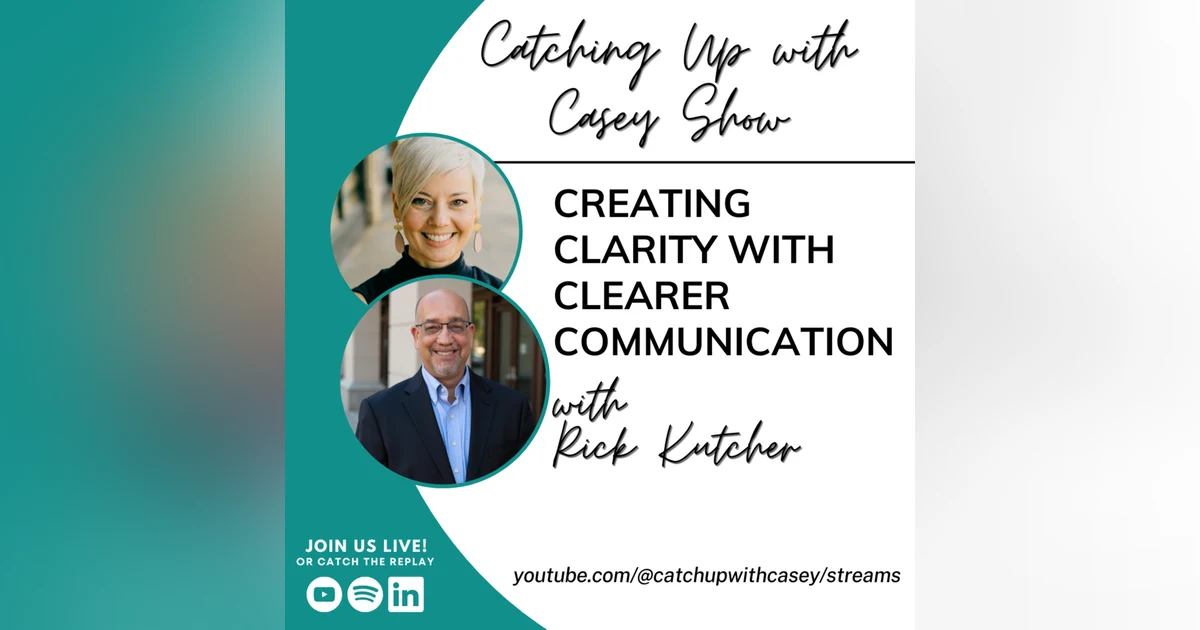
122. Creating Clarity with Clearer Communication with Rick Kutcher


 RSS Feed
In this episode, Casey sits down with TEDx speaker and leadership coach Rick Kutcher to unpack what it really takes to lead with clarity—from building a data-informed school culture to communicating with confidence. Drawing from his work at Region 13 and his own consulting practice, Rick shares how data, when used well, becomes a powerful tool for decision-making, alignment, and impact. Whether you’re leading teams, presenting to stakeholders, or navigating tough conversations, this conversation will help you communicate with purpose and lead with presence.
https://www.linkedin.com/in/rick-kutcher/
Data in Education Virtual Summit
Important Links:
Give teachers what they want WITHOUT spending more or micromanaging: https://www.catchingupwithcasey.com/clarityoverclutter
Need help getting your leaders trained in a purposeful way? https://www.catchingupwithcasey.com/identity
Ready to build the habits of a clarity-driven leader? Get The Craft of Clarity book!
0:04 Hey there, welcome to the Catching Up with Casey show. If you are tired of chasing buy in, frustrated by teams who just can't seem to get on the same page, or over the constant struggle of holding people accountable without feeling like you're micromanaging, this is the show for you. I'm Casey Watts, team leadership expert and the host of this show. I specialize in clarity, collaboration, and character, and I help leaders just like you take teams from chaos to cohesion, from frustration to alignment, so teams can actually work together toward a common purpose instead of against each other as though they are functioning in different organizations.
0:47 Whether you lead a single team or a team of teams on this show, we talk about strategies that are going to help you create a culture where accountability and autonomy go hand in hand. Now, with all of that said, let's dive into today's conversation and learn how to lead clarity driven teams. Well, hey everybody, welcome to tonight's episode. I am so ready for us to dive into tonight's topic. We're going to be talking about creating clarity with guess what, clear communication because it all starts with communication. And I have with me tonight Rick Kutcher. Welcome to the show, Rick.
1:32 Hey Casey, I am so excited like I've been waiting for this for weeks now. I love it. Yeah, absolutely. Now, let me ask you, this is really, really important. Did I butcher your last name or did I get it right? You were very close. I pronounce it. I pronounce it Kutcher. You're like Kutcher. Think of Ashton Kutcher. I'm his twin brother. OK, got it. Well, The thing is, I pronounce Ashton Kutcher as Kutcher all the time. So anyway. I'm. Just bound to happen. You can pronounce my name any way you would like. Well, I'm going to stick with Rick, and because that's normal in any way to call you by your first name. So tell us, Rick, a little bit about who you are and the work that you do. So I work at Region Education Center ESC 13 in Austin, TX and we support school districts and campuses. In the Austin area, there's about 70 school districts and that encompasses about 600 campuses. And so we provide all sorts of services to them. Whatever you can think of within a school district, we do something with it.
2:43 My work centers around data. I do a lot of training on some applications, a lot of data presentations and data trainings and accountability trainings and working with leadership most of the time, but a lot of times with teachers as well and helping them dig into the data, what they have, how to use it, what it means. And so that's where my big bucket of things kind of lives. Yeah. Now you have other things that you do as well too. And before we talk about those other things that I just want to mention how important, and we're going to talk about this in this episode, I'm sure, how important clear communication is in the work that you do at the region service center. You have some other things that you do as well.
3:24 Can you tell us about those? So my own coaching business I do, I have a public speaking coaching business where I help people become better communicators, better speakers. And that's just a whole lot of fun working with people one-on-one and getting them to to work on how they're speaking, whether it's a toast at a wedding or a team at work or even up on a big stage. I've been speaking in one way or another for for a long time in front of audiences. And it's just a lot of fun to do that. And so those two kind of came together because in education, I had an opportunity, an unbelievable opportunity to do a Ted X talk. And it had to do with data as a superpower, right, in education. And we have this data that we can do so much with to affect our bottom line, which is student success. And so I had the opportunity to get up on on a Ted X stage and it was, it was like a bucket list thrill of a lifetime. And so from there, but I need to be doing more public speaking and I can help people do this as well. So it kind of all comes together. Yeah, when you have that much joy about something like that and you have the skills paired with that joy, you know that it's a space for you to help other people that are wanting to do the same thing.
4:52 In fact, you talking about Ted X stages, that is a that's on my bucket list as well. That's something I haven't done yet and I absolutely want to get there one day. So you might, you might just end up being my coach on that. Just so you know, Rick. Maybe we can trade off coaching. It could be some of yours for sure. Listen, and I, and I know you believe this too, Everybody not only needs but deserves a coach. No matter where you are in your life, you deserve a coach. Absolutely. OK, so we've talked about like what you do, your passion now, what is something just so real and authentic about you that makes you super just just a regular old human?
5:35 Old is probably the keyword, but I don't know that what makes me just regular. I will say that tying it all together. So I'm a trumpet player and I've been playing since about fifth grade. And so I think that being up on stage and playing music kind of led to this, this stage presence that I just love being on a stage. But it also ties into how you how you get there, right? How you practice. So as a performer, you can't just go up there and decide I'm going to play this thing, I'm going to perform this piece, I'm going to give this speech. You have to know it.
6:17 You have to work on it inside and out and really dig down into it and over and over and over until it becomes second nature. And so I think just being a musician, I've played in orchestras and jazz bands. I'm still playing now. Matter of fact, we normally rehearse one of the groups on a Monday night and we just finished our season, so I have this Monday night free, which is perfect. But I think just, you know, being a trumpet player, loving music, all kinds of music is just kind of another part of who I am. Yeah, Well, you are speaking to a fellow musician also someone who adores music. And there's something you're kind of bringing up so many great analogies for speaking, but in your message and speaking because you also have to have a connection to the music itself.
7:02 You have to have to have a connection and a respect for the instrument that you're playing. And I think there, there are so many different levels of that that apply to your speaking not only on stage, but like you said, if you are visiting, if you're talking with a group of people about data, like you're in a data meeting, everyone has a connection to that. And we have to almost allow those connections to lead us in our communication. So man, that's there's, there's just so much we could talk about there and we'll save that for another episode in the future for. Sure. I've already got an idea in my mind, so lock it away. All right, so tonight we are talking about clear communication and creating clarity with clear communication.
7:46 So you know, you've talked about your work with the region service center and, and I know that you work a lot around building data culture, but also coaching leaders to communicate with clarity. What do you feel like the connection between data communication and strong leadership could be? I think that it's, it's kind of a connect the dots, right? But it has to start with this strong leadership. So the leadership has to know, they have to have again, that clarity. What are we doing? What is our data? How are we looking at it? What do we want our data culture to look like, to feel like what, what's the language that we want to operate around? And if the leadership has that, then as they lead their teams, their campuses, their teachers, all the staff, that's going to basically trickle down if they, if they do it right, right, if they, if, if they are communicating well. So now we've got that communication piece that they may know exactly what they want, but it has to be communicated very well.
8:52 So I know, I know I have and I'm sure you and, and probably many in the audience, we've been given mandates at times of this is what we're doing. And there's very little clarity to, to anything else, like why are we doing this? How are we supposed to do it? What does it mean? Are we getting support? There's no clarity behind that. And that becomes very frustrating on, on the end user that's being told, hey, here's a, here's a new thing for us to look at. So I think that that from the top, that clarity of communication, not only being able to speak well, but understand what you are talking about and why and what does it mean to our our ROI, the bottom line of student success. Yeah, you are speaking my language here, OK. And I'm going to try not to go on our on a rant here, but it, I think one of the things that you talked about was we as leaders have to gain clarity before we can create clarity. And you hit the nail on the head when you talked about we have to understand what it is we're communicating and why we're communicating that.
10:06 And like we have to know it on a deep level before we can communicate it to other people. Otherwise that communication is just going to fall really flat, right? It's going to go in one ear and out the other with no impact on the staff or ultimately students, student and student learning. Just to interrupt you for a minute, I think that on top of the, the clear communication, when you're as a leader going to implement something, you have to be excited about it to a certain extent, motivated and motivating because we get told things all the time, right?
10:47 So if we're not a leader, or even if we are, our leaders might tell us something, but if they're not motivating about, hey, we're going to do this thing, yeah, maybe it's going to be a little rough, but we're going to support you through it. It's going to be really good. There has to be that, that part of the communication that is the motivator as well, right? To get people the buy in. Otherwise, they might listen and they might hear you because you're communicating well, but there's no buy in. Yeah, 100%. And we absolutely cannot do what I see happen so often. And I know there's a there are so many factors that create this, but we can't be the leader who says, well, it's not don't shoot the messenger. You know, like it's not me telling you this, it's this department, right, right.
11:41 And that that's that doesn't do any good for anybody. As much as you want to be the person to say I, this is not me, but we have to do it. You're not going to gain any kind of buy in with it or commitment to what is what you're being asked to do. I think that leads really well into what I wanted to ask you about next because, you know, especially data, it can be such an overwhelming thing, right? And so much so that leaders sometimes will avoid it altogether, or they may even find themselves passing that conversation off to someone else. What are some ways you feel like district leaders or school leaders can shift their mindset so they're seeing data as this tool for clarity versus something that's going to cause confusion? I think again, you know, we're going to keep saying the same things over and over.
12:39 I think getting clarity the the, as the school leaders and district leaders can gain clarity on the data that they're talking about South in in the presentations, the sessions that I do, one of the pieces that I put up is this big kind of like a spreadsheet. And it's it's what we call a heat map. It's of an assessment that's got a list of all the kids, all the questions, the right and the wrong answers, red and green. And so and, and people listening probably know pretty much what that is, right? And so you're looking at an assessment and it's got all this stuff and it, it's overwhelming. But if we take just a sliver, right, and we just look at, let's say one student and how they did, we can make some assessments and I can make some pedagogical decisions tomorrow how I'm going to help that student, right? Or if I look at one question, question four, and and 80% of the wrong answers were the same wrong answer. OK, I can now dig into that and go, what is that telling me? So as leaders, if leaders can learn to parse out just little pieces and go, OK, I'm not a math person, I'm not a numbers person.
13:49 It's intimidating. All those are myths, right? But they can look at data and just go, let me look at one piece. How do I understand that? What is it telling me? What is it not telling me? And and what next? What do I do with this? If they can learn that, then they can help those that they lead do the same thing. So they get again, that clarity on how to look and manage and assess that data and then work with with those people to make them feel like it's not that bad, right? You go to the doctor, you have your blood pressure checked, that's data or data, and you could just do something or not with that information.
14:39 Yeah, I'm hearing 2 key things. And what you're saying. First and foremost, as an instructional leader, if you were going to be facilitating conversations around data and you don't want them to be, it's first and foremost maybe a little bit overwhelming for you and you don't want it to be overwhelming for your people, then you have to prep. You have to prepare by doing the hard work first, and I think that's fantastic that you mentioned that. I don't know that we do that enough ourselves as leaders before we ask teachers to do that work. And I know it, but probably so much of it is because we get swept up in time. And you know what, Whatever else is taking up our time. But if we do even a small portion of prepping and thinking ahead, like what is it?
15:29 That could be overwhelming to our staff when they look at this data and how am I going to support and facilitate conversations meaningfully? Which leads me to the other thing that I feel like we could allude to is we have to put on a coaching hat as an instructional leader when we're facilitating conversations around data, data, data data. Tomato. Tomato. Yeah, I think. It's data because the singular is datum. So then the portal would be data. Oh, so I know Jess was listening to this. So, OK, Jess, we're that's what we're going to put in our back pocket, OK.
16:10 I, I made that. I mean datum is the singular because I've looked this up, because data data, nobody knows it's all, they're both correct. But I, I made a decision. It doesn't mean I, I, I abide by it every time. But that's what my brain is if I have to think about it. OK, great. OK. Well, I'm going to stick with data then. OK. But you're, you're right in that prep. And you know, if we're asking our, our teachers to look at data and we know that there's still, it's a, it's a, a time issue, right? Just like you said, we're time and other things that we in education, there's not enough time to do everything that we're asked to do. But as a leader, we're asking our teachers to do it and find that time.
16:56 Then I think we should find that time as well, like you said, to prepare to prep. And just like anything else, the more we do it, the easier it gets, the faster it gets and, and almost second nature where OK, we have APLC, you know, the reports to bring and we can go through it and we can move through those processes faster saying, what are we seeing? And the teachers, as they dig in and they get better and better at it, can look and scan and go, oh, here's what I see. It's just like if we're teaching again, we'll stay with math. If we're teaching students math, how many times do they have to learn to add 2 digit numbers? Quite a bit. Are you still learning how to add 2 digit numbers?
17:38 No, right? You know how to do that. So it's the same thing with looking at data, it just it takes practice and some time in the beginning. Yeah, Oh my gosh, yes, on point. And this is exactly, I can't wait for you to go and listen to my podcast episode with Jess, Curtis and Lorna, which I know you also did a podcast episode with them, which by the way, if you're listening to this, we're going to just remind me, Rick, we're going to link that your episode into the show notes of this episode. And I'll, I'll link my, my note, my episode link too. You're going to also want to go and register for the data and education Virtual Summit because you're going to hear, be hearing from both Rick and myself, but so many other people about all things data. But in the episode that I yes, Oh my gosh, it is next week. That's crazy.
18:29 OK, Glad you reminded me of that. But in our in our discussion, my discussion with them, one of the things that we talked about was we make assumptions as leaders or as a staff that everyone comes to the table with the same knowledge of how to analyze this data and the same understanding of what to do with those analyzations and we don't. So we really should be at the beginning of the year as instructional leaders, setting aside some time to decide, like teach our people about how we as a collective group go about analyzing data. And then what are the things that we do with this data when we have analyzed it.
19:13 And we we don't do that. We let other things take their place when we know data meetings should be happening regularly across the year and analyzing data should be happening on a day-to-day basis in the classroom. So why aren't we putting more time and attention into that? It's mind boggling. That's another episode in and of itself. I agree. OK, so Speaking of data and and I feel like what we're talking about is like culture, right? You're we're trying to build a data culture. So assume that a district wanted to build a data culture from the ground up. What do you feel like are the essential components of that process? How does communication show up at each stage? Because I know you're doing some of this work right now with the region center.
20:03 So I have started this monster project. May have bitten off more than I can chew, but I'm developing a year long series. It'll be a six session workshop series on building a data culture in a district and the first workshop and, and there'd be a full day, right? So we're talking 6-7 hours at the service center and we would have a, a district bring in or form a leadership team. So probably the Superintendent, maybe a couple of key central office people, campus leaders and, and it could fluctuate depending on what they want to do and, and who they want involved. And then we start the process with, it's the first module is assess the current state of your data culture. Where are you right?
20:59 And, and we're all using data one way or another. Some districts I've seen are doing phenomenal, like incredible things that I'm learning from, but that's not very, very common. So we, we assess, where are we, what are we going to look at? Are we going to talk about just academic data? Are we going to talk about behavior data? Are we going to talk about financial data or facilities data, right. So all of these different things could fall into it. So, and, and it's all the same, right? What is the data? How do we look at it? What is the engagement level? Who owns the data? How frequently? I mean, it's this big assessment, right? And so I've that first session really is the big one, right? Where are we?
21:48 Where are we? And here's some some template worksheets, some surveys, like all of this thing is built out so that we can really dig in. And then they go back to their districts and then they do more of that work. They really start filling that out and bringing all that information into play so that when we meet the second time, now the second one is I'm going to forget these building like a strategic plan. What, what are we going to do now? Now that we know where we are, we know some of the gaps. We know who's who's ready to roll with this and some of the people that are reluctant, all of those things. Now what's our strategic plan?
22:30 How do we build that? And then we just got kind of go from there and there's six sessions. I think one of them is. See, now I'm just drawing a blank. But it. Happens. To me, all the time. It's pretty, it's pretty in depth with how to get into it. Where do you go? How do you build feedback and checkpoints to make sure that you're how do you know, how do you know if it's working right? How do you assess in the middle of this? Where do we go and do we make corrections? Right. Yeah. And then and then you know, you ask the communication with that, that's again kind of going back a few questions. It's that clarity of communication from that, that core team that you have campus leaders and district leaders together, working, collaborating, and then being able to clearly communicate where we are because we've done the work and where we're going because we've outlined the process and our mission, vision, agenda for this data culture. Yeah.
23:38 And none of that can happen without that first step, which is probably why it's such a massive piece of it. And it's probably also a massive piece because we we don't do it often enough at the level that you probably are taking people through. Yeah. And it's, it's pretty, it's, it's pretty in depth. Yeah. But, and it has to be, it has to be if you're going to make any any significant progress. And we give them the tools, right? Some some templates and forms of like. Let's plug in something so that you can think about this and have it down and be able to reference it.
24:18 Yeah, you talked a little bit as you were mentioning that the six modules, you talked a little bit about vision goals and definitely the data that they're, that, you know where they are and where they're headed. Those leaders have to communicate from all of those things to their stakeholders. And I know that we make mistakes all the time when we are attempting to communicate vision, goals, data, insights, things like that. What do you feel like some mistakes are that you've noticed maybe in the past? And what does clear communication actually look like?
25:00 Almost like a This is what we do, but this is what we should do. It's interesting, I think that the vision sometimes is that we're doing data. Oh yeah, we use data all the time and, and we believe that and it's it's not a, it's not a lie. It's not, it's just, Oh yeah, yeah. We have assessment data. We look at our standardized test data at the end of the year, which personally is more of a we all know this, it's a post mortem, right? There's, there's not much you can do except maybe do better next time, right? But it's at the end, right. But, but we say, Oh yeah, we use data all the time.
25:42 We, you know, I pull up these reports. But, but are we using it the right way? Are we, are we looking at the right things? Are we looking at the right reports? I pull up a report and I see, you know, 82% of my kids passed the, the quiz on Friday. All right, we're rocking and rolling. OK, well, you have 18% that didn't what what is that telling you? What are each question, the skills that we're testing, are we testing on level all these pedagogical things, right, like the the rigor of the assessments, right, the validity of the assessments what is telling us how many questions were there how long all of that stuff.
26:26 So I think the the communication part again, comes from leadership, the the lead, because you don't know what you don't know if you're a teacher and you've never really dug into data the way that we're talking about you and I and and everybody else that that's listening, you don't know, you think that this is what I do. I look at my exit tickets tickets, I look at my quizzes, I look at my, you know, BOYMOY, all of those things. But but what am I doing with it? And what is it really tell me and is it guiding my instruction? And so that clarity has to come from the leadership saying all of those things.
27:09 Guys, I know you're looking at data, but let me tell you how we're really look at data. So that's you asked about the, the, you know, this is what we're doing. We're looking at data. We've got data, but this is what we really need to do. We need to look at specific data to guide what happens tomorrow in the classroom, right? I mean, what do I do tomorrow to make it better for my students so that they can improve and learn and thrive and grow? Yeah, man, so much I, I can tell you just in what you're saying right now, I relate so much because I feel like I've made, I've made these mistakes as an instructional leader before too.
27:50 And you know, like we, I'm, I'm thinking specifically of 1, one year we were analyzing data. It was state assessment data. It's not my favorite thing to analyze, by the way, But that's, you know, we, we all have our feelings and beliefs about that. And my Co worker and I had developed, we were working as district instructional specialist. So we were supporting both campus staff, like instructional practitioners and instructional leaders. And so principals had said we really want them analyzing data. Great. We're going to create a spreadsheet and this reflection spreadsheet is going to have very intentional questions on it.
28:34 Well, when we presented it to staff, we just said we want you to use this reflection sheet as you are analyzing your data data. And it was almost like like we could tell in the moment with the eye rolls and the people, you know, like they just had, there wasn't a data culture that had been built. Well, there was a culture, but it wasn't a positive culture and it wasn't a data culture where people were invested in analyzing the data in order to make instructional practice decisions. And so that was, you know, that was definitely our fault for not being really clear with the principals on the campus.
29:16 Like, hey, what is our purpose? What are our goals, and how are we going to roll this out? It was more of us saying to principals, hey, this is what we came up with. What do you think they said? That's great. And then we shared it with teachers, but it didn't have the impact that we wanted it to have because, number one, it didn't come from the campus principals and #2 there wasn't enough clarity behind it to get people rallied around the purpose of doing it. Yeah, and you know, a kind of a quick story, but I've always loved numbers and spreadsheets, but I've never been a really, you know, a big data person. I come from, I was a band director for like 16 years, then I was a principal and now I'm at the Regent Service Center.
30:02 Well, when I got my principal job, I was there for about 3 years and my first year was just learning, getting my feet wet. I did, I knew nothing. And the results for the the, the test came back at the end of the year and we were DS and FS. It was, it was pretty bad. So the next year I didn't know what I was doing, but we did have a software platform that they were using, one of the popular ones here in Texas. And one of the teachers had been using it. So I asked her to show me and I thought, look it up. Wow, this is great. Like we could use this. So I took that and that was like, we did a lot of work on data and a lot of other things, right?
30:50 And at the end of that year, we were at all A's. I mean, it was, it was miraculous. It was crazy. And we, but, but it took the first, first semester just throwing everything at this that we could figure out. And we, we did lots of things. I talked with every single student individually on campus about their scores. But a lot of what we did had to do with the data and even talk about the kids about the data, right? They had no idea. And I said, hey, Casey, do you know that if you get 2 more questions right this year, you could go from this level to that level. And I'm talking about data in terms of that you could understand as a student.
31:33 They said really, 2, can you do that? And they'd be like, yeah, good, get out of my office next. I mean, I mean, really like every single student and looking at those numbers and printing up reports and, and having these, these PLCS basically really did tremendous things. The teachers did all the work, right? I was just kind of sure, let's do this. But it was, it was a tremendous amount of work, but we had to get clear each step of the way of what are we doing and why are we going to do this and is it going to have an effect on our outcome at the end of the year. Yeah. And it took you as the the instructional leader to say why are we doing this and getting some ownership from your staff members about why we are doing this and what impact it could have. Yeah.
32:25 So that's super impressive and really exciting to to listen to. I want to shift to your public speaking and leadership coaching. And I think the story that you just shared is pure evidence enough that your leadership coaching comes from a place of lived experience. But what do you tell educators or leaders who often feel nervous or uncertain about speaking up, resenting or sharing their voice publicly? I know. I mean, we've already said even for leaders who are leading or facilitating data meetings, it can feel uncomfortable. It can that God, I could talk about this forever as well.
33:10 I think the one of the key things is making leaders understand they're already in the chair, they're already there, they've already been hired, they've already been positioned to be a leader, right? So they don't have to worry about not being the leader. They're already there, they've earned that spot. So now use that as a confidence foundation, right? So, and it takes a lot more than just, you know, a few like tips, but which goes back to coaching, but it's knowing that you're already in that chair, you've already earned that spot.
33:52 You are the leader and you have the right and the duty to speak. And so the, the nervousness is, is just another form of excitement. It's energy and, and there's tricks to transform the nervous to the excitement because it's the same thing that's going on, you know, chemically in our brains. And so just slow down, get out of your own head, think about your internal clarity. What is it that you need to say now? If it's in front of like, let's say your campus staff and you've got to start now, let's say I'm going to introduce, you know, PLCS with data looks and things like that.
34:36 If I get that clarity, I already know that I'm in the chair. I am the leader. OK, that's out of the way. Now I know we're going to look at this. Here's the reports that we're going to look at on a weekly basis. This is what we're looking for. This is how we're going to look at it. And then we're going to make decisions on what to do. And if you rehearse that, again, going back to the music and going back to speeches, the rehearsal part, it becomes easier and easier. And so just building that confidence slowly, slowly over time will help you stand confidently in front of whoever it is you need to. And that's. That's kind of that. I love doing that. I love help and seeing people feel better about being able to do that, you know, just giving people that hope and that that. Wow, wow, yeah, that felt really good. It's like, yes.
35:30 Yeah. Like watching a student get it that aha moment, it's the same thing. It just, it just really, you know, it feels good. Yeah, yeah. And I, I even for me, like it's helpful to hear you say these things again. You know it. And that it's important to hear these things and practice them again and again. But just knowing I need to know what it is I'm about to say and why I'm going to say that. Not to say we want to rehearse it as a script, but I want to know in my heart what the message is and why this message is about to be shared. And I want my people to know the same things. The why and the what and the why.
36:14 Yeah. So whether it's on a campus or on a stage, clarity and confidence seem to go hand in hand. What helps leaders show up with both? You mentioned a little bit already, but what do you feel like helps leaders show up with both confidence and clarity? Having a coach, right, yes, I, I think I think it is having a coach and you know, people should have coaches like we've talked about, you know, wherever they are in their life. It's really helpful if you think about there's so many analogies, but if you think about sports right, there are think about a football team.
36:55 I'm not a big sports guy, but on a football team, how many coaches do they have? They have, you know, the defensive coach, the offensive coach, the quarterback coach, the line, right? They all have coaches. Pro athletes have coaches, right? Michael Jordan had a coach forever. I mean, you can do your thing, but you still need somebody to help you and coach you through. That's an out. They're outside of who you are and they get to watch and help and walk you through things. And I've had lots of coaches in my life from music, of course, and then in education, I've had coaches when I was a band director, we would coach each other. Bring somebody into your band hall. Hey, I'm bringing in this this this band director from down the road who's won a ton of awards.
37:44 He's going to help us, right? And in the music world, we do that all the time. And so we bring in instructional coaches. We have coaches everywhere. So I think having somebody and maybe not a coach, maybe just a partner that can come into your classroom as a teacher or a partner, as another principal, if you're a principal or an instructional leader to help you and watch you and say, hey, I have an idea, right? And so talking with people, walking through it in your mind. And again, that clarity piece of, oh, I've got to go, you know, talk to the staff tomorrow about this thing. Well, yeah, that's part of the job. So how do we find a way?
38:28 Watch podcast with with coaching, with speaking. There's tons of tools out there. So it's it's just and it's a matter of again, practice. Absolutely, yeah, coaching and practice. And I will say that's one thing as a consultant that I love to be able to do because when you hire like an independent consultant or a coach, they're able to come in with an unbiased perspective and it's not someone that's super close to you. Sometimes it can be really hard to get coached or mentored by someone who's really close to you or even in the same sector. And so that's the benefit of bringing someone from the outside in because they can see things that even the people that you're working with can't see.
39:14 So yeah, Oh my gosh, Rick, this has been a phenomenal conversation. I can't wait for episode #2 which will. Come. Yeah, me too. Sometime in the fall, yeah, it's going to happen. So guys, come back when you see Rick's name pop up again on the podcast episodes. And until then, Rick, where can people find you? Wow, so I'm I'm on all the social stuff. My website is Rick kutcherconsulting.com and Kutcher is Kutcher like Ashton. And I'm on Facebook and I'm on Instagram. And then if you're looking, you can reach me at any of those. But then also at the Regent Service Center. It's, it's a long, we'll probably put it in the notes I guess or something, but it's rick.kutcher@esc13.texted.net. It's a mouthful, so.
40:13 But you can reach me there if you have questions on, you know, the, the data program that we're putting together and data in education and all things data. I'll talk to you forever about that. So and then again, Casey and I'll be presenting next week on the summit. Yes. Absolutely. Yep. And all of that will be in the show notes. OK, Rick, thanks for coming on. Thanks, Casey. I've loved it. It's been great. Awesome, we'll catch you guys later. Hey there, thanks for joining this episode. I would love for you to do ME3 solid favors before you head out. Number one, subscribe to this show.
40:54 I've got a lot of great guests and content coming up and I don't want you to miss any of it #2 share this show, share it with your like minded colleagues and friends who want to learn how to lead clarity driven teams. And finally connect with me on all the social media platforms you can find me at. Catch up with Casey on Instagram, YouTube and LinkedIn. Until next time, go off and create teams that leave people feeling inspired, empowered and eager for more each day.

