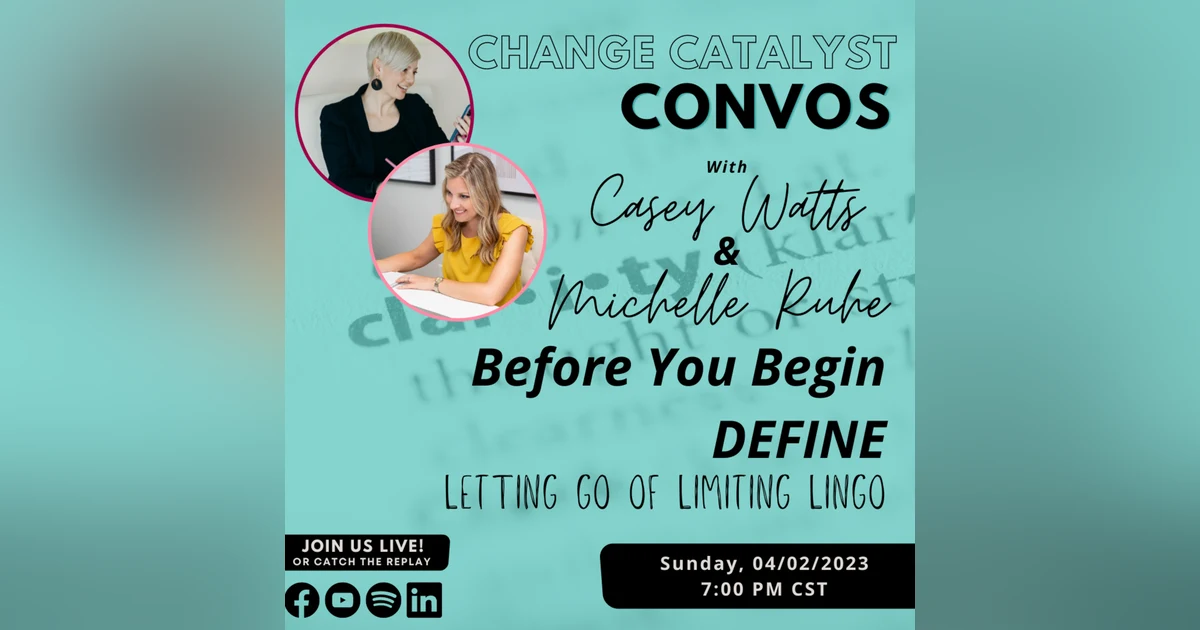
Before You Begin, DEFINE: Letting Go of Limiting Lingo


 RSS Feed
"EVERYTHING boils down to clarity. Literally nothing can be left to assumption." -Michelle Ruhe
Isn't this SO true?! It's easy to assume that "everyone understands", especially when we think about common terms and phrases we throw around in education. But this is a dangerous assumption. And when left unaddressed, this assumption can limit (and dare I say, debilitate) staff, teachers, students, and parents! It's time to let go of the limiting lingo! In this episode we converse about what limiting lingo we hear on a day-to-day basis, how we get to the place where we hear mere jargon, and how we might find a place to start to get out of the messes in which we find ourselves!
Are you someone who works with teachers that could benefit from a literacy coach like my guest, Michelle Ruhe? You can find her here:
Connect with Me on Facebook, Instagram, LinkedIn, or YouTube!
Join the Facebook Group, Leading Collaborative Teams and connect with me and others who are eager to build cohesive, vision-driven teams!
Level UP your leadership game with resources, tools, and strategies located on my website!
0:03 Hey there and welcome to another change paddles conversation where we talk about anything and everything that has to do with building. A cohesive Vision, driven teams that make sustainable change happen. Even when change seems impossible, I'm Casey W impact, coaching consultant and the host of this show. What I know from experience is that making change happen can be Overwhelming, if you don't have cohesive Vision driven teams, no one has a collective understanding of why change should happen or what changed to begin first. You notice all starts because a solid action plan, hasn't, been formed or crafted where you're met with resistance because you don't know how to motivate such complex people and that leads to schools remaining in a cycle of stagnancy.
1:00 Experiencing the same problems and ineffectively repeating the same initiatives or programs again. And again, and that leads to low morale burnout, High turnover, and who suffers most, it's our students but there is a better more effective way to bring about change in your school that does not deplete the energy of your people. You need a catalyst to help you get a solid start. My goal is to make cohesive Vision driven school teams a possibility. I helped School leaders, zoom out to cast vision and then Zoom back into script.
1:48 The critical moves that help teams collectively go farther faster and better even when change seems impossible. Here's what I want to know from you. What is the change that, you know, needs to happen in your school? What are you hesitant to get rolled out two teams. What exists only in your mind that you are absolutely certain? Would benefit your school but you're just not sure how to get started right now. I want you to take a sticky note or put a note on your Your phone or maybe in the comments, make a note that says change Catalyst.
2:36 This is your reminder to email or message me about your future endeavors and your current reality because I would love to encourage you as a change Catalyst in your school, okay? Now that you are primed for thinking about cohesive Vision, driven cheat teams that Make change happen. Let's jump into this week's change Catalyst conversation. Well, hey there everybody. Welcome to another change Catalyst conversation. I'm super excited about tonight's topic. We are thinking about why it's so important to Define before you begin, and we're really digging deep into why we should let go of limiting lingo.
3:33 And tonight, I have a great friend of mine. Michelle rui, who is going to introduce herself in just a moment, Michelle. Hey hey. How's it going? Thank you so much for inviting me to be on. This will be so much fun. Yes, I'm super excited. Okay, if you're here tonight, let us know in the comments who you are where you're from, what brought you to our live session tonight and what kind of limiting lingo you're hearing all over the world of education and in your school. So Michelle, let's start off. Tell us who you are, where you are, what your role is and your aspirations. So I am a very longtime educator. I feel embarrassed to say how long this is my 23rd year in education and I was 15 years in the classroom and additional five as a literacy interventionist. And now this is my third year as my dream role of a literacy coach.
4:27 And I am in a tiny little town, right? Outside of Charlotte, so enjoying that new role. Yeah. And you have a little bit going on the side as well, right? Yeah. So I love coaching. I'm so much. I just so value. Those one-on-one conversations and I love the idea of just bringing Clarity and simplicity to teachers because that's what those conversations are all about. And I wanted to bring that bigger and help more people. So I started a little little side hustle coach from the couch because that's where a lot of the conversations happen from my couch, where I just, you know, reach out and help as many teachers as possible.
5:09 Yeah, that's awesome. Okay, so You if potentially, if someone was really invested in improving themselves as a literacy instruction assist and structuralist that they could reach out to you right. 100%, there's so much especially today right now in the world of literacy going on, and if you're in social media at all, it's just a battlefield. So, yes, reach out. We can talk absolutely even if you just need to vent about where you find yourself. If in the midst of this full-on war, we've got going on. Yes, ma'am. Okay. And hey, it looks like we've got Melanie here.
5:49 Hey, Melanie, welcome to the show. Okay, so tonight we're talking a lot, Michelle, about those terms that we hear that jargon we here in education, all the time and the reason I included the subtitle letting go of limiting lingo as because it is just Bingo. And I feel like oftentimes it limits us to, from what our full potential could be. It reminds me of really so many stories, but one story in particular that happened recently, I have friends who live nearby, who are from all over. I've got a friend from Michigan.
6:32 I've got a friend from Mississippi, and then a couple of other really close friends who have grown up in the Texas area nearby. And we had my 40th birthday party here. There was a fire going on in the back and one of my best friends came to me. She's the one from Mississippi and she said, hey, um, what do you call this? Kind of fire that you have? I mean, it's just like a fire pit, right? Like just chairs around this. This fire pit made of cylinder blocks and just a few logs in it. You know, and I said, well, you're sitting by the fire and she said Yeah, but see, I call it a bonfire and that's a bonfire is locked. Have a massive pile of gems and trees and logs and all kinds of things and you can't even really get close to it. You have to stand around it for years. She has been putting on these little events at her house on top of mine.
7:36 Since we've been friends for almost 15 years, she will send out invitations. Stations and say we're having a bonfire. Oh my gosh. And it's just like you're sitting around a fire pit and I wasn't anything. But I just assumed like, okay, well maybe maybe this is a bonfire, I don't know, or maybe they decided not to do a bonfire, they just decided we're just going to have a small Fire and Ice. Oh, honey. That's not a bonfire. That's just the fire. Like we have two different ideas of fire and bonfire going on. Yeah. So this title reminded me of that but think about how often that happens in schools, right? And everything, everything really everything, literally everything.
8:23 And one of the things that you said to me, when we started talking about doing this live, do you remember what that was? I put it in your post but it was all about making assumptions. All what it was that you said, I feel like it was around lesson plans. Yeah, I think, I mean, but literally everything in the school day from how Do you walk in for an assembly to what's the behavior plan in the cafeteria? To what? What does it mean to be a fully? Have a fully planned lesson to what is reading? I mean, yeah, yeah that's absolutely. So tell me what you feel like it means for this title defined before you begin. What does that mean to you?
9:08 So just like your bonfire example, that has come up so many times in my role, especially after following a different coach, who had been there for a long time, and made her own definitions of things. But luckily, early on, when through the group that we're in together, we read dare to lead by brene Brown, and she talks all the time about how clear is kind. And that is the most important thing. And the thing that sticks out the most to me in that book and I reference it all the time is she says, to paint done. Here's an example.
9:48 I have very recently and you this is familiar to you Casey, but I recently was asked to make a diaper cake for a baby shower and I do, I like good diaper cake like it's all made of diapers, it looks like a wedding cake in the end, there's ribbons and flowers. It's actually pretty beautiful that to me is a diaper cake. Well, somebody Else at that shower has we had planned to surprise the mom-to-be, what I for cake and it was the most hideous. Looking like they're what, isn't even many died on it. It was like, mostly Monday horrible. But that's, that's the kind of thing that happens. Like we should have said, Pay, let's paint. What would I break a leg? Looks like what does it mean?
10:30 Because if she had brought that to Mon Ami, you know, shower I would have not let her in but I probably make her feel Because it was so much nicer so that happens in the world of Education. Constantly. What's the PLC? What's a lesson plan? But what are they behave? Classroom management. Expectations. All of it, growl is different to different people. You're right, you're right. And not only that, but I think we make the Assumption to that people use the same language in the way and are familiar with that language. Like even the term itself, recently, I met with teachers and one of the terms that I used was common formative assessments.
11:18 Well, I was using it just as flippant like just as common language for myself you know secondhand for me to use this language because I'm so familiar and immersed in it but these teachers they had no clue what I was talking about which to me was Really surprising but then when I really pause and think about it, I was like, okay, wait a minute, why am I frustrated that they don't understand what I'm talking about? Why am I surprised? If I know that we haven't come around this term together, you know like that was that was my fault for making assumptions that everyone knew the language that I was speaking and making assumptions that they had already heard of it and done. The work together and that's like this hard part. I was thinking about like workshop model for me, that's like I lived and breathed workshop model for more than 20 years and I'm pretty well versed in it but it's one definition and others have another definition and then finding that more and more.
12:25 But what's hard about? That is when it becomes so second nature to you, yes, you don't even remember or think about, oh this could be different for somebody else because it's so ingrained in Who You Are. It's so it takes a lot of, I guess concentrated effort to think about, okay. What are you saying? What does that mean? What do we need to come around to Define together? Because it's almost like reading, for example, like it's so second nature to us, we're not even thinking about the 10,000 things that are going on in our brains. And then, when it comes time to teach that to kids, you've got a parse apart, every single little, you know, strand of Of yarn right to teach it explicitly and that's kind of what we have to do in schools with our lingo. Yeah.
13:14 And I want to ask this question, what do you feel like? And I have some ideas and thoughts about this myself, but what do you feel like causes us to have these different definitions and understandings or like in my situation where I'm using this lingo that other people have not been using? Why do we have those? Different definitions and understandings. I think it is 90% your experience just where you came from and what you eat. And that could be either. You came with nothing and it's brand-new to you. So you're sort of creating your own definition or you have been in a place or several places and you've developed a different definition, it's your training and your own learning or lack of it.
14:03 That's where it a lot of it comes from. But I also think some of it comes from Um, social media and because it's almost like confirmation bias out there. So you're looking for you're looking for definitions for things because you're kind of unsure. And then your get you get this barrage of differing viewpoints and opinions and feelings mixed in. So I think that's like the other 10% of it. It's like others influence but I feel like it's mostly your own experiences. Yeah and I think sometimes too when we find a definition that fits with our Current philosophy or our current beliefs, or our current way of doing things we latch onto it. And, yeah, that's where those feelings and opinions become so deeply rooted.
14:49 And then the resistance comes in, when you're met with somebody who doesn't quite have that same opinion. Yeah, for sure. Okay. I want to do something fun and I want us to think about and if you're here with us tonight, I want you to put in the comments. What Michelle Are like words that trigger you when you hear them you're like what do we even mean by that everyone has a different idea of this word and yet we use it so flippantly and it becomes this lingo that limits us. So type in the words if you're here in the comments like what are words that you hear again and again and schools that are just jargon kind of meaningless jargon and Michelle.
15:34 What are some things you have? So there's little things like classroom management although that's not we all know that there's a lot to that but oh my gosh, plc's for sure is a huge one. Culture actually is another one reading for for certain right now, like, what is actually reading comprehension those kinds of things but I feel like the more complex the thing The that makes sense. But the more divided people are on it. And the more nebulous that definition actually becomes so big things like like, plc's and reading for us.
16:18 Yeah, someone said differentiated instruction big time or even like Tier 1, tier 2. My God, what is that? Yeah. And that's so different at different schools, fluency. Yeah, you said one the other day I'm going to Type it in the chat. But you I think I heard you sharing in our group that were in Fidelity. Oh my gosh. Yes, the word Fidelity. That means such different things. What if your admin if you're a state representative, if your classroom teacher, it just means completely different things and sometimes that really does stand in your own way, small groups is again, another one, those words, when you, when you don't know what they are, or When you when you have a very narrow definition of them without gaining other perspectives, to broaden that definition. It really does limit what you do, especially that weird Fidelity.
17:14 Right. Right. Because when even when you come together as a group and you're using this lingo, you have you run the risk every time when you're using it without a common definition, or understanding. You run the risk of everyone believing that maybe they're working toward the same vision or goal really, what's happening is? We're working toward different visions and goals because we don't have a common understanding. Yeah. Or a common definition that we've worked around together. Yep. I think it's one thing to have even like the dictionary definition behind you and a totally different thing to have a Teacher-led or a group, led converse definition. Every every school culture is different, every school student makeup is different and needs different things. I can tell you right now, in my district, what ones with the school beside me needs?
18:20 For their kids, is absolutely not what my kids need, right? And so, we can't have that same like Fidelity to definition, that would be unfair to students and we wouldn't be meeting their needs. So there needs to be flexibility and common. You have to, like, just ground each other and sort of calibrate. What your definition is. Yeah. So let's talk about how we let go of that limiting Leo because obviously, we're not saying we can't use those terms anymore, we shouldn't use those terms. We are not saying that. I think it would be fair to say though, Michelle. And you can add to this or correct me if I'm wrong. But I believe that our goal would be for people.
19:02 For to use those terms intentionally with the work being done behind it. So that your entire organization has a common understanding and you know that you're on the same trajectory toward Student Success. Yeah, it's a lot about honest. And open conversation and before you get there there has to be a culture of it being, okay. To have those open honest conversations and an expectation that you have those conversations so that, you know, a lot of this really does start from the top. Yeah, it really makes a difference what the the whole, you know, value system in a school is and how they display it and live it because you can say we're a cult, were a culture of collaboration, but if you're not living it, and if you're not really inviting it and you're not really doing it, right?
20:00 Which means we have another term that we Would have to come around together which is collaboration and Trust like people have different ideas of trust even. So how do we, how do we let go of it, or how do we even minimize the large discrepancies between our definitions and understandings? What comes to mind for you? I think it's about making space for those conversations first of all and getting ahead of it by partnering with admin for sure to get on that same page to say this is important.
20:41 If we don't get these definitions defined, we're going to move forward and not make any games. We're going to keep, you know, this hamster on a wheel thing going. So I think it starts there. Just just those from before the hole The chaos of the school year, even begins. I think it starts there. And then from there really sending the message to the teachers, and inviting them explaining, why, why that's such a big deal. You got to have the why? I think a lot of times we get so wrapped up in the what? And, and even in the how we forget about the why, but if you don't come to your why, then you don't really have a common definition at all, you just have like a task list and then It's going to move the needle for kids.
21:28 Yeah, I love that. You said that, I love that you said task list, but cat task list. Because that, even in thinking, back to my experiences, just this past week, like, I met with probably, I don't know. Four teams of teachers this past week. And when you said task list, it made me reflect on what that time looked like. And now I'm thinking, man, were there times where were we? We were just checking things off and I think absolutely yes. Even, you know, I was saying earlier I shared about that term common formative assessments, will it became something that they just embedded into their task list without even knowing what we meant by it.
22:14 You know. Yeah. And there has to be room for that because once you have come around the definition and you have decided what to do, then you have to get it done the right content. Come first, right? Yeah. And aren't we? So guilty of just making it, the first thing that we do, like the right past it, straight into the work. But then it's this. Then it's this constant cycle. It's a vicious cycle because nobody was clear and up and everybody, the table had different that I had a diaper cake. You would a diaper cake. She had a diaper cake but it was not the same diaper cake, but then we're trying to make this same task list and only one person making the list is happy. Yes yeah, you're right. Oh, Man, such good stuff.
22:57 Okay. It kind of makes me think. So my friend who lives in Michigan and those of us that live in Texas, we have different terms for like soda and you know I say oh can I get a Coke while? We all know, I mean, dr. Pepper. What do you think? Well, you mean Coke right? Like the actual Coke because up north they call it yes soda or pop or whatever it is and you know, those are two totally different terms but I think even that Happen in education, to where we have two for two different terms. But we think we mean the same thing or we have two different terms that mean the same thing, but we don't know that they mean the same thing. So it just becomes this discombobulated mess even think about like SOS you know the like as a northerner who came to the South? I can promise you.
23:48 You all have a bunch of weird terms but for sure, like there's things like that like that solos in, Ohio are buried. Different than they are here or just team meetings. Those are very different or in observations and expectations and evaluation tools. Like, literally everything is very different. Yeah. And we don't give time to really just explore those definitions and lay the foundation. Like we need to. What do you feel like that does or how does that affect teams in your mind? I think it can really, cause a lot of dissension for sure. And a lot of, I think, a lot of people, sometimes, you know, if you've got that louder voice in the room, they're going to kind of usually take charge a little bit and then the ones who aren't so familiar, what kind of step back and that can really limit them, we only with the team because they're not bringing forth their own gifts and ideas and the, you know, how do you grow without Those conversations. How do you grow?
24:54 Right? So I think that can be super limiting. You have to be the kind of person who is who is ready to advocate for your students. Yep. And because you're ready to advocate for your students, you're taking that courage courageous step in having the hard conversation about even the terms that were using right, like hey, I know you're using the term small Group. I want to make sure that we all have the same idea and definition about small groups because in my opinion, or from my perspective, I think I have a different idea of what small group is, then you do.
25:36 That's a hard numbers, a huge. That's a huge one, but but if we are doing that because we're advocating, or for our students, then the conversation that needs to be had, but it's a conversation that needs to be had with administration because they couldn't. Not, they cannot expect one thing when they're walking into a classroom for an observation, right? And they and see something that they don't believe is small group, for example, and duck, somebody that it's got to be very shared. Yeah. And, you know, that kind of you're bringing up another good point because let's say that person who's the loudest voice in, the room has one understanding of the word Fidelity and they have been On that campus longer than most people.
26:25 And the principal believes that this person has. I mean, clearly they have an understanding of this term, they're the loudest voice. Surely, they are knowledgeable about this and then that overtakes, that becomes this group, think type of atmosphere, and their group, thinking around the wrong definition, behind something, or Saying that I see this a lot, too. And I've been there pretend groupthink where you nod your head and smile and then somebody just goes back and shuts their door and does their own thing anyway. Yep. Absolutely yep. And we can't gain buy-in together. We can't gain trust and it's funny that we're talking about this because two weeks ago I did a live with several administrators.
27:15 Principals assistant principals a classroom teacher myself. And one of the things that we talked a lot about was trust and this idea popped into my mind about trust Cycles. Like you have to get into a cycle of trust in order to build a circle of trust and without that trust there. There's no way for anyone to move forward in your organization without that trust are you can't have the conversations that need to be had and that's imperative especially at the beginning of the year or at the beginning of any initiative to sit down and have those Frank conversations like do you mean what I mean? When you say this yeah and that comes right back to the culture, that's established.
28:06 Yeah. Because how many times did we been on teams? These teams that are super polite with each other, and they might even like be friends. Yeah. But they're not having the big conversations because they're afraid to write. And, and I would refer to that as Folk collaboration. Like, that's all that's happening there. Yeah, okay, so I want to ask you this as we start to wrap up our conversation with so many because there are so many ambiguous terms or terms that are Did there are tons of distorted terms and education? Specifically, where do we even begin? Like, what would you feel like, would be most important. Where would where would you suggest someone starts? So I feel like there's a couple steps here, one separating out. I don't know who said this case you, you will know who said this?
29:00 Who said the thing about move your big rocks first? Who do you know who said that? I think it was Sherry Sinclair. Maybe she. So, So, what is there's so many terms? Like, let's just think about reading. For example, there's reading their small group instruction, there's comprehension, there's fluency, then there's like, you know, inferring and like all the all these things. So many things, literacies, huge. You can you can try to attack them all where you can sort out, what are your biggest rocks? And so by that, I would think about like what is the definition of reading first in for me and on our team. So I would I would sort out what are the Rocks. And, and, and look, and look at those first.
29:41 But I wouldn't do it alone. I would do it at your, with your team, with your school, because no matter what definition is out in the public or on social media, it's not going to be the same as what you all come together to to use as your definition and your beliefs with your children. So I think it's twofold. It's sorting out. What are your big rocks versus your small rocks, right? Think about your big rocks, first and come around that those definitions on your own. And that might be you have to dig into it a little bit and learn some more before you can really land on something. And that doesn't mean it doesn't change but come around at first, but do it together as a cohesive team? Because if you have a deaf then you're back of the same square one.
30:24 Again, if only you have the definition and everybody else doesn't then, what's the point? So that's I guess my answer. Yeah, and I want to add to that. Because I think it can be done in casual conversation to or maybe not in casual conversation but I think it can be done. More casually in your moment-by-moment collaborate cap collaborative, work times because let's say, you're in a PLC or you're in a planning meeting or meeting of any kind and you get to a term where you find yourself thinking? Yes, this Sounds right.
31:06 But I wonder if they have a different understanding of this than I do, wouldn't it be so easy if we intentionally did this to pause the conversation and say hey I just want to be clear that we have the same understanding of this term. When you say this, is this what you mean? And then it opens up opportunities for you to have deeper conversations about those terms to just bring Clarity to the table, right? Absolutely. It is. Find out and every everything I think I think just being a conscious all the time of what is coming out of your mouth and what are you hearing around you? What you could do like a time out and say, hey, let's get around this a little bit before we get going.
31:49 Yes, I love it. And it one of the things that you did say was like, letting go of all the assumptions. I put that in one of the posts. Like you cannot make an assumption about any term or idea we cannot make that So that people have common understanding. So and this is something I feel like it's going to be a lifelong thing for me to keep remembering because like I said I've been living and breathing Literacy for almost 30 years that's pretty, like it's part of my blood but it I have to be really intentional about stopping and pausing and seeing where everybody else is on that. Or it's as a coach, it's going to cause just massive amounts of friction so I'd be very careful.
32:33 Yeah, absolutely. So, I would say that if you are a listener and you were thinking about, like what our next steps that you could gain from this conversation, what I'm hearing, you say, Michelle is that we want to start with the big rocks first, right? Yeah, so be thinking about those those terms that you find, your team coming to again. And again that you feel like, man, we should be a point at a point where, when we say this term, we can all Paint a picture for that. Like we can paint what done looks like. Yeah, it's like taking take nothing at all for granted just like in the classroom like if you're about to teach a new unit you would never just say, okay everybody like you know I don't even know what can you think of something? The War of 1812 conflict?
33:23 Yeah. Blah blah blah blah. You got to get around. What was the conflict first understand that? We wouldn't do that to kids, but we just move forward with adults. For some reason, we do we make a lot. Lot of assumptions with adults, I do it, I do it all the time. I go to, I'm terrible and I want to let go of it but it is hard to let go of it. Yeah. And then the other like next step you could take is just recognizing it intentionally in conversation and ensuring that you and whoever it is you're working with do have common language and common definitions. Yeah. And maybe if you're lucky enough to have it a real PLC like set aside time Where you have a true collaborative conversation, maybe even leaving room for that.
34:09 Yeah, kind of conversation in your agenda, every couple of weeks. Like here's something that's coming up for us or just something we're curious. If it could be anything but just making space for it. I think is number one, right? And I'm just going to put a plug there. Since you said it, if PLC is one of those terms that you find is just a limiting lingo in your school or organization. I have a free. Marco Polo, Share Cast going on right now. You can find out more about it at bit.ly slash PLC reset and I give you four tips or strategies to completely reset plc's or start them from scratch, especially if you feel like that. That's a term that's coming up empty and I will say a lot of people feel like PLC is just one of those little pieces of limiting lingo that we throw around. Sound.
35:05 Like I don't understand what it is and whoever is watching this. I had no idea she was about to do that. And this is not a commercial for Casey, but I can s this. Like she is the PLC Guru, so if you need some support with that, please reach out to her. I love to talk about it. But I'm going to tell you this, I'm gonna go a little bit deeper than just like your for PLC questions, because there is some deep work that has to happen in order for you to have a truly effective plc. Okay, so we're going to wrap up. And if you are here with us tonight, what I would love for you to do in the comments as just type out, what you feel like was most useful for you in our conversation today and Michelle, I would love for you to share what you feel like you want listeners to take away from our conversation.
35:54 Specifically, I think it's to understand that it's normal to have these kinds of conflicts and that's that's Part of growth but just being intentional about making space for those conversations and being intentional about your Clarity around all the terms that you come across. And just just a little bit of time, you can't, you can't do it all. But just take one step at a time and you'll grow you'll move mountains that way. Yeah, so I want to challenge you listeners to choose one term like what is the Big rock that you want to go back to your school or your team tomorrow because tomorrow is Monday.
36:43 If you're listening to the replay and it's Saturday tomorrow well just like lock in your brain right down. Put it on a sticky note what does that term you want to come around with your team or what does that term that you hear again? And again that you're like okay when I hear this in conversation I'm intentionally even if it causes discomfort I'm intentionally going Pause and say, hey can I tell you my perception about this term and get into a conversation about it? That's the groundwork that has to happen. Okay? Michelle. Tell our listeners where they can find you because people are going to want to reach out to you.
37:23 I would love to help have these conversations with anybody. So I have a Facebook group, so if you just go to elementary literacy lessons.com, hopefully if I've done that link, right? You will lead you get LED right to that. Group to join in. I'm also, I have a website coach from the couch.com, and I'm on Instagram, quite a bit too. It's coach underscore from the couch. So any of those methods I'm available and I can add that to the comments after this after we get off are alive. And that way you guys will be able to access it. Okay, Michelle. I had so much fun with you in this conversation and I can't wait to have you again in the future. You so much Casey.
38:06 Okay, listeners. We will check you the next live Catalyst conversation. See you later. I want to give a big thank you to you guys for tuning in and I would love for you to do me two solid favors number one. If you've enjoyed this or any other shows, please hit subscribe. I've got a lot of great, gas and content coming up. And I don't want you to miss any of it too. If you know, of someone who may be Be interested in building cohesive Vision, driven teams that collaborate well share this show with them and until next time, I want you to go off and have the great collaborative conversations that help you and the people you work with two completely. Unleash Your impact.
38:56 See you later. Be interested in building cohesive Vision, driven teams that collaborate well share this show with them and until next time, I want you to go off and have the great collaborative conversations that help you and the people you work with two completely. Unleash Your impact. See you later.

