Bridging the Gap Between Instructional Leaders and Teachers


 RSS Feed
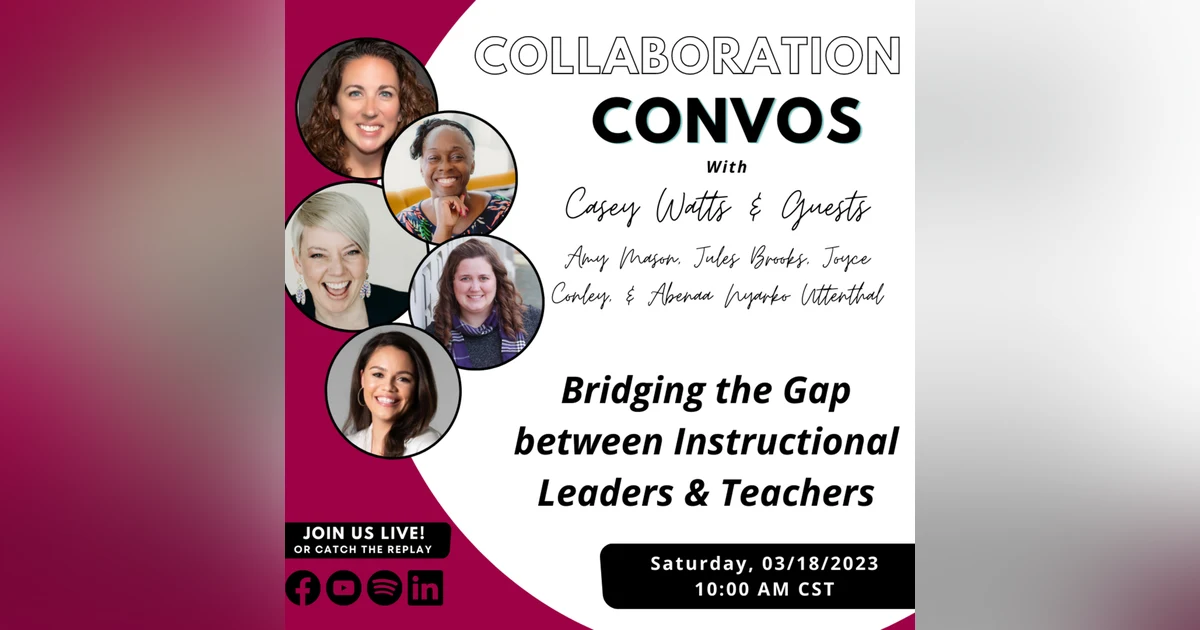
Unfortunately, it is common for gaps (sometimes really BIG gaps) to exist between instructional leaders and teachers. What's even more unfortunate is that it feels nearly impossible to bridge that gap! And the effects of this gap can be devastating. In this live session, I've gathered people with many different perspectives to share their thoughts on why the gap exists and how to repair the disconnect. You'll hear from Classroom Teacher, Jules Brooks; Instructional Specialist, Casey Watts; Assistant Principal, Joyce Conley; Principal, Abeena Nyarko Uttenthal; and Former Principal & Consultant, Amy Mason.
Connect with Me on Facebook, Instagram, LinkedIn, or YouTube!
Join the Facebook Group, Leading Collaborative Teams and connect with me and others who are eager to build cohesive, vision-driven teams!
Level UP your leadership game with resources, tools, and strategies located on my website!
0:03 Hey there and welcome to another change paddles conversation where we talk about anything and everything that has to do with building. A cohesive Vision, driven teams that make sustainable change happen. Even when change seems impossible, I'm Casey W impact coach and consultant and the host of this show. What I know from experience is that making change happen, can be 0 Overwhelming, if you don't have cohesive Vision driven teams, no one has a collective understanding of why change should happen or what changed to begin first. You notice all starts because a solid action plan, hasn't, been formed, or crafted were, you're met with resistance because you don't know how to motivate such complex people and that leads to schools remaining in a cycle of stagnancy.
1:00 Experiencing the same problems and ineffectively repeating the same initiatives or programs again. And again, and that leads to low morale burnout, High turnover, and who suffers most, it's our students but there is a better more effective way to bring about change in your school that does not deplete the energy of your people. You need a catalyst to help you get a solid start. My goal is to make cohesive Vision driven school teams a possibility. I helped School leaders, zoom out to cast vision and then Zoom back into script.
1:48 The critical moves that help teams collectively go farther faster and better even when change seems impossible. Here's I want to know from you. What is the change that, you know, needs to happen in your school? What are you hesitant to get rolled out two teams. What exists only in your mind that you are absolutely certain? Would benefit your school but you're just not sure how to get started right now. I want you to take a sticky note or put a note on On your phone, or maybe in the comments, make a note that says change Catalyst. This is your reminder to email or message me about your future endeavors and your current reality because I would love to encourage you as a change Catalyst in your school, okay? Now that you are primed for thinking about cohesive Vision, driven chain teams.
3:00 Make change happen. Let's jump into this week. Change Catalyst conversation, Well hey there everybody and welcome to our change Catalyst conversation and I will have to tell you that in previous weeks. I've called it a collaboration conversation and I have adjusted that just a little bit because truly what we're doing is coming around each other to make change happen and having conversations that help you to also go back into your schools and make change happen, okay? I've got a wonderful group of ladies with us today and I I think one of them is trying to jump on and so I'll pull her up on screen when she gets here. But I've got a group of a variety of roles here. We have everything from hey a banana. Hey we have everything from a classroom teacher all the way to principles and Consultants.
4:05 So we've kind of got it all here. A representation of all and today our conversation is About how to bridge the gap between instructional leadership and teachers because we know that that Gap does exist and we're going to talk more about what that looks like and how to overcome it as we move into today. But I want to take a moment and allow these ladies to introduce themselves and tell us about who you are, where you are, what your role is, and even what your aspirations are. Okay? So Jules, we're going to start with you. All right, thank you. Casey, my name is Jules Brooks and I am currently a classroom teacher in my 11th year of teaching.
4:52 I currently teach kindergarten at a charter school in Nacogdoches Texas, and I hope to make an impact with my colleagues, as well as Future teacher's. And I hope to be an instructional coach soon. Awesome. Amy. Welcome. Hi Casey. My name is Amy Mason and I am currently an educational consultant. I founded aim to educate to work with Educators across the country, who are really needing support and a lot of different areas, whether it be social, emotional learning, and how to kind of kick that off and get that going in your schools, or even just coaching up some of the new teachers that are coming into schools.
5:38 As we all have seen, there's a lot of turnover of people. I mean in and out as well as new instructional leaders that don't have a lot of experience and maybe need someone to come alongside them and help with ways to best support the mission and vision of their school. So I actually was a k through eighth grade principal most recently and actually work in that environment for seven years it was a K-8 Title One school and then two years prior to that was principal of a affluent Elementary School here in Huntsville Alabama. Bama. And then, of course, have the teacher hat that you always wear and that's something that we should touch on today. But I was a classroom teacher for nine years before going into Administration for 13.
6:23 So I'm looking forward to this conversation with Casey in the group today. Yeah, awesome. Joyce Hi everyone. I am a really excited to be here for one, but I'm Joyce Conley. I I'm down in Florida, so I'm an hour ahead of the game and it was really interesting waking up was like, oh, I have one more hour to get get ready. So that was nice. Okay, so I am currently an assistant principal, I have been in education for over 13 years, so I taught at the elementary level, and then I went into being an ESD resource teacher, instructional coach for a couple of years, because I knew I needed Some more experience I really did before I moved into my Administration career.
7:06 So I have been an assistant principal for six years now. So, this is your six, it has been a wonderful time. These six years, I've learned, I've learned so much. I've grown so much and this year, I have to say, I was a finalist for AP of the year in my district. So I was really excited about that and it just made me realize how much I my aspirations like, how much I want to impact the new leader. Cuz I struggled as a new assistant principal, I didn't feel like I had the support. I was trying to balance being a single mom and a middle, having a middle schooler being at home by yourself. So, I realized that those first years were really, really, really important for me, my mental health and my child's mental health, and so I can, how can I impact the new leader?
7:54 Those who want to get into the position and then those are in it and struggling because you will be on The Struggle Bus. Right. It's so I created I'll be Pro. It's a network for assistant principals. We have almost 5,000 assistant, principals that we just share. We do some PD, some collaboration talk and now I'm breaking into Consulting. So I have a pro Consulting where I am there to support the new leader and the 3 R's of relationships response, so that communication and resilience because we got to get through it, right? So yes and 11th. Thanks Joe. Joyce. Okay. Hey, I have an idea. Hey, okay, so I am very far away. And that's why I was late because I had my hours were long.
8:41 I thought I had another hour. Did not deny. Yeah, and I'm the middle school. Principal. For an middle years program. For the IB International School here, our school is extremely diverse and that creates lots of interesting, challenges, and opportunities. For us a challenge one, big challenge them working with this week.
9:21 As at my head, it has done my head in. So, yes, resilience is something that we have to think about in our rules all the time. This is my first year as a principal And prior to this, I was a curriculum coordinator for four years prior to that a dean of students for four years. And before that teaching special education, English literature, and individuals and societies which is basically a social studies course, that is integrated with many different topics. But yeah, that's me. I've been in education for 23 years and it hasn't stopped being Lunging. I'll tell you that much.
10:02 That's right. And it probably won't ever stop being challenging, which is why we are all gathered here together this morning to talk about the challenges and how we can overcome them knowing even still that those challenges will still exist. But if we can make it better for ourselves then we in turn can try to help others to make it better as well and just create that ripple effect. So I am like just so excited that I have all of you here because I admire each of you so much and I'm inspired by each of you in in lots of different ways. And I'm really interested to hear the necklace of gold that you're going to share from that amazing brain of yours about this topic which is Bridging the Gap between instructional leaders and teachers. So I wanted to tell you I was visiting with a friend the other day and he actually Actually teaches at the University level and he's not in, educate like he is in education because he's a university Professor, but he is in the department of Kinesiology and when we were visiting, we were just talking back and forth.
11:13 How are things going? And he said, well, you know, I mean, just all of these, all of these people who don't haven't been in the classroom for 20 years and they don't know what it's really like, making all of the decisions for us. So that's how it's going. And it was so funny because Someone else who is nearby was asking me. So what is it that you do Casey? And I said, well, I'm an instructional specialist and I'm one of the people that tells people like Todd who was my friend, all the things that we expect them to do in classroom. So I'm the kind of person that he really gets frustrated with and we kind of laughed about it and he was like, no way there. I know that you haven't lost sight of what it's like to be in the classroom but Truly, I tell you, I have been in both parties, so I have been the teacher who has said, well, they've just been out of the classroom for so long. They don't remember what it's like. And I also have been on the other side of it, as an instructional leader, seeing a different perspective, and trying to make changes so that our organization is moving forward, and I have truly lost sight, sometimes of what it's like in the classroom.
12:28 So I want to ask you guys, Guys and just feel free to jump in here. What does it mean to you to bridge the gap between instructional leaders and teachers like speak to what that says to you. And if you're here in the comment or if you're here live with us, please please, please put in the comments and let us know that you're here. Let us know what your role is and what you notice about the Gap that we notice between instructional leaders and teachers, Okay? Who wants to take the floor on this one? Can I start? Yeah, I've got a, I've got a Bernie answer. To this one. But you know, in my experience As an instructional leader, you have to go about collaborating and creating opportunities for shared decision. Making no one wants to feel like things are being done to them. And so you know, opening up that dialogue before even difficult conversations, have to happen, making people feel that their their thoughts are valued and that their perspective is valued.
13:32 And you know what? They bring to the table. I think that is like, first and foremost, and that would happen as a new instructional leader, that should happen day one when you walk in and you get to know the people that you're working with and then everything that you're doing is sort of like building that capacity as time goes on. So once you have built trust with the people, you're working with, helping them to understand, you know, everybody knows that all of us have demands, whether it be, you know, nationally or at your state level, or Internationally Abba not. You can probably speak to that too, but like there are always going to be things that are musts that have to happen and that are being required by even people above school administrative level.
14:17 And so you know it's not about those things being done to you but it's how you approach them and how you facilitate an opportunity as a team to come together and figure out how you're going to kind of buy it off. Those small pieces of what it is that you. Need to accomplish as a group. Yeah, no. I definitely want to jump into what Amy is saying, because I think it's a practice and empathy. This the whole question of bridging gaps, it's all about standing in somebody else's shoes. And of course, what happens when you're a leader? Once you're put into a leader seat, there's that sense.
14:59 The first sense, I think people naturally get is, I need to A show that I know these things I need to show that I have the answers. I need to show that I can direct this train, but what people actually need in the beginning with at least what I'm experiencing, I can't say what everyone needs. But what what I'm experiencing is that what people need from me or need from the leaders that come to them is understanding. To be seen that feeling like oh you are here for me. And of course, as an instructional leader or as any leader, you're there for the purpose of taking care of the students.
15:45 That's the main thing, but the teachers also need to know you're there for me. I'm also valuable to you you're not here to wreck shop or you know, to downsize or get rid of The the messy teacher. You're here to help me. Yeah, a better version of me so I think that's the beginning of Bridging. The Gap is to meet the teachers with empathy. Yeah. Can I add to that please? Okay, so that was so good and I have a just so you know I have a four year old who's running around here so I was trying to chime in but then I was literally going like this. All good.
16:27 So that's so good, right? And one of the things like was a notch. Moment for me. I just recently moved schools in January so I went from one school to another mid-year, a, but before I let that school, I said you know what, one of my goals for the year was basically building Trust of Faculty. I wanted to say what can I do to have the faculty to understand that their voices matter? Right. So I created some committees at the beginning of the year but then I said you know what, I want to do a survey like I want to know why I keep hearing. Oh, they don't understand or all we need more. Resources. Oh we don't know what's going on. I'm like, what does that even mean? So I put out a climate survey and they fill out the survey. There were some like, you know, multiple choice but then there was like, filling the gaps.
17:12 But then I said, all right, this is funny because it clearly shows that there is a gap between what we're trying to project and share and what they're receiving because perception is everything, right? So I said, all right, let's get together and let's meet with each team and let's go over the survey because that the my Is transparency if we can be transparent as much as possible. Then we're going to get that by and we're going to bridge that Gap, right? Yeah. So I said, hey, look. Here are the results. These are what your people said, tell me, what does this mean? Even if you didn't say it, like, you heard something like your ears to the ground. What do you know about this statement? Right here? And a lot of the feedback was, we they feel like the administrators because I'm an administrator some speaking from that lens, the administrators are making Decisions. Right?
18:02 That we can control and we're not communicating those decisions. Yeah, so they asked for hey look if something comes down from the things like from the top because there's the top and there's the top in their top top. So there's something that comes down to us that we cannot control can just tell us, can you just second? Look, that's not a joist hands. That's not a, you know, the principles hands. So I'm like, oh, okay, that's easy. They said, then we will feel like we're in this together and I said, That's a no-brainer like that right, easy fix. Yeah, so look, if something has to be done. Look, this is something we had to do guys. Now, how are we going to do it just having that open dialogue is super important.
18:44 Then when I moved to my new school, I said, just like that Abner. First thing I said, was I am here to help you to be the best version of you. So if I give you feedback, just know, it's out of love and it's so that you can see that you're doing. A great job. However, we can do even better because I'm one of those, like, we are here right here. Everybody's here. We all have room to grow. There's nobody's perfect. I can grow. You can grow, and I'm here to help you do that. So that's what's going to say? Yes. Yes. So there were several Buzz words that I was like oh my gosh, these are my people.
19:24 I mean value like yes, from a teacher's perspective, we want to feel valued. And then you said trust and empathy empathy is so big and then transparency. So those are all things that I as a person as my own person desire and feel like I convey. I also like clear expectations and then I was thinking communication, but not a false communication like don't send me a blanket email and think that that's Waiting to my, you know, and so like, true, communication, like you said, Joyce like that that dialogue and Amy, you said, like inviting us into those decisions or explaining, why a decision was made, that is out of your control like that immediately would allow teachers in my opinion to be able to trust you. And then also, I think the trust Needs to come both ways. Yep.
20:33 And I think teachers need to feel like, yes, I can trust you to help me, but I also need you to trust me to do what you've hired me to do. And so, absolutely, those are just some buzzwords that. Yeah, this is, this is what we look for what I look for. And and what I hope to see happens in schools everywhere now. And I want to add to that. So it's so much of what you guys I'm writing some I'm writing things down. I'm taking notes on everything that you guys are saying because it's just, I'm truly if you are here today, please put in the comments, one, buzzword or nugget of gold that you have heard because I'm hearing so much like, trust capacity, what people need, keeping the main thing, the main thing, but then coming around the main thing with transparency because here's what I believe we can say and Amy you talked about that teacher had earlier, like we always have our teacher And while we know that that has to be true, when you leave the classroom, you do lose a little bit of understanding of what it is like because your how your brain is spent thinking about the bigger picture. So it's inevitable like you are going to lose a little bit of insight and understanding and empathy for what it's like to be a classroom teacher on a day-to-day basis. However, that's why bringing that transparency to the table is so incredibly important
22:06 because not only do we want to be transparent with them, we want them to be transparent with us so that we can then meet their needs. So it's like this constant cycle in at any point, there can be a rock thrown in that cycle, throwing us out all of these different directions. And it's really hard to get back into the cycle that we need. Need the trust cycle. That's a great where I'm going to write that down. Trust such as like we're gonna and we're going to investigate that more, my invent my inventors hats coming out but you know it's completely different because we had a pandemic.
22:49 And yeah, I hear that all the time. It's like if you didn't die or be like, I talked to the pandemic. So I interesting it. But and so it's like I can't even speak to that because I didn't teach through the pandemic. I was an administrator and the clearly that's a whole different thing. It's just different, but that's another thing you hear often. Now it's, I was a teacher during the pandemic and you will never understand that. You know. But you know something, one of the things that I think we don't do enough as administrators is talk about the responsibility to speak for all teachers because what happens and I would say this happens in plc's or Happens in whole team meetings that the loudest voices, carry the voice of the people. But often that's not the voice of all the teachers often, The Voice less are watching the people with the boys and they're like, well, they listening to the people with the boy, where am I in this picture?
23:53 And I think it's one of our responsibilities as administrators to help teachers understand, it's not that I've lost sight. Out of being in the classroom per se, but now I see more classrooms. Yeah. Oh my gosh. Yes. And so, I see how other people do it. I see how other people manage their time, I see how other people manage their classrooms. I see how other people plan for they learn for learning. I see how other people manage data, and I see how other people collaborate. So, I know that what you think is impossible and what maybe I thought was impossible when I was in my classroom. I see that it's possible because I see somebody else's classroom. So being able to open everyone's eyes by helping the quieter teachers to have a voice to find their voice in the storm of school life.
24:47 I think will also support that bridging of gaps of the Gap have and I want to piggyback on that because something that you and Joyce, both said, you know, those opportunities joist touched on committees and having like smaller groups. And I think, when you're talking about those loud voices and jewels talking about making sure that it's two way communication. I think that's the caution to having whole group conversations with your whole staff all the time because you do have those really loud voices, that sort of sometimes they're not even the most positive of the people in the group, they kind of bring the morale down. And so, the more that you can facilitate opportunities to have conversations in smaller groups, Things whether it's grade level teams and plc's or maybe focus groups around a specific committee topic or area of focus that they're working on collaboratively, I think it really helps to guide those conversations in a more productive and positive way than having the loud voice be the person. That's the only person being heard. Yeah.
25:52 Absolutely. So I just want to put a plug right here because I've heard plc's and I've heard transparency and like having those individual and small group Group conversations next Sunday. My live session is all about, it's titled PLC just say. No, and I thought about titling, it just say no to PLC so you can have to come next Sunday to hear what I have to say about that. But following that live, I am doing a free share caste called PLC reset. And one of the things we're going to talk about are listening tours and feedback meetings. You can go ahead and find out more about that at bit.ly. / PLC reset and find out how to get in on that Share Cast.
26:36 Okay, so I want to pull up a couple of things on the screen. First of all, I think you guys will love this, comment, what would you say to teachers who do not have such understanding and amazing leaders as all of you? Jules, could you speak to this? What would you say to that teacher? Yeah, so I've I've had several different leaders. I think I've I had five different principles in three different schools and so it's quite quite a lot. I would say that you can still. First of all, you can still have a positive outlook, you can still make an impact, even if you don't have teachers that you perceive as amazing and understanding and I think it takes a lot of courage.
27:31 You may have to be the one to initiate some tough conversations. You may have to be the one that instead of getting on the gossip train you go straight to your leader and and really be honest with them about why they're, you know why there are struggles. Now I say this it is so difficult to do as a teacher if you feel like there is not trust or value or appreciation and what you do, I know that in a, you know, I'm in deep way. So it does take courage.
28:14 However, I think that one of the reasons everybody's like oh there's just miscommunication. I think there's more lack of communication than missive miscommunication a lot of times and I think At, you know, just to take some ownership, it can be due to the teachers. Sometimes just feeling stuck or they don't understand me. They're not going to change anything. Or maybe you've had that tough conversation, and you haven't had change immediately, but that's where your empathy needs to come into, and say. Okay, maybe they did hear me. Maybe they are, you know, managing so many other things that it may take a follow-up conversation. Isolation.
29:01 It may take two or three follow-up conversations but I would say to that teacher. First of all, don't give up second of all have courage and be honest. But kind. Yeah and then also like put your own empathy hat on and your own understanding hat on because our leaders do have a lot more to juggle than we can see from inside our classrooms. Absolutely. Okay. So that leads so perfectly Jewels into this comment. Hey Teresa, I'm so glad you're here in the comments. I'm so she is an instructional coach, a band and I both know, Teresa because they're we're all part of this group called breakthrough circle with Allison Peterson. But she says, I spend a good amount of time in the classroom and what I see is that Administration is so overwhelmed that they aren't building / keeping relationships with teachers.
29:57 They aren't listening collaborating or supporting not because they don't want to but administrators need support as well with the challenges they are facing. What can you guys say about this? Can I just say thank you for that comment because I think having taught for 20 22 years because this is the first year in my career where I haven't taught. As dean of students, I had half a teaching schedule. As curriculum coordinator, I had a half a teaching schedule. This is my first year, not teaching and I am dealing with so much more at work than I've ever ever had to deal with before it is so intense and every day, all I think about is I didn't spend enough time in classrooms.
30:54 Didn't spend enough time with my teachers. I didn't spend enough time building trust and I know that that's the thing that's going to keep my work life happy but it's the last thing that I seem to be able to make time for. I'm it's a conscious goal of mine, I'm actively working on that. It's actually written in my goals to build relationships. It's the thing that I do focus on, but it's also the thing that is every single day, threatened. In that school building because there's so much to work on. So I what has helped me as a leader is teachers who are willing to just open my door. They just come?
31:40 Yeah. They're not asking permission to come. And talk to me. They're just literally like, hey, I'm a banana. Uh-huh. I need you now or hey, I need a hit. I'm sending you. Your to-do list to remind you that you're speaking on Monday for the de de da. I know I sent you an email, but let me put it in your hand or I'm gonna come and sit and have lunch with me. I would never say no. Yeah, and I can always say if the head of school is in its King me for meeting. Sorry, my teachers need me. I need to help them out. I can say no because they say it, but if they don't say it and they're waiting for me to show that, I care. It's not that, I don't care.
32:25 It's, I literally don't have time. Yeah yeah yeah, I want to add to that because that was fantastic and I want to say thank you so much Theresa as well. For the recognition recognizing, right. Cuz I feel like that's so lost and I will see people say, and I hate to say this out loud but like understand where I'm coming from that, we are there to be at service of the teachers. I completely agree with that, right? I completely agree with that, right? That's what we're supposed to do because we have all the things that we manage. Yeah. However, it is a two-way street. Yep, you cannot expect me to understand where you're coming from.
33:06 If you can't understand where I'm coming from, it has to be King to understand on both ends because there's only one and principal a lot of times only one assistant principal, I hope that they are doing well together and being able to build that relationship to Foster, you know, a tight leadership team. It's not always like that, right? Then we're talking about the last question where if you don't have an administrator that's understanding. What do you do? You are the person that just has to try to seek to understand like Asking questions. I don't care if anybody ask me any question, there's no dumb question. My dad told me that as a kid, there's no dumb questions. Ask questions if you see I'm overwhelmed and I may have responded a certain way ask me if I'm okay I'm gonna ask you if you want me to ask you if you're okay. Ask me if I'm okay.
33:56 You want me to know things about your family, ask me about mine, like it is, it has to be ongoing, and it's ongoing, it's not the beginning of the year. It's every single day we are caring about one another and it's just care. After about you, you care about me. And, you know, I have this to do. I know you've got that to do. I'm going to be there to support you. Yeah, you can't do. We can't do each other's jobs, right. We can't that's just not reality, right? But we can understand and support one another and that is on my gosh, that's key. But I can't. I just it's hard for me to say like, oh you are there to do all of everything for the teachers. Yeah, okay. I get that. Yeah, I'm responsible for making sure that the culture and the climate and people feel good.
34:39 Yeah, making me feel good. Yeah. Who's doing that? Because there's like, I need that, too. There's 57 of you. There's one of me in a simple. Hello. Good morning. Is it makes my day? Yeah, it's the little things anyway. That is so powerful. What you all are saying. And I think the other piece of that is that, let's take job titles away, and realize that everybody needs to be a leader in, whatever capacity, you're serving. And and you know, I Become an instructional leader without having first been. A teacher leader in my classroom. And with my colleagues and doing the things, like, Joyce is talking about truly having empathy, and care for your colleagues and the people you're working with. But the other piece of encouragement that I wanted to offer with that last question is, don't forget as principles that you need to have a network of your own people as well and it may not be your admit admin team. I've worked on admin teams.
35:39 At are not always super solid and you know, when you're facing a challenge you need to have other instructional leaders and other principals in other schools that you can reach out to. And yes there's many professional organizations that you can do that with. You can find those things online I mean really that's how Casey and I got connected with one. Another is you have to seek out those leaders that you fine and it doesn't take a lot of work on your part. Like we just kind of gravitate toward each other toward each other. It's like Magnets, you know, L gravitate toward leader so yeah, that's my encouragement. Yeah, man. This is so good. And it's got me thinking so much, but I will say, like, I started to notice in one teacher and Leadership relationship. I was in that was difficult, and in the past, one of the things that I saw made the biggest change was when I started putting myself where I could talk to that, that leader and in the car line, I just was like, okay you know, I've got my kids in my class and they're good but as it started to dwindle down, I would just go and talk to that leader and starting to build that relationship there and, you know, would ask her, like, how was your day?
37:02 She tells start telling me about meetings, you know, and it started to peel away the surface level. How are you? Good, I'm good. How are you? Good. And, like, she started telling me like, things that she actually was working on or, you know, all of these things coming down from TA or the, you know, the university and things like that. So, you know, I think for both of those comments for the teacher, like go and, and, and be that for that, for that leader, you know, and for the leader, Under the instructional comment.
37:42 Yeah, like building relationships, but that doesn't have to mean having a two-hour conversation with every one of your teachers. Like I had one leader that literally, she would pop her head in smile at me, give me a thumbs up and then, you know, go on to the next one and piece by piece. It was like, okay, she's trying to show me that she's here and she cares and she sees me. And so when I was thinking about, you know, bridging that Gap like I wrote the words responsibility of both in the relationship or partnership, like there's a responsibility for both of you. Like I can't just expect my husband to always be the one pursuing me, I have to pursue him as well. And so he feels love because it's not just about me and I would say the same for any partnership or professional relationship that you have.
38:34 It's it's both ways. Yeah, being visible is what Teresa said and isn't That so true. Isn't that so true, like, without even a word be visible? I think it's interesting that often teachers don't realize the extent of the power that they have inside of a school building because at the end of the day, schools are very weird institution. They're nearly like family in the sense that the way things happen in a school from how we protect each other and have each other's back. And you know, fill in the gaps for people it almost functions like home. And so it's a very Dynamic space but it's also very familial space and the teachers have to realize, I think that there's so much power in that because they're the CORE family. They're the group that is with each other and they have the reunions, and the outings and the get-togethers. And everybody wants to be a Part of a social situation, everyone wants community.
39:43 And there's so much leverage that teachers have having that strong community that just that, hello. I, when you were talking tools and make me think about a situation where I had such a hard day there was, there were a couple of weeks ago. I was just dealing with a huge student issue. Many students were involved. I was like, on it all day long and I was walking through the hall and the teacher. Who almost never speaks to me. She was eating cookies and she was like, here you go. You need this today. Honestly, it's like she handed me a hundred dollars. It was important that I got.
40:24 That one little cookie from that person. Yeah. And she didn't realize how powerful that was for me. So I had to let her know I needed in that very moment to know that somebody was seeing what I was going through that day. Yeah, so I think you're right. That needs to be mutual, we can't just expect the, the leader to be the one building relationships. You know what? I'm Seeing that as actually is, that's culture, isn't it? And, you know, I think about your students and they're all observing these interactions between adults and how powerful is that for them to see healthy interactions between teachers and administrators and because they're picking up on that and we think they don't know, but they know just like they know lots of other things that they pick up on and so you know that that's the healthy relationship model that you want to.
41:18 Create where there's that mutual respect there and then the students end up following suit, right? Yeah. Yep, 100%. So we're going to start rep. I don't want to wrap up this conversation. I mean, literally, I feel like look, let's just keep going all day. We're here all day people. This is what you're doing on your Saturday, but one of the things, one of the questions that we have because we created an agenda, we've got some questions on here, which I haven't even looked at the agenda because our conversation has been so authentic and Enoch, but one of my questions that I really have thought a lot about because I heard someone comment recently and it made me start questioning my my belief about this.
42:00 But should we encourage or even expect teachers to try on a different lens to gain a leadership perspective? And then one of the other questions was, who's responsible for Bridging the Gap and I truly think like, yes, we need to have that expectation of allowing them. To see the perspective of leadership. But that is also our responsibility to help them to see that. So the two go hand in hand and I. So a couple of weeks ago I did a special live session about Vision casting and scripting critical moves. That's part of transparency. So I think that the more transparent we can be about what we see what our role is. It's instructional Leaders with teachers. And what We come up against in our hardships, the more they're able to see from our perspective, they're more empathetic, they can be and again that trust cycle continues because I have to do the same for them. Okay, ladies so much goodness of has come from this conversation. I want to ask if you weren't here. Dropping the comments.
43:11 What you felt like was most useful for you here today and I want I want to hear from you guess that I have either. Why does it matter? Why does this conversation matter what is the change that we want to see happen? Or what do you feel like was most useful for you to talk together? I mean, I feel like we're all in the same business, right? We are here to impact children and the future. Like I'm at an elementary school level. So I see my lenses. Like I'm trying to mold them to be good people. Right? And someone said that they're watching us, they're watching us and if we don't have the culture and the morale and the communication, the relationships amongst each other, they're going.
44:04 To learn negative the negative behaviors. They're going to not see us fostering a familial type school and they need that because honestly if we don't know what they're dealing with at home, right? So we are tasked with impacting them academically emotionally, that's a big one emotionally and we need to understand them but they also need to see us because we are possibly like the most that they see our teachers there. L, i remember being a kid and I had a principal Miss James. I could, if I could find this James to this day, I would be so happy. But I admire her. I looked at my principles and I was like, man they're amazing.
44:47 My principles were amazing, I don't know anything about Miss Jane's life, I don't know anything about mr. Chavez life right? But they were amazing to me because at school they made me feel like I was in a place where I was comfortable. I was safe right? And ask the adults. In the building to do that, we get we have to be able to communicate with one another and love on one another and understand one another so that we can impact these children. Because if we don't do that, then the the the scores aren't, I mean, like come on, we talk about Statistics test scores all the time, right? Yeah. That's the ultimate goal is to get them to learn but they're going to learn better in an environment that we are showing that we care that we love that, we love each other, that Understanding all of that stuff and that, you know, when we have those meetings with them, we're seeking to understand we're being empathetic with the children. We're being empathetic with their families. We're being empathetic with one another. I did a relationship Workshop, we're talking about empathy empathy is real and if you don't have that, you're not going to be able to be that understanding leader. You're not going to be able to understand the children or the adults and it really have to.
46:00 So the question was but didn't Joyce. No, for me, I think exactly as you're talking about Joyce, that we are teaching with every single thing we do, there's nothing that's not teaching. And so if we show students that, we don't relate. Well, we can't solve problems together. We fight each other over Petty things. We keep our distance rather than approach each other when there are challenges. If that's what we're showing them, that's what we're teaching them. So we won't be able to argue that, they should do it any differently.
46:48 So I think that that is a huge job because it takes a lot out of our Spirits as human beings to walk in every day working on ourselves, really. That's what leading is. It's working on yourself is saying I'm the person who's going to work on being a better human being. On behalf of all these other people so that I can lift them up. So if if I'm not willing to do that as a leader, if the teacher is not willing to do that as a leader of students, then then we're going nowhere with education because education is not about books, and we know that now read all the books you want.
47:29 That doesn't make you a good human. So hopefully through learning how to be together, learning that both of our Jobs have great value in the lives of children will help us to work better together. It's an important conversation. Yes. Really. I think it's that reminder that we're all better together and it's not an Us Versus Them. Mhm matter like it can't be. We're all better together and we need those voices and does that mean that the voices are always going to be something rainbows and unicorns positive? No I mean post pandemic schooling is hard and it's hard on every level and I've seen it. It's like everyone has some level of angst about Something that has happened as a result of that and I think it's sort of being aware and of just listening to each other. Like but also it can't be a complaining Fest all the time you know like okay get it out and then when it's out we got to figure out what is the job we have to do. And how can we work together to be just the most productive people that we can to help students? And I know that's a hard thing to do. It's a hard thing.
48:49 You have to We be aware of yourself to be able to do that but I think those are the schools that when I walk through the doors you can feel it. The moment you enter that building because it's a healthy culture, the kids are happy, the adults are happy to be there. They call it a family. All of this, those things that we talked about and so that that's the environment that we want to create for students. Yeah, awesome. Okay, Jules. Yeah, thinking about why does it It matter to bridge the gap, the thing. The only thing that comes to mind is it matters because people matter students matter. Teachers matter, Administration matters parents matter like like all of you have kind of said and touched on his like, yes, we wear these hats and yes, we have these roles but we're people underneath, and so, yeah, people matter.
49:46 So, it matters to bridge that Gap and make it a more cohesive. And healthy learning environment for everyone involved. Yeah. I mean we're talking about our day to day lives guys, right? So let's bridge that Gap, I've gotten so much goodness out of this conversation and that's why I've changed the title to this as change Catalyst conversations because we are making change happen. We're making big change happen. We're making small change happen. And I hope that audience you can Come again next week, I'm going to be talking about that PLC word, you know, and say no to it.
50:29 And so I want to dig into what that means with you. And if you want to go live with me, when I talk about that, well, I would love it because there's nothing better than getting together with a group of other leaders who are like-minded. Like, we've talked about, find your people. We can be your people. We would love to be your people, okay? I hope you I have the most wonderful weekend and we'll catch you next time. I want to give a big thank you to you guys for tuning in and I would love for you to do me two solid favors number one. If you've enjoyed this or any other shows, please hit subscribe. I've got a lot of great, gas and content coming up.
51:11 And I don't want you to miss any of it too. If, you know, of someone who may be interested in building cohesive, The vision driven teams that collaborate well, share this show with them. And until next time, I want you to go off and have the great collaborative conversations that help you and the people you work with two completely. Unleash Your impact. See you later. The vision driven teams that collaborate well, share this show with them. And until next time, I want you to go off and have the great collaborative conversations that help you and the people you work with two completely. Unleash Your impact. See you later.

