Five Mindsets of the Faux Collaborator


 RSS Feed
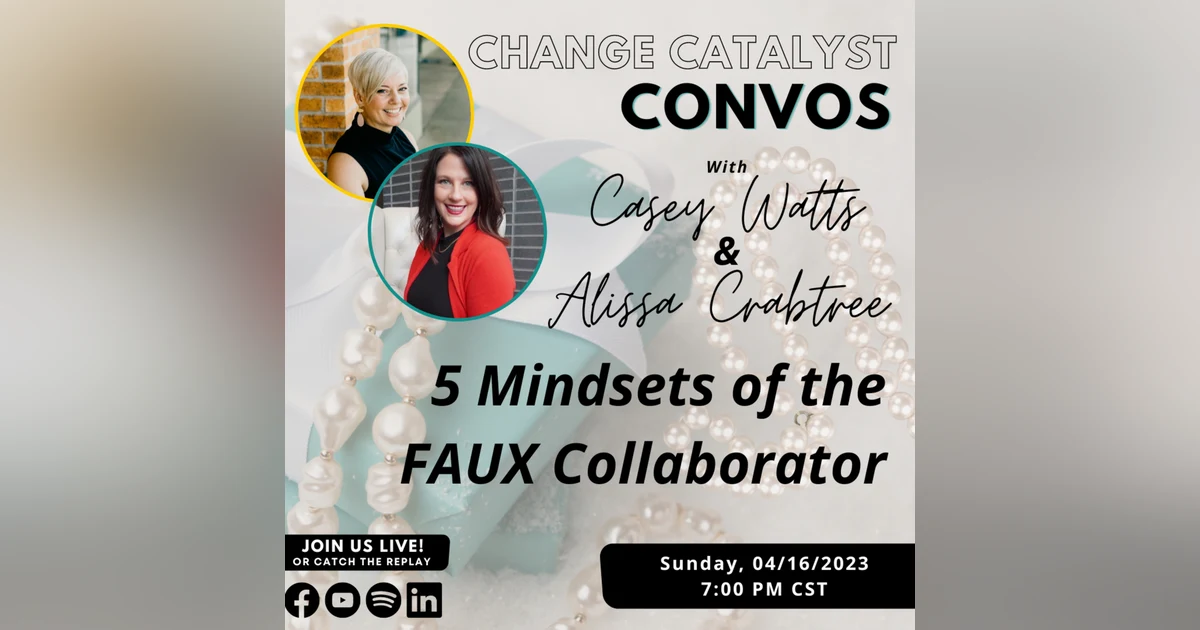
FAUX: made to look like something else that is usually more valuable : IMITATION, FAKE, INSINCERE... Does this really happen in collaborative settings and on collaborative teams? Is the collaboration just an imitation? Is it simply fake or insincere? Unfortunately, this probably happens more often than not. What looks like collaboration is often faux collaboration. Alissa Crabtree and I share our ideas and experiences with faux collaboration in this change catalyst conversation! We specifically dive into the five mindsets of a "faux collaborator". Could YOU or someone you know be the victim of one of these mindsets? Listen in and let's see!
Previous Episodes We Mention:
Find out more about Alissa Crabtree!
Connect with Me on Facebook, Instagram, LinkedIn, or YouTube!
Join the Facebook Group, Leading Collaborative Teams and connect with me and others who are eager to build cohesive, vision-driven teams!
Level UP your leadership game with resources, tools, and strategies located on my website!
--- Support this podcast: https://podcasters.spotify.com/pod/show/catchingupwithcasey/support0:03 Hey there and welcome to another change paddles conversation where we talk about anything and everything that has to do with building. A cohesive Vision, driven teams that make sustainable change happen. Even when change seems impossible, I'm Casey W impact, coaching consultant and the host of this show. What I know from experience is that making change happen can be Overwhelming, if you don't have cohesive Vision driven teams, no one has a collective understanding of why change should happen or what changed to begin first. You notice all starts because a solid action plan, hasn't, been formed or crafted where you're met with resistance because you don't know how to motivate such complex people and that leads to schools remaining in a cycle of stagnancy.
1:00 Experiencing the same problems and ineffectively repeating the same initiatives or programs again. And again, and that leads to low morale burnout, High turnover, and who suffers most, it's our students, but there is a better more effective way to bring about changing your school that does not deplete the energy of your people. You need a catalyst to help you get a solid start. My goal is to make cohesive Vision driven school teams a possibility. I helped School leaders, zoom out to cast vision and then Zoom back into script.
1:48 The critical moves that help teams collectively go farther faster and better even when change seems impossible. Here's what I To know from you. What is the change that, you know, needs to happen in your school? What are you hesitant to get rolled out two teams. What exists only in your mind that you are absolutely certain? Would benefit your school but you're just not sure how to get started right now. I want you to take a sticky note or put a note on your A phone or maybe in the comments, make a note that says change Catalyst. This is your reminder to email or message me about your future endeavors and your current reality because I would love to encourage you as a change Catalyst in your school, okay? Now that you are primed for thinking about cohesive Vision, driven cheat teams that make make change happen. Let's jump into this week's change Catalyst conversation. Well, hey everybody.
3:14 Welcome to another change Catalyst conversation. I'm so excited you're here and I didn't get the timing quite, right. So I'm eating a bagel with cream cheese and I was like oh I've got plenty of time to eat the rest of this and I was like oh my gosh I'm gonna have a mouthful and talking with my Mount anyway it's all good. So tonight we are going to be talking about five mindsets of Collaboration. And before we get started with this topic, I want to begin by introducing my guest, Alyssa Crabtree, and we've been together in change Catalyst conversations before Alyssa. Actually, we've had to change Catalyst conversations in the past all about guess what folk collaboration? So, Alyssa welcome.
4:06 Thank you for having me. I'm so excited to be here. I'm excited. You're here with me, okay, and we have If you hang in with us until the end of the show, we have some extremely exciting news. Like I'm already grinning ear-to-ear. My face is hurting. I'm so excited about it. So hang in there with us because we want you to hear this. Great news. What I want you to do Alyssa, real quick is introduce yourself to our audience and let us know who you are. Where you are, what your role is and what your aspirations are. Yeah, my name is Alyssa Crabtree. I am the founder of crab Treecko. Coaching collaborative where I have the absolute amazing privilege to work with instructional leaders across the state of Texas in strengthening their collaborative, team strengthening tier one instruction on their campus. And really my mission is to one streamline. All of the things that are coming down on two campuses that are just unrealistic and be able to truly focus on the main thing and what truly matters.
5:11 And that is teacher success, Student Success, Educators success, awesome. Awesome, awesome. Thank you for sharing that. And listen, guys, she's just giving you an idea of how she can partner with you. So, if you are in that boat and you're thinking, man, that sounds really relevant and familiar to me reach out to Alyssa. In all of her information will be in the show notes at the end of the show, so you can see the show notes on YouTube and or on Spotify, okay? Lissa. I want to tell you a story. Are you good with that? I love story time. Let's do it. And you are going to like, this is going to sound probably exactly like a story.
5:52 You're going to think. Wait a minute. Is that my story? Like, it was she living in my life? Okay, so, last May, I was gearing up to work with this leadership team to craft a vision and do some strategic planning, so they could lay the foundation for plc's because they wanted to begin working. Toward that in the year to come one of the tasks that I had them complete before we met for our first time for work. Our pre work, if you will was to send out a survey to the grade level teams to gauge like their current perceptions, and their understanding, or their beliefs about their own collaboration with their grade level teams and so they did that and then the grade level or the leadership team and I gathered around Round this oval table was a perfect picture of collaboration.
6:46 We gathered around this oval table, we had our coffee in hand, we had copies of all of the surveys ready and we had organized them by grade level teams, they're in these stacks and when we reviewed the seventh grade math team surveys, the leadership team, pause like we read through all of them and they just pause and then they started giving each other like these knowing Glances and smirks, and I was like, okay. Something is up here. Like, there's more to this story. So, of course, I said, okay, tell me about what these, what these glances are about.
7:27 And they said, well, when we look through these surveys, the team, the 7th grade team ranked themselves at the highest level of collaboration. And here is there evidence there evidence. Was that they all got along that they never complained or argued and that they got things done quickly, that was their evidence. And so, when I ask them to explain more about like why that was interesting to them, they said, you should see these grade-level teams working together. This 7th grade team working together because there is one veteran teacher, who shares everything that the team.
8:11 Is going to do in the week to come. They all say Yes sounds good and then they leave they might get some things checked off of their list but then they all leave and go back to their classrooms and you and I know that this is not collaboration. Yeah. And so I'm wondering if you if you have had similar experiences All the time, all the time. I've even been in that and in that collaborative, team as a member. And there is this misconception that if we get along really well, we are high functioning and so I kind of want to take it to an analogy. So I, you know, and wearing my foe, my photo items today. Like I was like I got my faux fur jacket on my phone necklace, my faux earrings and I was like it reminds me of my aunt Bess. See and Aunt Glenda and you know I can wear all my fake things and I feel real good in the moment and it feels like, you know, on the outside it looks good but the the trouble is I'm always wanting more internally, I'm not satisfied. So I think of my besties of my aunt Glenda that put on the phone and they're like, oh I wish I had the real thing and so it's kind of like even in those we get along. Well, someone's just handed me the stuff and I'm taking it. There's no growth there.
9:42 There's no growth and really you are left unsatisfied. And in the end of it. Yeah, there's no fulfillment in that. He and without that fulfillment, we are not building capacity and it leads to burnout and turnover. And what happens when that teacher leaves because that teacher won't be there forever. We know that Gene's switch and she might retire or whatever the situation is. I always ask my instructional leaders. If you won the lottery tomorrow and you do Stout and we're like, I'm done. What are the people that you lead?
10:23 What are they going to do? You want them to flourish and be able to have the real thing? Yeah yeah. And so we're going to talk about that tonight. We're first going to talk about. Like what do we mean by fo collaboration? And we'll both just. Share a little bit about our thoughts on fo collaboration and then we want to get into those five mindsets of the faux collaborator, hey, my husband just passed by. So we might let me just close these so he's not an alive. But then we're going to talk about those five mindsets. And what's interesting is you and I probably have been victim of these mindsets before, and I think sometimes it happens almost without us consciously thinking about it.
11:06 So, tonight, Right? We want to bring that to your attention so that you're not falling inadvertently or even unknowingly into fo fo collaboration mind mindset. So let's talk about that. Our working definition of like faux collaboration and we know Pho means fake. Yeah. So we've got all the fake things on it is just you know we want it to be real but it is just the facade. Of you know, the pearls is just the facade of true fur things but we don't have that even around me even surrounding me. I was thinking about this before we get started, I have plants all around me that are completely fake, hmm, but they give the facade of being real.
11:59 So tell me a little bit about your thoughts around the term folk collaboration my gosh you just sparked a An analogy. Well, it kind of expanding on your analogy of the fake plants. Here's the deal. My my fake. Let me grab it my fake succulent. Let me tell you, it's easy to maintain, it's easy. I don't have to do anything but my real plant, I do have to nurture it and care for it, but it's a lot prettier and it's gorgeous and I love it, it's more meaningful to me. And that is the kicker. And I think sometimes we fall into the fo because it's easier to access it's easier to deal with and in the world of Education, where the job is just hard. As it is, the path of least resistance is the most tempting one.
12:59 However, as we mentioned before, it just is not, it's not the real deal and it doesn't move us forward and we know that education. We need a revolution like we need to revolutionize it right now and if we just keep going for the easiest Right. We're going to keep spinning our wheels and section going to get harder but yeah, this is a lot easier to maintain it. Sure is, it's not healthy. Michelle rui is here tonight. Hey, Michelle and she said, love that photo is easy to maintain real takes nurturing, nurturing and it absolutely does. And I think about like if I walk out, I literally, this says, something about who I am.
13:45 I literally have told my husband, like, what if we just did fake plants? In the pots outside, on the front porch with, would anybody really know that they're fake plants if they didn't come up and inspect them and touch them and everything and he said, yes they would know that those are fake plants. Not only just by looking at it but it doesn't give off life and we know that real plants, give off life. We need those in order to survive and I the kind of makes me think about How fo collaboration limits us and you've spoken a little bit about this because we can't move forward.
14:29 If we are remaining stagnant at just fake collaboration, the facade of collaboration and if you're wondering, well, how do you know, if, if it's fake collaboration, listen, to the mindsets that we get to, in a little bit, and it will be very clear for you. But how else do you feel like folk collaboration limits? Either us as Jewelz our teams or our entire organization. You know, I do a lot with campuses on building Collective efficacy and we understand that the number one impact of Student Success is collective teacher, efficacy essentially the belief that everyone on the team can accomplish the goal. However, if we are in a state of FO collaboration, those individual Components of building capacity and confidence in individual members is going to fall flat, which then impacts Collective efficacy.
15:32 And again, one thing that I do ask instructional leaders, particularly instructional coaches or team leads, I asked them, do you trust every single individual on your job to do the job, right? And to accomplish it, if you were to say, go ahead, make Make all my things for me and do it for me. And I'll still be the one behind that like taking credit for it. Do you trust them? And I always get, no, I have yet to receive a yes, and to me that is problematic, but that is a symptom of folk collaboration. We have to lift the capacity of everyone, and that's that does take nurturing, it takes time, it is not easy.
16:17 However, the benefits are life-giving, Right? And once people have those Mastery experiences of what true collaboration feels like sounds like looks like and what it produces there. There's truly no going back from that. Now the problem is that because we get stuck info collaboration, we get stuck in these mindsets so many people. I'm gonna I'm gonna push the boundaries and saying that so many people will only ever experience fo collaboration because we don't I would say that very it's very rare that people actually have those around them that walk them through the modeling, the facilitating the explicit teaching behind what is collaboration. Truly looks look like and sound like can alike. So people just don't always get the chance to experience true collaboration and if you don't ever get that chance me and you just stay stagnant, info collaboration, and you're ready for retirement, you know, they'll I wonder if they don't realize they have lived true collaboration because sometimes I think we separate it from our professional life and our personal life.
17:39 But you know what? If I have true Raishin that is life-giving synergetic could be with your friends with your partner with your like I feel like the same components would apply but sometimes we just cart compartmentalize so much. Yeah. That and we don't realize that what's happening out here is also collaboration, but I take it back to you myself and two other women that we Marco Polo often and we are, oh my gosh, what about this house this?
18:19 And we're just friends. Yeah, we're friends who get excited to talk to one another and problem solve. And that is what we also want to bring into the professional world. Right. And we're building the capacity of the other person. Yes. Yeah and I think too like this this reminds me of Liz wiseman's work in the multiplier effect. Was I would say that we, each are multipliers for each other, you know? So I feel more intelligent, more productive and better in the work that I do and even as a human being, when I get to collaborate with you guys, and we don't even have to be in the same room to collaborate with one another. Yeah.
19:09 Do it virtually. Absolutely yeah. Okay. So I feel like it's time to dig into these mindsets, okay? And as we're going through these mindsets, I would love, love, love if you are here live with us to pop in the comments, either, I know someone or I am. So I know someone or I am, or you could even type the word both, meaning, you know, someone who's Fallen victim to this mindset, and or And you also have fallen victim to this mindset and I will be the first to tell you that I have been victim to every single mindset that is here.
19:56 So I'm guessing that Alyssa. This is true for everybody. Else, who is listening? So let's get started. The first mindset of a foe collaborator is the mindset of control, and here's what someone with us. Mindset might think and there are two different ways that we might think about that. Someone may either think if I'm not with the team, nothing will get done or someone might say. If the leader isn't here, then we don't even have to meet So there are two like there are two opposing sides to this, if I'm not with the team, nothing will get done mindset of control.
20:41 If the leader isn't here, do we even have to meet? Okay, what are your thoughts on that? Well, I feel like the first one. Definitely creates the second one, so if you have a leader who is very much wanting to be in control, or possibly, even just individual team members that are wanting Be in control. It perpetuates an idea that if they're not there then we don't have to meet because we only meet because of them. What they do is either important or they just want to show it. Like it, it creates an unhealthy culture. And one of the things that I have been working with school districts on is an adult learning series, and one of the things is releasing control, we have to do that especially To grow the capacity of individuals around us and you know, whenever we have the opportunity to release control and provide them the tools, so that they can do it successfully, man, oftentimes, you'll even see that they come up with something even greater something even better.
21:50 And it is a true influence to the organization that just makes it stronger, makes it right for sure. And I found myself the other day thinking, man, if I didn't show up to this meeting, Would people know how to continue the work and it was like a gut punch because I was thinking who I don't know if they would be able to continue the work, which only means that I have controlled the work and I've held on to this mindset, like if I don't do this, it won't get done. Yeah. Okay. Second mindset is. So the first mindset was the mindset of control and I already see some people saying yeah.
22:30 I know some someone's I know several. Someone's is what Michelle said. The second mindset that a faux collaborator falls into is the efficiency mindset, which efficiency is great. But here's the problem with that mindset. When you're thinking about collaboration, this person will say, and remember, there are two types of people. So, one person might say, I don't want to waste people's time. So I'm going to make this quick. Or on the flip side, it could be. This meeting is a waste of time. So I remember type in the comments either, I know someone or I am or you can put the word both.
23:13 I want to tell you. It was a couple of years ago we were at and it was during in service at the school that I was working at and a an assistant principal was required to talk about some Intervention Program or some, some kind of initiative that was going on. He started the conversation with. I don't want to waste your time. We're going to go through this as quickly as possible. I know his mindset was whoa. Oh, I don't obviously, I don't want to waste people's time, but the problem is you are setting up that Initiative for complete failure and you are setting up the ability for people to collaborate around this Initiative for failure. You know, I also look at how it impacts the people in the audience emotionally, so I'm thinking of two different types of people and you're good.
24:15 Dealing with adults, you have all different kinds of personalities. And I'm considering one type of person that if you were to say that, guess what? In my mind, you have planted the seed because you said waste of time. Yeah, I would've never thought waste of time until you said it and then that said, tends to Fester that you're planting the mindset in them. The second person that I am thinking of is the more No. This would be me. This would be my type of person that craves collaboration and I crave that, you know, let's let's talk it out. Let's go through it.
24:58 It's going to be like, oh, you don't spend any time with me. Yeah. Like you you are already telling me that you it's a waste of your time to be with me now. I, I also feel like this statement is well intended because of the Culture of Education. We are inundated with so many things, however, you cannot assume that everyone sitting in your audience is of the same mindset of the as you in that moment, right? And so you have to be careful with the words that you use. Yeah, yeah and how you approach even in your demeanor how you approach any collaborative time or any.
25:47 Any beginning stages of moving toward collaboration? Oh I love. I felt like I could talk way too much about all of you. I'm trying to keep it brief and move on to the next one. So we're not here for an hour but here, we've talked about mindset of control minds the efficiency mindset. The third mindset of a faux collaborator is the mindset of avoidance. The mindset of avoidance. So here are two things, the two different perspectives, Active behind this. One perspective is, I don't want to ask the hard questions because it's uncomfortable. The flip side is I hope no one asks an uncomfortable question. I have been both.
26:36 I'm guilty guilty as charged. I mean. No one wants to be uncomfortable ever. We all hate conflict. I don't mean, I have, I have yet to meet someone that's like, oh yeah. Yeah, I want some conflict today. I mean, there are some are really good at dealing with it, but that is also where growth happens, so we cannot avoid it. And I think that is why I would say that you're most agreeable teams. Oftentimes are the most dangerous because they're not getting uncomfortable and complacency is a Very, very unhealthy place to be or dangerous place to be but with that comes creating a culture where we can get uncomfortable with one another.
27:32 We need to understand each other's values and strengths and weaknesses and we need to talk about how it's okay to ask uncomfortable questions. This is a safe place and get in the habit of doing it. We just got to in the habit. Exactly. Exactly what I was going to say. Is like man, it isn't it all about, just those small habit. And we have to Foster that in a group of people like someone has to recognize it but then someone has to Foster it and facilitate it. Yo, get Michelle's question, though, I love this. Why is conversation always looked at as conflict and it should you know what, that goes back to a culture shift and it should be addressed at the beginning when we're building teams, Link conversations.
28:20 Yeah, that does not mean conflict. Great Point, Michelle? Very good point. It's very interesting to think about that too in the education system because it my I don't know who I've had this conversation with before but we've talked about especially now I have worked mostly with primary and elementary teachers. They have a little bit of more of the perfectionist mind. Set. So, they really want to get things right to do things, well, do things by the book and because of that and also, because teachers, I think tend to be their helpers there, more of them are people Pleasers.
29:03 When you engage in productive conversation or even productive conflict, it becomes so uncomfortable to them because they're just not accustomed to it. And, and to think, I think about this all the time. I'm all the time, we When we become adults, I think people just assume and this goes back to an assumption that we talked about several weeks ago or a couple of months ago, Alyssa in one of our change Catalyst conversations that I will link in the show notes, we talked about this assumption that adults, just naturally have the ability to collaborate.
29:45 If you have been blessed to be in a school environment that has taught that over the course of your Your career, educational career, fantastic. You probably do have those skills majority of us and think about our classrooms today. There are more classrooms than not, that don't have that. Don't regularly teach students the skills of collaboration and we go throughout we have gone. I especially, I mean, I grew up in East, Texas, grew up in an environment where Skills were not taught, I had to practice and learn those.
30:25 It had to be modeled for me. So I think that's another point to make to just expand on that because I see we have Facebook user said that. Some people are not comfortable with stronger, passionate emotions. And I think when we questioned anything, like question idea, bring you know suggest something different, the automatic trigger there for a lot of Oil is to internalize it as personal like a personal attack and so you have emotions that come up or if you question something and I don't agree with it again, it should not be an attack on the person but as adults when we're dealing with Egos and pride it a lot of people internalize it as it's just a triggering us and so it's kind of like, okay team we're going to sit here. Here, and we're about to question each other's work. So everyone take a deep breath and let's say out loud. This is not personal.
31:28 This is now, I mean exactly. You have to frame your mindset as a team and work as a team to Foster that culture. Yeah. Oh, 100%. Okay, let's talk. We've got two more mindsets. We're going to go through them pretty quickly. But so far mindset of control efficiency mindset, the mindset of avoidance and then the fourth would be The the task oriented mindset. So, these people might think with this mindset, could think the more we can get done the more successful, our team will be, or the flip side could be, let's get started and check things off of our list.
32:08 Like let's get started and finished and this every almost every one of these mindsets. I feel like was present within that story that I that I talked about with the seventh grade team. But the more we can Get done. The more successful our team will be. Why is that not true? You know, I take this back to what we had mentioned earlier about control. When we are just trying to get things done, were not necessarily growing. We're just being efficient. And, you know, oftentimes that means mistakes are made. Sometimes it means that we're siloed, we're not working on them together, and determining a growth factors and and it just can be dangerous. Now, I understand there's a A time and a place, you know? But to live in this moment like you gave the example earlier of the team that was very much we get along and we get all the things done.
33:08 Usually, that's just one person, driving that. And how are we growing the capacity if we always live in a task oriented mindset, right? And those tasks are it can often be the wrong tasks. Like yes, we're getting things checked off. But have we even And spent time thinking about the impact of these tests. And the probably the answer would be no. Okay. The last mindset is the socialite mindset. So these people generally say, what we've been saying this whole time, like if our team gets along, then that's all that matters or our team gets along great. We don't ever argue, we don't ever fuss. So, yes, we collaborate.
33:55 Well, that is the mindset that they often take on, and I feel like we've talked a whole lot about that so far. But is there anything else you feel like we could add to that one? The socialite mindset, I would just encourage that team to take inventory to see, are y'all questioning on a regular basis? Are you having the conversations that are making change and not just getting things done? So this this team, I would just encourage to get a clearer sense of reality of where they are and test their impact fulness. Yeah. And I also think it goes Back to that, people not being comfortable, strong or passionate emotions is there enough trust for people to be comfortable getting uncomfortable?
34:44 Is there enough trust? Therefore that? So, okay, love that we've talked about all of these mindsets, we're about to wrap up. And remember, I want you guys to stay with us because we've got some really exciting news, but let me recap the five. Five mindset, the mindset of control, the efficiency mindset, the mindset of avoidance, the task-oriented mindset, and then the socialite mindset. So those are the mindsets of a folk collaborator and remember any one of us could fall into these mindsets at any point. So you just want to be cognizant of it. When you are visiting with teams, take an inventory of those teams for yourself as you're observing.
35:29 But also take inventory like Do a self audit as you're working with teams. So let me ask you this. Alyssa. Do you like, how would you imagine shifting these mindset so that we're able to effectively collaborate and become a cohesive team? Like what would be one thing that you would say we could consider I would start by serving your teammates you know you have an anonymous format. There needs to be a clear sense of reality when it comes to where is your team and so generate Eating questions that prompt thinking and writing, I wouldn't just say have yes or no, I would use like Jim nights scales of a likert scale on a scale of one to seven, how comfortable are you questioning within our collaborative, team meetings, and and review the results, get a starting point to see where your team is. Yeah, that's perfect.
36:32 Yeah, I could agree with that. I think that starting point is really important and I want to add that It's okay to start right here, right now, you do not have to wait for a new week. A new year or say, Well, when this happens, then we'll visit how our team has collaborating and functioning together. Don't wait for that, because all that's happening, is your remaining in a stagnant cycle of folk collaboration, and your team is going nowhere fast and because your team is going nowhere fast. Your students are at the The risk of going nowhere fast, and we just cannot allow for that to happen. Okay, I want you.
37:17 If you're here tonight with us live, I would love for you to type in the comments. What was most useful for you here today? And while you're typing the comments, what was most useful for you here today? I just want to pull down this new book that is on my shelf, okay? And this is usually you see what is behind this? But today, I've put a new book there. I'm just going to show you guys what it says, okay? So it says, can you see that it reads fo collaboration? And then at the bottom of that, it has our names Alyssa Crabtree and KC W.
37:58 You know why I put this up there. Hmm. Because we're doing what, Alyssa, what are we doing? We are writing the book that will transform and Revolutionize collaborative teams. Yes, girl, yes. So, I am like, guys, we I can't even explain how excited I am about this book because it is so much of what we've been talking about tonight and so much more than that too. And I would like to, I'm going to actually dig into our materials that we have and I want to Need what we have so far as our blurb for this book, okay? And I'm going to put in the comment, a link to this survey. So we want to hear kind of what your thoughts are on this book and here is the the synopsis real quick. Many collaborative teams disguise themselves with faux collaboration.
39:04 With this book, you will uncover the invaluable potential of collaboration. No matter what stage teams are in, as a collaborative team, you will unveil an Implement authentic tools for habit, that will guide teams to strengthen. Listen to this individual capacity, haven't we talked about that tonight? Build momentum and cultivate Collective confidence. We're not saying Collective efficacy but you better believe that's going to be part of the book. We are talking about Collective. Confidence. So in a post that in the comments, I'm going to add it to the show notes.
39:45 Okay, so tell me a Lista. How do you want to end our conversation tonight? I mean just hides like doing this with our foe. Croaking oh I don't know, I just know those who are here man. I just want you to one consider what and what areas or where are some spots on your campus or in your District? Or maybe you're not an education, maybe you're in the corporate world. Where are some spots that you were noticing faux items and then consider? How is it that we can transform them into the real deal? And that is through, developing strong. Healthy habits put laying out, clear, reality, open communication.
40:38 And so really hope that those are some things that you have been able to take away from this conversation. But also in our book, One of the things that we mentioned in the blurb is that we are going to provide you with the tools to be able to do that with your teams and so we are extremely excited to offer that for you. Yes, absolutely. Okay. Well I have had such a great time tonight. I'm putting this on the comments and then I'm going to say it's time to jet on out of here. So Alyssa, thank you for joining me tonight. Thank you. Thank you everyone who joined us? Absolutely. Okay guys, we'll see you next Next Sunday. Actually we're going to be talking about fix up strategies for Pho collaboration. Okay.
41:22 So next time I see you later, I want to give a big thank you to you guys for tuning in and I would love for you to do me to solid favors. Number one, if you've enjoyed this or any other shows, please hit subscribe. I've got a lot of great guests and content coming up and I don't want you to miss any of it too. If, you know, of someone who may be interested, Stood, in building cohesive yet Vision driven teams that collaborate well share this show with them and until next time, I want you to go off and have the great collaborative conversations that help you and the people you work with two completely.
42:04 Unleash Your impact. See you later.

