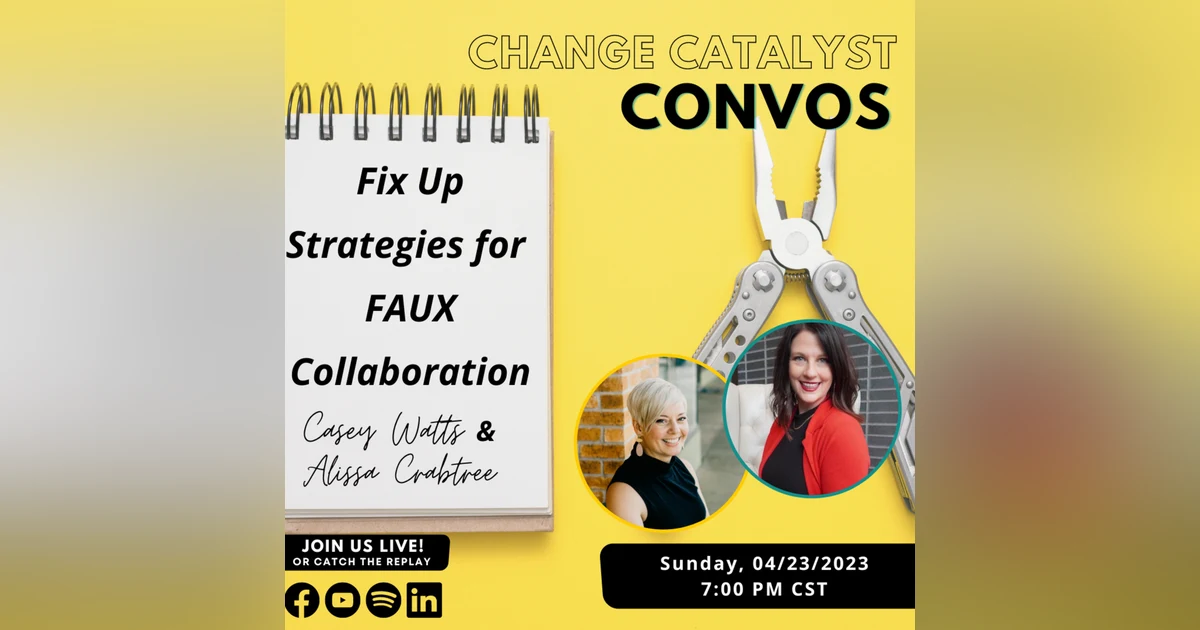
Fix-Up Strategies for Faux Collaboration


 RSS Feed
We all have mindsets that lead and guide us to take certain actions or say certain things or approach certain situations. Some mindsets are positive and some lead to something like "faux collaboration".
In fact, there are five core mindsets that lead individuals and teams astray from collaborating well and reaching the vision or instructional goals collectively:
1. Mindset of control
2. Efficiency mindset
3. Mindset of avoidance
4. Task-oriented mindset
5. Socialite mindset
It can be tricky to figure out how to take logical action steps to help teams move forward. This week, we're unveiling some fix-up strategies that will help YOU and the teams you work with move beyond these mindsets so TRUE collaboration can be experienced!
Connect with Me on Facebook, Instagram, LinkedIn, or YouTube!
Join the Facebook Group, Leading Collaborative Teams and connect with me and others who are eager to build cohesive, vision-driven teams!
Level UP your LEADERSHIP game and TEAM CAPACITY with resources, tools, and strategies located on my website!
Grab the download from mentioned in this episode to help you strengthen individual capacity!
--- Support this podcast: https://podcasters.spotify.com/pod/show/catchingupwithcasey/support0:04 Hey there and welcome to another change paddles conversation where we talk about anything and everything that has to do with building. A cohesive Vision, driven teams that make sustainable change happen. Even when change seems impossible, I'm Casey W impact coach and consultant and the host of this show. What I know from experience is that making change happen. Open can be overwhelming if you don't have cohesive Vision, driven teams, no one has a collective understanding of why change should happen or what changed to begin first. You notice fault starts because a solid action plan, hasn't, been formed or crafted where you're met with resistance because you don't know how to motivate such complex people and that leads to schools remaining in a cycle of Stagnancy, experiencing the same problems, and ineffectively repeating the same initiatives or programs again.
1:10 And again, and that leads to low morale burnout, High turnover, and who suffers most, it's our students, but there is a better more effective way to bring about change in your school. That does not deplete the G of your people you need a catalyst to help you get a solid start. My goal is to make cohesive Vision driven school teams a possibility. I helped School leaders, zoom out to cast vision and then Zoom back into script. The critical moves that help teams collectively, go farther faster and better even when change seems impossible. Here's what I want to know from you. What is the change that, you know, needs to happen in your school?
2:09 What are you hesitant to get rolled out two teams. What exists only in your mind that you are absolutely certain? Would benefit your school but you're just not sure how to get started right now. I want you to take a sticky note. Out or put a note on your phone, or maybe in the comments, make a note that says change Catalyst. This is your reminder to email or message me about your future endeavors and your current reality because I would love to encourage you as a change Catalyst in your school, okay?
2:55 Now that you are primed for thinking about cohesive Vision driven, Vinci teams that make change happen. Let's jump into this week's change Catalyst conversation. Hey everybody. Welcome to another change Catalyst conversation. I'm super excited. You were here tonight. If you have not had a chance to go and listen to last week's episode, it was all about five mindsets of the foe collaborator. So be sure that you jump over to either my YouTube channel or Spotify and you can catch the replays of that episode on those. Has two channels.
3:44 So there are people joining us today from YouTube. Some people are joining from LinkedIn and then some are here in my leading. Collaborative teams, Facebook group, welcome to everybody, I would love to hear from you in the comments. Let us know who you are, where you're from, and what brings you to today's episode. Now today, I was hoping to be joined by Alyssa Crabtree. Who is my co-author? Will be we're writing a book titled fo collaboration. We're really excited about that but she's not able to join us. You might be able to hop in later I'm hoping she's able to pop it in so you just might magically see Alyssa Crabtree hop on and if not then you're with me for the next several minutes.
4:32 We're going to be talking tonight about fixed up strategies for fo collaboration. So I wanted to tell you guys about kind Of a parenting issue. And you this might sound a little bit familiar to you. If you have kids at all, or if you have teenagers or specifically if you have a strong-willed Child, my middle child, who I love and adore is one of those children. He has highly intelligent. He is also stubborn and his intelligence benefits him. Most of the time, his stubbornness benefits him.
5:13 Him almost none of the time and I he is what we would probably consider a strong-willed. Child. Highly brilliant like this kid is a whiz. And at the same time, I find myself as a parent thinking, especially when he's doing things that he shouldn't be doing, or he gets in trouble. I'm like, what is The Logical consequence here? Because he out with me. Have you ever been in that situation where you're like, I don't even know, a logical consequence for this. And even if I did have a consequence for this, he would probably be able to rebuttal and give a reason why it's not appropriate or doesn't work. Work.
5:56 And I find myself stuck in that situation as a parent and I'm sure we all have had that experience before. If you're a parent, you know exactly what I'm talking about, where you're just kind of dumbfounded and stumped. The same thing has happened to me when I'm working with teams when I'm working with team. Sometimes I get to this point and you may have been in the same situation. I get to this point where I find myself sitting back and watching what's happening around me. And then I get stumped like this is not collaboration and I don't know what to do about it to make true collaboration happen. The difference between the parenting and leading teams is that leading teams is actually figure out of bubble. Like we can figure out how to support teams and becoming highly collaborative.
6:50 Instead of experiencing folk collaboration, so let me tell you a little bit. If you didn't catch last week's episode or if you haven't caught up with me on social media or my website, then you may be wondering what exactly? I mean, by fo collaboration at the root or very basic level faux collaboration. Simply means fake collaboration where one might peer into see a group of people working together and it appears as though they are highly collaborative. When in fact, it's just focal aberration or Action at a very low level. And so I want to start last week. We talked all about the mindsets of a folk collaborator. We're going to talk about that in a minute. I want to revisit those but I did want to clarify a misconception about collaboration because I have heard in the past week.
7:43 Someone asked me like, you know, is collaboration necessary all the time. Like, are there times where we're really not collaborating because I'm not working. I'm with someone and I let me clarify this. There are times when a deep level of collaboration isn't completely necessary. There are times when we see high intense collaboration happening when we're working together, but collaboration is happening even when we're not necessarily working side-by-side with someone.
8:23 So for example, I collaborate with a group of other Since in a Marco Polo chat and it's an asynchronous platform. So we're able to have conversations share ideas, work on documents together. We are collaborating virtually and it's a true sense of collaboration, because we are able to have the deeper conversations that push back on our thoughts, our beliefs, and our philosophies. And I think it also, Kind of depends like your level of collaboration, really depends on the stages of work that you are in and where you're working. Genius is coming into play.
9:08 So I know that there's going to be a lot of collaboration around beginning stages of work where we're in the ideation phase, and we're in the wondering phase as we move through phases of work. And we get closer to tenacity, where we just need to crank it up and get things done. We might see lower levels of collaboration but collaboration all the same. So I think it's important to consider that there are different levels of collaboration and it really depends on your stages of work. So, let's revisit the 5 mindsets of the foe collaborator, someone who may believe that they're collaborating. But when we dig a little bit deeper, it's just fake collaboration.
9:54 It's not true collaboration, that's fruitful and fulfilling. Young and brings joy and energy to a group of people, or an organization. So first mindset is the mindset of control. These people might say, if I'm not with the team, nothing will get done. So the leader might say that or on the opposite. End of that, someone might say if the leader isn't here, do we even have to meet? So that's the mindset of control. Then the second mindset is the efficiency mindset. I don't want to waste people's time. So I'm going to make this quick. That's what you might hear someone say. Or you might hear on the opposite. End of that, this meeting is a waste of time.
10:38 Those people are in the efficiency mindset, the third mindset of the folk collaborator is the mindset of avoidance. These people avoid things primarily they avoid discomfort. They might think or say, I don't want to ask hard questions because it's uncomfortable or the someone looking in, might say, I hope no one asks, an uncomfortable questions, that's the mindset of avoidance. The fourth mindset is the task oriented mindset. Someone with a task oriented find set might say, the more we can get done the more successful, our team will be, or you might hear someone say, hey let's get started and check things off our list.
11:21 So they're primarily focused on getting the tasks done. Now. Is that necessarily a bad thing? No. But there is, there are times when mindsets can get in the way of collaboration. The fifth mindset is the socialite mindset. These people might believe that if our team gets along and they're happy, then that's all that matters. These mindsets again are not inherently negative mindset. There are positive things to these mindsets until they get in the way of true collaboration. So tonight, what I want to do is share with you just a few fix up strategies.
12:06 For when you notice fo collaboration happening in your school with your teams and my hope is that you'll see these These as strategies that you can utilize tomorrow. When you start meeting with teams, sometimes we, when we're thinking about collaboration or furthermore fo collaboration with teams, it can seem overwhelming and just too broad to figure out. How do we approach? This? What is our first next step to help teams crawl out of this hole of folk collaboration. So we can experience true collaboration, that is invaluable and will. Help your whole organization catapult forward so you can experience true Collective efficacy, which is what we know makes the greater has the greatest impact on student achievement.
12:58 So let's talk about these fix up strategies. There are three broad fix-up strategies. I'm going to give you something you can do within those broad categories, but I want you to be thinking about what these three categories of fix-up strategies. Have in common. Ok, so the first fix up, strategy that I want you to be thinking about, is how you can strengthen individual capacity, how can you strengthen individual capacity in order to support true collaboration because here's the deal.
13:39 Your teams are made up of individual people and these individual people come with their individual Geniuses, their individual strengths, their individual weaknesses in order for them to be able to collaborate well with others, you have to strengthen their individual capacity and it does not happen of its own accord for most people. For most people, you are going to as the leader have to strengthen their individual capacity. They need your support, and I want to tell you a way that you might do that. The best way to easily strengthen individual capacity is by providing individual feedback. And by individual feedback, I mean like one-on-one outside of the team setting where you are.
14:38 Sharing things that you have noticed, so that you can recognize provoke and cultivate their genius strengthen that individual capacity so that they can go and be a, an essential part of their team. Okay. That's how fo collaboration is going to be broken down. So strengthen individual capacities. So here are some things that you might say. This is a document that If you want this document, I'm going to leave it in the show notes but you also can send me a private message on any of these platforms that this is streaming to and just say want the form or want the want the what is this?
15:23 I guess this is just a list, want the list and I can get you this list of ways to recognize provoke and cultivate native intelligence. So when you have watched someone within a Collaborative setting you are analyzing what they're bringing to the table and it can be just very small, minor things that you might not believe in the moment, really Foster Collective Collective efficacy and true collaboration but those little things make a big difference, okay? So I'm not going to go through all of this list.
16:04 I'm just going to read some things off of recognized. I wanted to tell you Situation that I experienced recently, that, that really strengthens someone in someone's individual capacity and allowed them to be an imperative part of their collaborative team. So if we look in the column underneath recognize, there are a few sentence starters that you can use when you're meeting with someone individually. So you've had the meeting, you go to the person individually, you might start with, hey, I noticed in the me. Meeting that you've given such and such a lot of thought, tell me more about that. Or hey in the meeting you said this and it really sparked my curiosity in the meeting.
16:50 I noticed you said and you tell them what you noticed or here's the one that I'm going to end with when you and then you name their words or actions that you notice in the meeting it and you tell them what the effect was. So here is The story that I have for that not too long ago, I was in a small meeting, a leadership team meeting, and it was team leaders from every grade level. And they had been asked to invite someone to come and join them from their grade level for this meeting, and some of those people were showing up late. And I noticed that the way that tables were set up, a teacher was placed kind of like on the outside where there was an empty chair in the middle.
17:38 It's tough, everyone and she noticed that the person she'd invited was coming in late and she picked up all of her things. So instead of like moving over so that the teacher could go around her and sit down, she picked up all of her things, she slid it all over, she sat down, and then she pushed the chair beside her out that you're that. She was in. She pushed it, pushed it out, so that it was behind people and her partner that she had invited. Could. Easily sit down without distracting, anyone around them or without feeling like an outcast, her Oddball or feeling. Like she was interrupting.
18:18 I noticed that and I didn't stop just there, I sent that teacher, a text message that evening and I'll let her know what I noticed and I said I noticed you did this. That was a leader move. You were empathetic to the person that you invited, and this is what it did for that person. And this is what it did for the environment. Here's the cool thing about this, I had another meeting a few weeks later, and that same teacher, who I had given the individual feedback to was a part of this meeting and she did something very similar in that meeting. Because guess what?
19:02 What gets celebrated gets repeated. So if you can recognize provoke and cultivate the intelligence and others and really give some individual individual feedback to strengthen, Our capacity. They're going to bring that to team meetings again and again and you are going to be able to Foster through that true collaboration. Okay? So first, you're going to want to strengthen individual capacity by giving individual feedback, okay? So, the second thing that you might do is build momentum. If you are building momentum in teams, then you You are one thing that you can do is consider how positioning and environment matters.
19:55 You can tweak the environment, just a little bit to Foster true, collaboration, and move past folk collaboration. So think about the way that the meetings are set up that you go to, when people are collaborating, what do you notice about where they are positioned? And what do you notice about the environment? What do you notice about? Where people? Are facing. Are they spread out and facing all different directions? Are they kind of close together but they're all facing a board or a screen. Are they coming together? And everyone is facing one speaker. So where is everyone positioned?
20:39 And then also think what, what's happening with the environment are there things getting in the way of people being able to collaborate? And what I mean by that Is are there even like blockades that keep people from being feeling vulnerable enough to share out with others that are near them, positioning matters. It is the way that you build momentum because you're breaking down fist, true physical barriers and you're also breaking down mental barriers. If I decide to go into a meeting and I sit away from The people around me, that's just a natural tendency for people.
21:21 People have the tendency to want to isolate unless they go into a space where they want to sit with a buddy. So those can be two very different ways that people approach or have Tendencies when they go into collaborative spaces. You have to as the facilitator intentionally set up the space so that that's not happening and so that everyone has a voice at the table. In order to build, momentum your positioning and the environment matters and I think the environment matters down to the lighting. Now you can go into depth with that but all I'm telling you to do is tweak the environment, just a little bit. And that can be simply, where are people going to sit? If that means that you have to move it from maybe someones classroom setting to a conference room or to your Room. So be it.
22:20 Tweak the environment so that you can build up build momentum and people can truly collaborate or they have the option to collaborate. And then finally, one thing that you might do to support true collaboration is cultivate Collective confidence. Now, let's think about this is similar to Collective efficacy, but we're adjusting that word a little bit efficacy to confidence. We want you to build Build Collective confidence so that people are eager to come to the meetings and they own it. And this is where I want to give you just one tiny little strategy. You could try tomorrow when you walk back into your school, who owns the agendas, okay.
23:06 When your teams are meeting collaboratively together, who is, is there an agenda being created? Maybe, yes, maybe no, if there's not now is the time to Are creating agendas if there is now is the time to audit those agendas and then decide who owns the agenda, who created the jet the agenda and when they created the agenda was it created by an outsider. Someone outside of the team or was it created by the team themselves? So what I'm suggesting is that you allow teams to decide, what does our Operation. Look like if we looked at a collaborative team, what Woody, what would we expect of that?
23:55 What would we hope for from our collaborative team? And how does that inform our agenda? What is our agenda need to look like and include so that we can reach these goals that were setting together? Could it be that the agenda looks different or the structure of the agenda? Looks different each time maybe most of the time. Our structure is going to be the same. But sometimes though the teachers who are collaborating together or the leadership teams her collaborating together, might decide. Hey, we know that the structure of our agenda isn't going to work for what we're doing right now.
24:35 Let's adjust it. And let's think about an agenda that will work for the kind of work that we're doing. Okay? So those are three broad things that you might consider when you're trying to eliminate Nate folk collaboration and instead Foster true and valuable collaboration. So strengthen individual capacity. Remember you can use these sentence starters and question, stems to help you give individual feedback build momentum tweak. The environment, just a little bit, whether it's the place, the positioning, the lighting, the blockades, the things that are getting in the way of collaboration, The environment even just a little bit and see how it can build the momentum for collaboration in your teams. And then finally cultivate Collective confidence and you can do this by allowing your teams to develop their own agendas and they need to do so collaboratively. So what would that look like for you? Okay.
25:41 So I would love to know what was most useful for you here. Today, we talked a little bit about The five mindsets of faux collaborators and we also talked about fix up strategies for folk collaboration. So let me know what was most useful for. You can do that in the comments, you can send me a private message, you can email me at catching up with Casey at gmail.com. And here's what I'm hoping that you take away from this conversation today, what I'm hoping you take away is that there can be small. Steps that you can take to get your team's out of a state of FO collaboration, take one small step at a time, try out something when it doesn't work, try it again. When it doesn't work, try to different way. Don't ever stop trying and taking small steps that can eventually turn into big moves for your teams. Okay, so I want to let you know, a couple of things before we get off of here.
26:50 Number one next week, I've got a really exciting topic for our change Catalyst conversation and it is why Tier 1 instruction is collapsing. Now remember, these change Catalyst conversations are all about Vision cohesive Vision, driven teams, but we're going to tie that It into y teams matter for Tier 1 instruction. So come back for that. I'm going to be posting some content about it all week long. So you kind of know what to expect when we get here next Sunday, evening second. I want you to know about the PLC reset. Sure?
27:34 Cast that I have going on right now. You can find out more about this by going to bit.ly, slash PLC reset. This is a free Marco Polo. Share Cast where I You all about tips and strategies to either reset plcs or completely start from scratch. This is a perfect time to engage in this on the go p d because you're going to be able to start thinking about how to Gear Up for your plc's next year, and start them with a bang and get them going in the way that plc's were meant to be. Okay, guys, so we're going to end there.
28:15 There. I hope you enjoyed tonight's episode and I look forward to hearing what you have to say about Tier 1 instruction. And why you think it might be collapsing? We'll talk to you next time. I want to give a big thank you to you guys for tuning in and I would love for you to do me to solid favors. Number one, if you've enjoyed this or any other shows, please hit subscribe. I've got a lot of great, gas and content coming up and I don't don't want you to miss any of it too. If you know of someone who may be interested in building cohesive Vision, driven teams that collaborate well, share this show with them.
28:59 And until next time, I want you to go off and have the great collaborative conversations that help you and the people you work with two completely. Unleash Your impact. See you later.

