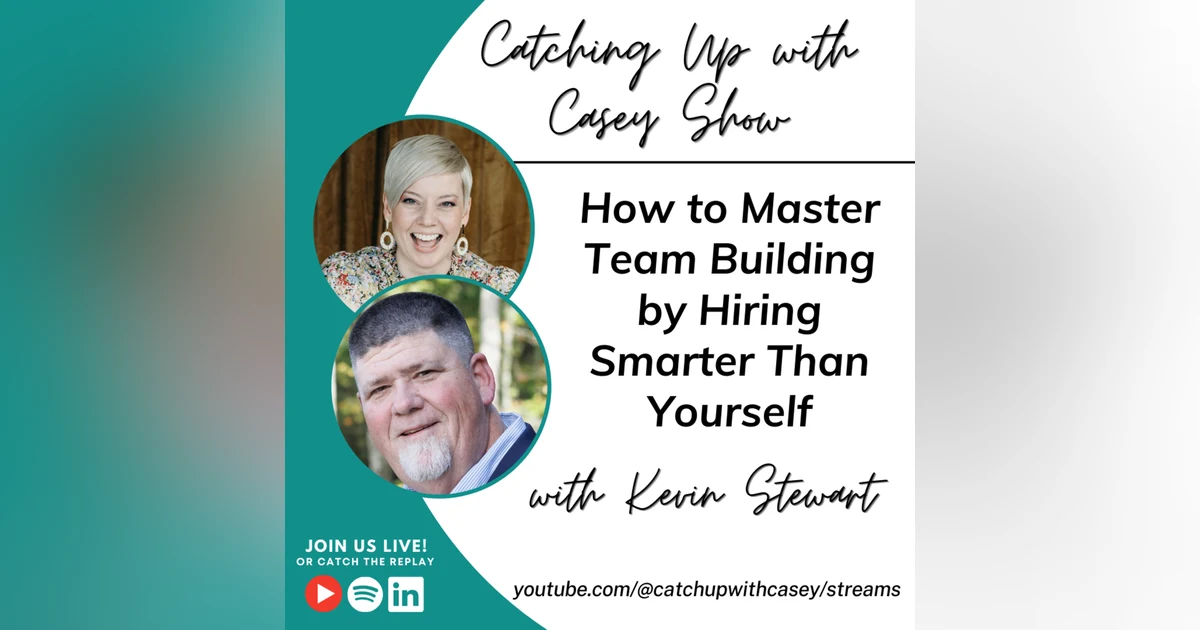
How to Master Team Building by Hiring Smarter Than Yourself


 RSS Feed
Do you ever worry about hiring someone who is better at the job than you are? Join Kevin Stewart, VP of Innovative Schools Summits, as he talks about why that feeling needs to stop! He’ll share his best tips on how to build an awesome team by finding people who are smarter than you and letting them shine. Learn the simple secret to becoming a great leader by giving others credit for their wins.
Kevin Stewart has spent over 12 years with AccuTrain and more than a decade with the Innovative Schools Summit, serving as Director for the past five years. He leads one of the nation’s top education conference series, bringing together renowned speakers to inspire and equip educators worldwide. Kevin is passionate about making a meaningful difference in the lives of others. https://innovativeschoolssummit.com/
https://www.instagram.com/innovativeschoolssummit/
__________________________________________________________
Your teams are itching for CLARITY! That can be a complex thing to provide. But I have a framework that guides you to do just that– gain and create clarity! www.catchingupwithcasey.com/claritycycleframework
Need help getting your leaders trained in a purposeful way? https://www.catchingupwithcasey.com/identity
Ready to build the habits of a clarity-driven leader? Get The Craft of Clarity book!
Subscribe to my newsletter to get the resources mentioned in podcast episodes! www.catchingupwithcasey.com/newsletter
0:02 Welcome to the Catching Up with Casey show. If you are tired of chasing buy in, frustrated with teams who can't seem to get on the same page, or over the constant struggle of holding people accountable without micromanaging, this is the show for you. I'm Casey Watts, speaker, author and the creator of the Clarity Cycle Framework. I help leaders just like you take teams from frustration to alignment, so teams can work collectively toward a common purpose in a committed way instead of against each other as though they are functioning in different organizations. And we do it all through the craft of clarity. Whether you lead from the middle or you were the front facing leader of your organization.
0:45 On this show, we bring clarity to the seemingly small things in leadership that make the biggest difference because clarity precedes capacity. Now with all of that said, let's dive into today's episode. Well, hey everybody, welcome to another episode. I am pumped that you guys have joined us to listen into this episode. It is all about how to master team building by hiring smarter than yourself. You heard me right, Higher, smarter than yourself, which I believe as we get into this conversation today with Kevin Stewart, we're going to notice that there's a little more complexity to that than meets the eye. So I'm super pumped about this conversation. So, Kevin, welcome to the show.
1:44 Thank you. Great to be with you. I'm all with the one and only Casey Watt. That's right. That's right. So tell us a little bit about who you are in the work that you do. So I serve as the vice president of Innovative School Summits. We are the organization itself as I like to call it, the mothership itself is ACCU train and we deal strictly with K through 12 schools, a lot of staff development training. So we have we offer on site trainings. We do everything from cloud, cloud training so they can go on on board with our system that we have. We also have started what is called accurate courses, which is very similar to the master classes. If you're familiar with master classes, we have that what we call accurate for, for educators. So we have some of the top names in education that are a part of that, that people can get.
2:46 We also do our summits, which I oversee and our summits, we hold those and then there's five to six different locations throughout the country every year. So we're in New York, Orlando, Las Vegas, Nashville, San Antonio and looking that hopefully in 2027 we'll be in a new city. So I'll be on the lookout for that. And so I I get to get to have a lot of fun got getting to meet a lot of great people like yourself. That's how we connected and so. Yeah. Yeah, that is, in short, what I do. Yeah. So tell because now that we're on the topic, tell everybody about the next summit like it's coming up.
3:30 It is so our next summit and just so, so all the listeners if they haven't been to a summit, they'll they'll understand a little bit. We, we will have between 4:00 to 6:00 different conferences, especially during this, this, this time of the year, during the winter time going into the spring, we'll have between 4:00 to 6:00 conferences that take place in the same location, under the same roof, that is, that is under the summit head. And people can sign up for one of those conferences, but it is also free flowing. So if they sign up for an innovative teaching strategies conference, we'll have plenary sessions that are general sessions for everybody. And then we have keynote sessions and breakout sessions. And so if they are, there's a breakout session within another, let's say the at risk students conference. If there's a breakout session under that, that they think, wow, that would really benefit me to go to. They don't have to stick strictly to their comments. They can, they can go to whatever breakout session that they choose as long as there's room and some of them fill up, fill up really fast.
4:36 So, but, but we have that for them. So we're kicking off in New York this year. We'll be in New York from February 25th through the 28th. Then I was telling you we'll have one basically one week in between that and then we'll be in Orlando. So yeah. Busy. Busy, yeah, but a fantastic conference. And I can say that having been not only presenter but also just a participant, it's been truly one of my favorite conferences to go to. I think what I really, I went to the Innovative School Summit in San Antonio in December and I think one of the things that I loved so much about this summit was there, there were intentional.
5:19 I'm sure you guys made this intentional, I have no doubt about it, but intentional breaks in between that we're a little bit longer than what you usually experience. And so here's what was so cool about that is even after my session, like I noticed people just kind of remain seated or they migrated out into the hallway where there's plenty of places to sit. And they networked and they talked and they continued to brainstorm. And that that's such a spectacular thing about conferences when they can provide that because sometimes it's just go, go, go, go, go. And you're moving from one thing to to another. And so there's no time to really think about how do I apply the concepts that I just learned about. And so that that's something I definitely appreciated. Plus the people listen, I felt like even as a participant, I was a superstar because there was always someone around a corner or like right at the beginning of a room before you walked in that was ready to welcome you. And I just felt like they care about the people that are here and even meeting with you.
6:23 I know that you care about the people that show up. So kudos to you guys for putting on a conference like that. Thank you for thanks for your kind words and and truly that it is it's I have long talks with our staff that it's about the people we want. That is truly our goal. And so thanks for sharing that. It's just helping confirm that we're coming. We're not where we want to be, but we're getting there. And part of our goal is that every single person that walks through the doors of our, our summit feels valued as an individual. We want every person that that walks through to feel like, hey, I'm the most important person there.
7:07 And I, we, we mean that sincerely. And so and, and the brakes we do, we take those intentionally because we want people to network. We also want people to be able to go by, visit exhibit hall and things like that have not feel like they've got to rush off. And so it works out well. Yeah, which I feel like really leads well into what we're talking about tonight because we're talking about this idea of how to master team building by hiring smarter than yourself. You have in the role that you have right now. You have probably lots of different groups of teams, like you have a team of teams that work with you. I want to know when you think about this topic like mastering team building by hiring smarter than yourself, what made you think about this topic when you agreed to come on this podcast? Wow.
8:05 You know, for, for me it is, it's probably the easy thing to say because most everybody that I hire is smarter than I am in a lot of ways. That wasn't a hard, hard, hard topic to figure out. But I, I think so often, in fact, I was, I was, I was talking with my wife today and I, I thought about this. How often do we get upset when somebody fails? I want and think about that from it. So I'm going to ask you a question. When you let's say your your first job, where was your first job? You. Remember my first first job or like my first job in education? No, either one.
8:47 We'll go. We'll go either way. Let's say education. Your first job in education. First job in education, I taught 4th grade math and science. 4th grade math and science. Do you remember what your first failure was? Not just my first failure. I remember my 1st 20 failures. But yes, I, I remember my I remember. Several and you can count them. Do you remember how how those in in leadership responded to you? Yes. Was it positive or negative? I it depends on the situation and who I was dealing with, but I had one positive experience that I remember.
9:34 The other experiences were relatively negative, if I'm being quite honest. And so I, I asked those questions because my, my thought is we so often treat failure like it's the ultimate, oh, I can't believe you did that. That's the worst thing that ever happened. How cool is it when we begin as leaders, and not just in my position, but across the board, when we allow failure, when we allow failure to happen without making the person feel like they are, they're a failure? Yeah, yeah, so, so good. If we can allow someone to fail, and, and maybe that's just because it's something I've learned, I've been gracious, I've been, I've been the recipient of people who did that in my life, allowed me to fail without making me feel like a failure. And so I hope that as, as hiring people, as, as we're talking about this subject, that's one of my, one of my goals is that, listen, if I can allow people to fail at what they're doing and learn from that, fail without feeling like they're a failure, they'll get better at what they're doing. Yeah, absolutely.
10:45 And you're becoming more of a multiplier in that situation. And so if you're able to allow them to fail and they're learning through that failure and they're growing in that, chances are they're going to be able to reciprocate that just like you reciprocated it or have reciprocated it in with your teams. It reminds me, it's so I don't know why my brain goes to this and this gets kind of personal, but not really. But I think about my husband and I talk about our dads and growing up. And you know, he has the story of he mowed the yard one day without being asked and his dad got home and he said, oh, you mowed the yard. Thank you, did a good job.
11:26 There's just this one area over here that that you missed or, you know, you need to think about doing this differently. I have the same experience where I was at a piano recital. My dad would show up and listen, and he'd be like, yeah, yeah, you did good. There was just this one part that I think if you really practiced and for whatever reason, that negative, what we felt was negative. Now it was not their intent, I'm sure, but that's how we received it. That's how we felt. It was just this negative thing that we held onto. And I think it's the same as my experiences where I where I experienced failure as a first year teacher. That's what stood out in my brain. And so it made it really hard to feel OK about failure moving forward. And it it is true.
12:14 I, it's funny you say that because I, I'm just reminded of the, the times that I've done that, even as a dad, I've done that as, as a leader. The, I, I kind of had the same. I came home one day and, and my oldest son was back when he was probably in, I guess at that time in middle school and I come home and, and he is outside on his own. No one had asked him to do it. He just realized that the front porch was really dirty and so he's out there cleaning the front porch. I mean, just doing it on his own accord and no one asked him do it. And I walked up and I was like, what are you?
12:54 What are you doing? Just caught me off surprise. But I did what you said. I caught myself thinking, well, you missed over there. Why didn't you get that spot? Thankfully I didn't say it at that moment, but I've done it. So it's not like I, I, I, I have not done that in the past, but I caught myself in that moment thinking that one, you should you missed that over there. And, and but I'm glad I didn't say it at that moment just because of what you're saying that. Yeah, man, I I tried it, you know, I was, I was trying. Yeah, I can't do anything right. Yeah, yeah, exactly, exactly. So when you're thinking about your teams, though, have you noticed times where someone made a mistake and they you, you recognize that it made them really uncomfortable? And how?
13:40 How did you address that? Absolutely. I think for, for me addressing that is simply so in, in hiring people that are, that are better than you. And I think just in, in leadership across the board, we have to be able to announce when someone gets a win, announce in public when someone gets a win and talk in private when someone fails and allow them to say, hey, my, my first question isn't why did you do what you did? My first question is, what did you learn from that? Yeah.
14:25 Here's here's what you did. And it's not the end of the world. We're not, we're not going to, you know, we're not losing face. We're not whatever. But the main question is what did you learn from it? How can we, how can, how can you get better from it? How can we get better from it? Yeah. That that, that's my all. That's my go to question. Yeah, that's great. In all those situations. I listened to a podcast, I think it was the Andy Stanley podcast, if anybody's familiar with Andy Stanley, but it, this was just last week, I think. And he was with, I think his guest was Charles Duig. And they, one of the things they talked about, they were talking about this specific situation where someone's messed up or they failed.
15:16 How do you address that? And one of the things Andy Stanley said was I first get curious because, and, and then I asked them the question, like, tell, tell me about this decision that you made and what, what made you think about doing this? Because we may not always know if their perspective, from their perspective, it could have been completely reasonable what they were doing. And so asking the questions first, I thought, man, that's, I think sometimes we jump to assumptions too quickly without asking the questions. I want to ask you a little bit about because it's titled hiring people that are smarter than yourself. When you are looking at hiring people, what shows you like what?
16:02 This is a two-part question. First of all, what shows you that this is a person who's smarter than me and I want to access their intelligence? Like what are you looking for? I'm always looking for, so normally when when I'm hiring or when anybody's hiring, they're hiring for a specific position. And so if you understand and know your position that you're hiring for is the person number one, what I'm looking for, Are they passionate about what I'm hiring them for? If they're passionate about that particular area, then they're more than likely they're really going to be really smart, intelligent in that area. They've studied on it.
16:45 You can ask a few simple questions, just kind of leading questions. Tell me, tell me why you're interested in in this specific position. What have you learned in any of those leading questions in regard to to what you're hiring for? And it's going to tell you whether they, they know what they're getting into or not. Sometimes you also have to know what their strengths are. So a great question that I always want to know is, is tell me about yourself. What are, what are your strengths in life? What do you, what do you see yourself doing really well, You know, for, for me, I, I have to be real, real honest, great leaders are not the smartest people in the room.
17:35 And that that is across the board. And so for, for me, I, I, I am not the most organized person. My, my staff will tell you I'm not. I like the dream, I like the vision. I like that to put things on paper. But sometimes the organization of it, I need help. And so in some of the positions I have, like Tanya, you've probably received some emails from Tanya. Tanya, I, I could not do what I do without Tanya. Tanya keeps me organized in every sense of the word and she'll be like, hey, did you send out this e-mail?
18:18 Do I need to send out this e-mail? Absolutely. And run by run things. And so understanding their strengths that there are things that they're really good at. She's incredibly talented, gifted at organization, keeping track of everything where where I could say, hey, yeah, I, I probably missed that one. So, so, so. And that's part of it, Realizing I as a leader, if I don't know my weaknesses, I'll fail at being a leader. Yeah, which leads me to my next question actually, because I imagine that there are some people who are intimidated by the idea of hiring people smarter than themselves. Where do you feel like that intimidation comes from? That intimidation most of the time comes from pride. Pride of feeling like I've got to be the best at everything. I don't know if did you, I don't know if you, did you play sports when you were younger or, or did you take, did you take music lessons?
19:30 Yes. So it kind of falls in the in the same realm. You have people who are incredible teachers that do a great job, will allow you to make mistakes, will allow you to, and they teach you, they work with you. But then you have others, you have coaches, maybe you're familiar with this, that thought they were the world's greatest gift to mankind and and they played every position the best that that it has ever been played and have an excuse for why they didn't make it. Past high school and any of the sports that they played, but they're the best at everything that they played and far better than anybody else on the team. And then you have people who are mentors that realize, you know what, I just love the game.
20:23 Wasn't the best at all of it, but I understand the greatness of it. It it I wish I I knew his entire story. Some something that I'm going to dig into, I'm not at all a Seattle Seahawks fan, they just won the Super Bowl. But their coach is crazily interesting to me because my understanding and someone can check me if I'm wrong. My understanding is he did not play. He started playing football in high school, got hurt and didn't play past past the 11th grade, but had a passion for coaching and his head coach recognized that within him and started allowing him to coach.
21:07 And as a result of that began when he went to college, started coaching, went through, I think he went through Jim Harbaugh's Academy of coaching and, and that whole process of that. So he never even played football past maybe two years in high school, but he's been coaching in what he was passionate about. Someone recognized that within him and now look where he's at. He just won. They just won the Super Bowl. I love that story. Yeah, it it is so interesting to me that someone it, it just took someone to be able to say hey, and, and within himself, correct, recognizes weaknesses. Well, I got hurt. I probably won't ever play, but man, I'm passionate about the game.
21:50 I'm passionate about what I do. And maybe I can help somebody else if I take time to learn. You know, that I think that's an interesting point and I want to, I have, I feel like I have an episode about this where I talk about the two different perspectives, especially in thinking about schools like we we have teachers who have their perspective. We have leaders who have have their perspective. And you hear so often, I think leaders kind of get into this, you know, kind of like an imposter syndrome, just especially if they didn't teach at the level that they are a leader of or, you know, or they've only been, they were only in a classroom for five years or whatever.
22:30 It's, I feel like it is so important for us to recognize that even when you may have staff members who say, well, they don't even remember what it was like to be in the classroom or they they were not. I've been in the classroom for way longer than they ever were. Whatever the case may be, I think it's so important for us to recognize that while that could be true sometimes, it is also imperative for us to have these two different lenses through which to look at our organization so that we can work together to move the organization forward. Those two lenses are absolutely necessary. We can't thrive off of 1 or the other. It has to be both.
23:11 And so I love that story because I think it gives even me, even me stepping outside because now I am consulting and speaking and writing. So I'm not in schools every single day. But the beauty is that I have a passion for this and I have certain strengths and I'm able to teach and coach in a way that allows me to help people implement things in their own school. So love that story. This it it, I hope it's all right if I throw a name out there and I'm not just throwing it to throw it. But I've thought about this several times. Ron Clark, when he started Ron Clark Academy, regardless what you think or anything else, when he started Ron Clark Academy, he didn't just go out and do it on his own. He called Kim Bearden and said, hey, Kim, I need you to help me start this.
24:05 And he's like, will you move up here and do it with me? Nope, I'm not moving. So what does he do? He moves down to where she is, starts a a Academy. Why? Because he recognized someone and their talents, their giftings and said, hey, she's better at certain things and I'm better at let's come together and build something incredible. And now I listen, the teachers he have are just as equally as good at teaching and and gifted in the areas. Why? Because they hire such a high level of people and aren't afraid to not afraid to get someone in there that's just as good or better than they are. And and that at wow, can you think of just the how, how schools could be transformed?
24:52 And I'll take it to education, since we both deal with the education side, school just even businesses in themselves, how much they could be transformed if we would be willing just to say, you know what, if someone is better than me, it's it's all right. I'm trying to think what the I read a quote and I'm trying is Harry, Harry Truman, That's who it was, Harry Truman said. It is amazing what you can accomplish if you do not care who gets the credit. Say that one more time. That's so good. It is amazing what you can accomplish if you do not care who gets the credit. Yep, so good.
25:35 And yeah, that is we, we have to be able to put our own egos aside to say, listen, it's not about me, it's about all of us, Yeah. And if we can all get better because someone else is better than me, man, let's do it. Every day of the week. Let's do it. I would imagine, Kevin, that you are one of those leaders who like, I'm just picturing you in a meeting with your staff and everybody's sitting around the room. And I imagine, tell me if this is wrong or maybe just let me believe this, OK? But I imagine this almost round table or Oval table and you're just kind of sitting back and you are listening to all of these people around you.
26:16 Like maybe maybe you set a vision, but then you're just listening to what people are saying. And you then maybe you're asking people to run with an idea that they have or giving them a little bit of feedback and then telling them to run with it. Is that is that is that? An absolutely, absolutely. So you came to, you came to San Antonio. And if people come to, well, we'll probably do something similar in in Orlando probably. But in San Antonio, you got a card on your seat on the last day, a happy holiday card would just say a were some wording on the back. Had a little Hershey kiss in there. That was in the spot.
26:56 That was all Liz Freeman and Lauren Bassett I had because we were sitting in it. That's exactly what I have. We set a meeting. I said, hey, how can we make it better? How can we do something that says, you know what, just in a small way to say thank you for coming and being a part. That was my words. And they then they started dreaming and Liz was like, hey, what if we did this? And Lauren was like, oh, we could add this to it. And I'm like, all right, let's do it. Yeah, you know, give giving them permission to dream and then then cheering their dream on. Let if you know, if there's some something you sometimes you have to be able to say, well, what if we did it this way? You know, it may not work exactly like that, but what if we did it this way? And then they start dreaming some more and and make it happen.
27:41 So that that part, that was just me saying, hey, what, what can we do better? That was all them. And hey, it makes your life easier as the leader as well. Absolutely, absolutely it does. Yeah, but for whatever reason, I feel like it takes A and then like a mindset. You really have to get into the mindset of I'm hiring people. Well, number one, I should be hiring people that are smarter than me, but if I'm hired appropriately, then I should be able to let them explore and take risks and live out there working geniuses. By the way, listener, you've heard you've heard me talk about working genius before.
28:23 I do not work for them. This is not a paid AD or anything, but I suggest you take working genius assessment yourself and then have your leadership team take working genius assessment. And that way, yeah, you absolutely should be tapping into the geniuses of others. But then also recognizing like where where am I? Where am I confined to my not weaknesses, but just frustrations, areas that are frustrating for me. But yeah, so, but if you're hiring with that in mind, then you should be making your job a little easier and actually a lot more enjoyable. Yes, here.
29:06 So going to the person of the working genius Patrick Lintoni, he said this. If you could get all the people in an organization rowing in the same direction, you could dominate any industry, any market, against any competition at any time. Yeah. And that's it. I mean, you're getting everybody on your team working together and, and understanding, knowing it is I, I 100% agree with you. I've done, I've done the work in genius. Actually, it's so funny because when I did it, I heard him, I heard him talking about it. I thought, I need to take that. So, so I took it and saw, saw, saw mine looking at mine. And, and so my wife at that time, there are some things that I was thinking, you know, what she just does before I took it, like she just does that to aggravate me, you know what I'm saying?
30:01 And she, she's probably saying the same thing about me. He just does some of those things just that to aggravate me, you know, and I, I started thinking, and so I called her, I said, hey, I'm going to send you a link and I want you to take this, this test. And, and so she said, OK, I'll do it. So we took it and when I got the results from it and realized her differences and my differences, I'm thinking, no, she's not trying to aggravate me. This is just who she is. This is her genius. She's working within her genius and and I was working within mine. And somehow we got to meld that together and figure out how how do we become a better team. And so yeah, IA 100% with you man, if you're out there.
30:45 Yeah, I'm curious, do you remember your working your two working geniuses? My two Yeah, you are putting me on the spot. I am AI gather all the people. What do you call that? I can't. Oh. You are a galvanizer. Galvanizer. Galvanizer. Yes, a galvanizer is is my #1 is a galvanizer. And what was my second one? I'm not a wonder. OK. Like what about Is it like IDH or is it invention? Invention, yes.
31:30 OK, yeah, so invention is one of mine, and then wonder is one of mine. See, wonder, I drives me crazy. Like I how do you do that? Let's just gather the crowd, pump them up, get them going and and keep. But we need you wonders. We need you people to because you ask the questions. That's it. That's it, Casey. That's why you ask the questions, because you're a wonderer. Yeah, that's exactly. Right, that is so true. Yeah, we just got. Up on a tangent on the people watching this. Like what are they talking about? Hey, this is our advertisement for Do Working Genius. Because if you know those things and you know what geniuses other people have, then Oh my gosh, it makes your work so much better. I don't have another word for it, just so much better. And what's interesting, So I, my former colleague who I am just hoping one day she's just a part of my team. She has the geniuses that I don't. And so we were, it was like we were one person when we worked together.
32:39 And I loved that because I knew and she was able to say, this is not in your wheelhouse. You're going to have to turn this over to me. Or she was able to say, and I didn't take offense to it. She was able to push back on things and that self-awareness is so crucial, especially if you are thinking about who do I want on my team? How am I going to hire smarter than myself? Know yourself well and then know your people well, too. Yeah. Who? I could go on about this, Kevin, but we're going to come to a close. What is it that I have not asked you or something that you want to share before we get off this podcast episode? If you could leave people with one thing to remember. If I could leave people with one thing to remember it, I would say be be real.
33:24 Be authentic in in your dealings with people, with everyday life, Be let people see the real you. Stop feeling like you got to put on a show for somebody. Be authentic. You can. You can change the world if you're authentic. Yes, I love it. All right, where can people find you? First of all, they need to go and check out Innovative School Summit. Yep, check out Innovative School Summit www.innovativeschoolsummits.com Check out our Innovative schools podcast along with staying with the one the only case you want. What you Sorry, I am on your podcast now what? Tell me the name.
34:11 This is a terrible way to end the show. No, it's not. It's it's so it's the catching up with Casey show. Like you're like you're drinking a cup of coffee with me. Yeah. That's it. So we're here, we're live, we're catching up. Hey, just a side note, a side note, Kevin, because I think I was talking with someone on this podcast last week and we couldn't, or she couldn't remember the name of her own book. And so I was like, been there because it took me forever to tell people, yeah, the title of my book is The Craft of Clarity. And I couldn't remember the subtitles. So sometimes I would make it up. But yeah, real. We're real. Authentic.
34:52 That's right. We are real. They find us on, on social media, on you, on all the social media things, including TikTok and YouTube, all that. You can e-mail me at kevin@accutrain.com. So nice. All right. Well, thank you for coming on the show. It was a blast having you here. Thank you for having me. Is it is it a pleasure? Look forward to seeing you again. Yeah, we will catch you all in the next episode. Bye, everybody. Hey listener, I am so honored that you listen to today's episode and I hope you gained something valuable from it. I'd also be honored if you did ME3 solid favors.
35:33 First, subscribe to this show. I've got a lot of great content coming up, and I don't want you to miss any of it. Second, be sure you're following me on social media platforms. You can find me at. Catch up with Casey on LinkedIn or Instagram. And finally, if you were looking to book a dynamic and relatable speaker for your next event, conference, or retreat, I would love to bring a message about how the craft of clarity makes a significant impact on both leadership and life. Until next time, always remember clarity receives capacity.

