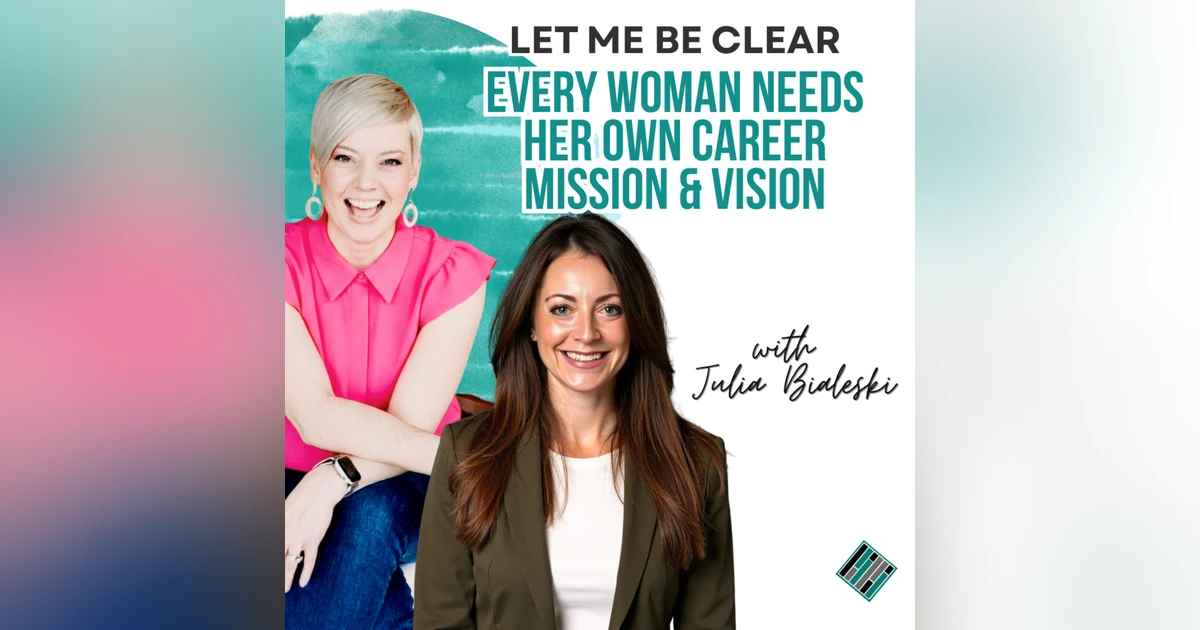
Let me be clear: Every Woman Needs Her Own Career Mission and Vision


 RSS Feed
Do you have a clear roadmap for your leadership journey? Julia Bialeski and I explore why every woman needs a personal career mission and vision to navigate the complexities of leadership. Join us to have a candid and clear conversation!
Connect with Julia here:
Julia Bialeski is a leadership practitioner, author, and speaker with more than 20 years of experience leading people and organizations through change, growth, and complexity. Her career spans roles as a teacher, school principal, professional development facilitator, and systems-level leader, giving her a deep understanding of the human side of leadership at every stage.
Recognized for excellence in leadership and innovation, Julia was named the 2025 recipient of the University of Maryland College of Education’s Outstanding Alumni Award. She is the author of Leading with Grace: Cultivating Hope, Authenticity, and a Focus on People Throughout the Leadership Lifespan, a widely used resource for aspiring, new, and experienced leaders seeking to lead with clarity, courage, and heart.
Julia is known for connecting with audiences through compelling personal stories and practical insights. She is deeply passionate about personal and professional development, mentorship, and helping leaders—especially women—integrate their work and personal lives through intentional, strategic, and sustainable approaches. Her work is grounded in her guiding mantra: Be brave, and care about people.
Website: juliabialeski.com
LinkedIn: http://linkedin.com/in/julia-bialeski-7a4a122a9
Instagram: julia.bialeski
YouTube: JuliaBialeski
Bring Casey to your next event to speak! www.catchingupwithcasey.com/speaking
Subscribe to my newsletter to get the resources mentioned in podcast episodes! www.catchingupwithcasey.com/newsletter
0:05 Welcome to Clear is the new Confident. I'm Casey Watts, speaker, author and the host of this show. If we haven't met yet, there was one important thing you need to do, and that is I am completely obsessed with clarity. I've seen too many brilliant women stay silent or feel stuck because they didn't have the tools and strategy to be courageous. If you are ready to stop second guessing yourself, say the things that need to be said, and stand firm in your integrity, you are in the right place. I am on a mission to spread the message that. Clarity precedes. Capacity helping you lead those around you with great courage and confidence.
0:49 Now, with all of that said, let's dive into today's episode and gain some. Clarity. Hey everybody, and welcome to another episode of The Clears, the New Confident podcast. I'm your host, Casey Watts. I'm excited that you are here with us tonight and I am joined by Julia tonight. And Julia, I'm not even going to attempt to butcher your last name, so I'm going to you do that for us. OK. It's by Lesky, Julia by Lesky. OK, I was going to be correct, but sometimes what happens, Yeah, that's where I was going to go. But sometimes what happens is I'm overthinking it and then what is going on in my brain doesn't actually come out of my mouth.
1:44 It's like totally. I can relate. I can absolutely relate. Well, thank you for thank you for letting me say my name. That's important, right? Yeah, Yeah. It's absolutely important. OK, So we're going to jump into the topic here in a little bit and I'm trying something new. So my listeners, probably if you have been with this show for the last couple of times, I think my first show was just a solo episode. And my solo episodes we're not starting with, let me be clear. But when I have guests on the show, they're going to say, let me be clear. And then they're going to finish that statement. So we're going to get into that in a little bit. So just know we're going to tell you guys what the topic is here in a moment.
2:26 But Julia, why don't you start by telling us a little bit about who you are in the work that you do? Thanks. Yeah. So my name is Julia Bileski. I have been working in education for 21 years. I have served as a teacher, instructional specialist, a school leader, as an assistant principal and principal. And currently I'm serving in a district leadership role leading the recruitment and hiring team for our district here in the state of Maryland where I live. I am also a speaker. I do some consulting work, and I'm the author of the book Leading with Grace, Cultivating Hope, Authenticity, and a focus on people throughout the leadership lifespan. I'm super excited to be here with you, Casey. Thanks so much for having me.
3:09 Yeah, I'm excited to have you with me. We recently met. I mean, we've been connected on LinkedIn for a while and I reached out to you and we ended up having a fantastic conversation. I was like, OK, I've got to have you on the show. And I think during that conversation, you immediately were like, I know what I want to talk about. And so I, I don't think I can wait any longer to get into it. OK. Are you OK with? That Yeah, let's go. So if you were going to finish the phrase, let me be clear. What would it sound like? Casey, let me be clear, every woman and really every person needs her own career, mission and vision.
3:54 OK, and say it one more time. Let me be clear, every woman needs her own career, mission and vision. OK, what is it that made you think about that as the thing that you needed to bring to this show? Yeah. So I think this is the perfect topic for clarity because at its core, any type of mission and vision work is about clarity and being really clear. And for me, having a personal career, mission and vision is a game changer for for all people, but for women in particular, so that we have a path that is our own to forge a life and a career for ourselves that is really fulfilling.
4:38 And so when we started talking about the show, I had a bunch of very quick ideas. But pretty immediately, as you said, I was like, this is the topic. This is what we need to dig into. Yeah. Have you noticed in your career that there are more women or less women that have a stronghold on their own vision and mission? I think, I think less women. I mean, I, I don't think this is something we really were taught to do. You know, we are so accustomed to thinking about the mission and vision of the organization that we work for, or if we're a business owner or an entrepreneur, the mission and vision of our business or our company.
5:25 And those are very important. But I don't think we were ever really taught to stop and think about what do I want my career and my life to look like? What do I bring to the table and what is my aspirational vision for where I want my career to be in the future? I like to think about it as really, what do I want my legacy to be when I'm no longer here? And we aren't taught to think about it through that lens. We're really taught to pick a track and pick a path in our careers and kind of get on that train and just ride. And there's nothing wrong with that. But for women especially, I think we aren't always shown the different pathways that are available.
6:07 And this is a great way to forge a path for ourselves. But we have to start by being very, very clear on who we are, what our strengths are, what our values and ambitions are, and the impact that we want to have on the world through our career. And I think it also allows us to view our career in a little bit of a broader sense because, you know, it certainly is what gives us a paycheck, what provides us, you know, with all the things we need, health insurance and pays the electric bill and buys us groceries. It's all very, very important. But our career is really the impact, in my view, the impact that we have on the world. And so that's a combination of the paid work we do. It could be side work we do, it could be volunteer work we do, could be how we contribute to our community and our families. And so it really gives like this holistic 360° view of our career when we think about it through that lens. Yeah, that is all so good, so fantastic. And I have a lot of different directions that we could go with that.
7:12 I want to start by kind of poking at why we're not taught this. Like why is that missing? Yeah, I don't know that I have a great answer for that. I think what I've learned myself is forging this for yourself, writing your own career mission and vision and and really sitting with it and refining it over time as we evolve is not easier than just getting on that train and picking a track and going on it. So I think it would be great if our organizations really built this in for us and a lot do in different ways through leadership development work that we might have access to. Sometimes we have a really wonderful mentor or leader who we're working with who really pushes us or encourages marriages us.
8:01 But it seems like you maybe if you can relate to this, then probably like me, when you were coming out of college and you were starting a career and and starting a job, no one was really telling us like I want you to really think about what's important to you. For me, it was 2005 coming out of college with a teaching degree. The job market was very competitive at that time. It sounds hard to believe now in 2026, but I was just really hoping and praying that I was going to get a job as a teacher. And so perhaps that was what it was, right? That nobody, nobody thought to sit down and tell me to really think about where I wanted to go in the future. Because, you know, the goal is obviously to get employment and to use that degree that you just worked so hard to learn to earn rather. But as our, as we get older and as our lives evolve and become enriched in so many different ways and, and we have responsibilities and the gift of getting to serve people in our families and in our communities.
9:03 And at work, it becomes really critical that we have this very clear understanding of what our own mission is for our career and the vision that we have for that legacy we're going to leave. Because then we can use it as a compass to help us make decisions and help us know which direction to go, whether it's, you know, applying for a new job or leaving a job. I like to use the lens, even when volunteer opportunities come my way, to think, is this aligned with what my career mission and vision is for myself? Then this is probably a really good investment of my time and energy. I wish I could say yes to all of the things that come my way, but most of us can't. We just time is a finite resource and our capacity is a finite resource.
9:50 And so it can be really helpful even outside of that paid work element of our careers to know, you know, what is aligned with what I want for myself and my career and that legacy I want to leave behind and what sounds really great and interesting and, and is very valuable, but is just not aligned with that at this time. Yeah. And I love that you are you're calling it legacy work essentially is we want to think about what is the legacy I want to leave behind? And would we don't do that. So I've met with one of the things that Ioffer is like a a clarity driven leadership institute and we're really gaining a lot of self-awareness, a lot of social awareness, those kinds of things, which really requires a lot of reflective thinking and thinking about your core values.
10:41 And one of the things that we talked about is what is your why? And so often, especially if I'm working with teachers, their why is wrapped up in their current job that they have. And it is so siloed to that and restricted to that, that it's impossible sometimes for them to see what can I do beyond this, even, like you said, outside of the scope of these four walls that I'm in on a day in and day out basis. So what would you say to someone who thinks that vision and mission work is just like bluff work that we hear about, but my gosh, it doesn't do a whole lot for us? Yeah, I, I would say I hear that and I understand where that is coming from.
11:32 And I imagine that that could be coming from prior experiences. When the mission and vision work is not about you and it's not really tied and focused on on you or on me, we can be as committed to the mission and vision of an organization as a human could possibly be. But just like you were saying with thinking about your current role, it's, it's one view, it's a narrow view maybe of how you see your work, a career, mission and vision that is yours and that is mine and personal to who we are is really about our purpose. And our purpose comes out in the work that we do, but it really comes from within. And so it is that self reflection. I, so I, I would say to them to give it a try because most of us haven't really thought about mission and vision work this way, really about myself.
12:24 We've thought about it of where do I fit into the organization? Where, where does my job or my role that I have right now fit into the organization? Again, for people who have their own business, it's what do I want to build the business to be? And it's very related to me and I'm very passionate about that. But it's not only about me. This is really unique to each of us. So I would push people to give this a try and see if it feels different than some of the mission and vision work maybe they've experienced in the past. Do you see someone's vision and mission changing over time? Absolutely. I think it has to. We're human beings. We change our needs change, our context changes.
13:05 So you know, a great way to think about it is we are all at different seasons of life in our personal lives right now. So what my mission and vision is, the core of it is probably not going to change that much. But I would say we should be revisiting it maybe once a year, maybe even more often depending on where you are in your career journey. If you're just starting out, if you just graduated from college and you're early in your career, you may want to revisit it more frequently because you're going to be getting more and more clear at each and every day about what you do and don't want out of your career. For for those of us like me who have been around a little bit longer, once a year is probably OK to see and and recalibrate where it is.
13:48 But as humans, our needs change, the world around us changes, the season of life we're in changes. There might be things at home that are pulling us in a little bit of a different way than they were a year ago, and there's nothing wrong with that. It just means that we may need to to revisit. So the core of who we are, our purpose, our values, that probably doesn't change all of that much. But the way it comes out in a mission and visions in a mission and vision statement might. Yeah. How do you even go about like, let's let's say someone's like this sounds great and how, what does that even look like? So what would be your suggestions there? Yeah. Yeah.
14:28 So I have a little worksheet that I can share with anybody who's interested, but really you don't need a worksheet. I think my advice of getting started would be if you have never done core values work, and many of us have, and there's so many wonderful exercises that you can use to to dig into your core values. I would start there because you really do need to 1st understand what your values are, what your strengths are that you bring to the to. And we're using the term career very broadly to your paid work, to the, the contribution that you want to make to your community, to society and to the world. And start thinking about the impact that you really want to make to write that mission statement.
15:13 You really want to think about how are you going to use your strengths? What are they to impact something, your fields, whatever it is, that is your purpose in life. And what will that look like? That really can be sort of a good structure. So I use my strengths in blank to impact blank by doing blank. That could be like a really good sentence starter to use to create that mission statement. And then the vision we know is aspirational in nature. It's that idea of the legacy that you want to leave when you retire or when you're no longer here. And so really think about the future. What do you see yourself leaving as a legacy in the future? What might you be creating in order to do that, and how do you feel?
16:00 And that's what's different, I think about a personal mission and vision is that we are explicitly saying, like, how do I feel at the end of that career? How do I feel when I'm retiring? Do I feel like my work was aligned to my values? Do I feel like I was able to show up in both my paid work and for my family? Do I feel like I made a great impact on people, whatever it might be? We are really being explicit about how we feel because it is ours and it's about us. Yeah. Do you ever coach people through this work? Yeah. So I the career mission and vision really is 1 component of a framework that I have called the fulfilment formula.
16:46 And it's kind of what it sounds like. It's about kind of putting these pieces together to build a career in a life that is sustainable and that you love and that is really personal to you. And so the first step in the formula, if you're thinking about it like a math problem, is crafting this career mission and vision statement. And the reason why we start with that is because we have to use it as a compass to guide our decisions, you know, through the rest of the formula. And so I, I do coach people through this. I have, you know, I, I present to groups and audiences, not only women, but I do think it's a really relevant topic for women because we are so many things to so many people all of the time. And that clarity I feel is, is so important for us as women to be able to make smart, aligned decisions about where we're going to give our gifts and where we're going to put our time and energy.
17:42 I love this work. I hope it's coming across. I'm super passionate about it. And once we have this idea of the career mission and vision, I'll just give you like a little teaser for the rest of the formula. Then we have to layer on intentional upskilling, so building our skills so that we can get closer to where that vision is. We may not have all of the skills and competencies we need yet in order to be able to get ourselves to that vision. So we dig into identifying what skills we already know, what we need to learn to get where we want to go. And then we have to compound that with consistency over time because we know that career development is a long game. It can be really frustrating that way. But what we know is that the power of compound interest, all those little actions over time really pays off in the long run. And then there's a little bit of an art to it, right? There is an art to the the balance or the integration. I like that term a little bit better of having that life and career that you love and feeling like you have space in your life, in your brain, in your calendar, in in your heart, in all of the things for for you to be able to do all of the things that interest and excite you and be really aligned to that mission and vision.
19:01 So it's the first part of the formula, but really it's the foundation of the whole formula because you can't do any of the other things without it. Yeah. OK. I want to put you on the spot a little bit. OK. OK, imagine I am your client, if you will. What would be a first question you might ask me if I was, if I came to you and I was like, I just want to figure out my vision and mission. I want to, I want to see what it feels like. I mean, I know what mine is, but I have like one statement and then I have core values that I lean into. But I would love for people to hear what that sounds like, just to kind of think through it.
19:43 Yeah. So I probably would start by asking you to tell me the impact that you want to have on the world through your work. It's a big question. It is a big question. OK, I'm going to answer it. I can I tell you my impossible goal right now? Yeah. That'd be great. OK, so my impossible goal is to reach 50,000 people with the message that clarity precedes capacity in the hopes that I'm going to say leaders, but specifically females in leadership because that's what this podcast is about specifically that they would understand how to gain clarity about who they are and how they show up in the world so they can stop second guessing themselves, so they can say the things that need to be said and so they can stand firm in their integrity.
20:31 Yeah. So I feel like you have you have your mission statement right there. The one thing I didn't hear that I might ask you is like what strengths or what is unique about you and your approach to the way that you do that? OK. And so my response to that would most likely be, and you can coach me through this if this is if I'm kind of going off track or off base here, probably the thing that I bring that is most unique is my ability to ask questions that causes people to dig deeper. Yeah, Yeah, I think I think you have it right there. I mean, asking questions to cause people to dig deeper so that you can help people find clarity. Women leaders, especially women leaders. OK, so now let's go to the vision part of the the, the mission and vision.
21:26 Tell me about when you have decided I'm hanging it up. I'm retired. I'm going to drink tea on the porch and like watch the sunset every day. What? What would be the one sentence that people you would want people to use to describe you and the legacy that you've left behind? I love this question so much because this is what I ask women who I'm interviewing for the book. This is so good. And I want people to say, you know, who believed in me and helped me to see my potential or to see what what more there is in my career? Casey Watts. Yeah, Yeah.
22:06 Yeah, you are that person, right? Like how many times have we been in some type of a session where we're asked a question like think of a leader or think of a person you want to be that person that people are writing on their worksheet or they're sharing with more elbow partner or whoever they're talking to? Yeah. Yeah, OK. That's so good. So. Good. I mean, I think for for most of us, we are very reflective, right? But we've never stopped to think and to put it into these words. And then you are so clear about where you want to go and what you're building and what you're doing to get there. For some women, you know, they maybe can't see beyond the role that they have right now or beyond the sort of menu of options that are in front of them right now. But excuse me, but by doing this, we are able to see other possibilities that we may have never considered for ourselves. Yeah, I'll give you a very quick example. I've sort of told you my trajectory. I was a teacher, an instructional specialist, an assistant principal, A principal. That is a very traditional career ladder type of path in public education.
23:21 And I loved all of those jobs. Let me be clear. Don't get me wrong, I loved each and every one of those jobs, but I was on someone else's path when I started thinking about how I really wanted to use my strengths in connecting with people to have a larger impact on the future of public education. My passion is the sustainability and longevity of our profession. Then I realized I could do other things to inspire other people to a career in service of children. So that really is my career mission. And then when this current role leading recruitment and hiring for our large school system opened up, I thought that's a different way to have an impact on the lives of children than what I'm currently doing.
24:05 I would never have really considered that before because I would have been sort of in my box and I would have thought, OK, I'm a school based person. I know really well how to be a school based person. I love being a school based person. But then having this idea of like I can help to inspire the next generation of people in all of the many important roles that we have in schools to come in and serve children within our community. It has helped me. It has helped me pick where I go with my volunteer work. Working with the alumni association at the College of Education at the University of Maryland where I got my my degree helps me to then give back and pour into that community in a different way.
24:46 So it just, it can open up and broaden our our lens and our view to what might be possible for us. And then it really has brought in my view through my writing work and speaking work, things I never five years ago would have ever dreamed that I would be doing because I just allowed myself to dream of what I wanted that that end goal to be, what that legacy would be that I would leave behind. This is just the best conversation ever. I I have chills. I and I want to say too, I want to, I just have to mention that this unit, you know, that I have shifted the podcast. This is the new, you know, clears the new confident podcast.
25:31 And this is exactly the reason that I'm doing this podcast. This is exactly the reason that I rebranded because these are the conversations that need to be happening. And so I've got Natasha's in the comments and Doctor Crane, I'm going to put your comment up. She said this is such a great conversation. I'm inspired and motivated to reflect and ultimately develop my personal mission and vision statements. That's the reason right there. And I love it so so so much. Thank you. Yeah, OK. So I one of the things that I wanted to ask about which you've already mentioned, but I think we can go there a little bit deeper, is the impact of having that personal vision and mission number one.
26:18 It opens up, it broadens your opportunity spectrum. What are some other things that come up for you that or other ways that it has an impact on our lives? I would love to start by saying, I think when you have that personal vision and mission, you are more able, capable of standing firm in your integrity because you know your core values and you know what you stand for, you know the legacy that you want to leave behind. So I could see that being an impact in the very present moment. What? What else comes up that you're thinking? Well, I think completely related to that, and it's such an important topic for women, which I know is at the core of your heart too, is confidence.
27:07 It gives you great confidence in just who you are and what you bring to the table and what you don't bring to the table. You know your value and you know your worth. And so you can then have a better way of choosing what is for you and what isn't for you. And a way that this shows up for me is, I don't know if you've done your Gallup strengths, but my number one strength is achiever. And that's very common for a lot of women and it's very common for a lot of educators I found. But my number one strength is achiever. So my core personality is if there is something to go for, if there is an opportunity to go after, I'm going to go after it. But since starting to think this way, and as I've gotten older and as I've gotten more clear and more confident in who I am, I've realized I have to pause before I go for something. Because just because it's there and it's a shiny thing in front of me that I could possibly be very good at, just because I can doesn't mean I should or that I want to right now. And so I think something that this opens up in addition to standing in our integrity and really knowing what we will and won't do is just being so confident in who we are are. And that seems to like be get additional opportunities. I don't know if you've experienced that, but when you show up with confidence for that was something I was afraid to do for such a long time in my life, you know, decades of my life. And then I realized when you show up authentically with confidence, so you're just
28:38 really sure of who you are and you're OK with how anyone else may receive that. And it's OK if, if if you're not for them, it really does be get more opportunities for you and you just start to notice things that you wouldn't have been looking for before, because you might have counted yourself out before you'd even really delve deeper into what that opportunity might be. So I think that's something really special about gaining this clarity on on what you want for your own career and life is it just gives you a confidence to move through through through your career with. It doesn't mean you get everything you want right away. It doesn't mean that it's easier than just getting on someone else's train and following like following that track.
29:25 That's probably a lot easier because it, it requires you to be driving and navigating at the same time. But that's why you need that compass so that you're not just kind of like looking around and following, you know, every shiny thing or every sign that's pointed anywhere. You know where you're going, but you have to be really in the driver's seat and stay there. So it's harder in many ways, but it's so much more fulfilling. OK. That's where we are going to end our show tonight because that right there is just a mic drop of itself. So if someone is looking to connect with you #1 you've got the book. Tell us again the book title where they can find it. Yeah, so the book is called Leading with Grace, cultivating hope, authenticity, and a focus on people throughout the leadership lifespan.
30:17 You can find it on Amazon. You can order it from my website, which I think is in the show notes. It's just my name, Julia bileski.com. And you can connect with me on my website. I am very active on LinkedIn. So I'd love, if we're not already connected to connect on LinkedIn. I'd love to hear from you. I'd love to talk to you about your career, mission and vision. So message me, DM me, comment however here you want to find the smoke signals carrier pigeon I will find, I will find a way to respond. I love talking about this and would love to stay connected. Yeah, and as far as that goes, guys, you can e-mail you guys know that my my e-mail is also in the show notes. But you can comment on this episode and we will see it and we love to see comments on the episode.
31:04 So you I know you can leave a comment on Spotify. You can leave a comment on LinkedIn if you're re watching or on YouTube. We want to hear from you because it is really affirming to hear from our listeners, but also it helps us to know that we're creating content about the right things that are valuable to you. So be sure that you're finding a way to like, like Julia said, to let us know. Julia, this has been so, so, so great. I can't thank you enough for this very honest conversation. Let's end this show one more time by finishing that statement. Let me be. Clear. Sure. Let me be clear, Casey. Every woman needs her own career, mission and vision. OK.
31:49 And there you have it guys. We will catch you in the next episode. I can't wait to see you again. Thanks Julia for coming on. Thanks for having me. OK, bye everybody. Hey listener, I am so honored that you listen to today's episode and I hope you gained something valuable from it. I'd also be honored if you did ME3 solid favors. First, subscribe to this show. I've got a lot of great content coming up, and I don't want you to miss any of it. Second, be sure you're following me on social media platforms. You can find me at. Catch up with Casey on LinkedIn or Instagram. And finally, if you were looking to book a dynamic and relatable speaker for your next event, conference, or retreat, I would love to bring a message about how the crash of clarity makes a significant impact on both leadership and life.
32:38 Until next time, always remember clarity precedes capacity.

