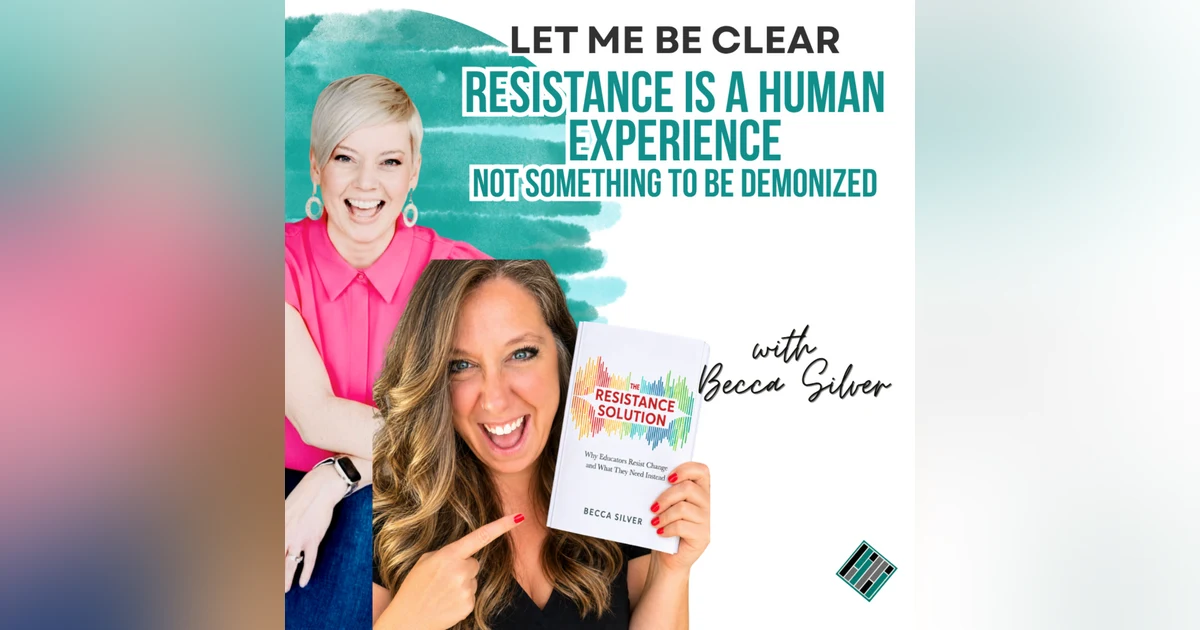
Let Me Be Clear: Resistance is a Human Experience and NOT Something to be Demonized


 RSS Feed
Resistance Isn't the Enemy — Here's How to Work With It, Not Against It
New staff. New initiatives. New curriculum. And right alongside all of it: resistance. Every school leader hits it heading into a new year — the question is what you do with it.
In this episode, I sit down with Becca Silver, author of The Resistance Solution, who drops a line that reframes the whole conversation: "Resistance is a human experience and not something to be demonized." We dig into why resistance shows up when change lands, how to stop treating it as a problem to eliminate, and what it actually takes to lead people through it instead of around it.
If you're planning your goals and initiatives for the year ahead, this episode will change how you think about the pushback before it even happens.
In This Episode:
- Why resistance shows up every time change enters a school — new staff, new initiatives, new curriculum
- Becca Silver's reframe: resistance as a human experience, not something to fix or fight
- What changes when you stop treating pushback as a problem to eliminate
- Practical ways to lead people through resistance instead of steamrolling past it
- How this mindset shift sets you up for a stronger year ahead
Links Mentioned:
- The Resistance Solution by Becca Silver
- The Whole Educator Podcast with Becca Silver
- Learn about The Clarity Cycle Framework for Schools
Loved this episode?
Reply and let me know what landed for you — I read every response.
0:05 Welcome to well clear clear is the new confidence. I'm Casey Watt, Casey Watt, author and this show, if we haven't met, we haven't there yet. One important thing to do and that is that is I am completely I've seen two. I've seen 2 brilliant women, brilliant women silent because they didn't have they didn't have some strategy. If you are ready, you are ready to stop yourself and yourself say the things that needs to be said and firm in your integrity. You are in you are in the right place. I am money. I am money miss print the message, press the message. That's the purity capacity, capacity helping you lead those around you rate courage and courage and content.
0:49 Now with all of that said, all that said, let's die. Let's die today's update and completely. Hey listeners, I am pumped for today's episode and it's been a hot minute since I've posted an episode. It is summertime. If you are just listening to this, just to paint a picture for you, it is summertime. It is July 1st at the time that I'm recording this, and June was a super hectic month of travel, but lots of fun, lots of connections, and you all know hopefully by now, if you've been a listener for a long time, I love, love, love to make connections and have really great conversations with people and that's what June was all about.
1:45 During the month of June, I had a conversation with one of my dear friends and colleagues, Becca Silver, about her book that just came out. She wrote a book titled The Resistance Solution. And in today's podcast episode, I'm actually going to share with you the recording for her podcast that we did together. And if you're not familiar with Becca Silver and her podcast, she has the podcast titled The Whole Educator. You're going to want to go check that out. I will link that in the show notes. But on her podcast, she invited me on and we were celebrating the release of this book that she's written and talking about resistance.
2:27 And so I want to start with her. Let me be clear statement that she actually mentions at the very end of the podcast next episode and she you're going to want to listen to the end because she expands on this let me be clear statement. I'm just giving you a snippet of it. So here's what she says at the end of the podcast. Let me be clear, resistance is a human experience and not something to be demonized. Let me be clear, resistance is a human experience and not something to be demonized. So on this podcast, remember, clears the new confident you guys, inevitably, if you're listening to this support teachers, you support other leaders, and you all inevitably will notice people experiencing resistance.
3:25 It comes up time and again and so often because it's so it's it feels so complex. We have a hard time figuring out how to address it. And I'm hoping that as you listen to this podcast episode, it'll give you a new frame of mind when you think about resistance. I also hope that you will go check out Becca's podcast, but more importantly, go check out her book, The Resistance Solution. That also will be LinkedIn the show notes. OK, with all of that said, let's listen to my podcast episode with Becca Silver. Hello, hello, hello, coaches and leaders.
4:08 I have my dear colleague and friend Casey Watts on with me and we are celebrating, right Casey? We I just made your move like the shoulder shield. The shimmy yes yes what, what what listeners don't know, especially if you only listen and don't watch it. When I get excited about something, I I like kind of shoulder shimmy and Casey told me last week that I do this. You know, everyone needs a friend that tells you what you do when you get excited because I promise you there's something you do that you don't realize that you do. I. Love it so much. Yeah. OK, wait, so, so we're celebrating, right. My my book has come out, has been a total labor of love. And it's, you know, the experience is kind of like birthing a baby.
4:51 Like it's this thing that's been coming up and working on. And Casey was one of my pre readers. And so she got to get the manuscript before it came out on print and got to kind of read it and and kind of gnaw over it. And Casey and I talk on a weekly basis and we talk about resistance, right? And I, you know what's interesting? Everyone listening, right? If you don't know Casey Watson, want to check her out. Casey does really important work with schools around clarity, clarity of goals and roles And like, right, like lack of clarity and please, like, you know, tell, tell me if I'm missing something. But like right? Like lack of clarity can totally cause resistance.
5:34 Yep, absolutely. Yeah. And so a lot of the work that I do, as you know, focuses on getting people not only on the same team, but on the same page, which requires clarity. But even after a leadership team has gained clarity of goals and of roles, they are really excited in the beginning, like, yes, this is like the initiative or these are the goals that we're going to work towards. We figured out how to communicate that clearly to our staff to try to get them to move beyond buy in and to commitment. And yet we get stuck because guess what? People are human, right? And they are complex. And they start to say, Oh my gosh, our teachers are resistant. Yeah, yeah.
6:21 So gosh, I totally forgot Casey because you know, everyone listening to Casey and I really like do a lot of collegial work. So we really talk about are kind of what we're doing with schools and I, I forgot you go beyond buy in too. You're like one of the few in my community that's like the goal isn't buy in. And so OK, so right. So, so the goal is ownership. I just wanted to make geek out for a second, like, yay, we're on the same team going beyond buy in, right. So resistance comes up when you when you read the book and the book is called The Resistance Solution. Well, I mean, what were your first thoughts? Did anything surprise you?
7:02 Like we haven't, we haven't debriefed about it. We haven't. And I, I feel like, I mean, we've already said this is, this is more than one episode, but it's funny. So yesterday or maybe 2 days ago, you sent me a text message and said, by the way, the book is ready for pre-order. And immediately I sent it to like 5 different people, some of my closest colleagues. But I'm super excited to share it with the people that I work with. Like for example, I'm going to work with the school this week and that's something that I know absolutely is going to come up. Like I have a section in my presentation that's titled what if?
7:45 Well, the what if is always what if the teachers are are resistant. And the beauty of your book is that it looks at resistance differently, right? Like when you and I have talked about this, and this is a large part of the reason you wrote the book is we have to look at it differently. We can't keep looking at it as well. We just need to hold people accountable. And I do talk about accountability in the work that I do like. Yes, it's important. Yeah, it is important. We want to hold people accountable. But in Chapter 4, I feel like you talk about one of the five mindsets that we have to consider when we're dealing with resistance, and that is the value mindset.
8:30 And it's all about like, do people know the value of this? Do they see the purpose? Do they see how they fit into that purpose or how it's relevant to them? Well, if you're only trying to hold people accountable, but they don't see the value of it, then we're going to experience resistance. So I think that's probably, you have 5 mindsets that you write about in the book. And I think that's part of the beauty of it is looking at the person. And it's so funny. You have the whole educator podcast. We're looking at the whole person and we're trying to figure out what is it exactly that, where is their mindset that's maybe causing them to experience resistance, which is the other thing that you have to talk about, because you talk about this differently than anybody else I've ever met.
9:22 And you talk about how teachers are not resistant, people are not resistant, they experience resistance. So. Yes, yeah. So, OK, I love this. And by the way, I don't know if you noticed at the beginning you were saying, what if teachers are resistant? I heard it. I don't know if you heard it too. It's like in our language. It took me years to stop saying that resistant teachers, that the teachers are resistant. So those those of you that are, there's some folks that have been listening to my my podcast and you're like, I know Becca, I've heard this. But look, this is the deal. No human is resistant. It's not who we are.
10:03 Casey isn't resistant. Becca is not resistant. We're also not happy or sad. I I am not a happy person. I am not a sad person. I experience happiness and I experience sadness and it moves through me. It's a temporary experience I have. It's not who I am. So when we use language like the teachers are resistant or that resistant teacher, we are labeling them and we are keeping them stuck in the very place we don't want them stuck in our own minds and our minds are powerful and people don't realize it. OK, I'm going to go on a little like, I promise this is related. I've never shared about this, but they're, they did these studies with cancer patients and they, they gave some of them chemo and they gave some of them placebo chemo, right? 30% of the people in this study that had the placebo chemotherapy lost their hair.
11:01 Wow, crazy. What that is how powerful our brains are like please everyone listening, our brains are powerful that we can and and it's not even like like that. I mean, that's kind of like that even kind of blows my mind. But even simply as when I am talking to someone and I've decided they are resisted, that impacts how I interact with them and how I interact with them. Well, of course interact, you know, anyone with a child knows this, right? How I end up with you, how you interact with me. So, yeah, thank you. Like I I'm just so passionate about this. This is really, this is not fluff. This isn't like Becca, just like say the right thing. This isn't about saying the right thing. This is like people, if you want results like, we've got to think differently about resistance.
11:52 Which is probably one of the now I'm certain that whoever is listening to your podcast, like your listener right now, I just want to highlight that you are doing the important work of listening to podcasts like this and being ready to challenge the way that you think because it is hard work. Shifting your mindset to OK it's not teachers are resistant, it's that they're experiencing resistance is hard work because it's already been concreted. Is that a word? We're making it a word. It's worth, it's concreted in our brain because we have heard it so much and we've said it so much. Teachers are resistant or people are resistant. So even even I have struggled to like catch myself saying, OK, no, no, they're not resistant.
12:38 They're experiencing your resistance. And also, if I can start to shift the way that I think about just that, that allows me then to start deciding, OK, what exactly is causing them to feel or to experience this. And I can dig a little bit deeper and do the archaeological work of diving into how we, how we approach it with each individual. So I'm curious too in your work that you do, because this book came from the work that you do and what you've researched is do you find that it has levelled up your work as a coach because you are now looking at resistance differently and you're now looking at these five different mindsets when you're working with individuals.
13:23 I'm. Going to give you my history with working with resistance here. A brief history of Becca's history of other resistance. So let's go back in time so first of all, when I started teaching I experienced resistance and there's a story in the book about that I mean, like many years of it and and right and I the, the mindset that I struggled with was value mindset like I didn't find the value in changes that were being told to me and so when I started coaching my first strategy, I totally forgot all of that My first strategy was do what I say here I have a good idea for you, right Teachers are experienced having like problems and I'm like, I have a solution and then I would tell them what I would have done and then they were all like falling flat it was not going well right so then I was getting that kind of and I was like, what's their problem Like, yeah, I don't I didn't call them I was just like, what what's their problem? If only they just did what I told them to do, they would be fine, right Then.
14:20 Then I started kind of working. I started traveling more and working with different schools and that's why I saw like a variety of, of people in different school cultures. And I found I was actually exceptional with the teachers experiencing resistance and their coaches were frustrated. And I was, I was really like caught off guard for at least the first year. I was like, why am I doing excellent with this teacher? And the coach is struggling and upset and, and all this and they, they would like sit me down and tell me all the terrible things the teacher did. And I'm like, OK, just like, let me give, give me some time. So there was a, a couple years where I was really, I was unconsciously competent. So I was naturally good at something, right? And I couldn't teach someone else how to do it because I didn't know how I did it.
15:11 I was just like, I don't know. Like I don't know why they are doing happy and doing the things I'm asking them to do and they're not for you. Then I was like, there's something here. So I started to kind of, you know, figure out strategic ways to build trust and strategic ways to not just the usual, like, how was your weekend? But like, really? So I started really looking at relationships and trust. How could be strategic about this? Then I started kind of naming, OK, there's different levels of resistance. And I did some work with Doctor Anthony Muhammad's kind of levels of resistance. He has a book, Time for Change. And then I was like, there's more to this.
15:54 There's more. And I thought, and it really got me. I was like, oh, we can name the motivations behind resistance. But as I was, I was using it in my work, I was presenting about it in sessions I was doing. And I was like, there's more. And that's when I, I went to the research and I was like, what, like, what is this? Like, what motivations are there? And that's when I discovered that the growth mindset researchers actually kept researching and published academic white papers on other mindsets that we need. And so I was like, oh, there's here it is, there is more. So I, that's, that's when I was like, that's I, I was so grateful to be able to name, Oh, it's a mindset.
16:40 You know, it it not issue, but like a, a mindset gap that's causing it. So the moment I started realizing and at first I only started using 4 mindsets. This is the evolution of it. There's four. So I was like go and I'm like, here's 4 mindsets. And then I kept doing research. I was like, there's more because there was a sense of there was. I mean, the the 5th and the final mindset I discovered was ownership mindset. That was the last one I discovered because it, it's actually, if you read the book, it, it, it's the combination of all four other mindsets to have ownership. When I, when I dug in, I was like, what is teacher ownership?
17:23 And I, I like discover the treasure trove. And by the way, teacher ownership research is like 100 pages long. I don't know who are these researchers? Are they it's it's so long these papers because ownership is so nuanced. Yeah, right. So broad. It's so broad and it requires so many motivations to have ownership over something. It's not just something you have or you don't. It's not something you tell people you. Ironically, you can't make people have ownership. You can make people be compliant. Yeah. And you could, there's some like ways you can kind of make people buy in in a sense, but you can't make someone have ownership.
18:09 So I'm like reading through the, by the way, my definition of ownership changed probably five times. I was like, this is it. I found it because I read a body of research. I'm like, this is it. I figured out what ownership was. And then it was like, oh, that's not it. OK, this is it. I mean, I, I'm sure there's like old blogs or I'm sure there's old podcasts that I'm like, this is it. This is ownership and I finally, it went clunk. I'm like, this is this is actually it. And it required that I put together multiple research studies. Like, oh, I started seeing like there's one research study I read around belong the relationship, the relationship of belonging and ownership. I was like, Oh yeah, that makes sense. Like to have ownership over something, I have to feel part of something.
18:56 Bigger than, bigger than, yeah, yeah. Yeah, and then I and then I was and then I read another one and I was like to have ownership, you need to find value in the change. I was like, duh, by the way, you know, value we were talking earlier about like what's your favorite mindset? Value mindset is my favorite. I was talking to someone last week. Belonging mindset was hers. And anyway, so what's funny, everyone listening was Casey and I were talking. I'm taking a kind of a little windy way. I'll loop back to ownership. Casey and I were talking about. I was like, Casey, what's your favorite mindset? Tell tell them what you said. Oh, I said I don't I don't know that questions too hard. Those works. That's what it really sounded like. If you if you guys want to know what conversation behind the scenes sound like, yeah, it is so challenging to figure out which one is is a favorite because they're all so valuable and valuable so. Valuable.
19:47 See, anyway, so all that to say, ownership I discovered through all of these research studies and I was like, oh, to have ownership, to have the ownership mindset, you need to find value in the change value mindset. You need to believe you belong belong you mindset. You need to believe you can be successful success mindset and you need to believe it's safe to improve here. And that's growth mindset. You need literally all four of those. And the missing component is agency. Agency shows up in. All of the research around ownership, you need to be able, teachers need to be able to feel they have voice and choice, some level of voice and choice in the matter. And I'm sure like that, that shows up in your work as well. It's not just, you know, not just doing clarity, it's like clarity.
20:37 And let me actually, I'm, I'm interested, I'm kind of interested in your work now because it's the, the agency work that I do with folks. Part of it is I asked them, OK, the word clarity's in my mind so I don't say this way, but I just like, are you, are your teachers clear about where they can use their professional judgement and what's non negotiable? Is that kind of part of the work you do as well? Absolutely. Yeah. So we get to, because my Clarity cycle framework has six, they are steps, but I really try to frame them as habits you want to develop as a leader. So the third step is gaining insight from your stakeholders. So when you're meeting with stakeholders, you're going on listening to us and just asking like what's on your mind about our campus goal and or our campus goals in this area of focus?
21:29 And then you take all of that information and it informs the critical moves that you script. So if we're going to map this out based on what we've heard from our people, what does it look like to show them the steps that we take to get to where we said we were going to head? So as you're and as you're talking about these mindsets, I'm thinking about all of the different mindsets that we're that we're targeting with just listening tours and getting insight from stakeholders. Yeah, yeah, like even just listening to folks starts to UN uncover like what's under resistance? And I anyway, I, that's funny, we kind of dug into ownership. I don't often get to like be like ownership.
22:11 But you know, I don't know. I, I, I, I find this work interesting and talking about listening, I think, you know, people say like, how do I figure out? I had someone, I had someone of gosh a couple months ago asked me like, how do we, I'm sorry. So I have a trust map. I, I talk about like trust as part of the belonging mindset. And then I kind of have a trust map as a bonus resource. Every mindset has a has a bonus resource where it's like this is the coaching process. Or I mean, it's like it's essentially the other half of the book that I did not include.
22:53 I literally folks, when you get the book, you're getting half of what I actually wrote. And so I wanted to figure out a way to give people the other half without overwhelming everyone because at the end of the day, my goal is that people read it front to back and use it like it is your it is your manual that you have on your desk. It's not something that lives on your shelf or under a bunch of papers. That is like a thing that has like, it's like has post it notes in it and things like that. So the trust map. So someone asked me, I have this huge grid of how to, how to identify which element of trust is missing.
23:36 Is it integrity, intent, capabilities or results? Those are the four elements, right? And so the whole idea is we're not trying to build trust here, we're trying to diagnose what element of trust is missing. Right, right, right. Yeah, Yeah. So and you use. The word diagnose a lot. A lot, which I think is another, the mind shift that people have to make when they're thinking about resistance. Like we want to diagnose it and then we want to address it. Yeah, yeah. That's, yeah, that's exactly it. Yeah. And it's, it's like diagnose resistance. We want to diagnose trust. And someone asked me, she looked at the grid and she says, Becca, how do I know which element is missing?
24:20 Like, she wanted me to put like, visible something like, like how? Like what behaviors I would see that would show each element. And I said to her, any behavior that shows a lack of trust could have any of these elements missing. Yeah. How do you figure it out? You listen. Yeah, and you watch. And you watch. Yeah, yeah, yeah. I want to say too that I know if, if people are listening to this podcast, a lot of the work that you do is the deeper human centered work.
25:00 And because it's human centered, there is no like Teacherspayteachers product that you provide. There's there's not a a protocol specifically that we use or a programmer. It, it's, it's human centered. Therefore we we have to tap into our human centered skills in order to address or diagnose and then address the resistance. Yeah, thank you for saying that. That's exactly it. This is not TPT worthy. This is this is not one-size-fits-all. This is not if you do this, it will work. And I think the danger in human centered work in doing that kind of stuff like if you follow this protocol, it will work because the research says it does, right. What is research?
25:51 We are watching a select group of people perform something and studying that right? It's not everyone and humans are complex, right? And so the same strategy I use with 1 teacher flops, flops with another teacher. All of that to say, I love that you said that because this is not, none of this work can be reduced to a simple protocol because and the danger of that is when the protocol, if we have the mindset that we need a set of protocols and procedures and that's how we coach. The danger is that when it doesn't work, not if. When it doesn't work, how do we explain why it didn't work? Yeah.
26:34 We usually blame someone. Yeah. It's, it's them they did, they are being difficult and look like I've totally in my younger coaching years, I've totally said that about people I've worked with. I'm like, they're just difficult. Yeah, same. I'm over here raising my hand like, oh, me too. Yeah, and that's also human, right? That's also like a human. Like the goal is never perfection, right, where it's progress over perfection. But we are. So I was just thinking about like how I say I'm recovering perfectionist. It's like a side side note. And and I I don't like it when people say, well, we can't be perfect. And I'm like, we don't want to be perfect. Why?
27:18 Why is the goal? Why are we including perfection in any of this besides acknowledging I'm working on it? That's it. Exactly. Oh my gosh. OK, so we have to wrap up. We've, we've been talking for 23 minutes. Oh, Casey. Casey, Casey. Said OK, 10 minutes, 10 minutes, let's go. Yeah. Right, everyone listening, our goal was to talk for 10 minutes. That was ambitious and not this is on brand for us. Casey, gosh, thank you so much for coming on the show and kicking out with me about all things for citizens and ownership. I just feel like they just go hand in hand. Anything else do you want to share?
27:59 I want to know, so on my podcast, I have people finish the statement. Let me be clear. If you were going to finish that statement based on what we've talked about today, what would you say? Oh I love this. I have not been asked this. OK, let me be clear, resistance is a human experience and not something to be demonized. Let's start interacting with our educators, experiencing resistance with curiosity and compassion and commitment that the work does get better.
28:40 Because at the end of the day, we do want things to improve. We're not not saying that, but we're going to do it through people's humanity and not around it. Love it, I love it so much. Thank you for being here. Yeah, thanks for having me. OK, that was the podcast episode that I would. I joined my friend Becca Silver for her podcast and I wanted to share it here. I hope that you enjoyed our conversation and are looking at resistance differently because of it. And I hope that you will go take a look at her book, The Resistance Solution. Again, all of that is LinkedIn the show notes guys. We will catch you in next the next episode. All right, hope you're having a great summer if it's summertime for you and if it's not summertime, I hope that you're enjoying whatever kind of weather is coming your way at the time that you're listening.
29:31 All right, check you later. Hey listener, I am so honored that you listen to today's episode and I hope you gained something valuable from it. I'd also be honored if you did ME3 solid favors. First, subscribe to this show. I've got a lot of great content coming up and I don't want you to miss any of it. Second, be sure you're following me on social media platforms, and you can find me at Catch up with Casey on LinkedIn or Instagram. And finally, if you were looking to book a dynamic and relatable speaker for your next event, conference, or retreat, I would love to bring a message about how the craft of clarity makes a significant impact on both leadership and life.

