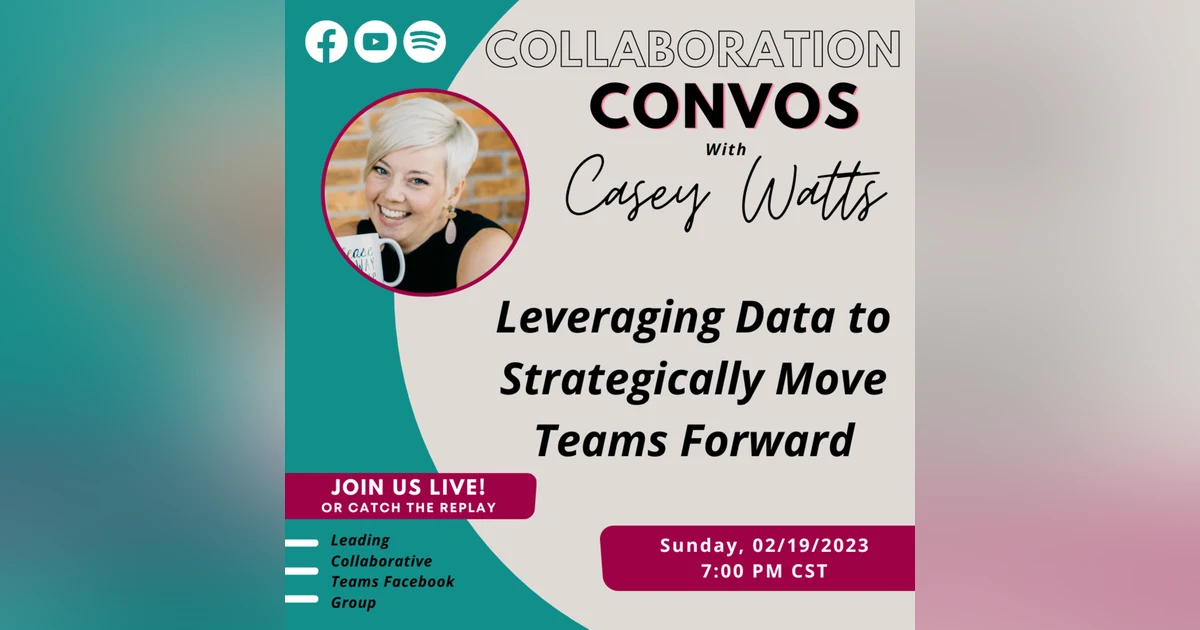
Leveraging Data to Strategically Move Teams Forward


 RSS Feed
At the crux of making change happen is DATA- more specifically, the emotions tied to data. Unfortunately, a preoccupation with data itself can have negative side effects of decreased commitment and burnout as teachers relentlessly chase targets that are ever-moving or obscure. But what if we could leverage data in a way that creates a sense of purpose and direction, creating alignment and inspiring people to collectively move forward? Join this live to catch a glimpse of how to drive noticeable and sustainable change!
Connect with Me on Facebook, Instagram, LinkedIn, or YouTube!
Join the Facebook Group, Leading Collaborative Teams and connect with me and others who are eager to build cohesive, vision-driven teams!
Level UP your leadership game with resources, tools, and strategies located on my website!
--- Support this podcast: https://podcasters.spotify.com/pod/show/catchingupwithcasey/support0:00 Welcome to another collaboration conversation, where we talked about anything and everything that has to do with building, cohesive Vision, driven teams, because this is where you Unleashed your impact. I am KC W impact coach and consultant and of course, the host of this show. Now Today's show is going to get started in just a few moments, but I want to take a quick pause real quick for you to introduce yourself in the comments. Let us know. Know who you are where you're from. And what it is that brought you to the show. And then I also want to get really real with you and ask you a question, okay. So here goes, have you ever made a suction? I'm guessing the answer is yes, because everyone has made assumptions, right?
0:50 Have your assumptions ever led to either negative consequences or stagnancy? I'm betting that your assumptions more than likely have led to those things, because that is true for me. I have been guilty of making the assumption that when two or more people are gathered together collaboration is naturally happening, or I've made the assumption that when teams get along, they are generally productive and effective. And I've also made the assumption that because we're working together, clearly, We all know the direction that we're moving and that is just not true. Those assumptions have lead to ineffective teams that are going nowhere, fast.
1:42 And I know that we want something different than that. We want teams, who can survive can Thrive instead of survive. We want teams who are less dysfunctional and are more of the kind of team that they deserve to be a part of These are the kinds of teams that can Propel your organization and benefit, not just the people who are on the team but can benefit the organization as a whole. Okay. And I want to tell you about something that can help them to get to this point where we're letting go of those assumptions and we're utilizing people. Well, so we can work efficiently, productively in toward a vision.
2:28 I want to tell you about how How you can build that cohesive Vision, driven team, let me read to you first. I quote, from Christine Caine, it's one of my favorite quotes to build a strong team. You must see someone else's strength as a complement to your own weakness and not a threat to your position or authority, okay? But I want to dig a little bit deeper. Sometimes we have this surface level knowledge of what our strengths and weaknesses are But how great would it be if you could dig down to a deeper level and truly understand, everyone's Geniuses their god-given talent, the kind of work, that brings them fulfillment and because it brings them fulfillment.
3:17 They are building capacity and you know what that built capacity helps your team to thrive How wonderful would it be if your team members knew each of their types of geniuses new? They're working competencies and new. They're working frustrations. I am going to be providing all of that information in an upcoming Marco Polo. Share Cast, we're going to be diving into the six types of working genius developed by Patrick Lencioni. And we're going to be thinking about how you you can recognize provoke and cultivate those Geniuses and support teams so that they are cohesive and All Vision driven so that you can Propel your organization forward faster and better.
4:16 I want to share all of this with you. If you want to learn more, you can go to bit.ly slash better. You better team, this will end Feb. E8. So registration closes February 28th. Be sure you get in before then if you want to learn more, just put in the comments, learn more and I will hit you up with more information. Okay. I'm excited to begin today's content so if you are ready, drop a hashtag ready. And let's get started. Hey everybody, welcome to another collaboration conversation. I'm so excited for tonight's session which is all about leveraging data to strategically move teams forward.
5:04 And man is this just the prime time of year to dig into this content or what? I see that there are some people here if you're here with me tonight go ahead and drop who you are where you're from, what you got going on in the comments so I can make this as personalized. As possible. Now I'm going to go ahead and tell you that tonight's content is heavy. It is cumbersome. And I literally could, I mean this like this session, the content for the session is truly, what takes place in a 122 day, professional development session. So I'm going to Breeze through a lot of this and you might be thinking, well, Going too fast and I have questions and that's okay.
5:52 If you have questions man I would love to talk with you about some of the things I'm going to be sharing about in this live tonight but I also have lots of resources that come with this session and at the end of the session or in the middle of it, whenever if you want to send me a private message or if you want to email me, let me know your email address and I will get these the session materials to you. So I'm seeing So Michelle is here. Hey Michelle I'm super excited to have you here. Alright, we are going to dig into today's content and I'm going to start with the screen kind of panned out a little bit so you'll see me. You'll see a little bit of the screen and there are some points where I'm going to expand it so that you can see a little bit more closely because there are some specific things I'm going to point out.
6:44 Alright, so here's our goal tonight. Our goal is to To think about how to craft change stories by capitalizing on data Reflections and making teams a part of the success story and we are going to do this in four different ways. We're going to think about gaining perspective, casting Vision, scripting critical moves, and finding the bright spot. So all of these pieces are necessary necessary in order to reach this. Goal. And a lot of this work that we're going to be looking into, I've gleaned from the work of Chip and Dan Heath, but from the books, which how to change things?
7:31 When change is hard, we're reading this book and this exclusive group that I'm a part of with lots of other instructional coaches and if you are interested in joining this book study with us with other instructional coaches, man, let me know and I can get you information about that. Group. Because this is a game changer and it is really the basis for the foundation of what I have been doing in my work as an instructional leader. So here's what I want to start with in this session description. This is what it says at the Crux of making change. Happen is data more specifically, the emotions tied to data, unfortunately, a preoccupation with data itself. Can have negative side effects of decreased commitment and burnout.
8:25 As teachers relentlessly, Chase targets that are ever moving or obscure. Give me a thumbs up if you have noticed that happening, but what if we could leverage data in a way that creates a sense of purpose and Direction creating alignment and inspiring people to collectively move forward. And that is what we are going to talk about how to Drive noticeable and sustainable change. Are you ready to get started? Give me a thumbs up. If you're ready to get started, we are going to dive in and I want to ask you a question. I want to ask you this very simple question of why do we look at data?
9:06 Why look at data and I'm going to give you a moment to drop in the comments. At least one reason you think we look at data and it can be personal to you, or it could be a reason that your district has that. They look at data and while you're dropping that in the comments, I'm going to take a sip of water. Okay. I'm seeing a lot of people jumping on. Hey Cristina. Hey Elizabeth, so excited to have you here. Drop in the comments. Why do we look at data? What is a reason or a couple of reasons that we look at data?
9:52 Okay, I'm seeing somebody from YouTube has said that we look at data to inform instruction, okay? Another person saying to see Trends, absolutely. We look at data to see Trends. We look at data to decide what instructional practices do we want to implement, right? Okay. Now here's what else I can say, based on the thing Things that you have jotted down and what I know about, why we look at data really? We look at data almost inevitably because we know we're going to determine a change that needs to be made a change that needs to happen, which means we are almost always in the business of creating change stories, but before we can craft change stories and look at our data, You need to consider three, surprising truths about change, that, that's going to guide our work today. And all of these truths come from the work of Chip and Dan Heath from the books.
11:03 Which so here are the truths about data, 3, surprising truths. I'm going to expand this you can to hopefully see it first truth. What seems like a people problem is often a situation problem. Now here's what I know. We have put teachers, I'm certain in situations where they experience pain. Maybe feelings of inadequacy guilt or shame when they're looking at data. Here's the second truth, about change chip. And Dan Heath say that what looks like laziness is often exhaustion? You remember me saying, there are these ever moving targets that teachers?
11:51 Are chasing when it comes to data and assessment. Think about that? We're always like, our standards are always changing or state assessments change, or we hit covid or time is non-existent. You, we see leadership changes. We see, team members change, there is always something changing, but what looks like laziness is often their exhaustion here are surprising truths. Number three, What looks like resistance is often a lack of clarity. Now, when we think about a lack of clarity, we have to consider what is the overall goal.
12:33 What is the vision or mission of the campus or district? Is there a common Collective goal that we have all bought into now? Before data Reflections are a couple of things you're going to do. So you're going to see in this session that half of it, we're thinking about what to do before teachers and staff, engage in data Reflections and then you're going to see a second half. We were thinking, what do we do after data? Reflections are completed. So there are really two parts to this. And in this before, we're going to look at two things, that is imperative for instructional.
13:14 To do that is gaining perspective and casting Vision. So we're going to jump into those two components that you will Implement before data Reflections. Now, you might be thinking, okay, I don't even have data Reflections. Our teachers don't fill out anything. That's okay. This is a starting point and I have some examples for you that I will share later on some of you may have data Reflections or data analysis forms that you already use. Use. And this is going to fit into what you do before, teachers complete those, or before staff completes those. All right. Are you ready? Here we go.
13:56 I want to start with this phenomenal quote, from Seth Godin. Who wrote the book? Oh, I don't have it with me. He wrote a book all about marketing and telling stories as marketers, but here is what we know to be true. And let me expand this for you. We know that stories. Are a part of our Lives. We fit into Stories. We Live breathe and eat stories, right? Like, that's what our life is. Here's what he says. Stories are shortcuts. We use because we're too overwhelmed by data to discover all the details. The stories we tell ourselves are lies that make it far easier to live in a very complicated world. When I read that I was like, oh my God. Gosh, that is so related to data because, think about this, when we begin to reflect on Common Assessment data whether it's local or State teachers, and I would say probably administrators to, we begin to craft stories, sometimes these stories are lies to make it a little bit easier to swallow data.
15:08 That's hard to swallow, sometimes, they're half-truths, either way, we're crafting stories to make. Easier to live in this complicated world of data. So here are some stories that we tend to craft or we hear other people, crafting. And if you have recognized these stories that have been crafted after looking at data, that might be hard to swallow. Give me a hashtag. Yes, in the comments or a hashtag data is hard or a hashtag craft stories in the comments, so I know that you're following me and you've had the same experience. Has so some stories we might craft especially if the data is hard to swallow would be well, it was just the wrong time of year to give the assessment or it was the wrong day to give the assessment. Right?
15:57 Or you might hear people say it's these kids they're just not mature enough or the standards aren't developmentally appropriate or kids aren't used to online testing even though our kids have been online testing now for about three years, Ears right. Or they've, they've been immersed in that for a good bit of time. Or we might hear. Well, the test was too hard or there were bad questions, right? So are you hearing some of these things? Where you are you hearing some of those statements? Some of those stories that we craft. I have definitely heard those stories. And listen, I have crafted those stories myself. And I think it's important to pause and decide are some of these stories true, or what is it? That's not true that we're just crafting to make it a little bit easier to live into this, in this difficult world of data. It is important, as instructional leaders, to still show, empathy, even when we know people are crafting stories, it is a part of crafting, a story and leveraging data. Data to move team strategically forward. Okay, here's another quote that Seth Godin shares and I love this one too stories, make it easier to understand the world, but then he also says stories are the only way we know how to spread ideas and we want to
17:30 spread positive ideas. Now if stories make it easier for us to understand the world and we live and breathe, He's our life is basically made up of just stories. No, wonder we take data personally, right? I hear so often that, you know, oh, it's not personal or you need to separate yourself from the data that's just impossible, even if someone says that they are fine with looking at their data and separating themselves from it, we have an attachment to data and I always like, to think About this idea that to see data only as numbers and Target is like separating characters from a story right? Let me read that again to see that as only numbers and targets is like separating characters from a story. Here's the deal.
18:29 Each of these characters that you see here plays a crucial role in the story of data, right? And ideal. Each stakeholder would have the same story in our hands. At least the same ending to the story, but in reality, we each have our own perspective. So students have their own perspectives, parents, come with their own perspectives, teachers administrators, the community, we all come with our different perspectives. And so often, Each of those perspectives remains isolated to the perspective holder. So and this often happens.
19:17 You can see this happening between students teachers and administrators for sure. And I can say that, you know you hear so often teachers who get frustrated with their leaders because they believe their leaders have lost sight of what it's like to be in a classroom but isn't it also true and this might this might be stepping on toes. Rose. Isn't it also true that it is crucial for teachers to be able to take on the perspective of Administrators? We're going to talk about that in just a moment. Now, in order for people to work collectively together toward an end goal and not remain in between like like the rising action and the climax like a ping pong ball. We have to be invited to see other perspectives. We have to be invited to see each other's perspectives. It's kind of, like I think about authors who reveal another character's perspective in a retelling of a retelling book, right?
20:24 And that's what we want to be able to do. So I'm going to show you one way that you might help or invite people to gain perspective. All right, so here's here's what. I'm going to say because we know that we speak in stories and analogies, you can use those to pull people into the story and help them to gain perspective. Okay? So this is a perspective analogy that you might use that I have used before to help others gain perspective or to invite people into perspectives. And I'm going to tell you what, I might say to a team of people and I'm Going to say teachers and administrators alike or instructional leaders alike, this is what I might say to them when we look at this image and I provide the analogy.
21:19 So here goes this is kind of what it might sound like. In our organization, we have two lenses through which we look, we have a teacher and classroom lens. That is super zoomed in and we have an administrator or District lens. That is super zoomed out. The zoomed in lens with teachers and students that teacher is focused on getting students from point A to point B, from beginning of year. We're to end of year, but when we take a zoomed-out lens and we think about the perspective of instructional leaders, we are considering those same students not just from beginning to end of this year, but what is it going to look like for them? Two years down the road for years, six years, ten years, down the road when they become a graduate, and then they become a part of the community, okay?
22:22 So, that's First part of that perspective analogy, then I move into explaining how both perspectives are absolutely necessary in order for us to reach the collective. Vision we have for that graduate for every one of our students as a working citizen in our world. And so I might say to them, you know, as as someone zoomed in, you have a perspective that we need in order to move forward. So your lens informs our path but our lands can inform the path to because we're seeing the bigger broader picture and then you might notice the outliers who are the little pinpoints in Black those outliers are any stakeholders teacher. Is administrators District leaders parents community members who have chosen not to follow along on the path with us.
23:31 They have chosen not to be a part of this Collective vision and work collectively together. Now here is what I know that people are thinking. When they when you talk about outliers, they're thinking or they're beginning to consider, who is it on their team that could be the outliers or They might begin to wonder if they themselves are outliers and then they will have to make a decision. Am I going to be an outlier? Or am I going to be a protagonist in this story? With that said, what I want to say to you is that giving a perspective analogy and pulling people into the story can begin to help Educators, not take the data, so individually personally.
24:23 But instead, they can put themselves in the story in a different way as the protagonist that's using data to inform decisions, so that everyone can move forward. Okay. If you're Following me with gaining perspective and why that's such an important part of debtor for Reflections or such an important part before you begin data Reflections, give me a comment that says, yes or follow or perspective. Let me know in the comments if that's making sense to you. So we've talked about gaining perspective and why that's important before data Reflections, you also, then after you've helped people to get Gain perspective. You also want to begin to Vision cast for yourself for your leadership team.
25:14 And for your staff, this is crucial and it's important for your people to see what is the purpose of data Reflections, right? Like, I can show them the time, like the framework and the perspective of, like each of the stakeholders, but if they don't see a purpose for Dad, Reflections and how that fits in with that perspective, then it's really not going to make a huge difference, okay? We skip this step so often and I don't know if it's because we are crunched for time or we just don't not, everyone knows how to Vision cast well, but it is skipped.
25:57 So often, however, without a vision or Clarity around Vision, no one can see where you're going, right. And they can't even see why, or how they belong, or what role they play in moving the organization forward. And what happens then is that the data becomes Moot and you're back to square one. We don't want that to happen. So how do we cast a vision and pull people into the story? And this is where you are going to show teams the timeline and process again. What often happens is that people are given these data reflection forms or data analysis forms. They're sent off to reflect to fill it out. They have little to no explanation, which lacks Clarity making change hard.
26:51 We create situations that cause tension or anxiety, or make people with Retreat and withdraw again, which makes change hard. And then finally, people become exhausted which makes change hard and we don't want that to happen. Happen. So what you might say, if you are Vision casting with a data reflection map is you you could say we're about to begin data Reflections. Before doing this, we want to share with you. The trajectory that we might follow in this process and get your feedback and then set Norms to do the work and then after you talk them through this data reflection map, you do want to get their thoughts. You want them to have ownership of this and feel comfort in this.
27:41 You can ask, after you explain this, okay? What stands out to you? What feelings does? This evoke what concerns do you have, or what makes you uncomfortable? Moving forward. All right, so let's look a little bit more closely at this data reflection map and your data reflection. Map could look very different than this one. It really depends on your beginning and end. Ending and what you want your teams to be able to do but together with your team you show them this map. And here's what I have here are the things that the teachers or team is doing in the beginning, they will set a purpose for data Reflections and you do want them to have to do that together?
28:27 What is our purpose here? Why are we doing this? Then they will develop norms for the work. What Norms will we set before? Completing dad or Reflections, both individually. And as a team, then they will actually complete the data Reflections individually by themselves. That is an important step, we're going to talk more about this in the next couple of slides. After that, I have them meeting with plc's to investigate the for PLC questions, using their data Reflections. Then they move into engaging in backward design for upcoming upcoming units or standards followed by setting learning goals with students and then they will Implement high quality Tier 1 instruction to meet the goals Bill engage in teacher-led, professional learning.
29:21 Then they will Implement common. Formative and summative assessments and guess what? Then you're back at the beginning where you're analyzing and reflecting on data and celebrating growth, okay? So this kind of fits into what I'm going to share next where we're casting a vision but we're also scripting some critical moves. Okay, now I want to talk to you a little bit about about data Reflections. I've got several Data, reflection forms and Analysis, forms and team reflection forms that you are welcome to use. There are so many resources out there, like you type in data, and you'll see tons of things pop up there are great resources.
30:09 I have a few examples, but my work comes from books, like, driven by data 2.0, which, I actually would say data-informed instead of data-driven. But that's another topic for another time. And then there's another book the handbook for collaborative common assessments, that's fantastic and has lots of resources that's from solution tree and fun. Fact, you can go to solution tree.com and get some of the resources from some downloadable prints from this book and other books. Okay, here are two things I'm going to say about data Reflections and data analysis. Forms number one, It is important that you preview any form, you're going to have people complete. That can be part of setting a purpose and that can be part of setting Norms, people need to know what they're about to get into and what the expectation is for these data analysis forms. The second thing is simple is better. Simple is better.
31:18 We want people to have the brain space. To truly reflect and not be overwhelmed by what's on the form. Okay, all right, so if you Can you tell me so far? What is really stood out to you like give me in the comments just let me know what is it so far that is that has been standing out to you or resonating with you and I'm going to move forward. All right, so I have shared with you how we want to before data reflections. We want to help people gain perspective and invite them into different perspectives.
32:02 Then we want to cast Vision. Now we've cast The Vision using a data reflection map and we are ready to do the work after data Reflections and that is scripting critical moves which we kind of already have done when you show them the map and finding bright spots along the way. Okay so here's I want to read to you from the book, switch about scripting critical moves. Here's what the authors say about this. Let me make sure I've got the wrong page or the right pitch. I don't want to get the wrong page. That would be awful.
32:43 Okay. Ambiguity is the enemy any successful change. Requires a translation of ambiguous goals into concrete, Behaviors in short, to make a switch or a change. You need to script the critical moose. Here's what else he says. They say if you are leading a change effort and remember when we're analyzing and reflecting on data really what we're doing is, we're crafting change stories. We're trying to make change happen. If you're leading a change effort, you need to remove the ambiguity from your vision of change, okay?
33:26 Up, we want to script critical moves so that the team can actually move forward and be a protagonist in the story. We do not want them to become antagonists. We want them to be protagonists in the story of the data and we want to find bright spots along the way. So how do we do that? Remember earlier, I showed you the data reflection map and you only saw the black portions. Well here is where you as the instructional leader. Fit strategically into the timeline and progressively move them because we can't stop after the inspiring perspective analogy. And we also can't stop after Vision casting for it to mean something and be sustainable.
34:13 We have to script the critical moves and find bright spot. So we do so through feedback observations teacher-led, professional learning story about the dog in the background. If you can hear it and the pink is the role of the instructional leader. So you will notice in so much of this, the instructional leader is questioning modeling and facilitating but I want to point out a few key things that the leader does to script critical moves and find bright spots. Notice underneath complete data Reflections individually I have that. The instructional leader is offering partnership earlier. I told you people need to be reflecting on data individually which is absolutely true.
35:04 However, every now and then you are going to have a new hire or a new teacher a first year teacher. And it is really important for that brand new teacher to have a partner In the process. Be careful though, that partner cannot be just any old teacher. It may not even need to be a veteran teacher. You need to choose that partner, strategically and intentionally, think about who your Runners are in the organization or think about other administrators, instructional leaders, maybe you're reading, or math, specialist and partner, those people, those new first-year teachers with one of those people, okay?
35:49 Again, through most of it, you're questioning and facilitating. But notice you get to where we set learning goals with students and that's what the teacher is doing in the classroom. But this is a great place if you choose to do something like this to survey the student body and that could be done in a simple Google form or just a written form. If you want to it's Anonymous and you ask students what is the learning goal that you set with your teacher and then you get to Analyze that as an instructional leader and notice patterns and consistencies. When teachers begin to implement high quality Tier 1 instruction to meet goals. Here's what you the instructional leader. Doing you're providing individual individual feedback on the data Reflections in your doing walkthroughs. So sometimes what happens is we have these data Reflections, people complete it and then it's kind of like that. Check list.
36:50 They've just checked it off and they're moving on to the next thing. But we want it to mean something. We want it to continue to be a part of the story so we can reflect on it later. That means that as an instructional leader to three weeks down the road after they've completed the data Reflections, you're going to want to go in there and give feedback that's individual to them. You're going to want to praise them for the strength of the data. And you're going to ask questions about the areas where challenges were present, okay? And you might even give some suggestions about things to try or someone to go and visit with like a peer to go visit with and then of course you're doing walkthroughs.
37:35 Now here's the next part. It says, engage in teacher-led professional learning. That's what the teachers are doing. Here's what you're doing, is an instructional leader. As you are thinking about the reflection forms and you're thinking about your walkthroughs, you are developing a Willis kill will quadrant and in this skill will quadrant. You are thinking about where to place all of the team members and you're deciding what kind of support they need. If you want to know more about the skill, will chart, let me know. And I can share more about that with you.
38:15 Learned about the skill, will chart and what to I mean it's pretty I think a lot of people know about the skill will chart but what kind of support to provide people is interesting and I've gained a lot of that information from Builder University by Robin Jackson. So you're also continuing to do walkthroughs and of course providing support you're doing that up until the very end. So you've kind of gone through this map. You get to the end where again they're analyzing. Ian's, you're offering that partnership, you're questioning facilitating, but you also with teachers and staff developing an instructional Focus As you move forward that instructional Focus that you determine as a team can give you a starting point and an ending point for a new map.
39:09 And it does not have to be data reflection map. It could just be like, if you Your instructional Focus was going to be, I don't know. 85% student engagement, I'm just making stuff up 85% student engagement by the end of the next quarter. Well you can start with a timeline again and decide what will be placed on this timeline to help us script. The critical moves and cast a vision, okay? Along the way, I know I'm giving so much literally each of these Things that I have on this timeline on this map could be a session in and of itself.
39:50 That's why I say I'm condensing everything into like 40 minutes probably. So you along the way are encouraging, you're finding bright spots, you're celebrating encouraging finding bright spots celebrating. Then you are ready to implement some unique things to help you to do that because it's easy to say, To celebrate and we can give a little clap, a pat on the back, or a tear, but here are some unique ways you can do that. You can find bright spots by doing classroom Snippets. And this is really specific to instructional coaches. So they can go in for 10 to 15 minutes.
40:32 Every single classroom. Only leaving positive feedback and find bright spots and encourage people. That's a great way to provide encouragement and find bright spots. You might decide to do Winds of the week and there are so many ways. Ways that you can do this. But I have a session on YouTube that I can link in the comments after this that shares about how to use Marco Polo to invite people to see Winds of the week and that can just encourage people and encourage them to take risks. And then another way that I like to find celebrate bright spots is by using the last graphic and it is all about recognizing provoking cultivating.
41:15 The intelligence in the members of your team's again, so much of this, you can get for free on my website. If you register as a member catching up with kc.com and you will be able to get all of those things for free, you can also sign up for my newsletter, bit.ly slash Casey's newsletter, and I send out things like this almost every week. Okay. So I have shared. Whoo, so much our goal was to think about how to craft change stories by capitalizing on data Reflections and making teams a part of the success story. We talked about gaining perspective, casting Vision, scripting critical moves and finding bright spots. What I want to know now is what was most useful for you here today in this?
42:14 This live session and I want to bring up again, that data Reflections in all of this, like, we're coming back to the data Reflections again, and again, and again, so that that data and those Reflections do not become moot, but instead they're a positive part of the story and we can make change happen. So, tell me what was most useful for you here today. Drop it in the comments. You can keep dropping. Comments even if you're catching the replay and I think we're actually going to end there who sing a lot of people say Dada reflection map.
42:59 Yeah, data reflection map is one of my very favorite things or maps of any sort because people need to know where they're headed and why they're headed there. And what role they play in getting there. Okay, I'm going to leave that. With you. And I hope you have a fantastic evening. Maybe you have tomorrow off, I, for sure do, and I hope that you enjoyed this session. Until next time, I will catch you on social media. I will catch you maybe in, Marco, Polo, and I will catch you in my messages. If you want resources from this session, just let me know that you want resources. I'll get your email and I'll send you the resources, okay? S have a fantastic evening.
43:47 See you later. I want to give a big thank you to you guys for tuning in and I would love for you to do me to solid favors. Number one, if you've enjoyed this or any other shows, please hit subscribe. I've got a lot of great, gas and content coming up. And I don't want you to miss any of it too. If you know, of someone who may be interested in building cohesive Vision, driven teams that collaborate well Share this show with them and until next time, I want you to go off and have the great collaborative conversation. That helped you and the people you work with two completely.
44:27 Unleash Your impact. See you later. Share this show with them and until next time, I want you to go off and have the great collaborative conversation. That helped you and the people you work with two completely. Unleash Your impact. See you later.

