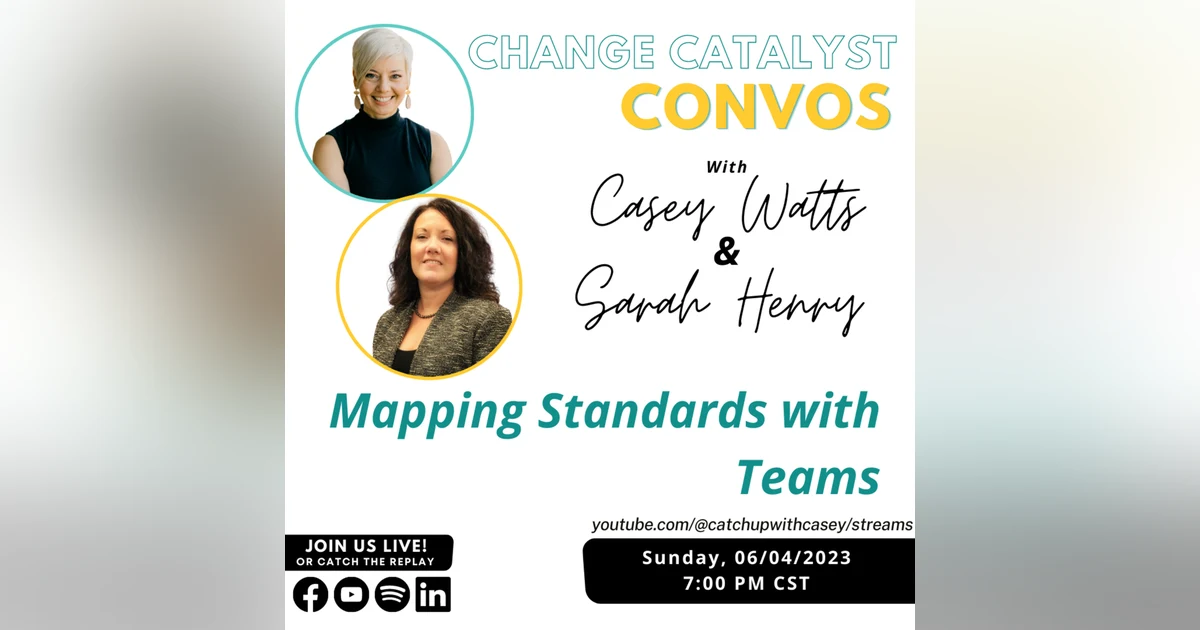
Mapping Standards with Teams with Sarah Henry


 RSS Feed
If you’re planning a summer PD for teams or thinking about how to spend time at the beginning of the year having teachers investigate standards, this will be super helpful! Sarah Henry, coauthor if Arrows: A Systems-Based Approach to School Leadership, will be sharing about how she mapping standards with teams. She'll be sharing about the strategies and processes necessary to map standards with teams in order to have the greatest impact on collective efficacy and student learning.
Learn about Launching PLCs with Sarah!
Connect with Sarah on LinkedIn
Connect with Casey on Facebook, Instagram, LinkedIn, or YouTube!
Join the Facebook Group, Leading Collaborative Teams and connect with me and others who are eager to build cohesive, vision-driven teams!
Ready to get CLEAR on your vision, goals, and initiatives so teachers and teams can actually make change happen? Book a discovery call with Casey!
--- Support this podcast: https://podcasters.spotify.com/pod/show/catchingupwithcasey/support0:00 Welcome to another change Catalyst conversation where we talk about anything and everything that has to do with building. A cohesive Vision, driven teams that make sustainable change happen. Even when change seems impossible, I'm Casey W impact, coaching consultant and the host of this show. What I know from experience is that making change happen can be overwhelming and downright hard sometimes. As an instructional leader you survey your Or organization from a bird's-eye view and it can seem as though. You're witnessing an anthill. That's been knocked down and ants or scattering everywhere. No one has a collective understanding of why change should happen or what changed to begin first. You notice false starts again and again because a solid action plan hasn't been crafted for your met with resistance because you don't know how to motivate such complex people. The thing about ants though is that they Have one common goal and that is to collectively.
1:03 Rebuild one solid anthill, this doesn't always happen for schools. You see, we can say as much as we want that Tier 1 instruction needs to happen or that a curriculum needs to be implemented with Fidelity or that plc's need to be collaborative and support student learning. But these broad ambiguous goals, do nothing to help. Teachers and staff build capacity and actually make change happen and that leads to schools remaining in a cycle of stagnancy, experiencing the same problems and ineffectively repeating the same initiatives again. And again, this leads to low, morale burnout, High turnover. And it leaves our students to suffer most. But if instructional leaders can get really clear on a narrow road, instructional Focus.
2:00 And script the critical moves for people. Then we can make Collective efficacy. A United colony of Educators if you will possible. My goal is to make cohesive Vision driven school teams a possibility. I helped School leaders, zoom out to cast vision and then Zoom back into script. Critical moves that help teams collectively, go farther faster and better even when change seems impossible. One way. I I do this is by coaching leaders through the clarity cycle framework a cycle for building sustainable capacity through intentional Clarity. Processes. Are you ready to feel great about exactly where you and your campus or headed?
2:45 And are you ready to know exactly how you're going to get there? If so you're going to want to stop right now and head to catching up with kc.com to learn more about the clarity cycle framework and then come back to catch up on this episode. Code. It'll still be here when you get back. Okay, now that you are primed for thinking about cohesive Vision, driven teams that make change happen. Let's jump into this week. Change Catalyst conversation, Hey everybody, welcome to another conversation where we are attempting to make great change happen in schools. I am excited to be joined with Sarah Henry tonight, co-author of the book arrows. A systems-based approach to instructional leadership and I am.
3:32 So looking forward to her sharing about tonight's topic. We're going to get to in just a little bit, but Sara take a little bit of time. I want to welcome you to our show. I want you to share Who You Are. What it is that you do and your aspirations. Well, thank you, Casey for having me on your show. So I currently am doing consulting and serving as a district and PLC alignment coach. So, working with school districts to help them kind of simplify their Vision, create Clarity in the work and basically create an atmosphere where we're being very intentional so that we're not working harder.
4:14 Yeah. And I forget what you just asked me the last question. Hmm. Your aspirations aspirations. So yeah. So this is my 22nd year in education started off with elementary and middle school science and went on to actually teach High School science as well. So I have that unique exposure to all the levels middle schools. Definitely my love. Got my admin degree and decided to. I didn't really I wanted to work with the teachers to help, teachers be more intentional with their instruction and that's kind of where I've always pushed myself to grow.
4:57 So in this role I'm able to kind of go outside now to other districts and it's been interesting to be able just to kind of see how everybody is set up differently and use those science diagnosis skills. To kind of figure out where I'm seeing areas that they need support. So really kind of my aspirations would be to continue to grow this work and to, you know, simplify things, you know, we're in a time where it's hard to retain Educators. And I think any of the things that I can do to make life easier and also, you know, result in positive things for students than that would be a fulfilling life for me.
5:39 Yeah, that's awesome. Yeah, it's great stuff and I love how your Churning like keeping it simple. Making things are working. Smarter not harder. But at the same time that he's comes with your intentionality, right? And I feel like, that's kind of what, what you're referring to in your work is being super intentional with your processes. So that in the long run, it can be a smoother easier process that has a greater impact. Exactly. Yeah. So tonight, you're going to be sharing with with us about mapping standards with teams. And I'm really, really interested in this topic because I cannot count on my hands the number of times where I have met with leaders to like as a teacher myself where I have had leaders talk to us about the importance of digging deeper into standards and sometimes when leaders come approach, this work it almost Seems a little bit ambiguous, you know where it's like, okay well I can read the standards and I know I know what it is.
6:50 I'm supposed to teach and we walk away from it, but then we find often times that teachers, don't really go back and reflect on the standards or even know like specifically what it means, like the details behind those standards and even more. So what it looks like from one grade level to another and so on. So there's just like a big complexity to them. A Turk and I think because oftentimes our leaders don't quite understand how to do this intentionally, it filters down and affect the way that our teachers approach this work. So I am really pumped to hear what all you have to say about mapping standards with teams.
7:33 And I want to start by asking you what it means to you. Like when you talk about mapping standards, what does that mean? I think, you know, for me it's it's Dedicating the time for the teachers, the people who are closest to the work, the people who do the instructing to really dig deeper into the standards. Like you mentioned to think about what is it. They're actually asking the students to know understand and do and I think when you marry this with, you know, collaborative work, like professional learning communities, you often will see See that these two things, really go hand-in-hand because when we think about critical questions for PLC work and we think about what we want our students to know and how are we going to know that they have learned it? You really have to go deeper and I think one of the things that I've noticed that it's probably easier to say that that mapping the standards is not.
8:39 It is not taking a pre-written textbook. And trusting that it has the standards. It's not someone at central office putting together a map without input from the people who actually have to implement it. So I see a lot of times like you've mentioned, because I think it is such a big monster and we don't dedicate the right amount of time for the work. It ends up being a rushed document that people aren't brought into. And so, in order to really ensure the clarity and the equity, For all the students, you know, super important that you make sure that you're really spilling out all those details. Yeah, man.
9:22 Oh, there's there's, there are too many. I really should be taking notes right now about that. I want to comment on because there were so many things. But one thing that stood out, that you said well two things really number one and this is what bothers me. I could go on a whole tangent about adopted curriculums that say that they cover all of the standards, right? Because Those curriculums are written kind of in a in a blanket way, you know? And so then they look through the states to the different state standards and they just attach whatever it seemed like they match with the lessons and it makes it really hard to to get buy-in from teachers to want to do the work of digging into the standards because the belief is that. Well I I know that this covers all of my standards because they're listed at the bottom of the page but I can we trust that really and even if it if even if it does even if it's all inclusive of all of your standards. Do you know and understand what it is? That the students should be able to know understand and do? Yeah.
10:37 So I love everything that you said about that. I think one of the things with that is that in and I would argue that It made it worse where it's you know we talk about in our book arrows, about its the people work. Its people not programs. Yes and I think especially when everybody was kind of in panic mode with we've got kids that have gaps and there was extra funding for. It was like let's let's buy all these magic you know programs and working with teachers and districts. I'm shocked at the number that when I say, what is it? The students are supposed to know and they're like, well, we're on module. This. Yes the section of the book. Okay well well it's argumentative writing they need to build a right argumentative essays. Okay.
11:20 But like what does your grade level need to know writing really? I'm seeing more and more with that that don't even know that. And so obviously that's a huge concern that we need to write the path on for sure. Right? It's almost like, you know, you're teaching this stuff but you're not teaching the students and you're not teaching the standards, we're just stuff. Tough. And that's yeah, I agree with that. I mean it and it's interesting. It's really really interesting to me. It's kind of like this weird back and forth cycle of a discussion where Administrators, I would say. And even, I would say District leaders or even state state, what is the word government like people involved, who are trying to make things easier for teachers, right?
12:13 Because we know that the stress level is so high, but the problem is, you're not really making things easier for teachers. What is actually happening is when we look at the path and the journey ahead, we're making things harder, we're taking away their autonomy, in their ability to teach to students needs. And then we're going to get to a point where we noticed students aren't making the progress that they need to make because we've been teaching the modules been teaching the stuff. But without understanding of what it is we're teaching. Yeah. Or even what, what needs to be going on in a student's brain to think through a standard. I think that's where I'm seeing.
12:58 Like, you know, we talk about problem solving skills and all the things that we feel like you know, kind of as you get older you feel like gosh these kids these days. Yeah but I think I think there's a there's a direct connection to that because I think we're also trying to cover too much and so that would be another piece of what this really means would be prioritizing. Yeah, the standards you really can't teach them all the United States has the, you know, we've got the bigger textbook so where are the smarter you know, the smarter country but being able to To really prioritize. The now, the amount of time that you have to spend on each standard, I know Carrie. And I One Time took our, it was our seventh grade State English standards, and what you took, all the sub indicators within the standards and you map them out. You had one day per indicator.
13:46 Wow. When we narrowed it down to the priority, it allowed eight days per priority standard and just to imagine how much deeper and you no longer, the kids have to kind of practice and Get the content to go to a long-term memory. Yeah, it's a big piece. Yeah. So I'm curious to hear about like what the process would involve if you were working with the team and mapping out standards, what would that look like? Yeah, I think the first piece really is to identify what the priority standards are something interesting in our state. We currently have happening in Indiana is they are reducing standards by a third. And so I think whether it's a state It has prioritized standards or you some in some states.
14:31 You have to go through and decide. You know, what are those enduring standards? What are those standards that really the students need to know to move forward to be able to understand more complex ideas? So, I think, once that's once that's happened, I think you really because of some of the bad practices with mapping in the past. I find, I have to spend time really kind of creating the atmosphere, the environment of what it's going to be. And helping them understand that this we're going to use this to guide the selection of our textbook of our resources versus trying to. You know, we're not really understand. We need to teach so that we can select the resources that are going to be the best for helping us and areas that that were weak but helping them understand that when we talk about mapping of the standards, as far as pacing goes, that really were only talking about the guaranteed and viable Parts the parts.
15:28 At we say every kid no matter who which teacher they have for third grade, we believe that these are all the standards that really need to be covered. I think that helps people who get a little may be worried that it is going to be. Someone's telling them exactly what to do for them to understand. You know you might have this great thing you do with that one lesson but because it's not a priority standard, you have to see if you have time to fit in and your classroom versus Nobody else. So I think getting that kind of context of we're not creating the map that says exactly what everyone has to do. Like a robot, we're really tightening up that what the standards are and we're tightening up how we want to assess those standards and deciding on what makes logical sense as far as pacing and priority, how many days you want to spend? So, one of the things too, I really ask them to think about with the standards are What prerequisites are needed. I think a lot of times because we aren't so used to the standards or especially if you're early in your career. You don't necessarily know what the threat of that standard is from their grades prior and the grades after. So really understanding like where you're moving them on the skill and then I think the other thing is having the think about what misconceptions students bring to the table because as you're deciding that, you know what it is exactly. And how many days you need to spend? You might I find that there's one that gosh. There's a lot of misconception
16:58 so you're probably going to have to spend more time with that one. So basically really kind of giving the space then for them to dive into the standards and really do the do that work and ask those questions and deciding what makes sense for their students as far as the order they want to create. Yeah I think the thing with pacing and mapping is I think you could come back to it and do another wrap around and this time we're going to add scaffolding and this And I think you could go on and on and on but I think the basics aligning, what is that? You believe the students are going to be covering and I think the other piece there too, is that vertical alignment and so making sure that those skills are vertically aligning.
17:43 So that we're not creating gaps or not feeling the need to reteach skills that we think may be a work covered. Or we assumed weren't covered in the past. Yeah, so there are a couple of things I Want to dig a little bit deeper into that. You've talked about number one, this idea of mapping the standards first and then choosing your resources is phenomenal, and it doesn't happen. I would say it probably happens less often than it does. And I'm curious about why you think that is, why do you feel like we do? We do it Opposite where we choose programs and then we do this, you know, and I don't know, it's interesting.
18:25 Because in Indiana, how its setup we are on a six-year cycle with our standards in our resources like for adoption. So typically what happens is they put the adoption year the same year that the standards come out. Hmm. And so because they have it set up that way everyone's in a rush and we're kind of doing it backwards where I know for example in Indiana we switched this year to the The the national or the Next Generation science standards, then National like core standards for Science and it's a completely different different way of thinking.
19:05 And so, really having to spend time, unpacking that piece and and thinking about If you don't, if you, if it's a different way to teach, we've got to really understand what it is. We need to do and where our weaknesses are at. So that then when we select a resource, if we know gosh, we don't have a lot of examples of scientists who are of different races or ethnicities or religions or whatnot and so, you know, that might be a weakness. So I'm going to purposely look to select materials that aligning with what our needs are for our students for our population. So I think that I think it, what I notice is it's the timing of and the rushing of trying to do that together.
19:52 So this year I did I did I was able to push back a year so they got this year to really get to know the new standards and now they can go forward and pick a book that makes sense to kind of support. So you know again I don't know if that's the timing of how we try to rush things or or what. But I just feel like if we if we Don't really know what it is. Exactly the students are needing than to pick a book prior. And then that also feeds into the frustration with mapping. Right? Well, why do we need to map the textbook already has an outline in the map for us to follow. Right? So, it does feel just backwards. Yeah, but doesn't it? I mean, and that's where I, we had to have this mindset shift, where and this is a process, this is process in and of itself, but bringing Clarity to All Educators, I would say, administrators included but teachers also to help them see that when you can get really clear about your state standards.
20:55 Like what exactly is expected of your students? Then regardless of whether you have the adopted curriculum or a resource, you can still craft and design lessons that meet the needs of your students, based on your standards, England, you'll feel really confident. Using a curriculum or using a resource knowing that I know exactly what the standard says. I know what my students are able to do right now so I can adjust this lesson to meet the needs of my students man. I mean what great flexibility that brings for teachers and what great capacity it builds. Yeah and I think we I think that's an area we missed out on. There's so much capacity and Leadership within teachers that you know, admin have a lot to do. Right?
21:44 So we need to be smarter about how we utilize our teacher leaders, and their, and I think that's it's interesting when I do this work, because I hear that often, like you really, you really do believe that teachers can be leaders. And I think, I think it's not the other people don't believe that, but somehow, we're not portraying that message or not creating situations for them to be able to do those things, right? Yeah. So the other thing I want to talk about is culture of consistency and see Sarah, I'm just going to let you know. Your screen is frozen, and it could be my end of things, but I'm just going to keep going because I think I can still hear you. Yes. So culture of consistency is one of the things that I've been working on in the district that I'm in right now and it's so interesting. I don't know where it came from but I was in a professional development session online and the presenter had these slides. That it was it was from a student's perspective. But it was like in kindergarten my teacher taught me this in math, but she forgot about this because she thought that I already knew XYZ and then moves to first grade. And the first grade student says in first grade, my teacher told me this to stop using this, because she thought that in second grade, they don't use this, you know, thing. So it's just like all of these assumptions coming up across the, the across each student's year. So you create this Little gaps.
23:15 Yeah, I would love for you to speak to that a little bit and how mapping standards can help build this like school-wide or district-wide culture of consistency. I think, you know, when you think about to like we're all We're all in this together, they're all of our students and so if we think of it like that and we think if we want our students, especially if I'm in a district where there's a lot of transient population moving from maybe apartment complex apartment complex. There's, there's certain conditions that it's just really important that the that we're all creating a similar path that we're going to go through.
23:59 Yeah, I'm going to. I feel I'm losing my train of thought because I'm distracted that I can't see myself. Try to remove you from the screen. And hey you're in the comments guys. Would you jot down like something that has stood out to you so far or what you're noticing in your District in regards to like mapping standards and what you were seeing happening and what you're seeing? That's that's not happening that should be happening. Okay, did that work? No. No. Is it Frozen on? Or end it. I see it frozen on my end, interesting. Okay, here's what's going to happen when I try to reload this page, okay, beware.
24:41 If you are here in the comments be where we might cut out for a second, it's gonna be all right. We'll be right back reload. Hey, are you all there? Sarah you. Here I am here. I still look. Let's do this. No. Interesting. Oh wow. So crazy. Okay, so I'm going to while you're checking into that Michelle rui. Who is here with us tonight. Hey Michelle says this whole rush to bring in materials at the very same time as new standards as huge problem. Oh my gosh, it's so is and it happens everywhere like who's making these decisions right?
25:35 Goodnight. Are you there with me? Sarah, I am here. Yes. Okay. All right. You good to keep going. Or do you want to talk? I'm good. You guys, just have to look at my stuck face. It's fine. We'll just pretend that your mouth is moving. And then let's see. Michelle Belen says our Ela vertical team has identified their power to standards and continue to work toward a scope and sequence and you know, kind of to your point earlier sir you're talking about the teachers being an active part of this. So I want to know a little bit like when you meet with teams can you paint us a picture of that? Like maybe even a situation where you've experienced this with teams before and the impact that it's had?
26:21 Yeah, I think you definitely when we talk about like who needs to be at the table, I think you know there tends to be someone in every District or school who wears that curriculum hat. That's maybe more familiar with some of the standards. I think that it's important that they help guide or structure the time for the teachers, but I think, like I said, a lot of it is just setting setting the groundwork and kind of fun, maybe unpacking the struggles. They've had with mapping and the past and redefining what we're trying to do and try and do a line and create Clarity on.
27:03 And then honestly, it's about stepping away and letting the teacher. Start to do the work. And and I think I've noticed what's interesting as they start to unpack. The standards post covid is they're realizing there are things that they used to do as teachers as instructors that they stopped. And so there's also a little bit of imposter syndrome where teachers are feeling like, gosh, why did I ever stop doing group work? That's, yeah, we cuz the kids didn't know how to behave when they came back. Yeah, we're like aw. These factors. So I think the other piece too is when you first start letting them actually get their hands in and doing the work, I think it makes sense to have, you know, if you're a larger District you would want representatives from. So for example, if we have two middle schools, we would want, you know, at least one representative from each building for the grade level and the content you would always want those to be equal but just knowing that when they're starting to work on this on this they're going to feel a little unsure of of themselves and it being able just to kind of circulate and reaffirm for them that they're doing the right work.
28:12 And a lot of times I think what's hard is, there's not one way to do it, right? And that's why this work, you know, never can be a robotic thing, because there's so many different ways and it depends on the context of your students, and your building, and their backgrounds, and all the things that we talked about earlier. So really, then it's letting them just do the work and once they've kind of I decided the order that they would want to put the standards in, really having them take those seniors and put them in student-friendly language. So we refer to those as I can statements. I really believe in the power of involving students and formative assessment and understanding of the standards. I think that At times, you know, like, I know I've been in schools where we post those, I can't statements and we post the objectives, but then nothing's ever done with them. And it's again, no one's ever.
29:11 Explain the wire the power behind evolving, the students in that and having them self, assess, right? So having the space to kind of Coach them through those conversations in those things that they have to think through and then usually after you've really kind of aligned that, then you Circle back and start Thinking about the assessments. And what, what are the things that we want to measure and commonality especially if we have collaborative conversations? Hmm? Yeah, it's interesting. I was thinking about as you were talking how you do have to get in and get your hands dirty and you need to be able to facilitate but let teachers just like just dive into it and what is so interesting and I have found this recently and doing some similar.
30:01 Work, is that teachers will recognize? And this takes a lot like you have to have some vulnerability in this because they will recognize when they have misconceptions about standards or they will realize, oh my gosh, I have been teaching this concept or this idea, and it's not even a part of our standards, right? Like part of, you know, last year, standards or next year standards. But I'm, this isn't even something. I need to be putting Icing priority on so I found that that's something interesting, that happens. Yeah, someone in the comments said, hold on, let me find it sometimes alignment is questioned after the fact. So they might say I taught XYZ but they meaning students didn't do well on our standards based unit assessment. What am I missing?
30:54 So have you noticed because you talked about like having to come back to this work? Have you noticed this happening in With teams that you've worked with. Yeah, I think you know, whenever we're looking at data. Carrie and I were recently having a conversation about how so much of our culture goes into how we perceive data and what data is important. And so what I do find is and we talked about like standards-based unit assessments a lot of districts have Done. What I believe is the wrong thing and they really focus on the Great Big Data like here is your. So, for example, in wa is something we use in Indiana. No, it's used other places as well, but here's your NW data for all your students, figure out how to fix them, right versus if we together as a collaborative, group have decided what it is.
31:51 The kids are supposed to know and we craft questions together that we feel Like other, right, rigor for what the standard is asking that allows us to come back and have conversations about our instruction. So I think what could be missing is that maybe it's too big of a standard. I know I also feel really strongly that summative assessments are autopsy data. They help us fix our instruction for next year. It's too late to fix the kids for that if we are doing formative assessments where? Might design a really well-crafted question together where we've intentionally decided that if the kid picks a they had this misconception. If they picked be, this was their misunderstanding. And then together we can talk to and brainstorm gosh, if a kid picks a, and that's their misconception. What's the best way to teach that? How have you guys done that?
32:46 I think formative data is better in those atmospheres to because we don't expect the kids to know at that point. So I might have a group of lower students and give her good. For Hire students. So comparing summative data feels confrontational? Yeah. Formative data. It's you know, as we're learning we're informing our instructions. I think that's the big switch that has to happen as well. Is really looking at those small checks that we do along the way. Yeah. And that will that would allow. If you're thinking more about formative assessments that allows teachers to feel a little bit more more willing to take risks able to be more vulnerable. With those conversations. So we have a question here actually about. I'm going to kind of go back to you, talked about, I can statements.
33:36 Okay. Melissa's asking, do you include all of the sub parts of standards in the student? I can statement? So she said, like, meaning ABC. So I guess like, this is what students are expected to do our their support to that. Yeah, yeah. So here's what I think. I think, I think that, you know, under the guise of making standards less, right? We all know the oftentimes that means, we're, we're compacting, a bunch of Standards into one. And so, my, my thought process on that is that I need to think in that one standard, what are all the sub skills and or concepts and really there should be an I can statement for each one of those oftentimes one Leonard could have gosh. And again, my background is mostly in science. So, if I'm thinking from the science world, I mean, you might have eight I can statements for each standard. Then how that translates?
34:40 Kind of how I see that. As if we focus on one, I can't stick my all week. So that's kind of how my brain unpacks those. But I definitely think that we don't if we give them all the garbage that group at once, it's still going to be confusing for them and we're having them self. Us and measure we want to be really narrowed down to the specific skills. Yeah yeah. Okay so we're going to kind of start wrapping up the conversation. I've so enjoyed this and I feel like we could talk so much more because talking about mapping the standards. There are so many sub talking about subcategories or so many subcategories to this conversation. Like you said so much about space and time. and by far the most, the the most What's the word I'm looking for? Maybe that's not the way I want to phrase it. What?
35:37 I hear most that's where the way I want to phrase it. What I hear most from teachers, when I meet with them, specifically in consulting or even in the school district that I'm in now, is that we lack time. We don't have time to meet. We don't have time to map out standards time, time time, time time. And last week, when I had a change Catalyst conversation with some ladies, they talked a lot about Michelle rui actually said, we actually do have time, we're just not prioritizing it in the right way. So as we start to wrap up a really want to hear. Like, if you were going to challenge leaders to do this effectively, how would you suggest they use their time and where would they fit this in?
36:29 Yeah, I mean and that is a hard thing. And I think in some districts, you have a climate where people where it's the norm that it's okay to do this work outside of the hours of the day. And there's some districts where that's not the case. And so I think in my mind I always try to think about how do we capture within the workday? I think, you know what we find and what your right is Teachers say, just give us more time and I think there's two sides, That too, and I'll have conversations with teachers that, you know, they'll say gosh, that faculty meeting was such a waste of time. They could have just emailed me that information and I don't disagree, but I'll counter that with, but we have to prove that we're going to do that.
37:12 Yeah. You know, we have to actually read the emails that are sent out, right? And so part of it, too, is proving back to those above us, that were actually going to follow through with those things. Yeah. But I think that Really, you know if it's something that can be done in an email, think about again building capacity if you have great level leaders or subject area leaders that you're able to, you know, kind of share the Imp wealth of information and they can take it and break it down in another type of meeting that they might already have with their groups.
37:52 So I think it's just being really smart with that and I think just you know when we have meetings and PD it doesn't have to lie. We don't have to fill all the time with stuff and that's what I think the biggest thing is, like, we need the space to to reflect and to ask the questions and, like, you mentioned earlier to be vulnerable and I think some of our biggest challenges in education in order to fix them. We have to be vulnerable. And so we need to create safe spaces for that. And like, you mentioned Clarity and predictability are all pieces that play into into that safety. Yeah, awesome. Okay, so here's my last question as I'm asking this last question, if you are here with us tonight, I want you to drop in the comments.
38:37 What you feel was most useful for you here tonight. So, just put that in the comments, maybe even jot down like in the comments. What you want to hear more of from Sarah, so there's something that's really piqued your interest, put it in the comments. So we know like what to look forward to in the future. But Sarah, tell me a little bit about how math Being standards helps to build cohesive Vision, driven teams. I think. I think of like an analogy of, you know, we would never trust surgeons. Who decided what equipment they're going to use for a surgery without knowing the surgery, right?
39:23 Or having the time to confer with other experts to decide the best plan of action. So I'm not quite sure why, in education. We feel like we can do this where we're going to, you know, we're going to select our tools, right? We're going to select our text books before we really um, I know what we need to teach. We're not going to have time to bounce ideas off of each other and to really think about what's the best way to to approach it. So I think I think, oftentimes for whatever reason, we look at education differently and how we respond to things and in my mind were just like doctors. Yeah, we're smart people that if we have the systems in the alignment and the clarity, we can work together to solve these problems.
40:08 And it doesn't have to be so hard. Absolutely, yes, absolutely. Okay. So, I'm seeing some comments here. I'm just going to pop a few up. Melissa says absolutely teachers and leaders need to be be able to actually collaborate. So I would say, yes, that's what we need to spend our time doing. That's needs to be the bulk of our time, collaborating together and then Valerie. Hey Valerie. Valerie says, I love the idea of thinking about building a culture of consistency. I'll be working with rela Team, this summer to Matt new standards and this is going to be key. Yes it is awesome and Michelle Rhee says I need to help my leader, understand why this work is necessary and be willing. To allow time for it and that that is a huge challenge. I feel like I could do an episode on that. So if they did on like in jumping in on a conversation about leading administrators in this direction, let's do it. But yes, that is that is hard but it is imperative. And then finally we'll do one more Michelle balloon says, I like the idea of knowing your standards and then choosing what you want to use.
41:22 Even in a canned Kirk and creative. Yeah that's a great way to say that. Okay Sarah. What is one thing that you feel like you want to leave our viewers or listeners with or like a challenge for them? I guess my child would be that for us to constantly. Remember that? They're all of our students. No one working in isolation. Is it going to be able to solve the struggles and the challenges that we come up with? And so it only makes sense that we We partner together and build on one another strength. So I would just challenge everybody that when you're kind of in the crazy times of the year and you're kind of feeling frustrated to maybe stop and reflect.
42:07 On whether you're really taking that perspective of, they're all of our students and if not what, what might change. Yeah, absolutely. And that is the key to Collective efficacy. Okay. Well, Sarah, thank you so much for coming on tonight. Thank you. Sorry about my stuck Faith. Hey, you know what? That's okay. I mean, well, I think we've learned in if we've learned nothing else from covid. We've learned to just like roll with technology issues. So, okay guys, I so enjoyed this conversation. Come Back for another conversation, not next Sunday, but the next Sunday and be sure I forgot to talk about this. Sarah has, and I'm going to put it in. I'm going to copy this.
42:50 Copy link address. I'm going to put it in the comments, maybe you'll see it on Facebook. You might have to go to YouTube guys. But Sarah, tell us about what you've got coming up next week with people in next week and then I'm offering this also one time in Line one time in August but really it's a hour-and-a-half virtual session about launching professional learning communities, and how maybe you have already done those and you want to reflect and think about what are the, the best ways to kind of reboot or what are the kind of critical things you need? How can I help save you? Some of the struggles that I hope that I've lived there before and helping launch plc's to be really successful.
43:36 Nice, and And I will put that link in the show notes. So if you want to catch that all that she has to offer, go to the show notes on Spotify or iTunes. And that's actually where we're going to end. I enjoyed this conversation. We will talk to you guys later. Bye everybody. Bye. Hey guys, I want to give a huge shout-out to you for tuning into today's change, Catalyst conversation. I would love for you to do me to solid favors. Number one, if you enjoyed this or Any other change, Catalyst conversation. Do me a favor and hit, subscribe. I've got a lot of great content and guess coming up, and I don't want you to miss any of it. Number two, if you are thinking of a friend or colleague, who could benefit from this show, share it with them. The only way to make change happen is through a multiplier effect and you can be a multiplier by sharing this show. Until next time, I want you to go off. Off and do the great things that change catalysts do. Off and do the great things that change catalysts do.

