Navigating Being the New Instructional Leader: 5 Best Things I've Learned


 RSS Feed
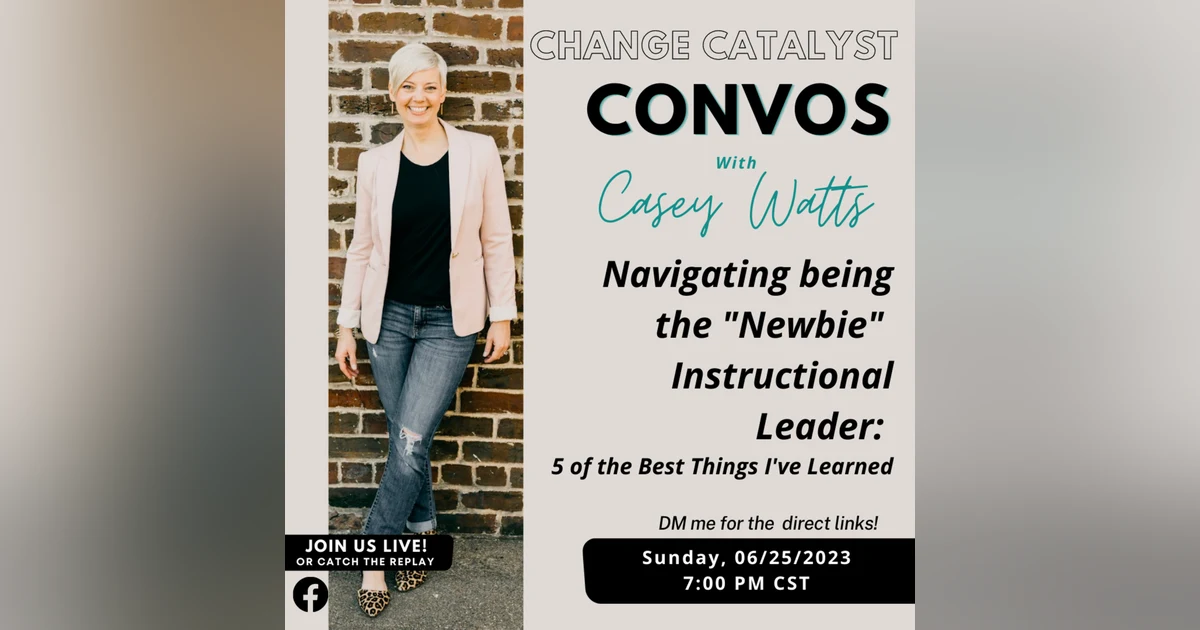
Being the "newbie" on the team or the "newbie" to the school as an instructional leader can be exciting, daunting, invigorating, terrifying- ALL the things! Because we can be eager and anxious to get started, it can be a little overwhelming to navigate the new terrain and take the right steps. In this live session, I'm sharing the 5 of the most interesting (and powerful) things I've learned about navigating being the "newbie" instructional leader!
Grab the free download here: www.catchingupwithcasey.com
Connect with Casey on Facebook, Instagram, LinkedIn, or YouTube!
Join the Facebook Group, Leading Collaborative Teams and connect with me and others who are eager to build cohesive, vision-driven teams!
Ready to get CLEAR on your vision, goals, and initiatives so teachers and teams can actually make change happen? A Clarity Cycle is exactly what you need and I want to share it with you! Learn more here!
--- Support this podcast: https://podcasters.spotify.com/pod/show/catchingupwithcasey/support0:00 Hey there, and welcome to another change Catalyst conversation where we talk about anything and everything that has to do with building. A cohesive Vision, driven teams that make sustainable change happen. Even when change seems impossible, I'm Casey W impact, coaching consultant and the host of this show. What I know from experience is that making change happen can be overwhelming and downright hard sometimes as an Anil leader, you survey your organization from a bird's-eye view and it can seem as though, you're witnessing an anthill. That's been knocked down and aunts or scattering everywhere.
0:40 No one has a collective. Understanding of why change should happen or what changed to begin first. You notice false starts again and again because a solid action plan hasn't been crafted or you're met with resistance because you don't know how to motivate such complex people. The thing about It's though, is that they have one common goal and that is to collectively. Rebuild one solid anthill, this doesn't always happen for schools. You see, we can say as much as we want that Tier 1 instruction needs to happen or that a curriculum needs to be implemented with Fidelity or that plc's need to be collaborative and support student learning.
1:27 But these broad ambiguous goals. Do nothing to help teachers and staff build capacity and actually make change happen and that leads to schools remaining in a cycle of stagnancy. Experiencing the same problems and ineffectively repeating the same initiatives again. And again, this leads to low, morale burnout, High turnover. And it leaves our students to suffer most. But if instructional leaders can get really clear on an arrow, Instructional focus and script. The critical moves for people, then we can make Collective efficacy. A United colony of Educators if you will possible. My goal is to make cohesive Vision driven school teams a possibility.
2:17 I helped School leaders, zoom out to cast vision and then Zoom back into script. Critical moves that help teams collectively, go farther faster and better even when change seems Possible. One way I do. This is, by coaching leaders through the clarity cycle framework a cycle for building sustainable capacity through intentional Clarity. Processes. Are you ready to feel great about exactly where you and your campus or headed? And are you ready to know exactly how you're going to get there? If so you're going to want to stop right now and head to catching up with kc.com to learn more about the clarity cycle framework and then come back. To catch up on this episode, it'll still be here when you get back.
3:04 Okay? Now that you are primed for thinking about cohesive Vision, driven teams that make change happen. Let's jump into this week. Change Catalyst conversation. Hey everybody, welcome to another change Catalyst conversation. It has been a couple of weeks since I have been on because we have been traveling. So let me tell you a little bit about our travels and while I'm telling, You about that. I would love for you to add who you are where you're from, what it is. That brings you to this live conversation tonight, just pop that into the comments. So a couple of weeks ago, my family and I spent an entire week on the western part of the United States, doing a national parks tour, we did a ton of driving but it was so fantastic.
3:54 We got to see so many gorgeous scenery in our country. And we can't wait to go back and we can't wait to travel to other places to see other national parks. It's kind of a little bit of an addiction. If you've ever traveled to National Parks, then we get home. We're here for a few days and I headed to Atlanta Georgia for this past week to spend time with some phenomenal. Women getting to dig deeper into our vision and Mission as instructional leaders, and it was such a phenomenal and energizing. Ying time, and now I get to be with you here tonight. Sharing about five things that I've learned as a new instructional leader. So, this is really timely, because I know there are so many of you who are either new to instructional coaching or you are new to Administration or you just have a new position and it could be that you're simply just in All leadership as a fresh. Like maybe you've been in instructional leadership for a year, maybe two, but still feel kind of new at it. And that is okay.
5:10 What I'm going to be sharing with you tonight is going to be applicable to you and any other leader, no matter if you are a newbie, or if you've been in it for several years and you're ready for a fresh new start of the school year, but let me back up and tell you that I have had both kinds. Of experiences as a new instructional leader. I've had a really poor experience as a new instructional leader. And I've had really great experiences as a new instructional leader, and in both of those situations, I have constantly learned about what is appropriate to do, ways to function ways to interact with people and ways that I should not interact and function with the people that I'm attempting. To lead.
6:00 And I'm going to tell you about all of it. So I'm really going to lay out some dirty laundry here, because I'll tell you the really poor experience that I had my first time jumping into instructional leadership. A lot of it was my fault I just wasn't ready. So, as we're going through this, if some of this is kind of resonating with you, let me know in the comments if you're wondering, like, how to go about doing. Doing some of the different things that I share about ask the questions in the comments, if we have time to dig into those questions, we absolutely will. If not, I'm going to encourage you to hit me up with a private message and we can have more conversation about these five things that I've learned about being the Newbie, instructional leader because guess what, it can be both exciting and anxiety ridden, right? So you can have Both of those feelings at the same time and your decisions about the things that you implement in the way that you approach leadership is going to make the difference between you having a really great experience or really not so great experience.
7:17 So I want to dig into my really not great experience. This was about probably 10 years ago. It could have been even more than that actually. Because I'm I forget sometimes that I'm into my 20 almost 20th year of teaching, which is mind-boggling to me. So many years ago, I was young. I had been in a school at actually taught as a classroom teacher for four years. Total maybe five years total, it was five years total and I was in a school and I'd been in this school for two years and the principal approached me or the leader at the time, approached me. About moving into the role of academic coordinator for the school.
8:04 Now, let me tell you, it was a small, small school, with a principal and academic coordinator. And those were the two instructional leadership positions on the campus, and, of course, without giving it, much thought at all, I was super flattered and I said, yes, like, of course, I'm going to say, yes. She's coming to me and Brad, Gagging on all of these things that I've done well in the classroom. Yes, as a classroom teacher and she's asking me to step into the role of academic coordinator. So of course, I'm going to jump on it. Here's the problem though. I did not have the leadership skills necessary.
8:47 Yes, I was a great Master classroom teacher and yes I collaborated well with my peers but no, I did not have the leadership skills necessary. To take on that position. And it made it a really, really challenging year. In fact, it made that year the worst year of my educational career. So let me tell you about some things that I did. Wrong number one, I went in without transparency, I went in thinking, I knew there were some things that needed to change and needed to be different within the school but I went about it in.
9:29 Non-transparent way. So I hid some of the things that I was thinking about what was going on in the school. And I thought, I could go in and make changes without it being super known that I was making changes. Does that make sense? Another thing that I struggled with was trying to make changes And have conversations with people without listening. I thought that I was a great listener and I listened, but I listened for the intent of my own purposes. I wanted to go farther and faster. I was kind of riding on this high, but instead of continuing to ride on the high, I started to crash and burn. I approached people in completely the wrong ways. Here I was this New Young, instructional leader, trying to interact with these people who had 20 plus more years of experience than I did in the classroom. And I'm trying to make changes, right? Let's see how that goes over, right? It did not go over well at all.
10:40 My Approach was not right. My Approach was not right, I approached it completely in the wrong ways and I blame myself for that. But I also think to myself, man, we often here's what happens, especially with instructional coaches and this can happen with administrators to, in the classroom. You are a master teacher. You were a runner, you were someone who knows what she's doing. You have a great Rhythm and you are pegged as someone who could be a great instructional leader because of how you function within the classroom and maybe even how you A function with your peers so they snatch you up and yes, it is flattering. It is awesome to have that privilege and more than likely you're going to say yes.
11:31 And this could have happened to some of you. The problem is many times when your peg as that Master teacher, we equate that with being a great instructional leader, and they're not the same. You have to have a certain set of leadership skills and often times, we're not taught those leadership skills. We're not primed to learn those instructional leadership skills. And when we get into our instructional leadership positions were often left to the Wolves. Right? So we are sent off, we go to do our job but it's hard and I want to help you to not fall into that as a, new instructional leader, this coming year. So today, I'm going to tell you five of the best things that I've learned about being a new.
12:21 Sectional leader and at the end of our time together, I'm going to send you to my website. You're going to see something that pops up where you can download this, a graphic that has all five of these things. You can latch onto it and post it, wherever you are as an instructional leader, maybe in your office, and maybe you're going to carry it in your backpack, have it on as a screensaver and you can remember these five things that I'm going to share tonight, okay? So give me a thumbs up if you feel like Are ready to jump into the five. Best things that I've learned as an instructional leader. Give me a thumbs up if you were ready for that. And I have to tell you, I'm going to refer to several books. As I am sharing these things.
13:10 I'm also going to let you know that there is no way I can dig as deep as I would like to into each of these five things. I truly could have. A full live session for every one of these five things. So this is just going to be a snippet, right? So we're going to go in till about, I don't know, maybe for the next, 20, 25, 30 minutes. I'm going to share a little snippet of the five, best things that I've learned. Okay? So here we go, you ready, I'm going to go ahead and tell you all five things up front and then we're going to dig into them. So if you have pen and paper, you might want to get it ready or just take a mental note, remember that? Going to have a Graphic for you to download at the end of this, but here we go.
13:56 Number one, clarify your role, this is the number one. Best thing that I've learned about being a new instructional leader. Whether you are a principal and assistant principal a director, an instructional coach, clarify your role. We're going to come back to it. A little bit number to listen to understand number three values, You experience value your own experience, but you're going to Value the experience of others number for respect. Traditions. I'm really excited about talking about this one. And then number five, which was one of the most important things that I learned speak cautiously.
14:42 Okay, here we go. We're going to dig into the first. The number one thing that I have learned as an instructional leader that has To me tremendously and even I have been in this kind of work for six, seven years now and I'm telling you, I do this to this day even when I've been in the same position for several years and that is clarify Your Role. Because here's the thing just because you have a title does not mean that everyone understands or can even act Accurately assume what it is that you do. What it is that you don't do how it is, you can support them or how you can function in a professional relationship with them.
15:35 So, again, like I said earlier, it doesn't matter what your title is, if you are an administrator, you are going to want to, clarify Your Role principals, new principals, go in and clarify, not only Your immediate leadership team, but for your entire staff clarify, what it is that you do, and what it is that you do not do. And guess what, sometimes when you're beginning to clarify Your Role, you might notice that you're not quite sure what it is you do, or you don't do or you might find that you're not sure what the expectations are for your role. So it's going to be a great chance for you to clear that that clarify that for yourself.
16:23 And for the people that you work with, I want to read something from Andy Stanley's making Vision stick book, and this book is all about making Vision stick. But really, when you clarify Your Role, your casting a vision for your role. And here's what he says about Vision, he says to repeat the vision regularly. I'm just going to read a little bit of this cast of convincing vision. Casting a convincing Vision, once is not enough to make it stick so I'm going to rephrase that clarifying Your Role once is not going to make it stick twice isn't enough. Either clarifying Your Role needs to be repeated regularly, to make it stick.
17:10 You need to find ways to clarify Your Role into the rhythm of your organization. This is not difficult to do, but it is one of those. Those things that won't happen without a leader intentionally taking action. So once you've clarified, your rule, you are going to do it again. And again and again not only verbally but also in the actions that you that you exhibit throughout the school year. So your actions need to match. What you've said Your Role is there for instructional coaches. If you've said, Ed. You are not an evaluator, then your actions need to represent that.
17:58 Okay? And more on this later because remember, the fifth thing that I've learned is to speak cautiously and this is part of it. We want to clarify our role in a way that we are able to exhibit through actions after we verbally. Clarified it, okay. So, tell me a little bit in the comments. How you Do you think you might clarify Your Role? Who are you going to clarify it to yourself first? Of course, who else can you clarify it to? How are you going to share about that with others? And how are you going to exhibit it through actions throughout the rest of the school year repetitively again? And again that is a continuous thing. All right, here we go.
18:47 We're going to move on to the second thing that I have learned about instructional leadership and being the new be instructional leader. And that is to listen, to understand. Here's the thing, we all know that listening is important. Most of us feel like we listen. Well, however, if we really pay attention to others as they are, Earning we're really pay attention to ourselves. We might notice that we don't necessarily listen to understand and listening to understand is a little bit different than just listening. Sometimes I find myself listening to someone for a couple of different reasons.
19:40 Either first, I'm listening to them because they're talking to me and I feel like I need to show that I'm listening, but I'm kind of tuning them out. Right? Look, let's be honest here. That's sometimes. What is happening with me? I'm not intentional about it. Another thing that sometimes happens is that we're listening preparing to interrupt, we're listening for the sake of thinking, about how we want to interject our own thoughts ideas or opinions. So I want to go to the work of Jim night here in a little bit from the book better conversations but I do want to clarify that listen and understand is actively and empathetic really listening for their perspectives, their feelings, their intentions.
20:27 So you as the listener, can grasp the full message of the speaker, the message is going to go beyond the words that are being spoken. So this takes a lot of intentionality. Let me tell you a little bit about what Jim Knight says and this is from the book better conversations. It's subtitled coaching ourselves and each other to be more credible, caring and connected. So here is what he says about. How you can listen to understand. His first strategy is to commit to really listen.
21:08 So when you're going into conversations, as a new instructional leader, with the teachers or staff on your campus, commit to listen, put your phone away. Think about your body language. About what it is. You were going to be listening for in that conversation strategy to be the listener. Not the speaker. How hard is that? That's hard for me sometimes because I want them to know that I'm listening. I want them to know that we have a connection and so I find myself ready to interject. But if you were going to be the instructional leader, that others are able and willing, To follow. You are going to need to listen and not speak. Okay?
21:57 A firm? Yes. Paraphrase. Yes. But listen. And stead of continuously speaking strategy, number three he says is to pause. And think before you respond man, are you the kind of person because I can be this person. Are you the kind of person who immediately responds without giving a little bit of think time? Awkward to have that pause in between because it's just this weird silence, right? Nobody likes that. So, we have a tendency to want to just jump in immediately after someone has shared with their thinking. But giving yourself time to pause and think before he respond does two things, it helps you to really collect your thoughts and think about what needs to be said and how you can say it, Number two.
22:51 It shows the person that you're listening to that you value and care what they have shared with you. Okay. And then his strategy number four is and I've already said it don't interrupt don't interrupt when my husband and I went on one of our first dates, it was the funniest thing because he interrupts all the time, he gets so excited about conversation that he finds himself interrupting. A whole date. All I was thinking was this guy cares. Nothing about me because he's not even listening to what I have to say. Well of course, come to find out. He was like no that's not at all. I just was so excited about our conversation and I wanted to connect with you.
23:37 So I find myself interrupting. So if you can be mindful of those things, you're going to show the people that you're working with, as an instructional leader that you value them, you value what they have to say. Say, and you want to hear fully what they have to say, not only with their words, but with their actions and emotions that leads me to the third thing that I have learned about being a new instructional leader, and that is to Value experience. This is something that I struggled with and I probably still do struggle with it. We have a tendency especially as new, instructional leaders to want people to do their very best especially for working in schools.
24:32 We want them to do their best for the students. If you were coming out of the classroom or you were moving up the ladder into other instructional leadership positions, it is likely that you have a strong instructional Foundation or you have a Wrong knowledge base about something regarding education and school and you are eager to share it with others. And you're eager for other people to know what it is that, you know, when we do that, though, when we go in and we share share, share. And when we go in and we give people ideas about different ways, they can do things, we are devaluing their experience.
25:19 There are a couple of different ways we could think. About that. We could think about that as coming across as the person who needs people to know that we know right? And that comes across as prideful and it shuts down any kind of strong, meaningful collaboration with your peers and it also could be that we are shutting down opportunities to get to know the genius of others. When someone feels like their experience is deeply valued though, they tend to be more engaged, more satisfied with their roles and their work.
26:02 And if you can tap into their Geniuses, if you can value their experience at hand, then you are building capacity. And in the end that's really what we want to do is instructional leaders. We want to build capacity. We want our teachers to stay. We want them to be at their very best for students. So here's what I'm going to encourage you to do as a new instructional leader. Number one, you need to be mindful that your experience is important. It should be valued, but your experience and your knowledge is the last thing that you need to capitalize on as an instructional leader.
26:49 It means less than your ability to tap into others experience and Geniuses, okay? So that's what you're doing. As an instructional leader, you are pulling out and calling the genius in others. So as you are surveying, your I want to say your team's your people, the people that work with or for you, as you're surveying them, as You are listening to them, intently listening to understand you and the back of your mind are thinking about what they contribute to the team, what they contribute to their classrooms, what they contribute to the entire community, and you want to find ways to tap into that value, not only their genius and what they bring to the table, but also their years of experience and their knowledge base, you want to view them? As the expert.
27:51 Okay? So, let's talk about valuing things. And what I want to bring you to next is the fourth thing that I've learned as a new instructional leader. And this one is twofold and I want to I want to dig into it because it's kind of it was a revelation for me and I think it can make a huge difference and that is to respect Traditions. So Traditions. Play a significant role in fostering a sense of belonging for people, it can help them with their identity within the community. And I want to say that it's important to respect a couple of different Traditions.
28:39 It's important to respect the cultural Traditions, but it's also important to respect the instructional or academic Traditions that have been established. In schools. And I want to tell you a little bit about a situation that I experienced with some teachers a couple of years ago. And this is what really made me reflect on on this idea of respecting Traditions, especially instructional, or academic traditions. I came to them, we've been talking about some things that students were struggling with, and I came to a team meeting with a suggestion with something that I thought they could try.
29:24 That could benefit student learning. I was really excited about it. It was something that I had tried in the past. This is similar to valuing experience, but I didn't think about Traditions that they had put in place instructionally that they thought were important and that they thought were valuable in their classrooms instead. I was coming in with a new suggestion, a new strategy, something that wasn't part of their tradition and saying it should be. So, in order for students to maximize their learning, what I wasn't thinking about is that these teachers had latched onto and practiced a certain method, For years and years.
30:15 So that they said and I'm sure you've heard this before, this is the way we've always done it and I also have heard the phrase if it ain't broke, don't fix it. That is their way of saying we have done this and perfected it for years and you're coming in and asking us to change what we've believed Works, you're asking us to change. A little bit of what our identity is, as instructional leaders in the classroom. And I didn't think about it in that way, but it's part of their tradition and people value Traditions, they find their identity in Traditions. There have been other Traditions that I've thought before, I don't even understand why this tradition is still happening. And I'm going to tell you, one of them is like, Johnny Appleseed day, I don't understand like Where I get the idea of it, I get the love for it. But I think to myself, where what are all of these activities having to do with the standards that you're teaching, where is the depth of complexity in student learning, but it was a tradition and it was something that they had done for years and years.
31:37 So, in my mind, I'm thinking take it away, it doesn't need to happen, but instead, Said what I really needed to do was think about the tradition, respect the tradition and consider how I could listen to understand value, their experience, respect for tradition and then decide as a team and collaboratively how we might migrate into better practices, okay? So it's important to respect Traditions, people find their identity and And they find their sense of belonging in Traditions and it's true for all of us. So let me go on to the fifth and final thing that is important to learn as a new instructional leader, and that is to speak cautiously.
32:32 And I know it probably goes without saying, but when we speak without caution as a leader, we risk Ask people seeing us in a different light than what we intended for them to see us in. And I can, I'm assuming maybe you can identify with this, maybe not, but I know when I was a first-time instructional leader, I really was eager for two things. I was eager for change to be made and I was eager for people to like me and because of those two things, sometimes I would speak out of turn. I would Say things that I wanted to happen, or I would say things that I thought people wanted to hear, instead of, and I mentioned this earlier being transparent.
33:24 And instead of just listening to understand when you speak out of turn, or you say things in a way that you didn't intend to say it changes the way people view you, even if If you are a person who was in the classroom, in on one campus, and in that, on that campus, you've transitioned into a leadership position. And people know you, you have to think about how you're going to speak cautiously your words matter as a leader, people latch onto the things you say, they latch onto how you say them.
34:10 And I want to say in the words of Michael bungay Senior. It is important for you to and I have this book with me somewhere, guys, from the coaching habit, say less ask more and change the way you lead forever. So let's recap all of the things that I have learned as an instructional leader, over the years, especially being a new instructional leader. But remember these five things can work for any leader. At any time. Number one, clarify Your Role continuously listen to understand with empathy and actively value, the experience of others value, their instructional experience value.
35:01 Also, their native Geniuses respect Traditions, respect the cultural did it, Traditions respect the academic and institutional Actual traditions, and finally speak cautiously in other words think before you speak, okay? I hope you have gained a little bit of comfort in these five things that I have learned as an instructional leader. Again, you can go to catching up with kc.com, you'll see something pop up immediately asking you to subscribe, so you can download this graphic. I'm going to show you this graphic right now. It Has all five of these things listed there and I want to tell you one more thing.
35:47 If you are, someone who is going to be a new instructional leader, or you've been a new instructional leader for a year, you're moving, maybe into your second or third year and you feel like you need a partner to go through instructional leadership with you. I am more than happy to be your partner and be your leadership coach. You can find more about Leadership coaching with me on my website. So, after you download this graphic, go and find out about how to partner with me as an instructional leadership, coach, and we can together make your year. One that is successful as a new instructional leader. Instead of one where you're learning from, lots and lots of different mistakes.
36:37 You're still going to learn from mistakes. We all make them, right? None of us are a master. /, but you can be a step ahead. Okay, I have enjoyed my time with and guys, until next time, I hope you have a wonderful week. Next week, we're going to be coming back. I'm going to be telling you about the ten 55 protocol for root cause analysis. I'm super excited about that conversation. So meet me here again, next Sunday, 7:00 p.m. I'll see you guys later. Hey guys, I want to give a huge shout-out to you for tuning in to today's change Catalyst conversation, I would love for you to do me to solid favors.
37:24 Number one, if you enjoyed this or any other change, Catalyst conversation, do me a favor and hit, subscribe. I've got a lot of great content and guess coming up, and I don't want you to miss any of it. Number two, if you are thinking of a friend or colleague, who could benefit from this show, share it with them. The only way to make change happen is through a multiplier effect and you can be a multiplier by sharing this show. Until next time, I want you to go off and do the great things that change catalysts do.

