Scripting Critical Moves with Vision-Casting Tools


 RSS Feed
According to C. Heath & D. Heath (2010), one surprising truth about change is that what looks like resistance is often a lack of clarity. In their book, Switch: How to Change Things When Change is Hard, these authors explain the importance of providing "crystal-clear direction". They aren't the only experts to make this claim. THOUSANDS of leadership gurus make this claim about vision and clarity. In this live session, I want to provide a couple of ways instructional leaders can vision cast and script critical moves in order to bridge the gap between chaos and collective efficacy!
Connect with Me on Facebook, Instagram, LinkedIn, or YouTube!
Join the Facebook Group, Leading Collaborative Teams and connect with me and others who are eager to build cohesive, vision-driven teams!
Level UP your leadership game with resources, tools, and strategies located on my website!
--- Support this podcast: https://podcasters.spotify.com/pod/show/catchingupwithcasey/support0:00 Another collaboration conversation where we talk about anything and everything that has to do with building, cohesive Vision, driven teams, because this is where you Unleashed your impact. I am KC W impact coach and consultant and of course, the host of this show. Now Today's show is going to get started in just a few moments, but I want to take a quick pause real quick for you to introduce yourself in the comments. Let us know who you are. You are where you're from. And what it is that brought you to the show. And then I also want to get really real with you and ask you a question. Okay, so here goes, have you ever made assumptions?
0:45 I'm guessing the answer is yes, because everyone has made assumptions, right? Have your assumptions ever led to either negative consequences or stagnancy? I'm betting that your assumptions more than likely have led to those things, because that is true for me. I have been guilty of making the assumption that, when two or more people are gathered together collaboration is naturally happening, or I've made the assumption that when teams get along, they are generally productive and effective. And I've also made the assumption that because we're working together.
1:28 Clearly we are All know the direction that we're moving and that is just not true. Those assumptions have lead to ineffective teams that are going nowhere, fast. And I know that we want something different than that. We want teams, who can survive can Thrive instead of survive. We want teams who are less dysfunctional and are more of the kind of team that they deserve to be a part of of these are the kinds of teams that can Propel your organization and benefit, not just the people who are on the team but can benefit the organization as a whole. Okay.
2:13 And I want to tell you about something that can help them to get to this point where we're letting go of those assumptions and we're utilizing people. Well, so we can work efficiently, productively in toward a vision. I want to tell you about how Can build that cohesive Vision, driven team. Let me read to you first a quote from Christine Caine. It's one of my favorite quotes to build a strong team. You must see someone else's strength as a complement to your own weakness and not a threat to your position or authority, okay? But I want to dig a little bit deeper. Sometimes we have this surface level knowledge of what our strengths and weaknesses are. But how Great.
2:59 Would it be if you could dig down to a deeper level and truly understand, everyone's Geniuses their god-given talent, the kind of work, that brings them fulfillment and because it brings them fulfillment. They are building capacity and you know what that built capacity helps your team to thrive How wonderful would it be if your team members knew each of their types of geniuses new? They're working competencies and new. They're working frustrations.
3:40 I am going to be providing all of that information in an upcoming Marco Polo. Share Cast. We're going to be diving into the six types of working genius developed by Patrick Lencioni. And we're going to be thinking about how you can recognize provoke and cultivate those Geniuses and support teams. So that they are cohesive and All Vision driven so that you can Propel your Organization, forward faster and better. I want to share all of this with you. If you want to learn more, you can go to bit.ly slash better. You better team.
4:23 This will end February 28th. So registration closes February 28th. Be sure you get in before then if you want to learn more, just put in the comments, learn more and I will hit you up with more information, okay. I'm excited to begin today's. Content. So if you are ready, drop a hashtag ready. And let's get started. Hey hey hey everybody. How is it going? I see we have some people live with us right now. I'm super excited. I want to know, first of all, I want to make sure that you can hear me. Hey, Amy, I'm so glad that you're here. I miss you and I hope all is.
5:05 Well, I want to know if you can hear me. So just give me a thumbs up or like, say yes, we can hear you and the comments. And I also want you to know that in this and in past lives and probably in future. Lives. You're going to hear me? Say I'm super excited. I mean it's just a habit. Like every time I get on here, I'm I say, I'm super excited to be here or I'm super excited you're here or I'm super excited about the content. So super excited is what comes out every time. It's kind of like when I have this habit of saying, good morning, I don't know what it is, but even in the evening time I will say good morning to people. It's just Talk about what we're here for in this live session tonight.
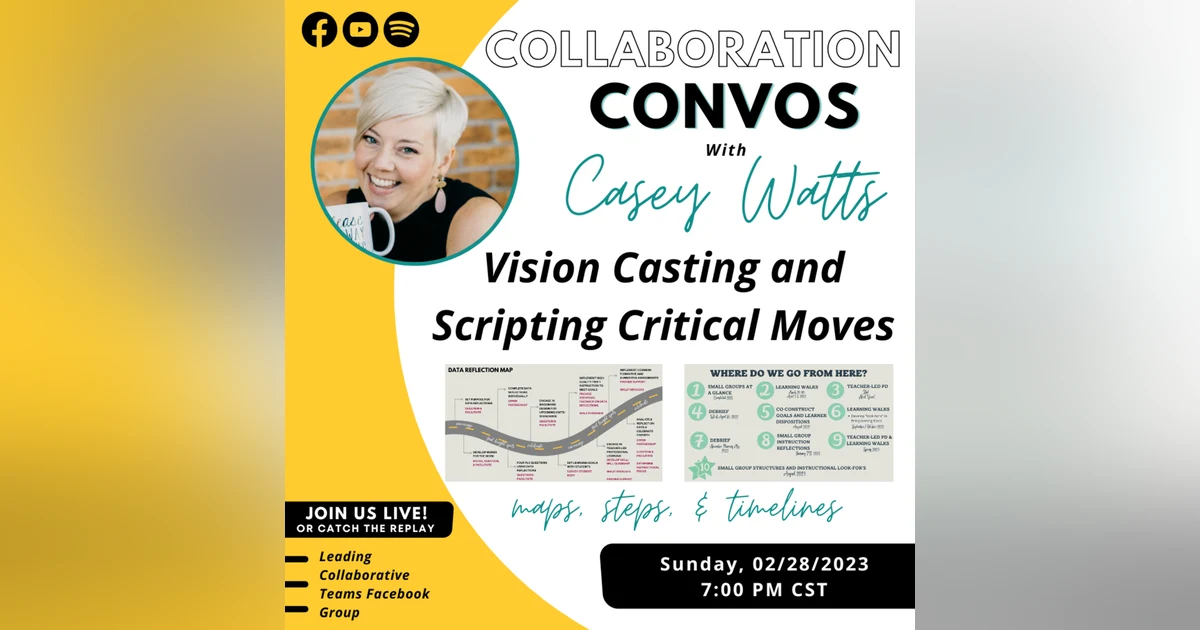
5:50 It is titled Vision casting and scripting critical moves and we're thinking about how to use maps steps and timelines to not only Vision cast, but also to script their critical moves to help us to make change happen. A lot of the groundwork for this work that I'm going to be sharing today comes from. Or is rooted in the work of Chip and Dan Heath from the books. Which that we are reading in the Breakthrough circle with Allison Peterson. And so many other fantastic instructional leaders or instructional coaches. So, if you're interested in that exclusive group, drop a learn more. And I can get you more information because we don't just read books that are this great. We read other books just like this that are phenomenal and truly help us to make change happen. So last week I'm going to share some slides here today and I'm going to try to zoom in to help you see some of them a little more closely and then I will also zoom out just like this for some of them.
6:54 But last week, the live session was all about how to leverage data to help teams move forward. Really? Our goal last week in that session was to craft change stories by capitalizing on data Reflections and making teams part of the success story. I linked that in the comments. If you don't see it, I'll try to link it again at the end. The end of this show, but to think about that, accomplishing that goal. We look through four different things. We talked about gaining perspective and perspective analogies, we thought about how to cast Vision, how to script critical moves and how to find the bright spots. And tonight we are zooming and narrowing into really Vision casting and scripting critical moves before we start tonight. Episode, or before we really dig in, I want to know in the comments.
7:51 Some changes that you feel like take place over the course of this year or maybe there are some changes that are coming toward the end of this year, or maybe you are anticipating changes in the future. So put a type of change that happens in school environment specifically but it really could be any organization. Drop a comment with that change. An example might be Like new curriculum. That's pretty common change that happens or another change could be like different protocols so just type in some different changes and while you're doing that, I want to comment on changes. Some changes are big and some changes are small. Some changes are wanted by staff or teachers and some are not some are By them and some are not requested, some changes are optional.
8:50 And then there are those that are, of course, are mandated no matter, which is true for the change at hand changes. Almost always hard, right? Okay, so oh I've got Michelle really here tonight. Hey, Michelle and she says, oh, this whole science of reading coming down, the pike is absolutely a Big change. Another change schedule changes within the school. Made by upper administrators. Yep. You better believe it and we got Allison Peterson here tonight. Hey Allison. I just brought up our book that we've been reading in the Breakthrough Circle. So if you want to drop a link to how they can get more information about that, go for it. Okay.
9:40 Yes, there are so many changes. We've got new curriculum shift in leaders and teams. New new buildings, merging of campuses new programs, different lesson, plan, format, new standards, new state assessments. There are so many changes that we could list here changes happening, almost all the time. So that's why it's super important for us to be thinking about how do we bition cast and script critical moves when. And if at all possible, But I want to start with focusing on the third surprising truth about change. And this comes from again, the work of Chip and Dan Heath, from the book switch, how to change things, when change is hard, the third surprising truth about change is that what looks like resistance is often a lack of clarity and I want to talk about Clarity tonight because really, that's what Vision casting and scripting.
10:47 Critical moves is all about. It's all about bringing Clarity to the work at hand and it could be a project initiative or a change. And I want to start with clarity through the lens of a leader. And I was listening to a podcast this morning by Patrick Lynch owning oddly enough, they were talking a little bit about change in like changing core values which is a huge deal and one Of the questions that he was asked, was, why are some lasers leaders hesitant to bring Clarity to a change? And here's what he said, he said they're worried, the leader is worried that if they try to bring Clarity to a change or to something new, a new initiative or idea that they're going to lose Talent or they're going to gain unfair criticism, which then Pain.
11:47 And I would also add that there's hesitation for leaders to bring Clarity around a change or an initiative because the leader is actually uncertain themselves about like the what the why or the how of the change. And I would say, specifically the hell, because Vision casting is not something naturally done by everyone, for some people. It is just a natural gift. That is my strong suit. I Specialized in Vision casting for teams so that they can make change happen. Sometimes leaders, just know that a change needs to be made that are not quite the kind of make this knee-jerk reaction to create the change.
12:33 So here's an example of that. If more and more students are being added to tears 2 and 3 instruction, a leader knows, oh my Change needs to be made, but the gut or knee-jerk reaction is to create this Band-Aid fix this, quick fix, and what they do is they begin to purchase and Implement more programs for Tears, two and three. Instead of considering, okay, how do we really ground ourselves in great Tier 1 instruction and vision cast and script critical moves?
13:16 So that's your one instruction is happening. So the strategies and tools that I'm going to be talking about in this session tonight are really not just for leaders to use with teachers and staff, but it could be for the leaders themself or it could be for their leadership team, or it could be for the leaders of an organization and thinking, okay, where is our mindset about what needs to happen and how do we prepare for how to get where we're going? So These strategies and tools can be used and implemented with any change big or small. All right, give me a thumbs up. If you're with me let's dig into Vision casting. So remember I said and I will probably say this a couple of times Vision casting and scripting critical moves. Go hand-in-hand and you Vision cast for yourself the leadership team and your Staff.
14:16 All of the people have to have Vision casted for them, cast cast for them. Casted is not a word, right? Someone check me on that. I'm pretty sure it's cast. We skip this step so often I talk about this in the last session, but it is a crucial step. And I think sometimes we miss this step because we're crunched for time. But if you choose not to have time for this step, think about what you were making time for in the future right where we're coming. Back to stagnancy and the same problems again, and again, and again. And if there is not Clarity around a vision or a goal or Clarity around a change in y, it's happening, then no one can see where they're going, and they can't even see where they or how they belong in the organization or what role they play in moving it forward, but we're going to ask four questions to help us to Vision cast. And those four questions are.
15:18 Where have we been? Where are we now? Where are we going? And how do we get there? One more time. Where have we been? Where are we now? Where are we going? And how do we get there? So many times you are going to hear people starting with where we going. And how do we get there? But we miss the first two questions, but it's so important to take a look at the past, the present, in order to help us determine what our future will be. I do want to clarify that some changes naturally, elicit these questions and some changes do not sow. For example, turnover in your organization is inevitable and that can be a sudden change and it really wouldn't necessarily elicit these questions naturally, but most changes and initiatives can use these questions to help Vision Quest, Vision cast, okay, and they are what so great about these Vision.
16:29 Casting questions is that they are cyclical in nature. They are asked In you ously throughout any change, any project in the initiative. And they seem like really simple questions, right? But we have to remember and I'm going to ask you to hashtag this. We have to remember that. Emotions are tied to these questions and you can just hash tag emotions are tied, we can hashtag emotions are tied because Emotions are tied to just about anything and everything but emotions are tied to these questions. Everyone, you ask these questions to our a part of the story of the organization, right? And each of their perspectives is different. So half the battle half.
17:25 The battle is inviting everyone to gain perspectives of all of these different stakeholders in the last session that I did last week in the live. I've, I talked about a lot about gaining perspective and inviting people into gain perspectives of stakeholders, and I shared about perspective analogies. Absolutely go to last week session. If you want to hear more about perspective analogies, it's one of my favorite things, okay? So I want to think about or talk about a scenario of change and implementing change for these questions and the the scenario that I'm going to consider it as one that I feel like is pretty common for a lot of people and that is small group reading instruction more specifically, I want you to pretend that a team is about to embark on this change of implementing, a small group reading structure and looking at instructional look, force or getting ready to consider instructional, Look for us during small group reading instruction. Okay, so the first two questions, we are going to dive into our.
18:44 Where have we been? And where are we now remember these are the two questions that I think we just kind of pushed right on by we brush past them, we don't give them a whole lot of credit, we don't really even consider them. Sometimes we jump into the change, we jump into, where are we? Going and how do we get there? But let's really think about how wise it is to take a look at the past and before you or even as you're starting to ask these questions, you have to be sure that you have established a rapport, a relationship. You've had some deep understanding of the organization, you know, the problems of the organization, you know, the potential of the people. People and you know, the desires of the people before you make assumptions about these questions and this is where you're going to want to listen to the varying perspectives because there's where you think the organization has been. And then there is where other people think. The organization has been so consider that you've got your perspective as the instructional leader. The you've got the veterans perspective, you've got the veteran who has been in that one Organization for their entire teaching career.
20:13 You've got the Newbie who has very little experience. You've got the new hire who has been all of these different places and has a wide range of experience. There are so many experiences at hand so many different perspectives and you have to be aware of your assumptions. As you were asking these questions. So this is where like, and I will say to these two questions, I feel like our little more quiet and reflective than the other two questions that we're going to jump into next or they're less visible than the other two questions. This is where you might Implement classroom Snippets listening, tours or feedback meetings.
20:58 So that specifically around the change at hand or the Give so you can get an idea of where people have been and where everyone is now. And I will say at the root of all three of these things that you could Implement is just the need for people to be heard, because they want to feel as though they belong, they want to play a role in the story of change in the organization and they do, right? They should belong. We want them to belong. We want them to play. Roll. So let's talk about these three things, briefly classroom Snippets. I have shared about this with instructional coaches for a long time and the classroom Snippets really could be implemented. Not just by instructional coaches, but any instructional leader because the idea is that you are going into every single classroom, very much like a walkthrough and you are observing for that specific like with that. Pacific lens.
22:04 So if we're looking at small group reading instruction, the only time that I'm going in is during small group reading instruction. I have also titled this like, oh, but I haven't another slide here. I can't remember what else I have titled it. I think small groups at a glance is what I've titled before, but it's truly classroom Snippets. You go in 10-15 minutes, you watch observe. They know that it's coming and you see, We leave one sticky note of positive feedback and that's it. Only positive feedback. If you wanted to implement listening tours. This comes from the work of Sherry Sinclair and listening.
22:47 Tours are very much like classroom Snippets, but your people know that you're coming in and you are just listening to gain understanding and perspective, you're listening to teachers. You're listening to students, you're listening to instruction, but you're also listening to their aches, pains hurts Joy's things that bring them fulfillment and this is very similar to feedback meetings, but feedback meetings would happen with a group of people and you come together and you make this a vulnerable space where people are free to share their thoughts and concerns about the change or their thoughts and concerns about You know like what's happening with that instructional practice.
23:36 So if the goal is to craft instructional non-negotiables or look fors and small group reading instruction, the classroom Snippets and the instructional, look for the sorry, the listening tours, the feedback meetings, they would all be focused on small group reading instruction and they would allow teachers and staff to share their thoughts or dispositions about small group reading and Action specifically. Okay. So is that making sense? Give me give me some sort of feedback letting me know that. Okay? Yeah, I can see where these two questions, where have we been? And where we now would be kind of imperative. Alright.
24:18 So you've ask these two questions and again they're more quiet than they are and in the background than they are visible. But now you're ready to ask the two questions. Where are we going? And how do we get? There and this is where the scripting critical moves comes into play before asking this question though, what you will have done is gathered all of this information and data from the previous, two questions, right? Over a period of time. So for instance, you may have implemented. The classroom Snippets and listening tours during small group instruction and you may have realized that everyone had a different idea of what was expected of them.
25:02 During small group reading instruction and sharing what you learn from the classroom Snippets and from the listening tours. Number one, you are being transparent and vulnerable yourself, but you also are being clear about what's happening in the whole organization. Show sharing that information helps people to come around the new question of where are we going? And this is, as if to say, we all agree. That there is a collective goal that we can work toward okay. Then you can begin to cast vision for a proposed change or maybe it's a mandated change, which is lot lot more challenging to do because it's out of your control and you are going to paint a preferable future and script critical moves using visuals. Such as timelines maps and stuff. Oops.
26:02 So this is where scripting the critical moves really comes into play. We want to make it visible to them. So these two questions are visible. Where are we going? How do we get there? All right. Last week, and let me zoom in for you last week. This is one of the maps that I shared. And in this map this is where I strategically thought about data reflection maps to help people. Move forward to help teams move forward and in this reflection map, or I'm going to say just on this timeline map, but in this map and you'll notice it's titled at a reflection map. They really the school was focused on implementing successful data reflection, so this really could have been called a data reflection cycle.
26:55 You'll notice that there are the black, there's the black Print, and then there's the pinkprint. The Black Print is, what would be visible to teachers this? These are the things that the teachers are doing overtime to get from point A to point B and point B would be like the very end of that. So I'm not sure if you can fully see that. I'm going to zoom in just a little bit more. Okay. So in the beginning, there are setting a purpose for data Reflections. So where are we now? We're setting a purpose. We're developing norms for the work. That's where we are now. Where are we going?
27:35 They are seeing all of the steps that are going to lead them to the end of the cycle where they're going to come back and have a successful reflection on data at the end and celebrate growth. So you'll notice there are things here that they're doing individually and things that they are doing here together. So if you want to hear more about this again, go watch. Last session about leveraging data to Moose move teams forward but this is casting a vision but also scripting the critical moves. All right, let me show you what this graphic could look like.
28:17 If we were thinking about small group reading instruction and remember, we're pretending that for small group reading. Instruction. The change is we want to implement structures like non-negotiables. And instructional look force. All right, you'll notice that this timeline looks a little bit different. This time line is a little more empty. You'll see that there are these pain points along the way. Those pinpoints represent, three of the questions, the dark pink represents. Where, where have we been the blue represents? Where are we now this light pink? Represents where are we going?
29:05 And there is not a pain point for how do we get there? Because all of these little timeline lines that are coming off of the road, I don't know what to call those. But anyway, all of those lines coming off of the road. That's how we're getting there. That those are the critical moves. We're going to make to get to this end goal. I do want to go back to the last slide and you'll notice like see the I end of this timeline of this map where it says, analyze and reflection and reflect on data and celebrate growth. That's what the teachers going to be doing. The principal is offering partnership questioning and facilitating.
29:46 And look at the bottom in that blue print, it says determine instructional Focus. So in this data reflection map, they've gone from point A to point B. Having a successful data reflection And they're getting to the end where the reflecting on data again, the principles committee going to be determining an instructional focus and look at. Now the new map look at where they have been. They have been at a point where they completed data Reflections, okay? So it's almost like the map is starting over again. And now this map represents the campuses new instructional focus and that is small group reading. Suction.
30:33 All right. So this is a little bit different than the other because it has these blank spaces. The idea here is that you were pulling in your people to help build this map or this timeline. So, you know, some things that probably need to be in place. And again, this is where that perspective perspective, analogies is so important. I highly encourage you to listen to the last episode about perspective analogies, but both, Perspectives like instructional leader perspective and classroom teacher perspective is necessary in order for the whole organization to get to that end goal. And if we leave some spaces open, we give teachers and opportunity to take ownership and it and think about well what could we say would need to go on this map or timeline that would help us.
31:32 Collectively be successful, right? So if you will, notice I'm going to zoom out a little bit right down here at the bottom under like, right after the pink, the dark pink, it says listening tours classroom Snippets then at the top principal defined campus instructional gold. That's where we are now, you can say to them, you know what, we know that our school has the core value of a school-wide culture of Didn't see. We're not seeing that in our campus or on our campus right now. And that's evident from the listening tours. One of the things that we learned through our listening tours and feedback conversations was that you all speaking to teachers you all feel as though you're not sure what's happening in other classrooms and you don't know if you are meeting expectations. So we want to be sure that you get to go into classrooms to see a other instructions.
32:33 So we know we're going to put that on our timeline or on our map. We know we need to have common structures for small group instruction in place and we want you to feel confident in that, tell us what you believe, will help us all to get there. And then together with teachers and Leadership staff you can build this timeline together. How much more powerful is it to build it together, then to just put it out there in front of them, we want them to Take ownership. Okay. And I realize guys like I'm looking this way on my computer because I'm looking at my video and I really should be looking here, but it's so awkward. Okay.
33:15 So that's one way that you can script the critical moves and make the vision visible to them. I want to show you another wing and this is through steps and it's very similar to a timeline, but it's just taking them Through how many steps is going to take to get to our goal. What I love about this is that you can add to it over time. So for example, you'll notice this says, what does the journey look like? And our journey, I like calling it a journey because we know that, even when we get to our end goal, whatever that might be, guess what? There is always going to be another goal, right? Like, Never ends our work never ends as Learners. So if we can pull them into the journey, it's going to make it a little less intimidating than saying, we're going to go into this change because we know change is hard. So, in the steps with this kind of timeline, you can show one full year and and show them like a year is a long time. And there are a lot of things that we could do during this time, but I want to tell you five ways that we're going to try to get there together or five times five things we're going to do to try to get there.
34:44 So this could be, this could be an example of a small group, reading, instruction Focus, where you're taking them through five things that we're going to do over the course of the year. So look at the beginning, it says, small groups at a glance so that would be the same thing as Stream Snippets completed fall of 2021 step to learning walks. Maybe that's where they are right now. Learning walks is where we are right now. That's happening March, whatever that says, 29th and 30th and April 5th and 6th of 2022. Teacher-led PD. See what it says underneath that. Where it says, haha next year. Is it okay that we didn't get to it or it didn't happen or it just kind of failed?
35:32 Absolutely. Do we want to take it off the timeline? No, because we want them to see that. While change is going to happen, there is flexibility and we are going to move with the punches, right? So then step four says, debrief step, 5, co-construct goals, and learner dispositions. This goes all the way from Fall of 2021. One to the next fall semester of August of fall 2022. Okay, so I want you to see though, how this can be expanded in another year to come. This also shows how change takes time and can be hard. This is the next year, okay, what does the journey look like? The journey is continuing this year. We're going to continue to script the critical moves by looking at the past and continuing into the future. Where have we been?
36:43 Where are we now? Where are we going? How do we get there? How do we get there as all of these different steps that we're going to go through this? Brings Comfort to people to know what is coming. And to know why it is coming and to know, okay, how are we going to get there realistically? It may not relieve any anxiety in the beginning, but over time, if you can remain consistent in these and scripting, there's critical moves, it will alleviate anxiety and pressure and allow them to become a protagonist in the story of change.
37:27 So, So you'll see in the last slide, we left off at step 5 and this slide we're continuing with step 6 through 10 and when we get to step 10, that's the final goal of setting small group structures and instructional look Force. Okay, tell me so far. What has stood out to you? We're coming to the end of this session and I know I've given a lot to you but I want to know what has really stood out to you. And what do you feel like has been most useful in this session tonight?
38:09 Okay, as we come to the end, I want to tell you a couple of things. This session was all about scripting critical moves. And vision casting knowing that the two go hand-in-hand. So, remember the two questions? Where we've been and where are we now? Those are your kind of behind the scenes question. You're laying the groundwork for making change happen. You're laying the groundwork for being able to ask the next two questions. The next two questions were where we going. How do we get there? Knowing that we have to take a look at the past in order to determine the future and this is where we're going to make those two questions. Visible and we are going to Vision cast with maps, timelines and steps, alright?
38:57 The other thing I want to tell you is next Monday, not next Sunday. Usually, I do my lives on Sunday evenings. Next Sunday. I'm kind of taking a break from live so I can just hang on. My family are going to go to a basketball game and instead on Monday which is March 6th at 6:30 p.m. we are going to You have a zoom session where you can come into the zoom and we'll talk about how to create this Vision, casting tool together, it is completely free, all you have to do is register at bit.ly slash create Vision tool. It's going to take you to a Google form and you are going to let me know if you want to join, if you want to be added to the email.
39:49 List. And what kind of change you're hoping to create this visual visual for, and what you plan to do after you create this Vision, casting tool, okay? I see several people who have jotted some things that I want to respond to. This person said, I can totally see that. We have to know the answer to these questions and the different perspectives, Michelle said, love this graphic makes me think so much about several things going on at your school. Girl, I would love to hear more. You have to shoot me up? No, don't do that, hit me up on, Marco. Polo words, I need to be more intentional with my three year plan.
40:30 I'm almost there, but need to script more carefully, intentional visions and carry through. Okay? I'm going to put in the comments, the link to register for the live Zoom, where we just have a working session together. And until next time, I will catch you guys. Later. Bye. I want to give a big thank you to you guys for tuning in and I would love for you to do me to solid favors. Number one, if you've enjoyed this or any other shows, please hit subscribe. I've got a lot of great, gas and content coming up. And I don't want you to miss any of it too. If you know, of someone who may be interested in building cohesive Vision, driven teams that collaborate.
41:17 Well, share this show. Go with them. And until next time, I want you to go off and have the great collaborative conversations that help you and the people you work with two completely. Unleash Your impact. See you later. Go with them. And until next time, I want you to go off and have the great collaborative conversations that help you and the people you work with two completely. Unleash Your impact. See you later.

