The 4 Misconceptions that Undermine SEL


 RSS Feed
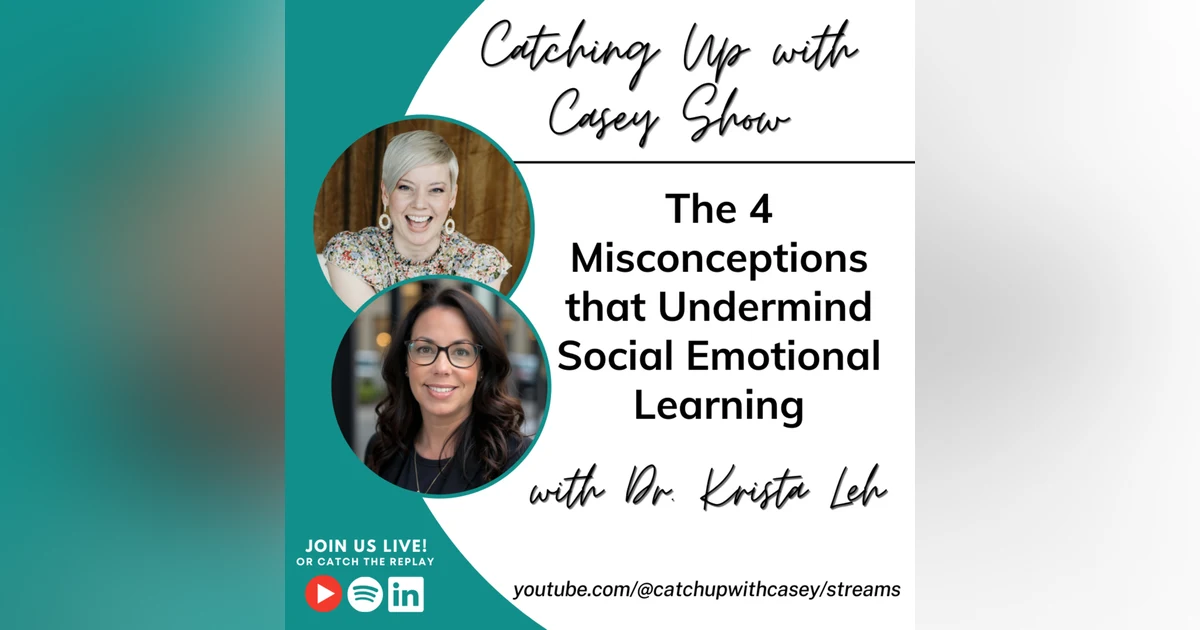
Misconceptions about Social-Emotional Learning (SEL) are preventing its true, transformative power from taking hold in schools. Join Krista Leh, founder of Resonance Education, as she brings clarity to the four most common SEL myths. Discover how an intentional, explicit, and co-created approach to SEL integration can lead to routine value in your school community. Implement strategies for daily SEL integration that are clear, valuable, and sustainable.
Connect with Krista!
Website: www.ResonanceEd.com
LinkedIn: https://www.linkedin.com/in/krista-leh/
Top Links: https://www.resonanceed.com/top-links
–
Your teams are itching for CLARITY! That can be a complex thing to provide. But I have a framework that guides you to do just that– gain and create clarity! www.catchingupwithcasey.com/claritycycleframework
Ready to build the habits of a clarity-driven leader? Get The Craft of Clarity book!
Bring Casey to your next event to speak! www.catchingupwithcasey.com/speaking
Subscribe to my newsletter to get the resources mentioned in podcast episodes! www.catchingupwithcasey.com/newsletter
0:02 Welcome to the Catching Up with Casey show. If you are tired of chasing buy in, frustrated with teams who can't seem to get on the same page, or over the constant struggle of holding people accountable without micromanaging, this is the show for you. I'm Casey Watts, speaker, author, and the creator of the Clarity Cycle Framework. I help leaders just like you take teams from frustration to alignment so teams can work collectively toward a common purpose in a committed way instead of against each other as though they are functioning in different organizations. And we do it all through the craft of clarity. Whether you lead from the middle or you are the front facing leader of your organization.
0:45 On this show, we bring clarity to the seemingly small things in leadership that make the biggest difference because clarity precedes capacity. Now, with all of that said, let's dive into today's episode. Well, hey everybody, welcome to today's episode. I have a special guest with me today, and we are talking about the four misconceptions that undermine social emotional learning.
1:26 Let me say that again because this is a special episode, and I'm really excited about this because we're pushing back on some things. The best kind of conversation is when you push back on things. The four misconceptions that undermine social emotional learning. Krista, welcome to the show. Thank you so much. First of all that was a beautiful intro video. I was like why? She looks so cool. I'd like to know. I'm like, I do know her. I'm so happy to be here. Thank you. Yeah, absolutely. So, OK. Tell us a little bit about who you are and the work that you do. Yeah, sure. I was a former high school social studies teacher, so I taught 10th and 11th grade. I loved it.
2:08 Was planning on retiring like when I was 97 from teaching in that same classroom. But I had an opportunity to become an Ed tech coach, and I thought, you know what? I usually play it safe on things, and this would be a chance for me to step out of my comfort zone. So I did that for three years and then they shifted that to an curriculum coach. And so I did that for another two years, supporting 36 different data teams. And the reason I say that is because I love curriculum and instruction. And so normally you have SEL on one side of the hallway and curriculum and instruction on the other side. And sometimes they don't talk. But my goal is to help secondary teachers be able to integrate social emotional learning skills explicitly into their instructions so that it feels authentic and meaningful.
2:58 Yes, I love it so much. OK, so then let's talk about this. First of all, teaching high school takes a unique person and I cannot imagine myself ever teaching high school #1 because I feel like I look like or did for a while. I recognize guys that I don't. I no longer look like a high schooler. But for a long time I was like there's no way I Oh my gosh, this is reminding me. I when I was in college I decided I needed some extra money so I signed up to be a sub in our local school district and I got a subbing position in high school and I wore a very, very fake ring just to make it look as though like I would. I'm married and I'm older.
3:48 No, I was maybe a year older than these kids. So it was really awkward and and uncomfortable. But I think that probably gave me this idea that, Oh my gosh, they're too scary. What is it about high schoolers that you love so much? So I was only a couple years older. I was 21. I actually was engaged teaching some 17 and 18 year olds, and I'm the oldest of four. And so I went back to teach at the high school that I graduated from and I had three siblings below me and two of them were twins, had just graduated. So some of the seniors thought they knew me because they were friends with my siblings. So it was really trying to find this line between like we're friendly, but we're not friends.
4:32 And even though it's four years, there's a lot of social development and emotional development in those four years. But I do remember even though I had amazing friends and amazing family and and things going on, I felt very lost for a lot of middle school and high school trying to figure out who I was. What did I like? How did I want to show up in the world? And in Full disclosure, I didn't start out to be a teacher, but that was my quote back up. And then once I got into the school system, I loved it for student or for like the pre service. And so I wanted to really focus on the social, emotional aspects of education and then the history second.
5:12 So how can I help students feel better than I did when I was in high school and middle school? Yeah, so that's like your spark and wanting to move into social emotional learning is your own experience in the past. Yes, yeah, yeah. And how did you? Well, I was just gonna, and you may be about to answer this, but how? How did you see your own experiences playing out with the students that you began to teach? I know that social emotional learning has been around forever, thousands of years, but I don't really remember having anybody explicitly talk to me about it.
5:54 And I would look at some of my students and I would think about the things that they were struggling and dealing with. And I'm like in my 20s and 30s. And while I'm in a different phase of life, I'm still struggling around those same skills. I'm still learning them, just in different ways. And so I'm like, wait a minute. I thought that when I got to be 21 or 25 or had a child, like this was life and it was going to be fine. And like, great. And I'm like, why is this still happening? And so I realized that these are just lifelong skills. And the sooner we become more comfortable navigating them and more proficient in developing them, then the better our lives will be. Yeah. So it's almost like I recognize as a human being who has grown into an adult that it doesn't necessarily quote UN quote get better.
6:43 It changes, but we, we can't change with it unless we have the skills to be able to do that. Well, those skills start in high school. Those are the skills that I was never taught. And so let's, let's teach these skills to our students that we have. So then let's talk about the misconceptions of SEL because what you mentioned earlier is taking SEL and let's integrate it so that it's just seamless within our instruction. What are what do you see people doing instead? The easiest default is to purchase a program. And I understand there are some really very solid programs, especially at the the elementary level. There's really not any at the middle school and the high school level and middle school and high school teachers are a little bit different too, in that they want the autonomy, they want the agency.
7:34 They only see students for maybe 40-5 to an hour and a half minutes every day or every other day. And so they feel this crunch for time pressure of tests and so they're not looking for an add on. And then the other piece of that is that the students don't really want an add on. And we know we don't learn best that way. We're going to learn the skills when we have a chance to actually practice them within a context and not see them as something separate. Yeah, yeah. I. Totally agree with that. I hosted a OR. Well I didn't host. I was the trainer in a 2 day PD session last week and the title of the session was.
8:16 It was a training of the trainer session and it was all about motivating the unmotivated students. Well, most of the people who attended the training were middle and high school levels. And one of the things that they talked about was we, we have this program that we're supposed to be implementing, but honestly, I can't fit it in with all of the other content that I'm teaching. Totally understandable. So talk to us like just brain dump. What could be other misconceptions about SEL and or what is it that you've noticed works best in helping teachers to integrate it with what they're already doing? Like, I'm sure there's like a mindset shift that has to go along with that.
9:03 There absolutely is. And so I'm, I'm glad that you said that piece because even if people are on board and they're like, yes, we need this, what it looks like in practice, it just, it takes a little bit of time. And so I think one of the other misconceptions that people have is, oh, it's about relationships. Why have good relationships with my students? And that's the foundation that you need. But SCL is actually 40 different skills within 5 different competencies. And it's usually when I talk to teachers, it's like, why have this kid and this kid and this kid who are really struggling in this skill? And I'm like, that's actually Tier 2, right? So SCL is tier one. These are natural skills that we all develop and not just like when we need them responsibly, right?
9:50 So it's what can we do to weave this into what we're already doing? And there are many entry points and the first ones are that we need to have a relationship. We have to be modeling our SEL skills with our students. So we have to be proficient. We want to have a good relationship with them and we want to build a good rapport among them so that there's a community of learners happening. But then where I start to shift them, usually people are OK with that. Why have a good relationship? I'm like, OK, and that's the foundation. Now we're going to start looking at where do these 40 skills show up in your instruction, which is how students learn in your classroom and in your curriculum, which is what they're learning in your classroom.
10:33 So what SCL looks like in a family consumer science classroom is going to be different than my social studies, which might be different than the math classroom, and it might even be different from class to class. So when we talk about those programs, not everybody needs empathy for 20 minutes at the same time period and then they're ready to shift to something else. And so our work is what are those two or three skills that you see are a natural fit in what you already do that allows SCL to become an accelerator of learning and you already inherently do. But we're just going to put more explicit focus on it, and we're going to extend it over time so students have opportunities to practice it over time instead of a 20 minute chunk where they hear about it but don't practice. I freaking love this so much.
11:25 OK, let's make it like super real. Can you give us an example of that? Like in action? What could this look like? Yes. Can I give you a couple? Because generally the math classrooms immediately go to growth mindset. And so it would be talking to students about I know we're going to be working on this problem and you may have found them, you know you're getting it, but we're going to start shifting into some that are a little more difficult. It's going to stretch you and you might hit a point where you want to shut down. And so let's talk about what productive struggle is. And some of the resources I've created for teachers are let's look at levels of productive struggle.
12:10 So you know, this is hard, but you're willing to keep going. You're hard. It's hard, but like you can turn and talk to somebody and keep moving forward, or you have a scaffold and then it's hard. And maybe you've tried a couple things and you need the teacher to jump in before you hit that destructive struggle where kids are just staring blankly into space or looking at their page or pretending to do something when they're not. And then the other piece is that you don't just all of a sudden have a growth mindset because somebody told you to. So let's break that down into small skills and introduce it to students and ask them talk to them about how their brain works and why this is a good thing for them and what their brain is actually telling them.
12:52 And then let's maybe ask them, what does this mean for you outside of school or with your family? We need to Co create these skills. So I'm sort of tiptoeing into a third misconception here, but that's these skills don't have. They have a universal, I think, definition, but not an operational. It's not operationalized universally. So what does this look like and sound like in a classroom with 30 of us all working towards this one academic goal? What can we all agree that this is going to look like and sound like for us? And then let's work toward that. In a science classroom, it might be looking at responsible decision making, which often follows lab procedures and the scientific process. Social studies might lead itself to looking at social injustice, or how do systems and organizations influence behavior.
13:47 And so now we're talking about where do we see these skills show up within our content? And then how do we relate it back to students lives? Yeah. Oh my gosh. OK, So it makes me sometimes when I have episodes like this, I'm like, let me go back to the classroom please, because this sounds, it sounds not only feasible, but it also sounds energizing for me as a teacher to have these kinds of conversations to, to think about something beyond the academics that I know is going to last or it's going to stick with them for many years to come is so empowering for me as a teacher, but also for my students.
14:33 So that's so fantastic. OK, so one of the things that we, we talked about in this session, I told you about that I did last week motivating the unmotivated is I think sometimes teachers have a tendency to bring to the table, especially in in situations like like this, in this kind of training, they want to bring to the table the most severe situations, right? And so when we look at OK, where we might do like a 5 Y situation where we're, we're looking at the student, we're thinking about what the, the experiences we're having with them, what we're noticing about them, that seems like a lack of motivation.
15:14 But that's we start to dig a little bit deeper. We noticed that there's definitely an underlying issue and it's not really a lack of motivation. And So what you're talking about even especially with thinking about that productive struggle and getting ahead of it, and then thinking about your whole class and the the differentiated needs of all of the students. There may be some students that there's so much past experience that they've had not being able to experience productive struggle, like they've experienced struggle, but they've not had productive struggle and they've not had an opportunity to understand what's happening in their brain. So can you speak to that a little bit? Just anything that came to mind regarding what I just said. Actually, the piece that jumped out to me was the story of my oldest, who's now 24.
16:09 And he had come down. I remember cooking, and I hate cooking. So I was just like, not in my happiest place. But he was working on a math assignment and it was on a Monday. And he's like, hey, mom, I'm really struggling with this. Can you help me out? And I'm looking at it. And to be honest, I was lost. I'm like, I have no clue what you're doing, dude. And so I'm like, when is this due? And he's like Thursday. I'm like, why don't you just put it away for now and work on it tomorrow? So he came down on Tuesday again and I could see his paper had like holes in it, like he was ripping through it and he was, he was more frustrated. And he's like, can you help me? And I'm like, you have one more day. I'm like, I know, please don't hate me. I'm not trying to not help you, but one, I don't fully understand what you're doing.
16:54 So I'm going to have to look it up or call on a friend. They have a phone, a friend, like the TV show. And then on that Wednesday, all of a sudden I heard him. Whoa, hey, I like screaming at the time. And I'm like, what is happening? He figured it out on his own. And all I kept thinking about is that if I had jumped in on Monday or Tuesday, he would not have owned that experience of figuring it out because I would have. I almost want to say I would have robbed him from that a little bit. Yeah, like, right. It was hard. He didn't, you know, I put it in the context. I'm like, it's not the end of the world. Like we can get a new sheet of paper. I know you're frustrated.
17:35 Take a break, come back to it. And So what I've been hearing from teachers is that students are so used to having somebody answer the question right away that they're not reading directions, they're not trying on their own. They're immediately going to just ask for help because they can Google things and they can use AI and find out answers right away that we're actually doing them a disservice of owning and empowering their own learning through those aha light bulb moments. Yeah, yeah. I think probably one of the things that you've said that I have loved so much in this episode is the explanation of like you, you mentioned it with productive struggle, like the explanation ahead of time, like here's what's about to happen, here's what you might experience.
18:27 What can we do in those situations that takes a very, very small amount of time? And if we can put in that kind of work ahead of time and be proactive with it, imagine how it's going to show up and benefit students in the long run. Exactly. And what I've tried to help teachers see is you don't have to do all of these skills yourself. But I've been doing small team like listening talks for my districts lately. And we've been mapping out what skills show up more naturally for you. And I'm doing an analysis like, are we addressing all of the skills that you think are important?
19:09 Like if there's one around? Well, kids are making bad choices and they're not being accountable. Nobody is talking explicitly about developing personal and collective agency. It's not a blame, it's just an awareness. So maybe we start shifting to that a little bit more and be explicit and it is a micro move. We don't spend 40 minutes talking about SEL in a classroom. It's little 5 minute segments. And then once we front loaded it, that's what I call front loading. Like we Co create this, we might create a anchor chart that's up all the time that we refer back to that has sentence starters and what this looks like and sounds like. And then we follow up with reflection questions at the end. How did you do?
19:53 What do you need to do better? But it's all within the context of that classroom learning. Yeah, yeah. Fantastic. OK. I'm curious now because you've mentioned the work that you do with districts. Can you tell more about that? Like what? Paint us a picture of what that looks like. Sure. It's ever changing. So we started off with looking at an SCL implementation framework. So this is how do we make SCL coherent and sustainable and cohesive over time, K to 12. And then I started working on what does that actually mean within a school building. And so to me, that's the integration piece. And now we're pulling the two pieces together. So I'm working with districts on supporting teachers so that they can see. And I like the use of differentiate. They have differentiated pathways that they can take for how SCL will start being integrated in their classroom because it doesn't have to look the same and we're all at different parts in our own learning journey, but we want to get to the same outcome.
20:54 And then once we have those pieces, those are part of the structural pieces. And so this is another misconception and it goes into what your work is around clarity that often times people want to jump right into, well, we're going to change the structure and add an advisory period and A and a course. But they haven't done the cultural work first, which is do we have a shared vision? Do we have our why? Do we have all of our constituents on board and understanding and giving their input on what this can look and sound like? And then do we all know our roles and responsibilities for what this is going to look like as we start and embark?
21:34 That part has to come first, and that often takes a bit longer than what people are willing to wait on. But if you jump right to the structural piece without that clarity, we're not going to build capacity because we're going to have stops and starts or just complete drops in the alignment that we want and the practice that we want to see happen. Yeah. It makes me think just about really what we're trying to do is humanize the work in schools. We're trying to humanize the learning. And honestly, and we've already mentioned this in this episode so far, but I'm a firm believer that we really should be probably more concerned and focused on what's happening in our brains and our minds and our bodies as a response to learning than the content itself.
22:37 There is a, there's a great, it's a just a quick YouTube short and it's oh gosh, what is the guy's name? It's Neil Neil Tyson degrasse yes yes and he mentions like, you know, everyone questions like why? Why am I in this math class? Why do I have to learn the Pythagorean theorem? But it's not really about learning the Pythagorean theorem. It's about what's happening as you learn that. Like are you learning how to be a problem solver? Are you recognizing what's happening within you as you approach this? We miss that so much, but just imagine what what kind of human beings we would raise and become contributors in our society if that's the part of learning that we were more focused on. Absolutely.
23:35 And this was part of the conversations that I had yesterday with the teachers around. And the hard part is, is that what it's like to be a kid has changed. The world has changed, education has not changed. We still have these high stake tests that are putting this pressure and there's money tied to these tests that are shifting. Even though our focus is this the well-being whole child, our focus is reduced to academics because that's how people are rated and money and and so on. And the part that you said about humanizing, I also want to add to that.
24:16 Yes, for the children and for the educators. So when we look at this implementation framework, the first part is cultural, the second part is structural, the third part is behavioral. And it's do we give the teachers an opportunity to talk and to share about their SEL integration in collaborative conversations, just like we do with every other type of initiative that's coming forward? Do we include the students and the parents and caregivers voices in bi directional communication? Are we monitoring and constantly adjusting to see are we getting the outcomes that we want instead of throwing spaghetti at a wall? And teachers are like running ragged, not knowing if what they're doing is actually working or going to change or they're not going to have time to be able to do it.
25:06 And one other story that I thought about yesterday was with our students not knowing, being problem solvers. So my middle son, who is now 21, when he was in middle school, I had made a pot of chili. I forgotten this story until yesterday. And he went to to get himself a bowl. And he opens up the drawer with the silverware, and he's like, there's no more spoons. And he looked at me and I'm like, OK, He's like, what am I going to do? I'm like, I don't know, what are you going to do? And he's like, yeah. I'm like, oh, my God, you are a kid. What? I I don't. I'm speechless. There are spoons in that.
25:46 We didn't have a dishwasher. You can wash a spoon. You can grab a ladle if you want, or a wooden spoon and eat that. Eat it with a fork. I like this is not. Yeah. What? Somebody rescue me, please. I don't have a spoon. Yes, I'm like. What is happening here? You can't make this stuff up, but this is, yeah. This is. You know, and the, the, yeah, I don't have any words, but I've been there. Yeah, and I think our teachers are there probably more often than we than than you and I probably ever experienced in school or as teachers and also as students. But the lack of the motivation, but also the understanding of I can be a problem solver.
26:34 I can actually take an initiative in this moment instead of waiting on something to happen for me or waiting on someone to recognize that I need help and jump in to support me. What are, are there any other things before we come to a close of today's episode? Are there any other things that are just like really hot about this topic that you feel like we have to talk about? There actually is one that rose to my mind as you were speaking now. And it's another misconception that I understand. And I SEL does involve emotions, right? That's the center. That's the starting point of everything. But that doesn't mean that every teacher needs to talk about emotions or like, how are you doing? What's your trauma like?
27:19 No, please don't do that. That's not healthy for kids. It's not healthy for teachers. And I joke and my ex would laugh about this, but he's like, I don't want to. He was a physical physics teacher. I don't want to do that touchy feely stuff. I'm like, please don't do the touchy feely stuff. Like that's not you. But you know what he was good at the executive functioning, responsible decision making within the science classroom, self management around what this can look like. And so this idea that we don't have to do everything, but what can we do to our strengths and what our students need and, and we can work towards this. It'll take a little bit of time, but it doesn't have to be all of this like we're going to have mindfulness and meditation and talk about how we feel. There are other skills there that we can each contribute to and and support our students in developing. Yeah.
28:11 And, and I think this is a, an approach to SCL that people could actually get on board with, you know, because I, I think we also sometimes experience the, the resistance where teachers are a little bit resistant to any kind of program because it is that one more thing on the plate. But when we do that one more thing, that additional program, we are as you said in the beginning, completely separating this from the academic side of things and the and the curriculum and instruction when it really should never have been separated in the first place. Correct. Yeah, and it these are the skills that actually help us learn at higher levels and deeper levels and build connections with each other. Yes, you guys can't.
28:59 If you're just listening to the podcast, you can't see the head nodding that I have going on. But when I get really eager and excited about something, I do this like whole body head shake. It's like my whole body's moving up and down. So anyway, I look a little bit like a kangaroo. OK, I do still have a question though. OK, if if if a. School is like, or someone's listening to this and they're like, yeah, this sounds great. I would love to start implementing this. They don't know where to start. How do they get clarity around like what is step one? I think step one would be understand that SCL is more than relationships.
29:45 You don't need to know all 40 skills, but I think get comfortable that there are 5 competencies, 2 of them are intrapersonal, 2 are interpersonal and responsible decision making. And then when you look at those skills, I'm going to add a Step 2 would be which do you leverage and want students to know to be able to learn in your classroom. Like if only kids could do this skill, they could learn at high levels in my class and focus more explicitly on that skill and building that skill over time in your content. Yeah, I love that. Do you ever suggest that administrators or teachers send out like a whole school survey to students to kind of gain some insight from them?
30:32 I, it depends what you're going to ask them. I think that if you ask them how they're feeling like the outcomes in the moment, you're going to be all over the place. And that's often what these assessments are trying to look at. And it's a snapshot in time. And I don't know about you, but I'm not fully 100% competent in all of those skills at any one time. But I would probably narrow into a couple skills that you think are really important for your students to be able to know and do and target those first. Narrow it in and ask the students you know if it's around having a sense of belonging or community or resolving conflicts. Ask them specific questions around those pieces and know that you'll have time to build on it.
31:18 But I think that when you look at assessments for and for all 40 skills, it's overwhelming. And then people don't know where to start. Yeah, absolutely. OK, I love that. And I think too, you probably can narrow it down by looking at several sets of data from your campus or school or whatever. But you could look at your behavioral data, you could look at attendance, you could look at even walk through observations if you're at the administrative level. So looking at all of that could help you to identify what would be the couple of core skills that we want to focus on. I can say that right after COVID, almost every teacher that I worked with, no matter what grade level or what state was talking about identifying stress management techniques. Right now I hear self motivation and self-discipline and around a growth mindset and being kind to each other like the empathy, compassion.
32:15 I would like to just bring up one small piece though. When we look motivation, I do think that we have to take an honest look and this might be an unpopular opinion at the work we're asking students to do. Because if it's about compliance, that's not going to motivate. If we're asking, students aren't organized, like plant can't plan and organize. But if we're asking them to do exactly what we wanted them to do, it's not about that skill, it's about compliance. And so how are we having this gradual release of responsibility where they're taking ownership for these and really looking deeply at what our expectations are and giving up some of that control?
32:57 Yeah, yeah. Nope. Love it. Great. No, I'm all about the unpopular opinions because typically when someone shares an unpopular opinion, I'm like, well, that's a popular opinion in my in my. View So anyway, thank you. OK man, such good conversation. So Krista, where can people find you when they after they listened to this episode? Yes. So probably the easiest place would be the website that I put up here. So it's www.resonance Ed RESONANC EE d.com. I've practiced that. I am on LinkedIn, but it's at Christa Dash Lay or you can e-mail me christa@resonanceed.com. OK.
33:43 And you also have a podcast. I do, and you were on it and it's coming out. I think yours is being edited right now, so it should be in the next week. So think about that. We'll be dropping around the same time. It is SEL and Edu. And so it's looking at leaders like yourself, whether you're working with teachers or you're working with students, and how you're integrating social emotional learning in a way that feels meaningful and empowering to people. I love it. Yeah. OK. And all of that will be in the show notes, guys, So be sure to check that out and connect with Doctor Crystal A. And any final words for this episode? What would you hope that people take away from this episode? One of the things I've been hearing lately is that SEL is getting politicized and not being used anymore. And you know what?
34:30 I, it doesn't matter what you call it, human centered skills, values clarification, affective education, it's not going away. You can call it whatever you want, but these are essential skills for a living. And I think one of the most important things is that we, we can't dictate what it looks like and sounds like. We need to have open conversation, but they're here to stay, and if we want students to be healthy, contributing individuals in life, then we need to explicitly focus on them and give them. Opportunities to practice, Yes, yes. And I would love if you are a listener and you are thinking we do this really well in our schools.
35:12 We want to hear about it, reach out to us. So e-mail, Doctor Lay, e-mail me. We would love to hear your fabulous stories. And if this is something that you know, your school needs to make a shift in and you're just not quite sure how to get started, I'm going to encourage you to reach out to Krista because she can be the person that supports you in that. OK guys, this has been a fantastic episode. Krista, thank you for coming on. I appreciate it's been a pleasure. Yeah. All right, guys, We will catch you in next week's episode. Bye everybody. Hey listener, I am so honored that you listen to today's episode and I hope you gained something valuable from it. I'd also be honored if you did ME3 solid favors. First, subscribe to this show.
36:00 I've got a lot of great content coming up and I don't want you to miss any of it. Second, be sure you're following me on social media platforms. You can find me at. Catch up with Casey on LinkedIn or Instagram. And finally, if you were looking to book a dynamic and relatable speaker for your next event conference or. Retreat. I would love to bring a message about how the craft of clarity makes a significant impact on both leadership and life. Until next time, always remember clarity receives. Capacity.

