The Seven Deadly Assumptions: Part 2


 RSS Feed
Bada-da-da-da, I'm loving it! You know the place- McDonalds! Yesterday my son and I were heading to the local Farmer's Market and I had a craving for some Mickey D's breakfast- a sausage, egg, and cheese McMuffin to be exact. The line was crazy long, but it was moving pretty quickly. I had already decided I would get TWO McMuffins because I VERY RARELY eat breakfast and I definitely don't usually go to McDonald's. When asked, "What can we get for you this morning?" I said, "Two sausage McMuffins and a blueberry muffin." Within seconds, it seemed, our order was ready at the second window. I happily grabbed the paper bag, handed it to my son, and we began to drive off. I was hungry, so I asked him (in my very sing-song voice) to "gimme my sausage McMuffin!" But it was interesting... my McMuffin had NO EGGS!
I made a BIG assumption that a sausage McMuffin, it was the same as a "sausage-egg-and cheese" McMuffin... Turns out, it's not. You better believe I turned around and ordered AGAIN.
Assumptions can lead to a lot of negative things in life... and yet, we still make them. My McDonald's assumption was minor, and really didn't affect me too terribly much. But when I make assumptions about teams and individuals, the cost can be paralyzing.
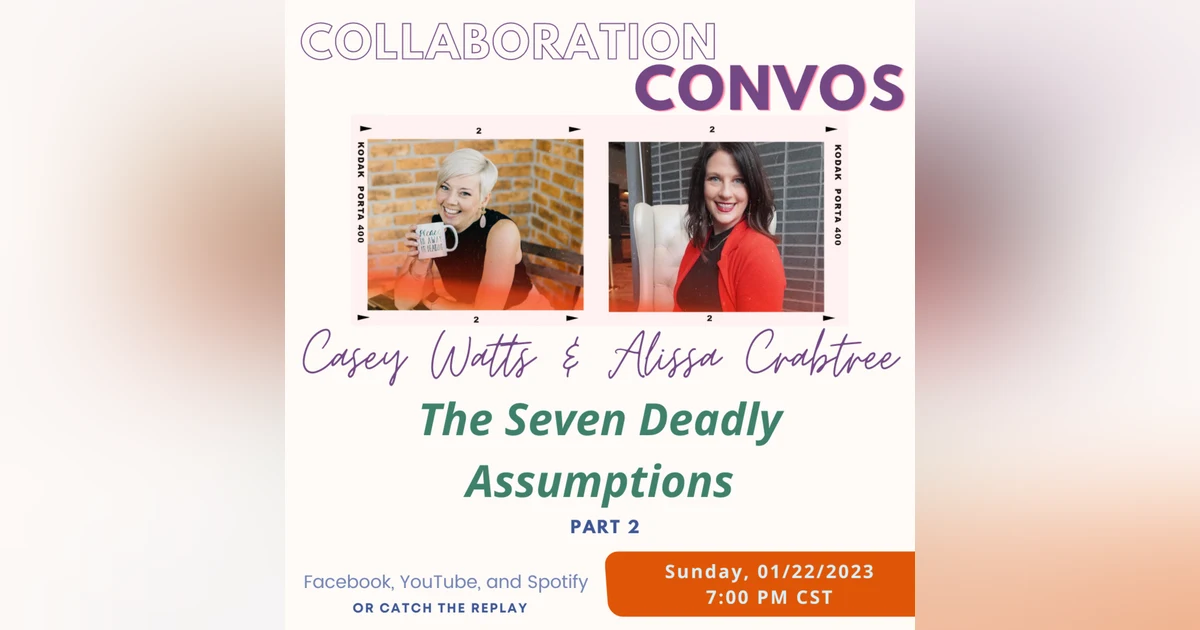
In this "Collaboration Conversation" taking place on YouTube and Facebook Alissa Crabtree and I chat about the next three of the "Seven Deadly Assumptions" and consider what to "look for" to see when these assumptions getting in the way of collaboration. You can join us from ANYWHERE and jump in on the conversation in the comments!
Our hope is that you learn how to raise your awareness of assumptions that get in the way of collaboration, even if you THINK things are going well for teams!
Grab the PDF mentioned in the show! Assumption "Look-Fors"
--- Support this podcast: https://podcasters.spotify.com/pod/show/catchingupwithcasey/support0:01 Hey there and welcome to another collaboration conversation where we talk about anything and everything that has to do with building cohesive Vision, driven team, because this is where the greatest impact Line, This is what makes change happen. I'm Casey W impact coach and consultant. And the host of this show, today's show is going to get started in just a few moments. So as you're getting settled in, leave a comment, letting us. Us know who you are where you're from. And what it is that brought you here. And I also want to take a little bit of time to tell you about something. That is pretty vulnerable and burdens my soul.
0:44 Let me tell you some things that weigh heavy on my heart and if you feel like this resonates with you, would you please leave a comment or an emoji reaction to let me know that I'm not alone. Okay, here goes It burdens my heart and weighs heavy on me to know that schools struggle to build a Common Language around Collective efficacy or common language around their goals or visions or any terms for that matter. It weighs heavy on my heart. When I notice that schools are functioning as individual separated vessels separately or even in competition against one another Instead of working collectively toward a goal together, it weighs heavy on my heart to see Team struggle, because they were never provided intentional time or guidance to determine in what ways, each team member contributes, it weighs heavy on my heart to see when teams struggle to collaborate, because it's just assumed that they will collaborate of their own accord. But we know that true collaboration must be explicitly taught modeled and celebrated okay so here's what else I believe at the center of what it could be called faults efficacy instead of collective efficacy
2:14 is bow collaboration or fake collaboration and at the center of fake collaboration, is this Lack of self and social awareness and I want to invite you to come Join me in a better you better team Share Cast which is completely at your own pace. Learning experience that we will take time to dive into the six types of working genius because this can be the pivotal turning point that makes Collective efficacy and true collaboration possible. I want to take you through that learning. If you want to learn more drop me, learn more in the comments and I will hit you up with With some more information about this Marco Polo share past.
3:01 Okay, so we are about to get started in today's content. If you think you are ready, give me a thumbs up, drop the drop a hashtag ready and let's have a collaboration conversation so we can all go and unleash our impact. Hey everybody. I'm super excited to have you here tonight. It's going to be an awesome show tonight, okay. So here's what we are discussing. We want to join in some conversation with you as fellow leaders about how to let go of assumptions that hold us back from collaborating well or that holds our team's back from collaborating.
3:47 Well if you didn't get to see our first Episode part one of the seven deadly assumptions, you can catch the replay. I'm going to leave that bitly link up here. Right now, you can catch the replay of part 1 by going to this link. You can see it on my website. You can find it on YouTube or you can see it on Facebook for like the next 30 days. So I want to Welcome to our show Alyssa Crabtree and she's going to tell us a little bit about herself and then we're going to dig into this content together and have some Attic fun conversation but we also want to get real with you. Okay, listen, how's it going? It's going fabulous Kacie. I am like like you said, a list of Crabtree from Crabtree coaching collaborative and I am ready to dig into the final final assumptions that are killing collaborative teams because we know who we want to organizations to thrive, we got to get our people working together. Absolutely.
4:45 So we last week, we went through the first four of Seven Deadly assumptions. Today we're going to go through five, six and seven. So again, if you want to catch those first floor because we really just don't have enough time to go through all seven at the same time, go catch that replay. Okay, so tell us a list of a little bit about about yourself and I really want to know, what is the native or working genius that you bring to the table with the people that you work with. Yeah, so I do a lot. Lot of coaching, I am a coach at heart. I've been a coach for a long time, in a coaching in so many different ways. So I have been an instructor.
5:30 I've been in education for 15 years. A coach for 88 years and gosh. No, I would even say longer that I would say at this point, because I could become an instructional coach, after four years of, teaching, after four years became a coach, and I've been a campus coach, a district coach. And now I am coaching on my own and Coaching leadership because I find truth and I find Value in a coaching approach, no matter where I am. And so that makes me a galvanized, ER, I will tell you, I am that person, that's like, okay, it just here. You could do this. This is your goal. You're going to Pivot here and I am cheering people on all the time. I mean, like I'm telling you coaching coaching Is My Jam. I also feel as though I do hold, One of my other, oh my God is invention.
6:25 Oh, yeah, for sure. And so, I am a big thinker. I am thinking of, you know, just Big Ideas how to come up with Solutions. I'm constantly thinking of problems and let's solve it this way, but I would have to say, I'm a coach all the way and I do believe as instructional leaders, as leaders in a corporate world, Wherever You Are. Coaching approach has longevity versus one and done type, I guess management. Yeah, absolutely. Okay. That's awesome. Thanks for sharing that. Okay. So I, you know, before we got on Alyssa, we were talking a little bit about our weekends and things that we did and I said I've had a productive weekend and we would love to hear in the comments like while we're just sharing. What your questions are, what your ideas are, what you want to know more about, or Or if you get an amen, that you want to throw out there just put hashtag. Amen.
7:24 Or hashtag. Yes. We want to see that because we want to see you interacting, but we were talking earlier about our weekends and yesterday, I was really has to do with assumptions because that's what we're talking about. But my son and I sometimes will get up relatively early on Saturday mornings and we will go to the farmers market. It's one of his favorite things to do and so we were heading there and I was like, you know what? Craving, I'm craving a Mickey D's breakfast. Like I just want to go to McDonald's for breakfast and I never do that because I never eat breakfast and I if I do eat breakfast, it's generally not from McDonald's and so we decided we're going to go to McDonald's and I get in the Drive-Thru and, you know, they've got the two lines now, which is great because it goes pretty quickly, but it was a long line.
8:16 But both lines were almost to the road and I was thinking and if I don't get my sausage egg and cheese to make muffin, it's just going to ruin my day because I've had my mind set on this and Hayden already knew what he was going to get a blueberry muffin. So it's going pretty quickly. So I'm feeling pretty confident, and I don't know how many of you are fellow. What's the word for this? I don't know if there's a word, but you have a phobia for like ordering in the Drive-Thru because it's just like I get paralyzed or I get up to the drive-through. Like wait, what was I going to order or am I going to get this order, right? You know, it's just it's like that. So I'm thinking as I drive up, okay, I'm going to say I need a sausage McMuffin.
9:03 That's what I'm going to get and a blueberry or a sock. Yes, sausage McMuffin and a blueberry muffin. So we get up there and I confidently roll down my window and say yes. Can I get almost like in a robot voice? Can I get a sausage McMuffin and a blueberry? Free muffin and she repeats it back to me and I'm like that's what I want. So I pull up to pay that goes really quickly and we get up to the next window and I get the paper sack and I set it down and I'm like, all right, we're ready to go to the farmers market and we pull out and because I am just so excited about this sausage egg and cheese McMuffin. I have my son, pull it out of the bag. Well, he hands it to me.
9:48 And I'm like, this is kind of light and I open it up and it has no eggs on it. And I was like, what? In the world? They forgot to put eggs. So we go back to McDonald's because I'm determined, I'm not going to eat something that I didn't order. So we go back to McDonald's and I have Hayden go in for me with the receipt and I said just give them the receipt and tell them that we asked for a sausage McMuffin. Sausage. And cheese McMuffin. Well a little bit goes by and he comes back to the car and he was like, they gave you a sausage McMuffin, you should have ordered a sausage egg and cheese McMuffin.
10:30 So here's the assumption that I made. I assumed that a sausage McMuffin. Was the same as a sausage egg and cheese McMuffin. It is not, but you better believe. I went back through the drive-thru to get my sausage egg and cheese muffins. And listen, that is a very, very minor assumption. But it affected me, it may be a minor way, but it's still affected me. And the problem is that, we make assumptions that people Paralyze our teams and paralyzed collaboration. So that's what we're going to dig into tonight, right? Alyssa tell me what, whatever need to add to them.
11:11 Well, one thing I just want to say here, I know that we're getting into sumption, five, six and seven, but I'm going to take it back to assumption for where I've stated my expectation and everyone should know it. Even though, I guess the sausage, the egg wasn't an act like you didn't state it. Sometimes we have this assumption. That you're going to read my mind, you know me well enough, you know, Mike Works. We've been together maybe three months by now. You should know what I mean. Absolutely, it's not the case. And so Clarity is kind that poor kid. That handed you there, McMuffin. You know what Casey you're a nice person.
11:52 There are probably some people who would have whipped around and yelled at that poor teenager or an adult or whomever it was Was and made them have a bad day, just because they made an assumption and Grady is kind, we got it, we got to be clear. That's right. Absolutely okay. So give us a hashtag assumption if you are guilty of or, you know, someone else who is guilty of making an assumption that led to a consequence. Just type in hashtag assumption. We want to see it. And if you are bold enough, let us know what that assumption was even if it's a simple. He's like, hey, I asked for this, but I got this instead because I was not clear, okay? So, let's let's jump in because I know people are like chomping at the bit to hear about the next, the last three of the seven, deadly.
12:45 Some options here is assumption. Number five. Are you guys ready? Assumption number five, everyone has a shared understanding of the vision Concepts or goals, okay? Okay, you want to walk us through this Lissa? Where do you see this coming into play? You know, it definitely comes into play at a sense of when we have a goal or when I've seen it happen all the time, it kind of happens with your egg McMuffin whenever we have like this vision and maybe the team lead, maybe the principal comes in and they have even their vision statements on campuses are very problematic in a sense of no one knows what the vision really is. It they might can repeat the sentence but they couldn't even tell you what that means because there's not a shared understanding.
13:40 And being. And so, you know, it really is. What is, what are the success criteria for this Vision? What are their success criteria for the concepts? When we get this right? What will happen next? Yes. Oh, I love that so much. Okay, so we I mean, this is a parent all over the place with vision. Let's talk about Concepts or goals. Like tell, what were you thinking when we think about Concepts, where are they? The concepts that we believe people have a shared understanding about. So right now I am taking a several teams through Collective, efficacy cycles and the primarily there in education.
14:23 And so one in particular is just going down to standards. One thing that we ended up doing is we surveyed this team and it turned out that four out of the seven teachers did not feel comfortable with content. They did not feel comfortable when the team starts talking about standards. What does That mean and that's nothing to be ashamed of, you know, as adults, we get thrown into the arena without any training or any kind of collaborate. This white collaboration is so important. And what has been beautiful is the team has now, because we went through this whole protocol and we dug in together, we get our hands dirty, it has leveled the playing field and ensured that one every student across the This in this particular grade level will receive the same level of understanding.
15:15 What we're talking about Equitable education, here is what we want and then to it has it has strengthened the efficacy of these teachers on the team where I we did a strategies gallery walk or we went in and we'd like we're diving into our own strategies and building our own capacity for it and it was so cool to see like that first. Your teacher or even, you know, maybe it was a six-year teacher who was just like, oh my gosh, we've never had this conversation before their confidence, their whole body language changed and the team had a shared understanding. So now when they come together, whether they're planning or talking instruction, it's removed a level of frustration that has always been there.
16:04 Yeah, I think sometimes we some people are waiting on someone too. Bring Clarity to a vision or even begin that conversation, you know. It's kind of like we get into these groups of people and you just kind of look around and if there is not been, if there's no one who feels comfortable facilitating collaboration or they don't, they haven't had their own Mastery experiences, then the team's going to remain stagnant, someone's waiting on someone else to take the lead with that to say, hey, let's talk about what the vision is or what are Goals, are I want to talk about like that Concepts idea again?
16:44 Because you and I were talking before this even got started that we jumped into things without defining them, and we know how imperative it is to Define before you begin. And we know that people get together and not even a having a common or shared understanding of collaboration, And guys, I'm going to I'm going to tell you I sent Alyssa and message earlier, I mean, right? Before this live started it was kind of like crazy how it happened, but it will spill the tea for a hot second. I'm just, um, I am gonna just spill the tea and you know, this is this is a reality and this is something that, you know, I said in my introduction video, some of these things Burton, my heart, this burdens my soul, so our friend Melissa AA sent me something that she saw on Facebook, where a and administrator.
17:40 I'm assuming it was an administrator coach posted asking. Like, hey, what ideas do you have? I've got a team that's struggling. They're frustrated with each other, and then they just leave the meeting wanting to do their things on their own because they feel like they're better off on their own. Here is a response and I just want to know like if you want to throw an emoji reaction to this, in the comments I would love to see your reaction because I love you may agree with this I'm going to flat out. Tell you that I disagree with it and it hurts my heart. But here's what here's what a response was if this is a team of Veteran teachers and their data indicates, their students are all learning what they are supposed to do.
18:25 Supposed to is collaboration, A Siri. Collaboration is great and can be a wonderful tool to get new ideas. But at the same time, it may not be what is best for all teachers? As long as they are professional and doing what they are supposed to be doing. I see no harm here guys. I just kind of want to throw my phone across the room. Woo, but it goes back to his. Definition of collaboration is very different than our definition because yes, definition of collaboration is just lesson planning. That that is that's what he believes it is. And yep that has been his experience.
19:07 Last week, we talked about how experiences Our a are like they can hurt you have collaborative teams because they don't clarify because of their experiences. If that makes any sense, I kind of ran up, but his definition is based on his experience. His experience, obviously has not been positive, that is not what I would say. The definition of collaboration is from what he has, oh my gosh. Absolutely, I somebody said, can you define your Definition of collaboration. So I'm going to, I'm just going to put a plug here, first and foremost, that this is collaboration is our expertise.
19:53 We both came together because that's our topic of Interest. That's just it's our jam. And I believe that some people have different definitions of collaboration because of their experiences or what research they've dug into. But I also want to tell you, we are going to be coming. NG together sometime the semester. Hopefully and doing a webinar that is focused on supporting people with collaboration. And in that webinar we're going to dig deep with a definition so that people can in turn take that to their teams and ensure that their teams have a solid definition. So I'm going to put it on you, what are you thinking? Alyssa would be a finite, finite snot, the word, a brief definition.
20:42 Working definition of collaboration, I would say a brief definition is when Minds come together to analyze the problem, develop a goal that specifically solves the problem and they're coming together with to work on that specific goal. They understand each other's strengths and they play on those strengths they play. On each plant, each other's weaknesses in a sense of where I'm weak. You're going to Pick up and they use their superpowers together to solve a problem and create a better system. Whatever field you're in to me that is collaboration.
21:25 Yep. Look even if you're talking about a soccer game I got the Dallas Cowboys going on right now. I'm not I'm a Cowboys fan but I'm like you know that team we know the problem we got to collaborate to bring it up to bring up together. So it's really interesting the the work of Patrick Lencioni and hit and the table group, they share a lot about well, because they talk so much about working, genius, and the five dysfunctions of a team, they share a lot about the two different kinds of work. Like you do have teams that are like, working groups. But you also have collaborative groups, they're really two different things because I can have a working group. We're truly, we're coming together to just get stuff done, that's on a list.
22:12 You know, like I need to make these copies, can you do that for me? We need to be sure. We're getting letter sent out to parents that's not a necessarily a collaborative time but that's just a working group a collaborative time. Like Alyssa said is we're coming together to think about the problems issues at hand or we're thinking about what we're wondering and we're taking that Wonder through the process of invention. Permanent galvanizing enablement and tenacity to get to an end goal. I love that idea of having that shared goal. It's truly working toward a vision together. Thank you for that question.
22:53 And you know what, Casey, I would want to ask that. The man that said that man, like it's such a mean thing that man, I would really like to ask him. What is your team's very specific goal? Have you discussed because you cannot tell me as an educator. Gator, you have zero pain points. I know they have pain points and what is their specific goal that they're coming together to get I guess to accomplish to have success with to solve a problem or to like you said this moment of Wonder to make things better. Yeah. Absolutely.
23:34 You can tell how passionate we get because we both will be like it and and this and we just stumble over our words because we're So fired up about it. Okay. I think we're ready for our next assumption. Assumption number six. Here's what it is. Guys, what we've been doing is working and no one wants to change it. Hmm, let's dig into that assumption because I know this is bound to be happening where you are and if it is, would you drop in the comments? Yes. Or it's happening to me, or give me a call. Thumbs up emoji to let us know.
24:14 You have experience with this. What might we notice about people who are making this assumption? I like to call it. The, if it ain't broke, don't fix it type mentality and I'm not going to lie, there are times when I'm like, man, if this is a compliant thing, if it ain't broke, why do we got to fix it? Like I get that who expedite certain tasks that we need to do. However, if In collaboration, they are talking about. Well, it's what we've always been doing. It's working my change it. My questions then then would be, when was the last time you evaluated your system? When was the last time that you went back and thought? Again, I love Adam grants book.
25:06 Think again, and it talks about if you have gone, a whole Year without rethinking, some of your ideas. You're probably stuck in stagnant. And so I would even ask the team's, you know, what is your goal? They probably don't have a goal. They're okay with being just. Okay, yep. And they haven't evaluated their system. Yeah, man. That's so true. And I, the rebuttal that I often get, and I would say that I see this mostly with teachers in classrooms, I think it can happen with administrators and instructional leaders as well.
25:48 And a lot of that comes from a fear, I listen to a podcast from Elena Aguilar. Nominal and she talks about resistance and how resistance is really the equivalent of fear. People are working out of their fear of something and so I truly believe that's where that phrase comes from because we fear like we're thinking we're going to have to change something and change is hard and scary and it's uncomfortable. Well we know that there is growth and discomfort and we are okay with that change. JH, a lot of people are not because it triggers some fear of some things that maybe they won't some needs that won't be met for them.
26:37 But I also hear teachers say when they say, if it ain't broke, don't fix it. They and I rebuttal with well really, we want to evolve with, with our students, and, with our society, They say but my numbers don't lie like I've got great scores. Why would I change what I'm doing? And that's that's a hard one to push back on because sometimes it's true like your scores do on paper look. Decent. My my goal then is to help them to see.
27:18 Students on a on a long-term trajectory so yes, you are. Looking at short-term you've gotten your students from point A to point B in this short amount of time and they have made, maybe this growth according to the numerical data, but as a whole child. And if we think about them from now, into the next 10 years, what will we notice? I would even want to give the students an Efficacy survey confident, are they feeling in their work? Yeah, pal. You know how confident are they and feeling that they can solve problems in this world?
28:00 You know the yes I understand the importance of looking at that data and if you have decent data that is that's awesome. One is it 100% because that's that's the goal but I do you know I like what Sad in the comments. She said they they usually think it's working and it's not. Yep. And it goes back to exactly what you said, it's fear. And even when their scores are good, they're decent. I still think there is a fear to, to change. Yep. And I it is hard work, we totally understand that and oftentimes it can become personal and you oh my God, you know? I'll have to defend this.
28:50 It's just always trying to get to that next level. Let's take them to the next level. Let's make it better. Let's always strive for better. Yes. Okay man. So good. I want to go back to assumption number five was everyone has a shared understanding of the vision concepts are goals. They don't what we have been doing is working and no one wants to change it, and I want to address the last part of that. No one wants to change it. I think we make that assumption but I would absolutely believe there are people who want to change it, but they are overwritten by is overridden. A word, they are overcome by the the more vocally What's the word I'm looking for vocally? Ambitious people.
29:40 Just the vocal people. Usually your veterans? Yes. Just your people who vocalize. Everything's okay. And I just just I'm going to stand up and you're going to you might see my workout pants just so you know I'm I might be dressed nice up top but I'm comfy down bottom. Okay so just kind of thinking about that. There's this great book called wiser getting Beyond. Groupthink to make groups smarter because we follow the group think. And that's where this assumption comes out, like, no one wants to change this, my beg to differ. I bet there's someone that does, okay. Assumption number seven.
30:21 People are equipped with self and social awareness. Hmm, these adults that come into the workforce, they naturally are equipped with self and social awareness. What do you have to say to that assumption? I've, you know, I'm going to take Get back to experience when what I might think of someone who is socially aware, and I maybe I believe someone as socially unaware that person's experience may be completely different. But I'm going to take it back to the conversation that we just had about this gentleman, who responded to the leaders post.
31:02 For me. That gentleman was not socially aware in a A sense of she, she did not elicit opinions about collaboration, she was not asking, what is your definition? She was asking for a solution to the problem and this person felt the need to insert their opinion. A negative opinion about collaboration which in turn just perpetuates the problem especially if one of that leaders teachers is reading the email or reading the posts. So I feel like just because you put a bunch of adults on Media. The doesn't mean that they are socially aware and it goes back to social awareness is difficult to coach and it is, especially if you are not, maybe you're not the team leader, but you understand that some of your teammates are not socially aware but it is okay to have collaborative conversations about agreement and norms. And, you know, because I would even think that Then if you have this assumption that they're all aware. My first question would be what are the teams agreements and are they upholding them?
32:16 What does that look like right? And I would bet that several people would respond with what do you mean by agreement or we don't have, we don't have agreement and I will also say as it's been common for me in my Consulting, I will meet with teams and when we begin I always always always begin with here. Is her objective. Here is our success criteria. What are some Norms? We're going to come around together. Listen, I will be met with crickets because people don't understand what I mean by norms and they immediately go to do you mean rules that will follow?
32:58 And it's the same ones every time that really don't don't support our You know, it's just like some stuff you throw on the wall and we don't give it any credit and we don't really pay it too much attention. Yeah, I would I would even go as far and this is something I want to encourage everyone to do. Adjust your norms, and adjust your team agreements based on your goals. So, as your goals evolve, your goals change, change your Norms, because the way that I show up as someone who wants to problem-solve, maybe a parent issues, like we, maybe we haven't. A couple weeks of a goal solve a in issues I might show up a lot differently than I would if we're coming together to solve Solutions around classroom behaviors.
33:46 Yeah. And so, those are different ways that we can show up. The team has to calibrate those Norms though. So if you say tame your technology as a norm, I need to know what that means. Like, I need you, like, you said, give success criteria. Let's define it. Together because when you don't and this is another symptom that it is sumption has been made people become frustrated with their teammates. Yep. And then people are passively aggressive passive aggressive. I even like Ashlynn Abney. She's referring back to what we were talking about earlier about people being vocal, she said, vocally aggressive.
34:28 You're going to have some team members who are vocally aggressive and that is unfortunate and creates toxic environments. Yeah, guys, in the comments we would love for you to just add another comment and tell us like are you seeing people who are either not self-aware or not socially aware and you can just put hashtag self-awareness or hashtag social awareness. If you see those things lacking in teams at school and I think it's hard for people. It's hard enough for people to be self-aware. If you have not taken the time to dig into What unique things make you who you are. Then you don't know exactly how you contribute to the team. And if you don't know exactly how you contribute to the team, then other people don't know exactly how to tap into your Geniuses or tap into your strengths and I love that you put that on the PDF that we have for people to download. At the end of this episode, you are going to get a link to be sure to, you can download this PDF. EF that has all of the things that you are going to want to look for to see if these assumptions are at play in your team's.
35:46 So that's one of them is team members of not tapped into one another's, genius or strengths, and absolutely true and evidence. Okay man. So I feel like we could just go on and on but let's review those last three assumptions, assumption five, everyone has a shared understanding of the vision Concepts that are goals six. What we've been doing is working and no one wants to change it. Mmm! Nope. And then seven people are equipped with self and social awareness. They're not even though we would like for them to be okay. So we're going to come to a close in our conversation but too close. I would really love to know if you guys will put in the comments of your here live with us and you can what was most useful for you tonight in this conversation? Just type that in the comments.
36:40 And what do you feel like Alyssa? Is one thing you would hope viewers would take away from our conversation? The biggest and man girl can I tell you I have taken this document that we created. And I have the great privilege to coach a principles and instructional coaches. I've used it all week and I've asked them, I've been like, okay, let's talk about some assumptions. We might be making about the team's and the biggest takeaway out of everything is no matter you the Dynamics on your collaborative team because no two teams are the same, no matter the Dynamics.
37:20 The key factor has to be communication. And that is communication Clarity. Clear Clarity of the goal of the team, agreements of the concept, everything needs to be clearly defined even when it comes to your social awareness. What is it that I need from you? You need from me. And what are some pet peeves? Having those conversations? Stations are just so important. And so, my biggest thing that I want everyone to take home tomorrow when you meet with your team on Monday and you have a, whether your partnership group of 20 doesn't matter Clarity and ensure that everyone understands the expectations of everything.
38:12 Yep. Yep. What is your goal? How can you bring Clarity to it? I love it. Okay so we are Going to in there. But you know what, I know that you have a really exciting thing coming up that you can offer, people, can you share a little bit about that? So I have a free it's called the Crabtree coaching leadership lab and it really is just an online experience. We're doing it for three months and when you join it is all about honing in on our leadership capacity. No matter where you are in your leadership Journey, if you're in a Firing leader, a current leader.
38:52 Maybe you are, you could be an office manager. You could be a CEO doesn't matter, but we are just kind of, like, going through different ways to build our own strengths as a leader. So if you're interested in joining, you don't really have to do much. All you have to do is join receive the free resources and make this community. The Crabtree coaching collaborative Community part of your community participate in it. Because community and collaboration is so important. And so, if you are interested in joining, the Crabtree coaching leadership lab, please join free. It's free through now.
39:33 Through March 31st using the bitly and had backed r. /C c LL 23, yes, I love it. Okay guys, thank you so much for joining us. We will catch you. Next time we meet together, it's going to be in a webinar and We are going to be equipping. You even more to combat these deadly assumptions. Thanks for joining us. Alyssa. Thank you. Alright, bye everyone. I want to give a big thank you to you guys for tuning in and I would love for you to do me to solid favors. Number one, if you've enjoyed this or any other shows, please hit subscribe.
40:14 I've got a lot of great gas and content coming up and I don't want you to miss any of it too. To if, you know, someone who may be interested in building cohesive Vision, driven teams that collaborate well share this show with them. And until next time, I want you to go off and have the great collaborative conversations that help you and the people you work with to completely Unleash Your impact. See you later.

