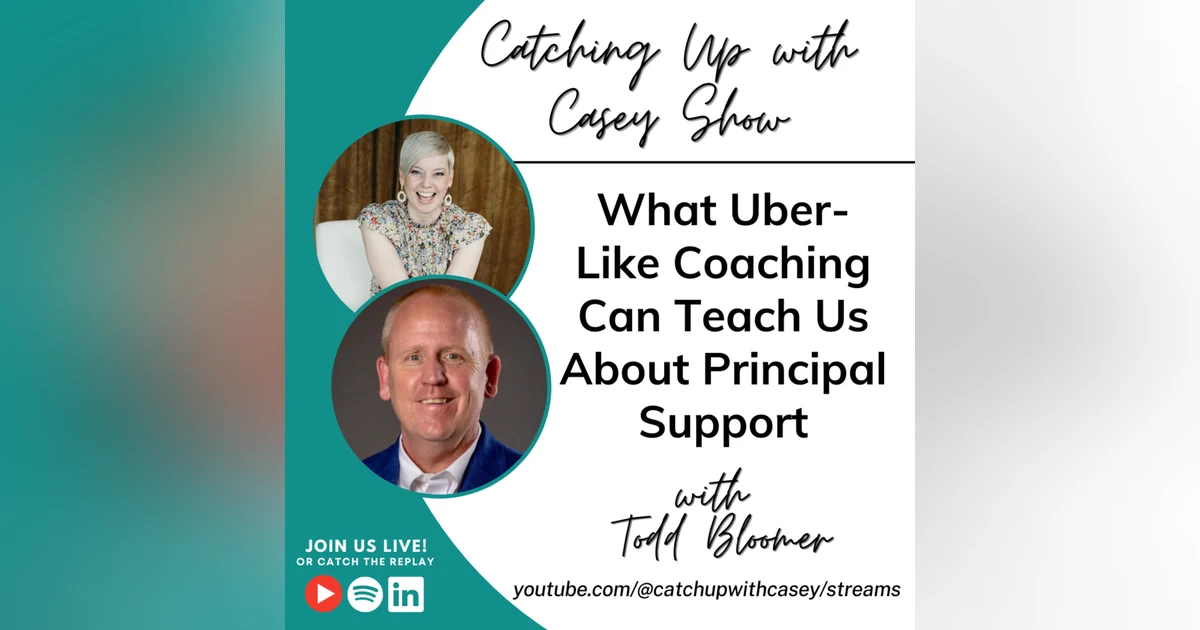
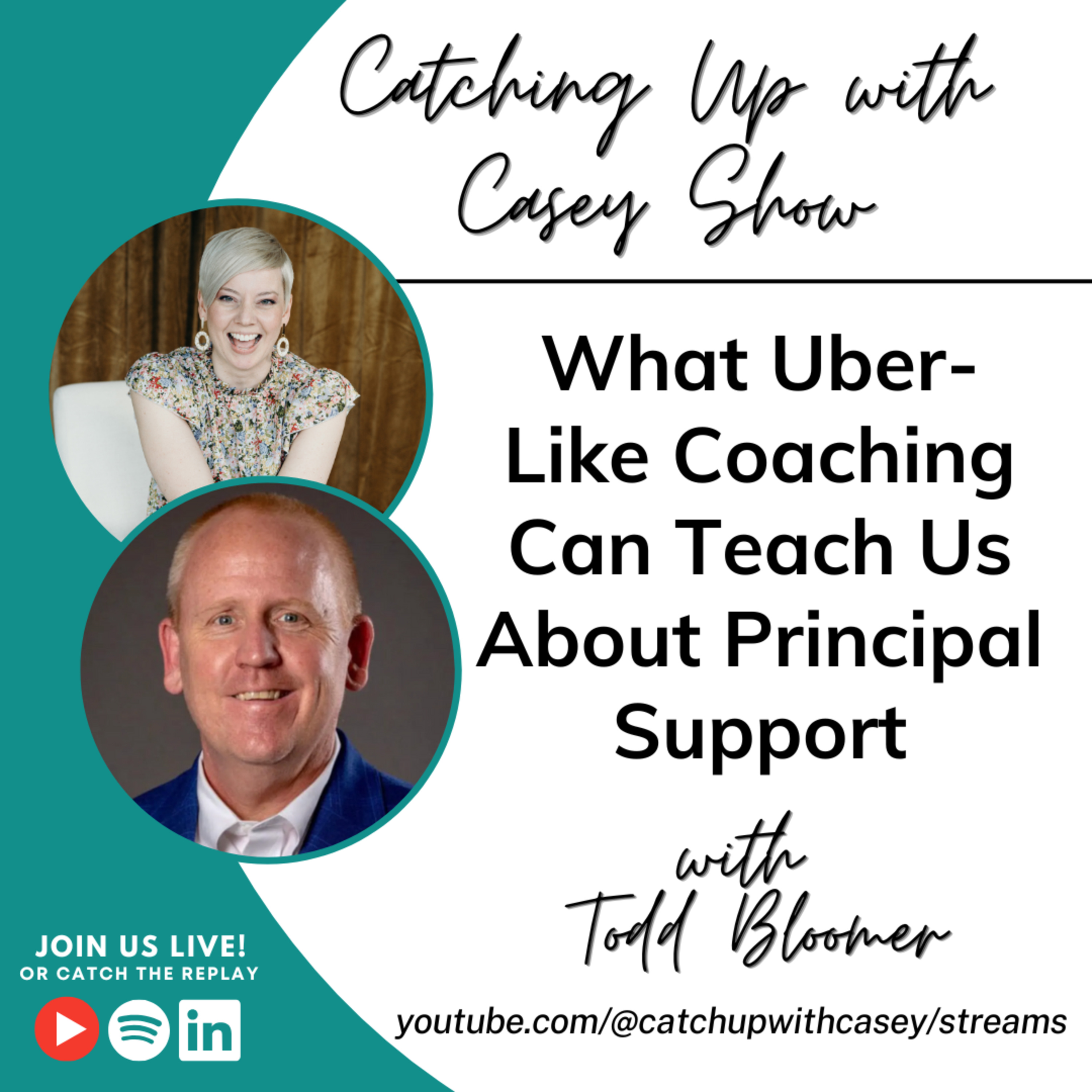
What Uber-Like Coaching Can Teach Us About Principal Support


 RSS Feed
The modern school administrator's plate isn't just full—it's overflowing. If you feel like you're constantly fighting fires instead of leading with vision, this episode is for you.
Join me as I sit down with author of The BluePrint, coach, and speaker Todd Bloomer to tackle the critical question: How can we support the current school administrator with tools that allow them to not only survive, but thrive? We dive into the concept of "Uber"-like coaching for principals and discuss practical strategies to cut through the chaos. Todd shares his wisdom on managing the mass, miles, and food and fun of leadership, giving you the focus you need to build a sustainable, successful principalship.
Your teams are itching for CLARITY! That can be a complex thing to provide. But I have a framework that guides you to do just that– gain and create clarity! www.catchingupwithcasey.com/claritycycleframework
Need help getting your leaders trained in a purposeful way? https://www.catchingupwithcasey.com/identity
Ready to build the habits of a clarity-driven leader? Get The Craft of Clarity book!
Subscribe to my newsletter to get the resources mentioned in podcast episodes! www.catchingupwithcasey.com/newsletter
0:03 Welcome to the Catching Up with Casey show. If you are tired of chasing buy in, frustrated with teams who can't seem to get on the same page, or over the constant struggle of holding people accountable without micromanaging, this is the show for you. I'm Casey Watts, speaker, author and the creator of the Clarity Cycle Framework. I help leaders just like you take teams from frustration to alignment, so teams can work collectively toward a common purpose in a committed way instead of against each other as though they are functioning in different organizations. And we do it all through the craft of clarity. Whether you lead from the middle or you were the front facing leader of your organization.
0:46 On this show, we bring clarity to the seemingly small things in leadership that make the biggest difference because clarity precedes capacity. Now, with all of that said, let's dive into today's episode. Hey, everybody, welcome to today's episode. I've got my notes ready because we have Todd Bloomer with us. And tonight we're talking. Well, I guess it's tonight if you're joining us at night time for those of you that are live. If not, you're coming to us from like the podcast and you're driving in the morning.
1:30 Well, good morning to you. We're really talking about principal support tonight and I love the title of this episode because it is titled What Uber Like Coaching can teach us about principal support. And I dig in this title. So I'm really excited to hear what Todd has to share with us about Uber like coaching and we all probably have experienced being in an Uber. So Todd, welcome to the show. Share with our audience a little bit about who you are and the work that you do. Thank you, Casey, it's an honor to be with another Texan this evening or this morning depending on when you're listening. My name is Todd Bloomer, you're 30, in education, currently started a new role. I'm the director of school leadership for the archdiocese in San Antonio, TX, 29 years in public education, about 18 as an administrator, 25 in Northeast Independent School District here in San Antonio, and really excited about, you know, just being here tonight and just kind of talking with you. It's an honor to be here this evening. Yeah, that's awesome.
2:30 So tell we always start the show with our guest sharing some unique random thing about you that just makes you totally human. Totally the just just what's what makes you human unique. Yeah, You know what? I'm a New Yorker that's been in Texas for, you know, 29 of my years here in education. I moved to when I was in college. I packed up my 1996 Geo Prism with ATV in the back and all the clothes that I owned and moved to Houston, TX to get a job teaching. New York was in a hiring freeze at the time. And so I really tell that story because honestly, when you put your mind to it, you can, you can do hard things and you can accomplish things. I moved 1800 miles away, didn't know a soul in Texas, thought I'd stay a year, thought I'd move back to tech to New York. All my family was there and I ended up staying year two, met my wife and the rest is history.
3:28 And so something that's kind of unique about me is, is you know, I'm a New Yorker that's living in the great state of Texas. I love both states equally. And when I was a student, I was either going to be the shortstop of the New York Yankees, the 4th member of the Beastie Boys. Neither of those worked out. And so I became a administrator and a principal in the state of Texas. Yeah, Now if you've mentioned sports already, and I know if you, if you guys follow Todd on social media, like Instagram, he does Reels all the time. So you're going to get lots of really get great content. But in a lot of your Reels you're talking about some sports. So I'm guessing you are a sports guy? Yeah, You know what I was?
4:13 You know, if anybody knew me, I was not a very good athlete. I played every sport I possibly could. That's what we did 30 years ago, 40 years ago. Growing up, you played every sport you could have learned a lot of lessons through athletics, a lot of lessons that that made me a better teacher, a better coach, a better human. I became a coach when I was in Texas. And really, there's so many analogies now in this day and age of just great coaching. And I will say this, I think coaching is probably the last frontier of like great accountability when it comes to just just people in general. Like the coach has a lot of clout, a lot of say, and a lot of ability to motivate people that might not be motivated. And so love sports. Grown up big Yankee fan, big Knicks fan, big Giant fan. Tough injury for Cam Scataboo yesterday for my New York Football Giants.
5:02 And I will tell you, Casey, it's extremely difficult to be in San Antonio, TX with all these Cowboy fans when you're a New York Football Giant fan. Yeah. Oh, I bet. I bet it is. I bet you get all the jokes. Who's your team? Do you have a team, Casey? I don't. I follow whatever team. Like if I'm, if I'm surrounded by people who are, who are rooting for yesterday, what was it? The Broncos? Were they playing the Dallas Cowboys? Yeah, yeah. So if if I'm surrounded by people who are rooting for the Broncos, I'm going for Broncos. If they're rooting for the Cowboys, I'm going Cowboys. That's me as a Scrubs fan. I love it, love it. So you, I know you have spent time in your career as a principal. And tonight we're really focused about focused on principal support.
5:52 And as we all know, principals among other leaders have very full plates. In fact, I would say for a lot of principals, especially if you're looking at like the principal Facebook groups and pages, you'll see how much they're talking about feeling overwhelmed, their plates being overloaded, they have no time to get into classrooms. And I think a lot of there's a lot of principal turnover because of that. Can you speak a little bit to that? Like what? What do you feel is constantly happening that keeps them feeling overwhelmed? It's it's I'm not going to say anything other than speaking from experience.
6:32 It's not judgment. We've all fell into that administrative quicksand when it comes to those first couple years as an administrator. You know, where the classic game of whack A mole. We're out doing everything except what we should be doing. And I think one of the things Casey talk about clarity to talk about our friend Darren Peppard is getting crystal clear with what we need to do as as the principal and the different the job is so different from an assistant principal. An assistant principal were butts, books, buses, I'll even throw in their vapes, door checks, like all those kind of things as an assistant principal. And we get caught up in that sometimes as an early career leader in doing stuff that isn't our job description. And I don't know if sometimes it's it's like you fail to delegate or you just do what things that you did really well. Because if you think about it, an assistant principal was really good at what they did.
7:20 And that's probably why they became the principal. So they default to sometimes things that they felt they did really well in, whether that be discipline or would that be inventory or would that be other things. And so sometimes that takes us away from our mission. And all of a sudden we're a year into our year and we haven't observed a teacher, we haven't talked about academics, we haven't talked about accountability, we haven't talked about MAP scores, we haven't talked about STAR scores, AP scores, accountability, graduation rates, all those kind of things. And so I think one of the real crystal clear things that we could do as an administrator is that early on, have that great relationship with our our administrative assistant and really tell that administrative assistant. My job is to be the instructional leader of this campus.
8:00 Also, my job is to be the safety leader of this campus because if the campus isn't safe, there's no instruction that's going on. So it's really twofold. And so as long as I keep my campus safe, I have to be in classroom. So my administrative assistant, God bless you, Terry Morana, I love you dearly. Like I need you to protect my calendar so that I can get into classrooms. I need you to challenge me to say, you know what, it's Wednesday. How many classes have you been into? And leaders were like, don't talk to me that way. Like I've been busy. You don't know what I'm doing, but you need someone to hold you accountable to that. When you have somebody that protects your calendar and says to you, hey, you told me early on that academics was your main focus.
8:41 How are you getting into classrooms? And so I think we have to really differentiate ourselves as administrators to say, okay, now I'm the principal and at least one day a week I got to be in classrooms. Let's make that our goal. And at Churchill High School, when I was the principal, I sat every Monday as my day to be in classrooms. That was going to be my day. I blocked off my calendar. The only reason I was going to get called out of a classroom was if the Superintendent needed me or if the school was literally on fire. And I could do that because my my admin assistant protected my calendar and I knew my assistant principals could take care of everything else that needed to be taken care of. So I think you have to have a great team that you trust in. And then I think you have to get real clear to say, you know what, at the end of the day, the community expects a safe school.
9:25 I said that to begin a safe school and they expect good test scores when kids come to school, they want them to learn, they want them to grow. They want them to be successful academically. So they have any hope or future that they have whatever they can do, they can get into whatever college or university or trade school that they want. And so I think early on, we get lost in the minutia, lost in the quicksand of what we're doing. And we get distracted. And then one year turns into three years. And we're that principle that, you know, what hasn't been in a classroom except for an observation. And we're that joke or that meme or that person to say, I've never seen my principal and I never wanted to be that guy. And so I'm not speaking, I'm not judging. I'm speaking from experience. That first year, I was everywhere but where I needed to be.
10:07 Year 2, I got better. Year three, I got better. By year 12, man, I was rocking and rolling. So really getting clear with what's important. And I always told people this, show me your calendar and I'll show you what's important in your job. And if your calendar shows you observations and you built in time during your day, a third period on a Wednesday, 1/7 period on a Thursday day, like all of a sudden all day Monday, all of a sudden you're at 2530% of your week being in classroom observations, coaching teachers, doing the work that you're supposed to be doing. I love all of that. And you're. Just it's. It is much easier said than done, but what I'm hearing you point out is #1 you've already, you've said the importance of your team, your instructional leadership team, your admin team. And that that also your admin team includes those front desk people, your administrative assistant, your human resources person, your secretary, like whoever it is that's at in the front helping the school to option. I don't know that we give enough credit or praise or validity to those roles, But I also think we don't clarify those roles. That's another thing that I heard you say too, is are we clarifying what my role is and what your role is? And that makes it really challenging to delegate. If you haven't clarified the roles of the people in you on your teams, why do you feel like it is so challenging? I mean, that's one reason it's
11:39 challenging to delegate is we haven't clarified roles. What do you feel like are some other things that make delegation so tricky for people? I was at a conference today and a conference for women executive school leaders, and one of the things that they talked about was delegation and how challenging it has been for them to learn to delegate things to people. Why do you think that is? I I think we just can't let go. Like sometimes we have to honestly just say, I'm going to trust but verify. I But when I left Churchill High School last May, I had hired all of my assistant principals. I knew that I could coach them up. I could give them a directive and they were going to take care of the job.
12:21 And I had to get real comfortable with knowing that if it was 95% of what I wanted and 5% of what they wanted or 85% of what I wanted and 15% of what they wanted, I had to be OK with that. I had to be OK with giving direction and allowing them to flourish, stand on their own 2 feet and go from there. And I think sometimes we get to the point where we feel like we have to have our fingerprints on everything. And I ran a 6A high school, 2500 students, 200 adults on the campus. If I tried to micromanage every single person on the campus, I'd still be there. Like I'd still be there at the school right now. And I retired six months ago. I'd still be there micromanaging what I do. So there's an old adage that says hire great people and get out of their way. I think that's hogwash.
13:05 And yes, I said hogwash. I think that's hogwash. Hire great people and walk alongside of them. Hire great people, hire them for the the skill set that they have and empower them to make decisions. Now, we've met as a group every week and I met with my administrative assistant every day and she knew the big rocks. She knew the hills that I would die on. She knew what was important to me. And then the other stuff, finish it. Like the other stuff like how are we going to give out parking permits this year? How are we going to give out textbooks? How are we going to do this? You know what, honestly, whatever you want. Like honestly, I just want kids to be able to have a permit on day one to park whatever you got, own it. Now. That also means if the parent calls me and complaints, I'm going to make sure you handle it. So as long as we're cool with all that stuff, go for it. Like, and then if I need to step in, I'll step in and say I need XY and Z otherwise, rock'n'roll.
13:57 So I think it's hard for us sometimes to have the confidence in the other people because I feel like we think we're going to be judged all the time. And honestly speaking, anyone that's listening, we're going to be judged no matter what. No matter what decision we make, we're going to be judged. It doesn't matter if I've been there one year or 12 years, somebody's going to criticize what we're doing. But as long as you make decisions based on what is best for kids, staff, the community, I can lay my head on the pillow at night knowing that everything's going to be rocking and rolling, everything's going to be good. So I would tell any leader that's out there, give your, give your leadership team whatever guidance you want. Here's the parameters. Now make it happen. Now, if you've got questions, come check in with me.
14:37 I'm going to ask you how things are going. But at the end of the day, this is your project. And if somebody gets upset, I'll defend you always, but I'm going to steer them back to you. You're going to be that first line of defense. So think about that for many different lenses. And if you got a question, I'm here for you. But if not, rock'n'roll, let's go. I was blessed with the two leaders that I had as a middle school principal and a high school principal when I was APS at different campuses. That's how they led me. They said make sure we can get here. How you get there, I don't care. I want to be here in a week. And then I knew all I had to do is fill in the blanks to get there in a week. And if I had questions, I could go ask them. And so that's how I tried to lead. I tried to empower my people because I wasn't an expert in everything I did. No principle is.
15:20 And the principles that struggle feel like they have to be an expert in every single domain, every single category, every single arena. And that's not humanly possible. You will burn yourself up. You'll be you'll be miserable as a human. You'll be miserable as a spouse, a principal, a brother, a son, you name it. So trust but verify and empower people to do what you hired them to do. Get out of their way, walk alongside them, but let them do what you hired them to do. Yeah. So much of what you're saying is extremely encouraging. And I know we have people listening that are thinking, I want, that's what I want to be. That's who I want to be. I want to strive for that. We are in October, end of October.
16:02 You know, a lot of people call October, October. And I know there's just there's just so much that goes on November, December. What would you say to the leader who feels like it's hopeless for this year? And they don't they're, they can't turn the ship around. You know, I'd say nothing's hopeless, nothing. And I would say that in honesty, and I'm not judging. I'm speaking from experience. My first year was extremely difficult. Tomorrow's a new day. Like, and that's cliche, but it's so true. Tomorrow start. If something's not going right, change what you're doing. If, if, if, if the, if the narrative is you're not approachable, work on that. If the narrative is you're not in classrooms, work on that.
16:44 So I would tell you that like sometimes like, like we get that narrative. We think, OK, I'll do it next year. Well, that shortchanges the kids and the students for what you have. You can't do that. So I would say just like the sun rises each morning, you have an opportunity tomorrow morning to change that narrative. And honestly speaking, there's things that you can do to be able to solicit voice from staff, this solicit voice from students, from parents. There's ways that you can get out. And it's only, you know, going to be November. You can still get out and make it a regular routine to be in classrooms. You can still get out and make sure you're during passing period. You can still get out and make sure you're approachable. One of the greatest things that I would say right now to a principal that feels like things are are not going well, they can't change the ship is I would encourage you to do a one-on-one meeting with every teacher before the end of the semester.
17:32 And I'd send out three or four questions that you're thinking about or things that that you're worried about. And I would ask teachers to come in and see you before the end of the semester. And I would do a 10 minute meeting and say what's going well? What are what are areas that you think we want to always continue to do? What are areas that were maybe a little bit below average? And then is there anything else that you want me to know about you or know that would help you second semester, allow you to get that insight and then listen to what's going on with that insight. Take whatever they say and then be able to go forward as you're kind of going from there. And then I would also say this, like wherever the most traveled area is on your campus, like be there in between passing periods. If we ask teachers to be out the hallway during passing period, every one of my administrators better be out in passing period and I better be modeling that as the principal.
18:18 A minute before the bell rang at Churchill High School, I would get on the walkie-talkie and say let's see the people. And that meant get off your butt unless you got a parent and get out into the hallway where you're going to be because we have 9 buildings and 2500 kids that are going to be on the move in about 45 seconds. And they would tease me, but people realized, hey, see the people Matt, let's get out and see them. And so I think there's, it's never too late. Tomorrow is always an opportunity to start again. And like if we, if we take the mindset that this year's awash that we're doing a disservice to the staff, the community and the students. So we just can't do that. Absolutely, absolutely mic drops everywhere, guys. And also we, if you're going, if you're committing to making a change or committing to improving as a leader so that you can improve your campus, you have to let somebody know what it is that you're wanting to change so you can hold be held accountable because we can try to hold ourselves accountable. And that's all great and grand.
19:19 But unless someone else knows that there's only so far you can take yourself. You've got to have leadership is a team sport. You've got to involve your people. I want to know about because our title of the podcast episode is Uber like, like it has Uber like coaching just bringed up on us. Tell us what you mean by that. So I, I retired in, in, in May, June of last year and I had a month off essentially till I started my second job at the Archdiocese of San Antonio. And I thought, cool, I'll sit at home and, and relax and take naps and go for a run and swim in the pool and then about a weekend hours. I can't do that. We're not wired this way to just take off a month. And so I I downloaded the Uber app to drive Uber. During the Final Four, when the Final Four was in San Antonio. But I never actually got around to do it. And I thought, you know what?
20:11 For the next three weeks, I'll just drive Uber just for fun. And I started driving Uber and I really liked it. And I started to think about the concept of Uber and the concept of coaching principles like Uber, like Casey, if if you're going to the airport tonight, you're going to send an Uber, you're going to connect, I'm going to come pick you up on the take at the airport. You may not use the Uber again until you come back a week later. Or you know what, someone may pick you up and you may never use Uber again. Or you may use Uber three times a week or five times a week. And I started to think about coaching principles and assistant principles with that same concept. And it's, it's a niche that's, that's not out there because people sign these big contracts and it's, it's, it's a, it's a well paying job and the principal is going to be there all year and he's going to do XY and Z. Well, I started to look at what about those small schools or those individuals that have a question that just needs somebody one time.
21:05 And so I start, I, I put together, I sent out a, a, a broadcast on, on social media and I put out there like I am available for Uber light coaching. So if you need me tonight, tonight is Monday night at 7:15 PM Central time. If you need me, text me, we'll talk and I can take care of your issue in a 30 minute call and a 45 minute call in a 60 minute call. And you may say, you know what, I want to talk to you again next week. Or you may say, you know what, thank you so much. I'll be in touch and I may never hear from you again. And so I started to put that out there to say, you know what, I'm available because Casey, sometimes, sometimes you need somebody outside of your circle to hear your story and to give you some advice.
21:46 Sometimes it's good. Like I had a great group of principals in, in my district, great friends, people that would give me feedback. They'd tease me a little bit because we were friends, but they would always give me the truth. Sometimes people don't feel comfortable enough, especially early career leaders to say, I don't know what to do. Like, how do I handle this? What would you recommend? How would you role play this? And so for the last, since about June of of 20, 25, I've got 5 or 6 people each week that I kind of coach in that Uber style. Hey, what are you dealing with this week? What do you need to talk about? How can I help you? And each conversation is different because you may be talking about how do I handle a relationship with a principal? How do I handle a relationship with a teacher?
22:28 Casey, I had a, a principal secretary reach out to me to help me work on the relationship to the principal secretary and a principal. And so the Uber like coaching that is out there, I think it's a niche that like, to be honest with you, I don't have enough time anymore and I don't want to give away my secrets because I don't want anybody to steal my, my Thunder. But right now there is a niche out there of people that want to be able to be coached, but they can't afford the large contracts. And so I'm providing a in the moment on demand coaching that I feel helps people. And it also includes like some text messages throughout the week, some podcasts, some links checking in on you. And so really, it's been an exciting 2-3 months. And I think it's the last frontier of coaching. Like it is the space of coaching. Yeah, that's fantastic.
23:20 I love this because there are even if you do something like so there are so many principals who do you know, group coaching or you you're in a program or even you're doing like regular coaching, all of that is great and wonderful. If you can afford it, awesome. I am always going to be to be an advocate for having a coach of some sort. Even me moving into my business full time, I will always have a coach. It might be a speaking coach. It might be a writing coach. It could be a business coach like I'm going to have it. It could be a leadership coach, especially as I start to build a team for my business.
24:02 So I will always be an advocate for that. But you're right, sometimes we number one, if we're in Group coaching, it's typically like we're in a group and we don't have that one-on-one time. And sometimes I have to wait until that group coaching session to get my question out there and it's not always relevant with the conversation. So if I can do Uber light coaching, I just need this. This is top of mind. I need this one thing answer. I just need to talk it out and it needs to be timely because I'm dealing with it right here, right now. And I want to highlight how important it is to reach out to someone from outside that space where they're not, they don't have any kind of biased opinion or touch points with the people that you are dealing with or with the organization.
24:52 It's so important they can see things that you cannot see or can see from a different perspective where that maybe you're not seeing from. Yeah. Absolutely. That's why I'm doing. Yeah. Do you see how because you talked about in your where you were working before you retired, you had people who were pouring into you, fellow principals, administrators that you would provide feedback and honest feedback, which is not always the case for people. But do you see how Uber like coaching could take place in school districts among the people who work there?
25:35 What describe what you think that might look like? You know, I think from a mentality of being an athlete growing up, which is questionable, but playing sports teams growing up and being a coach, you know, we're used to, to instant feedback. If you run a football play and you lose 10 yards, that's the feedback that you need. Don't do that again, because that's not going to work. And, and translating that to coaching is, is, is such a mindset that like everybody's got to get past. And I think that takes a mindset that I want to be a great principal. And when I become a principal, I don't know all the answers. I think the people that struggle feel like they know all the answers, got to put their fingerprints on everything. So I think that's important.
26:16 I think the mindset is key. And then I think at the end of the day, I don't have any. I mean, I have pride in my job. I want to be successful. But if somebody comes to me and says, I think you should do something differently to be more effective, I'm not going to take that other than I think that person wants me to be successful. And everybody that provides you feedback is giving you something, whether that, you know, taking it with a grain of salt or not. Everything that they provide to you, you need to take with a grain of salt to be able to, could this be, you know, could this work? So to take to answer your question of like, how could Uber like coaching work in a school? It works right now as it is. If one of my assistant principals comes to me in the moment and says, Hey, I'm working on this. What do you think about XY and ZI Give them XY and Z and that's the moment. Then they go back and they do what they're supposed to do. And so I, I think it can work and I think the relationship is, is so important.
27:06 But sometimes, as you mentioned, sometimes not knowing that I know all the players in the situation, I'm just going to give you straight feedback to think this is what I would do. I'm not telling you what to do. Don't quote me on this, but here's, here's kind of what I would do in this situation. Now you have to make a decision at the end of the day. And a lot of people I'm coaching, all they need is that they need that reassurance. Because I believe people that get into education, they got a good mindset, they got a good frame, they know what they want to do. Sometimes they just need a little push and that's what I was able to get as an athlete, as a coach was like, hey, if you don't win, you don't, you lose. And like, you know, like you can either be 10 and O&O and 10 and like that's the coaching that we need. We every school wants to be a 10 and O. And so I think at the end of the day, this can work in schools because there's so many small moments that a text message, a voice call, a Zoom or a phone call or a face to face can help solve the situation.
28:03 And, and honestly, so many times driving home from work, I connect with leaders that are driving home from work at the same time and they just need 15 minutes to, to, to debrief their day to walk through. Should I have done it this way? What would you have done? How would you handle this? And I have one that always says to me, can I say that? And I'll say yes or I'll say, no, don't say that. That'll get you in trouble. So I do think there is a need for it in Casey. It really reminds me that like in my job now as the executive, I'm sorry, as the director of school leadership for from my current spot, I have to be able to give good feedback and good advice to my principals because they want it, because I don't want principals to have to go out unless you're going to pay me for it. Like I don't want people to have to go out and do that.
28:46 But there are so many principals that like just need a reassurance and, and who knows with those reassurances along the way, they could be the principal of the year, but without those reassurances, they could quit because you've been there. We've all been there. We've driven home, we sat in our car, we've done this. We thought, I'm not going to go into my house, I'm a failure, everybody hates me, the job stinks, blah, blah, blah, blah, blah. And no, it doesn't. You received 7, you know, attaboys and you received one negative e-mail or your boss reached out and said a report was late and you're, that's all you, you focus on. And then you go home and you're an absent minded parent, you're an absent minded spouse. You eat poorly, you don't exercise, you don't sleep well, and it just spirals into this thing. And so I would tell anybody that's listening to your podcast right now, if you're in that spiral, let's connect. I'm not saying I can solve every problem, but you know what? In 12 years as a principal, I've seen just about every problem that you've had.
29:45 And I'm not judging, I'm speaking from experience. I consider myself a very confident person. I thought about quitting my first year as a principal. I, I was struggling. I was not, I couldn't go any direction without falling into that quicksand. And so if that's you, like reach out, maybe not to me, maybe to you, Casey, maybe to our friend Darren peppered, but reach out to somebody because all of us got guidance from somebody. And it's our job. It's our moral imperative to pay it back to people, to pay it forward because we step away from the job and schools are still there. Like we need our schools to have the best leaders. And I'm cheering for each and every one of them. And if you need something, just reach out. That's, that's what we're here for.
30:26 And if I can't talk to you in the moment, I'll call you in an hour, I'll call you in three hours, I'll call you in four hours, I'll step away, I'll call you during my lunch. And so like, I really feel that this is a niche that can really transform school leadership. And it's kind of exciting to be on the ground floor of it. Yeah, that's awesome. Now that's not the only way that you can support people because you have written a book and you are currently writing your second book. So talk a little bit more about that because it sounds so incredibly helpful. Thank you. The book 1 was originally an e-mail to my brother. He was becoming an assistant principal and it turned into something else.
31:07 And seven years later, Darren Pepper published it. It's a structure, systems insight. More importantly, the mindsets that are needed for you to not only strive as an administrator, not only strive as an administrator, but thrive. And so like that, that's the that's the survive and thrive mentality of, of, of the book. And it really dictate, it really explains kind of my failures because I think it's important to be very humble and be very vulnerable to say, you know what? I failed Also, I made, you know, I, I, I spoke too, too soon. I, I discounted something. I, I didn't account for something and I struggled. And it's important to realize that you're not alone in this. But then the story also becomes how I pulled myself out of that quicksand and became the principal that I'm very proud of right now.
31:54 I'm not going to talk about it, but I did receive a couple of awards along the way for being a pretty decent principal. And so that's the journey of the book. It's called the Blueprint, How to survive and thrive as a school administration. So I put the book out in August of 24 and I'm really excited about the book. It is, it is, it is. It is my journey, my passion, my soul. But it also talks about hiring. It also talks about school culture. It gives great stories. It's a who's who of the state of Texas. Lots of people that you would maybe know about. Great school leaders are included in this book. And after I published a book, I had numerous people reach out to me and say thank you. Do you have a month by month guide for what a principal should be doing? What should a principal do in July and August? It's October, October, what should I be focusing on? So the blueprint 2 point O is about 85 percent, 90% done. And it is a month by month guide to what a principal should be doing on July 1 because you know, like when you're there on July 1, nobody else is there and you're like, OK, they tell you, hey, Casey, call me if needed, but you're like, I don't even know why to call you.
32:58 I'm just going to sit in my office and do what I think is right to be successful. And so this is the companion to the blueprint. And I think a guide to be able to help somebody, especially maybe smaller schools that may not have the robust systems that like bigger districts may have. But even it's a great resource for current principals to kind of reflect on some of the things that may have blinders. They may have blinders to them as they're going through leadership. And so the Blueprint available on Amazon, it's available on my website. If you pick it up on my website, I'll autograph it and send it out to you. It is available there and I'm hoping that the Blueprint 2.0 Jay-Z best album, which you know, it's just a, a side plug there.
33:41 It will be available to come out in the summertime. So if you're a new principal starting July 1, you'd have it in your hands. And I think the two of them together, married together could really help you along the way. It's not going to make your job any easier because the job's extremely difficult, but I think could be a a guide that you can look back to to reflect on. It's got great reflective questions, great things to think about, great advice. But lastly, it's got great mindsets. What do you need? What is your mindset to be successful? And so those things together like right now, you can go out and have the blueprint in your hands tomorrow. And I will tell you this. If anybody's watching on the podcast or listens on the podcast and and picks up a copy of the book and, and messages me and says, I was with Casey on the podcast and Todd, I will give a 30 minute free coaching session to anybody that's out there. If they wanted to reach out to me and say, can you clarify? Can you do this?
34:31 Can you do that when that Uber style coaching? And so if you pick up a book on Amazon or my website, I'll throw in the the 20 minute coaching for free because I enjoy that. It keeps me tied into the schools. And I also think it's a way of kind of paying people back for the people that helped me along the way. Yes, OK, guys, take advantage of this. Take advantage of it. I'm telling you right now, look in the show notes. I'm going to include everything in the show notes. Thank you. Everything that Todd has mentioned plus links to where you can get in touch with him is going to be in the show notes. You said things don't become easier, but we become more confident. However, we can only become more confident if we're pouring into ourselves as leaders by doing things like the Uber, like coaching, by reading the materials that are available to us, by having someone mentor and coach us. So this has been a lovely conversation. Casey, can I add one more concept that I think is so important, learned the hard way.
35:32 And there's, there's three things that you need to as a leader, ensure that happens. You need to take care of yourself physically. And that means every day, every day it's either it's either running, it's weights, it's, it's not only yoga, but it could be yoga. It is walking, it is swimming. It is something physical like you have to have a physical wind for the day. And I get up every morning, rise and run before the sun, 3 miles this morning before the same came up. Second thing, I think, and it's not a religious podcast we're talking about, but you need to be right with the good Lord. I read the Bible every morning. I make sure I'm centered. I make sure I'm good spiritually and where I'm at. And the third thing is you need to make sure that you're OK with your family, your spouse and your children. And if you can put those three things together, and I'm not judging, but I failed at that early on, miserable.
36:18 I received awards for being principal of the year, but not father of the year, principal of the year, but not spouse of the year. And so I would say if you can get those three things right, get the home right, get your mind right, get your heart right, get the heart rate up and be good. It's going to make the job much more manageable, not easier, but much more manageable. Physical exercise, mental, spiritual and making sure that you're with your family, like those three things I learned the hard way. And if I could go and do that over again, I wouldn't, I wouldn't, I wouldn't shortchange that for anything. So you have to put those three things first. And like they say, others first, put others first, put others first. I push back on that, Casey, because I say if you're not right, you can't give of anybody else.
37:01 So you have to put yourself 1st. And it's not being selfish, but I have to make sure that I'm running, exercising, I have to make sure that I'm spiritually right, make sure my family's right. When I'm good there, I'm good for everybody else. Because if I'm not good in those three areas, if I'm not exercising, I'm gaining weight, blood pressure's going up, I'm miserable, not sleeping right, not eating right. My, my wife is ready to kick me out. My kids don't even, you know who I am, you know, like I'm not right with the good Lord. I'm not right for the teachers, the kids of the school community. And so like, if you're not putting those three things first, like it's going to be a tough, tough challenge, tough maybe. Impossible. Yes. Yes. Oh my gosh. Let's go fire it. So guys, if you come back so and I'm going to say maybe November, I'm talking about this very thing about really gaining clarity in your personal life so that you can gain clarity in your professional life and provide clarity to to the people that you're leading.
37:55 So come back. We're going to be talking about that love. Let's go so much. Yeah. OK. Todd, where can our listeners find you? Yeah, no doubt. You kind of mentioned early on Instagram and TikTok, I'll tell everyone there, I'm 51 years old and never thought that one of my joys in life would be making TikTok or Instagram reels. But but I, I, I have thoroughly enjoyed that. And so each morning I, I post an Instagram and Tiktok, Facebook, LinkedIn and to Twitter are real and it's kind of a 2 minute and kind of motivational message. And so Tiktok and Instagram is Todd under score, Bloomer under score author. LinkedIn is at Todd Blimmer.
38:36 Twitter is at Bloomer under score SA. It'll all be in the show notes. Easiest way to get in touch with me is at Todd under Score Bloomer under Score author on either Insta or TikTok. Awesome. OK, Todd, thank you so much for coming on the podcast. This has been great. Yeah, Casey, you're awesome. Go Texas, right? Hook em. Well, hook em. I don't know. I don't know my. Daughter went to Texas, right? Let's go. I'm close to SFA so it's going to be lumberjacks go jacks. What is it? Cotton jacks or what is it? It's Axom Jacks. Axom Jacks. I apologize. Axom let's. Go.
39:16 All right, guys, We will catch you in next week's episode. Back everybody. Hey, listener, I am so honored that you listen to today's episode and I hope you gained something valuable from it. I'd also be honored if you did ME3 solid favors. First, subscribe to this show. I've got a lot of great content coming up, and I don't want you to miss any of it. Second, be sure you're following me on social media platforms. You can find me at. Catch up with Casey on LinkedIn or Instagram. And finally, if you were looking to book a dynamic and relatable speaker for your next event, conference, or retreat, I would love to bring a message about how the craft of clarity makes a significant impact on both leadership and life.
39:59 Until next time, always remember clarity receives capacity.

