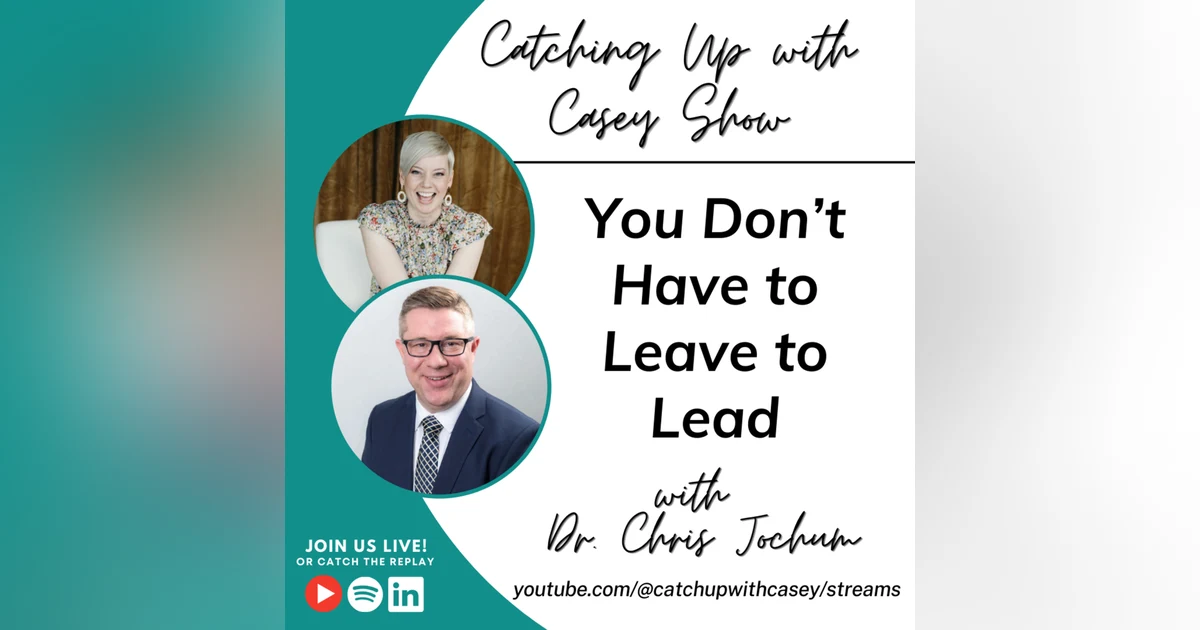
You Don't Have to Leave to Lead with Chris Jochum


 RSS Feed
Dr. Chris Jochum, Founder/CEO of CJ Leadership Solutions, joins the show to discuss the vital importance and often-misunderstood value of teacher leadership. He shares insights from his new book, You Don't Have to Leave to Lead: A Practical Guide to Teacher Leadership, explaining why training and supporting teacher leaders is essential for school success. The conversation explores why this crucial aspect of school leadership is frequently overlooked and how it can transform school culture. Listeners walk away with practical, "take-home" strategies, including concepts like the "Leader's Daily Five" or the "Teacher-Leader's Credo," to implement immediately.
https://cjleadership.com/ https://www.linkedin.com/in/chrisjochum/
Your teams are itching for CLARITY! That can be a complex thing to provide. But I have a framework that guides you to do just that– gain and create clarity! www.catchingupwithcasey.com/claritycycleframework
Need help getting your leaders trained in a purposeful way? https://www.catchingupwithcasey.com/identity
Ready to build the habits of a clarity-driven leader? Get The Craft of Clarity book!
Subscribe to my newsletter to get the resources mentioned in podcast episodes! www.catchingupwithcasey.com/newsletter
0:03 Welcome to the Catching up with Casey's show. If you are tired of chasing buy in, frustrated with teams who can't seem to get on the same page, or over the constant struggle of holding people accountable without micromanaging, this is the show for you. I'm Casey Watts, speaker, author and the creator of the Clarity Cycle Framework. I help leaders just like you take teams from frustration to alignment, so teams can work collectively toward a common purpose in a committed way instead of against each other as though they are functioning in different organizations. And we do it all through the craft of clarity. Whether you lead from the middle or you are the front facing leader of your organization.
0:46 On this show, we bring clarity to the seemingly small things in leadership that make the biggest difference because clarity precedes capacity. Now, with all of that said, let's dive into today's episode. Well, hey everybody, welcome to today's episode. I'm excited that you have joined us. More than likely a lot of you are coming to this episode after the new year, but it is actually New Year's Eve. So if you're coming to this podcast episode today or tomorrow, happy New Year.
1:30 Happy new Year anyway. I'm so honored and feel so blessed that you are joining us on this podcast. I hope that this year you will continue to come back to the podcast again and again that it provides so much value for you and maybe your colleagues. And with that said, I hope that you will pass this podcast on to fellow like minded colleagues who want to gain the craft of clarity and lead well and lead from where they are now. I think that's a great segue into today's episode. I'm joined with Chris and I want to make sure I didn't even ask before we started recording Jokim. Jokim. Yup, Jokim, it's OK. It's OK.
2:13 Close enough, Yokum. So I'm joined with Doctor Chris Yokum, and today we're really going to be talking about leadership and leading from where you are. I can't wait for this conversation. So tell us a little bit, Chris, about who you are and the work that you do. All right. Well, first of all, thank you. It's honor to to be here. Been a big fan of your work Casey and I appreciate all that you do. Again, my name is Chris Yoakam and currently serve as the chair of a large teacher education department at Fort Hay State University in Kansas. And then I also am founder and CEO of CJ Leadership Solutions where I work primarily, I guess with K12 higher Ed.
2:53 And then I've been doing some work with, with corporations on various aspects of, of, of leadership training, but started my career as AK12 educator. And then I've been in higher Ed now for, oh boy, a while now training teachers and then the last 10 years in a formalized leadership role, like I said, leading a a large department. Nice. And you? So you live, you've spent most of your career or your life in the Kansas area? Or have you been to other places? Primarily Kansas and Nebraska, almost probably 5050 now native Nebraskan spent time at at the University of Nebraska Carney for eight years training future foreign language and English as a second language teachers and then currently in my 10th year now chairing this department in Kansas.
3:44 I got to ask, ask what is your favorite thing about being in your position now in that department? Favorite thing is the people and more so because I know that's general. I really like. First of all, I have I have a rock star All Star team of professors in my department. It is so awesome to spend literally walk around in the building. And we also have an online program. I love working with people who are passionate about wanting to serve others as educators. And so yes, there's a teacher shortage. And yes, if you want to find negativity, you can find it. But what I get to do on a daily basis is I get to work with people who want to be teachers who are either preparing to do that in the future or maybe through our graduate program, current teachers who are enhancing their skill set. So the people and most importantly, I really like working with both the pre service and the in service teachers.
4:42 Yeah. That's awesome. And we have some connections there because I during a so I spent, and we talked about this a little bit before the show, but I spent probably 11 years of my career at a university charter school and in that charter school it's set up really uniquely. I don't know that I've been in another school much like this, but there were two classrooms per grade level. And in between those two classrooms they had what they called booths. And so there were like, you know, double screens where people could go into the booth and see into the classroom, but the students couldn't necessarily see people that were in the booth. So observed quite a bit, had lots of student teachers and teacher candidates from the education program. So it was really unique and I enjoyed every bit of that. Probably for the same reasons, just really getting to pour into those who want to spend their time and energy and effort in becoming an educator who's really great at their craft. So, yeah, OK.
5:38 Now, because I do this every time I have a guest on the show, I just, I like to know that we're just normal, average people. Every average, normal person has some kind of unique, very human thing about them. What? What is that for you? Oh gosh, I mean, I could, I we could talk all day about my claws. I, but you know, one thing that's maybe unique or, or a hobby or an interest, two things. And I don't know if this answers your question, We can, I can certainly expand upon it. But maybe two things about me that might be unique or a hobby. One, I'm bilingual. I speak Spanish because that's what I used to teach. I lived in Mexico many years ago. And the other thing is that I kind of as a hobby, I sing and play guitar.
6:28 Hey, we have so much in common. Likewise. Except not necessarily guitar. Piano. I mean, I can dabble in guitar, but piano's? Perfect My my first instrument growing up was piano. I, I grew up playing piano and, and did all those things. But yes, I again, nobody pays me to play and sing. But but it is, you know, I literally don't quit my day job for it, but I really enjoy doing it. And in in my corner of the world, I can, you know, I can serve people through being bilingual and then at times playing, playing my guitar and singing. Yeah, well, that's awesome. Okay, so I promise those of you who are coming to this podcast episode, it's not all about just what we love to do, Okay, we're gonna get into the content.
7:14 I just, I think it's so important to make us real to the people who are on the other side listening. So if you're listening and you're like, oh, we've, I've got that in common with them to reach out to us. I, I love hearing about just the human things that we have in common with other people. So tell us what it is that we're bringing clarity to today. The title of the episode is You Don't have to leave to lead. So I just want you to start point blank with that. What are we bringing clarity to? Well, as as the title of my new book says and something I've been passionate about, the clarity here is twofold.
7:54 If you are a pre K12 educator, you have more what I call superpowers than you realize. You are uniquely qualified to do many, many things and you because of that, I want to be clear with educators and the formalized leaders who serve them that you are inherently a very, very skilled and capable leader. You can do things that Fortune 500 companies spend a lot of money, spend a lot of money training their formalized leaders to do. And as you know, as I unpack that with teachers to teachers, it almost seems like, oh, you mean not everyone knows how to do this. No, not everyone knows how to have a difficult conversation, how to get a group of humans moving in the right direction. All the things that that that teachers you do before lunch. And so I think the clarity question here, Casey, is K12 educators.
8:52 Nobody is just a teacher. They're superheroes. They do work that most normal people statistically can't do. And I want to be very clear, you're already a leader where you're at in your classroom. What made you so passionate about this specifically because it led to a book, so talk about that. Well, I've always been, I, I've always, you know, we always have leadership leanings or we're intuitive in certain ways. I've been blessed growing up to have been around great teachers, great leaders, great coaches. And, and the flip side to that is I've also seen the negative effects when people lead for the wrong reason or absent of the right core values, Right. And so specifically, I've always, I've been a teacher, I've trained teachers most of my career. And about 5-6 years ago, I was working on a book for higher education leaders and it coincided with me teaching a special topics class for our teachers here. And I, I had seen the term teacher leadership and most of us have, right.
10:00 And like most teachers, anytime you hear a professional development flavor of the month topic, I understand if we're a little, you know, we want to get curious. And the more I dug into it, the more I realized and, and there's a book out there where they call it the sleeping Giants in our school that developing, supporting. And what I like to do, I always like to give people perspective and permission that we really often times have a field of diamonds under our feet. And it's not a cure all. But I think the more we can realize in our schools, let's try to cultivate the talent we have first before we look elsewhere. The sleeping giants in our school. Wow, that's a powerful title and it's so true. And I think, and I'm, I'm even speaking from my own experience, there are so many, I think probably specifically like those listening to this podcast, like you and like me, we were probably fairly high achievers who wanted to make a greater impact.
11:07 And sometimes it felt as though I've reached my glass ceiling and I can't go any farther unless I step out of this position. But so often that means that we're losing really great people on our campus because they're searching elsewhere. I I wonder if you have thoughts or opinions about that glass ceiling that some of us feel like we run into a. 100% First of all, I would say as there's a great book out there, I think it's from strength called From Strength to Strength. I'm not saying as we get older, but as we mature we it's natural.
11:52 All I'll say real quick is it's natural for us to want to actually serve at a different level, do more legacy work, right? But with that being said, I think it's, it's important for us and, and, and to answer that question about the glass ceiling, listen, we need, as you know, we need people get going into formal administrative roles in K12 just as much as we need people in the classroom for the right reasons, right? I think what's happening though, is with the teacher shortage, everything is being fast forwarded. And so you may have only taught three years and quite frankly, you might need a few more years to, to, to perfect your craft. And you know, as a four year teacher, you're a veteran now and now you're in the ministry of pipeline. And so I would say, first of all, we need people to go into formalized leadership for the right reasons. But if you feel as though you've reached a glass ceiling, step one could be, you know, the old do I want to retire or retread type of of scenario is maybe there are some things that you could do to enhance your practice where you're at, give you again, permission and perspective. And you know, one or two things might happen. You might realize that actually opened up the door and confirmed I need to become a formalized leader. Or it made me realize at least for the immediate future, the next couple years, I'm actually, I feel fulfilled now because in addition to teaching, I have seen other ways that I can serve the profession.
13:22 So that that's my answer. If you feel like you've maybe maxed out a little bit, is can you expand where you're at or do you need to be intentional, have some clarity about getting on a path to formalize administration? Because we need those. We need great principles. Yes, but we need great principals and leaders who are also fulfilled. And that's the word that I heard you mentioning and fulfillment, it's interesting. I for the longest time I haven't written about it necessarily. I haven't talked about it too much. Just in this podcast is where I've talked about it, but it keeps coming up again and again and again. But you know, we have, I think especially in, in All, in all sectors, I think we have this, but in education we have that, that climbing the ladder, ladder trajectory in people are looking for the next position, next position, next position.
14:13 But I want us to think about what it looks like to lay the ladder down. So we're looking at this landscape. We're we're going across it horizontally and we're growing at each rung in different ways. And that means that I can go along that ladder in any direction. I can go to the right, I can go to the left. And no matter where I'm going, I'm growing in some capacity at each of those levels or at each of those, those places on my journey. But that that word fulfillment is so critical because if we're not experiencing fulfillment, then we are going to reach our capacity. It's going to turn into burnout.
14:54 And I think sometimes that burnout almost feels like a glass ceiling when it may not actually be a glass ceiling. It could be that we just haven't figured out how am I going to gain fulfillment where I, I am right now and how am I going to grow? I'm not experiencing fulfillment if I'm not growing, but I need to, I need that self-awareness to decide to kind of reflect on myself as a leader, where I am and leading myself first. So any thoughts you have on that? Well, I, I love that you, you say that because I, I love the latter analogy. And you probably, you know, the symbol, I think it was Stephen Covey that that said, you know, before you get going on climbing the ladder of success, make sure it's leaned up against the right wall. And I think it's very similar to what you said is if you are not, I mean, to me and a lot of my my book and the works that I do is it's personal development first, right, Because for the most part, if if you were perpetually maybe not happy, whatever. Fill in the blank in job A.
16:01 You know, one thing I've learned in in the years that I've been on the earth is I'm every good and bad decision in my life. I'm the one constant variable. And every time I move, no matter what I may or may not put in EU haul, I always bring myself. And so first of all, I always encourage people, is this a professional issue? Is it a personal issue? Right. But I do think that we need to make sure and, and again, I'm, we write the books, as you know, that we need. And anything I tell you, it's because I messed up and I needed help with it is I think it's really important. As you said, we need to be clear on who we are, why we serve and what brings us joy and how we can, you know, fulfill or offer value to others.
16:51 And in the start of my book, I actually tell a story about I, I was at a conference with K12 educators and professors and I heard someone just in passing say, Hey, I hadn't seen you, you know, how, how's that admin job? And they essentially said, well, that's OK. But you know, I missed the classroom. But you know, I always wanted to be a leader. And I, I, I think if, if you're not enough without the title, you're not going to be enough with it because the title in the parking spot and all of that fades after a while. And so, and you know, and you might know this Casey is with social media, it's not too hard to find people that like to post about why I left teaching.
17:33 My hunch is if they're being honest, follow them around for 6 to 18 months. They eventually they're going to post why they left the next job. Yeah. Because anyway, so not to go on a tangent on that and I don't know if I answered the question, but I, I just think it's so important for people to understand who they are, what brings them value, how they can serve others. And once you're pretty clear on that, then it's easier for you to kind of take a, you know, we're all the CEO of our, of who you know, of our personal corporation, our personal career. Once you understand who you are, it's easier to take that into different areas, whether you move up the ladder horizontally, whatever.
18:15 So again, like you said, we need to find out who we are, what we believe, what our personal mission statement is. I know we're both Simon Sinek fans. What's your, why? What's your, your greater, you know, bigger why? Once we figure that out, it doesn't make the the work easier, but I do think it makes it easier to navigate. Yeah. What is fascinating to me is how many people go into these positions of leadership. So, you know, the principal, assistant principal, what whatever the case may be. But when we climb the ladder, I think oftentimes people are pegged for those positions, but they're not prepared for those positions. So a master classroom teacher, they're someone's thinking that they tapped them on the shoulder and they said, oh, master classroom teacher, you should probably be a leader. So they get thrown into that next role. Instructional coach, maybe they thrive in that because they're a high achiever.
19:14 They get thrown into the next role because they're a high achiever, but they've never actually been trained how to be a reflective leader who has the self-awareness, the social awareness, the emotional intelligence that are required to work with other complex adults. It's mind boggling to me. Amen. I, I, I mean that I am. The reason I wrote my chair book is, and this isn't an indictment on higher Ed. This is just how, like you said, how organizations work, like I always say is just because you're the best person on the widget assembly line doesn't mean that you wouldn't be the best CEO of the factory. And I think with the best of intentions, we, we make that connection.
20:04 And I think with training, I think a lot of people you, you know, leadership, there's part of it that is innate. There's other parts that we can train. And, and I do think that we need to be intentional and understand that the best 4th grade teacher. Might have the ability to be a great persistent principal, a great principal, maybe someday a Superintendent, but just essentially moving them from the 4th grade room into the administrative office by itself, we're almost doing them a disservice because we are completely changing the job that they're doing. And so yeah, I, I think in every organization we need to be mindful that the best fill in the blank worker isn't necessarily the best prepared to run the organization or be in a formal role of leadership. Yeah.
20:54 So then let's kind of shift the conversation. I actually want to go back to our title is you don't have to lead to lead. What has to be present in a school in order for that to be true? So one of the questions I think we were talking about looking at is why that teacher leader training is so important and why it's overlooked. Well, you know, two things. And in the book, I do have a chapter or two because this book is for administrators as well on in ideally what what this would look like from a district or at least a building level. Now, my footnote to that is even if you're not in that area, in that type of environment, you can still you're the CEO of your classroom in the four walls of your room.
21:39 You can still get better for the sake of getting better and enhance, you know, use this as professional development. So ideally what would happen in in what it would look like is you would have an administrative team that is evolved enough, if I can use that word as leaders that is vulnerable enough to realize that the more they enable and build capacity in the classroom, teachers actually I'll step up every adult in the room, every adult in the district actually, the more they are enhancing their reach and their ability to effect change in that building, right. As you know, a principal can't be in every single classroom, but you can set up, create an environment to where you've enabled those and powered those in the classroom to kind of come along with a vision that you set for the, the organization. So ideally it just takes I, I would say leaders, formalized leaders who are curious enough and who are willing to say, what would it look like for us to adopt this, this culture, this climate, this mindset?
22:48 And it's, it's not, as you know, and I think you, you talk about this in your book, Look, it, it's, it's not something that you have to spend money on that you have to, you know, adopt A new curriculum. It's really, how are we going to day by day? How are we going to align ourselves with core values and behaviors that at the end of the school year, you know, with 180 days of interest that are going to mean we are a district that values our teachers as leaders, that empowers them appropriately. And at the end of the day, we know that that to some some extent effects student achievement, faculty morale, and teacher retention. Yeah, as you're talking, it's reminding me of Liz Weisman's book Multiplier, The Multiplier Effect. But she has another one called Multipliers. But so the, the two books, I think she wrote Multipliers in as her first book, but then it transitioned or not transitioned, but she wrote another follow up book, The Multiplier Effect that is specific to tapping into the genius in your schools.
23:52 It is a fantastic book to read because she really outlines how to be a multiplier versus a diminisher. And you're really looking to multiply that intelligence. So you're, you're trying to be a talent Finder. And I, if we could as, as the positional leaders get into the, the mindset and habits of cultivating the genius in our people, Wowza. I mean, it would make such a tremendous difference in our culture, but it also would make a tremendous difference in what is we find that we've then we want them to multiply and grow to the next level.
24:38 We want them to be the best version of themselves. It's us. OK, you cut out for a second there, Casey, but I think you're back. OK. Oh, I'm back. You're back. Your audio. We both froze. Did my. Audio. Oh no. OK, so you didn't hear the powerful things that I just said? I heard most of it, but just. Kidding, kidding. I just talked about multipliers and diminishers. I heard that, yes. OK. Yes. Yeah. Yes, if we if we go back and listen to this, I'm hoping that people heard at least some of it. But tell me your thoughts on that. Well, I, you know, one of my over the last couple years AI guess, a colleague, friend and mentor, Brad Black, CEO of Human X Ventures.
25:24 He has a wonderful book called Talent, Culture and Teams where he talks just about that. And you know the part of me that that at one time thought I would spend my career as a high school teacher and coach. I guess I do take a coaching mentality to leadership. And you have to have an eye for talent and an eye for development. And I learned long ago, couple things Casey is I never want to be the smartest person in the room because when I surround myself with people that can do things I can't 1 I don't work as hard and I still look good. I, I, it's, and so I, I think that that the more we can look at any organization, certainly a schoolhouse as how am I cultivating and supporting talent and what does that look like?
26:19 And, and, and you know, it's sometimes supporting talent. And you know, every year Gallup does a worldwide leadership hole, and they always find this of people that voluntarily leave a job, over 75% say that in the, I think the 60 to 90 days preceding their departure, If a leader would have simply said, how are you doing? How can I help you? A lot of those people would have stayed. And so, again, it's not rocket science. It's how are we checking in on people? How are we develop relationships? How were we letting them know, hey, I'm not after perfection here, how can I support you? And I think in that we as formalized leaders, that shows that we have an eye for talent.
27:05 We have an eye for relationships. And we know how to support that. Which by the way, if you are a classroom teacher, you do that every day with your kiddos. I, I mean, you are uniquely prepared to identify and develop talent. That's what teachers do every day, yes. And when I, I have a reflective leadership institute that I take, it's done like at leadership retreats and things like that. But one of the things we talked about is everyone leads someone. It does students in your classroom who are leading someone, Everyone leads someone. I think we like that so easily, especially if our talents are not being cultivated, especially if it's not something that we're we're bringing to mind frequently. Yeah.
27:54 So I want to know what other things are in the book that you feel like are just you need to with our audience before we start to close the episode. Well, I, I will say, you know, there is, it's not void of research. So there are thing, obviously I started and I, I support, you know, the, the literature base for developing teachers. But most of this I wrote as if we were coaching or in a professional development or workshop scenario. And it aligns with the course that now I don't know. 6 for six plus years I've taught on leadership. I would say a few things that are in there that I think are very important that that I know I've already added value to people are I talk about relational realities, things to keep in mind that if you are in a leadership role, whether it's with your students, your colleagues, your parents, whatever, that are going to help you.
28:44 I have what I call my teacher leaders credo, which, you know, like you said, the first one is it's not about me, but it starts with me, right? Is it leadership is I'm here to serve others? And then the other thing that I think is a nice take away is my Leaders Daily 5. And those are just some things to keep in the back of your mind through the day, throughout the week. Maybe now and then you don't have to ask yourself every all 5 every day, but just a few things, you know, Hey, am I improving myself by improving others? Whom am I serving today? What I've enjoyed being my teacher, leader, principal, colleague today. And, and so those are some things because like you, Casey, I, I believe in being practical. I believe in in giving people things that they can use right away.
29:34 That makes sense. And so that was my overall goal in the book. But those would be the three things a relational reality, the the teacher leaders credo and then the the the leaders daily 5 that I think we are very practical. Those you know use on Monday type of tips for teachers I love. That and this is a great, great, great time of year to pick up the book and start to practice those things that you have there. And so where can people find the book? Well, it's on Amazon. You can go to mywebsite@cjleadership.com. And then that's probably the one of the easiest ways because I have a link for for both of my books.
30:15 So I would either go to cjleadership.com or if you put the title you don't have to leave to lead in Amazon, you will find it there. I love that. OK, what's something that you hope our audience will take away from today's episode? You know, I hope that they will take away certainly the the K12 educators. I've said this many times, if you can, if you can envision or visualize a bell curve and on the far in the left end or people classroom teachers that are maybe 1 bad day, one bad semester from maybe wanting to leave the profession. And on the other side, as you have folks that are do I leave to go into formal admin or not, what I hope this will do is add value, permission and perspective.
31:00 Those that are maybe 1 bad day, one bad, whatever from leaving, I hope it gives them the encouragement and the perspective to realize they need to stay in the classroom serving kids, that they can do it. Those on the other end, I hope it it, it, it gives them the affirmation of, yes, I think I'm ready to, to go into a formalized role or maybe not yet, but I can still add value where I'm at. So those are the, and then every, everything in between. If it gives teachers that are comfortable where they're at, but they're just looking for maybe a little spark or little new perspective, maybe that one thing they want to implement. I think there's some nothing for for folks in that that part of the population as well. Love it.
31:45 That's so awesome. OK this has been a fantastic episode. Guys. If you want to connect with Chris, go to the website that he mentioned. It will be in the show notes. He is on LinkedIn. Any other places that I'm missing? LinkedIn I you I have a YouTube channel. I I try I'm getting better. I'm getting better at at uploading content to to my TikTok for CJ leadership. But probably the place to start would be my website or LinkedIn. OK, awesome. Thank you. Thank you. Thank you, Chris, for coming on the show. I appreciate it. This has been so great.
32:26 And everybody, we will catch you in the next episode. See you later. Hey listener, I am so honored that you listen to today's episode and I hope you gained something valuable from it. I'd also be honored if you did ME3 solid favors. First, subscribe to this show. I've got a lot of great content coming up, and I don't want you to miss any of it. Second, be sure you're following me on social media platforms. You can find me at. Catch up with Casey on LinkedIn or Instagram. And finally, if you were looking to book a dynamic and relatable speaker for your next event, conference, or retreat, I would love to bring a message about how the craft of clarity makes a significant impact on both leadership and life.
33:09 Until next time, always remember clarity receives capacity.

