Baking Up Positivity in Education and Beyond with Phil Januszewski
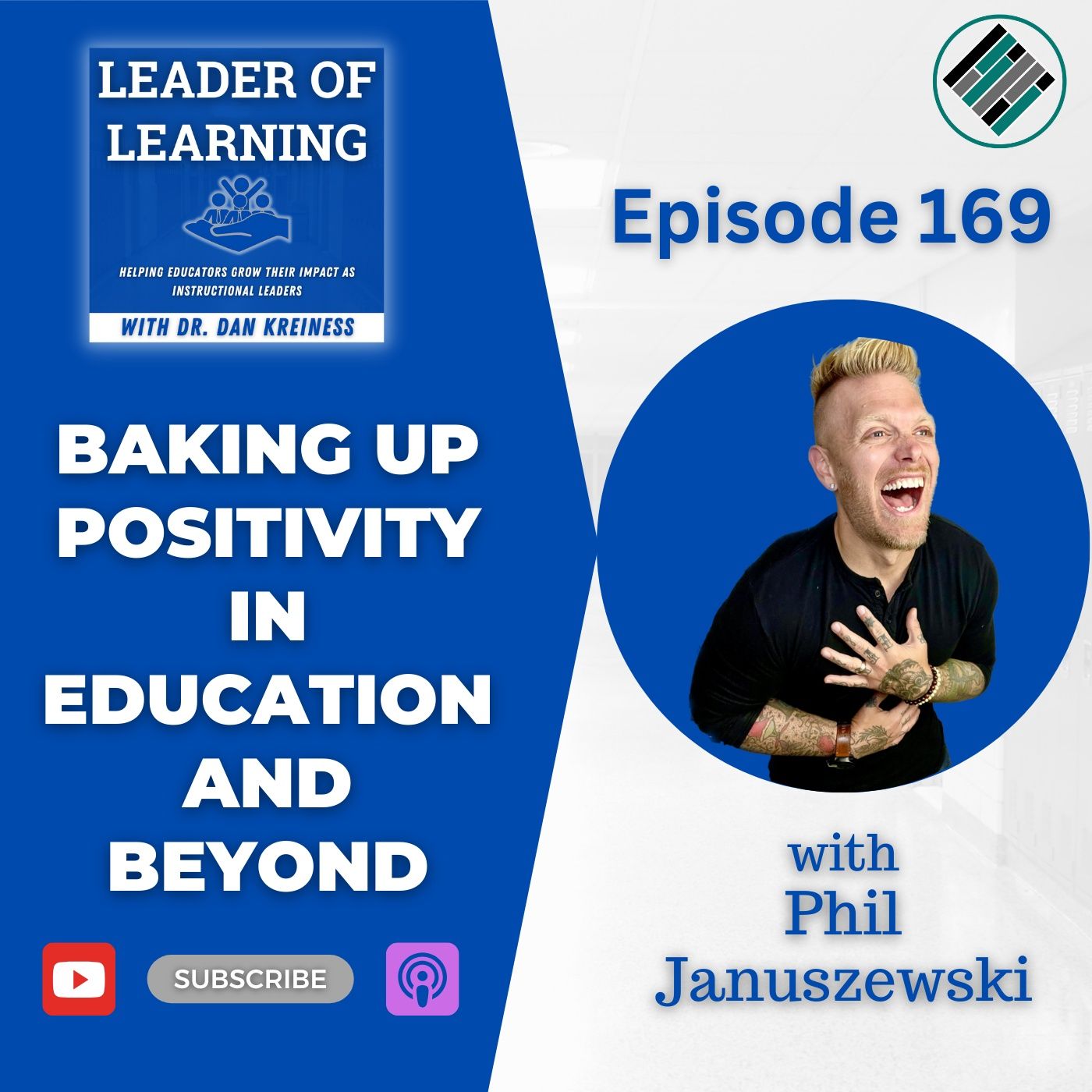
Welcome to episode 169 of the Leader of Learning Podcast. In this episode, we will hear from Phil Januszewski, a dynamo in the realm of education known for his infectious energy and mission to infuse happiness into the world of teaching. Since...

 Apple Podcasts

 Spotify

 Castro

 RSS Feed
Welcome to episode 169 of the Leader of Learning Podcast. In this episode, we will hear from Phil Januszewski, a dynamo in the realm of education known for his infectious energy and mission to infuse happiness into the world of teaching. Since stepping into the classroom in 2005, Phil hasn't just taught chemistry and physics; he's also become a beloved motivational speaker who champions the well-being and upliftment of educators everywhere. Some of you might even recognize him from his whimsical foray into the "Nailed It" baking show on Netflix, where his alien cake became a memorable highlight.
Phil's powerhouse teaching strategy draws from the science of energy, motivation, and the pursuit of flow states. His structured schedule approach creates that coveted sense of calm and control that so many educators seek. This episode will delve into his fascinating insights on the art of giving and gratitude, including how his passion for baking enriches the lives of coworkers and students.
We'll also explore how Phil's interest in positive psychology led him to the Flourishing Center, and how this knowledge shapes his teaching and life philosophy. Today, he stands as a testament to balancing life's many roles: as a father, creator, worker, and teacher, Phil knows firsthand the importance of flexibility and decluttering our lives to focus on what truly brings us joy.
Guest Information:
Phil Januszewski is a tattoo-covered, Netflix baking-show flopping, high-energy chemistry/physics teaching keynote speaker and coach who is on a mission to create and spread happiness through education, motivation, and entertainment. He empowers his audiences to completely flourish in their personal lives first, in order to ignite passion and purpose in their professional lives as well. Phil is a nationally known dynamic speaker of 10+ years and a public school educator since 2005 with a bachelor's in chemistry, a master's in teaching leadership, and a certification in positive education. When not teaching, speaking, or supporting educators, Phil enjoys everyday adventures with his wife and two children and pursuing his personal passions of fitness, baking, networking, and personal development. If you ever meet Phil, be prepared for a great deal of positive energy, love, and passion.
Episode Resources:
Phil's Website
Positive Growth Lounge
This episode is sponsored in part by MagicMind, the world's first productivity drink. Visit https://magicmind.com/LL and use the code LOL20 at checkout to enjoy 20% off. If you want even more MagicMind, that same code will also get you 56% off on the 30-pack subscription!
**************************************************************
TAKE MY NEW LEADERSHIP STYLES QUIZ!
https://dankreiness.com/quiz
**************************************************************
ACCESS MY INSPIRING RESOURCES:
SUBSCRIBE TO MY YOUTUBE CHANNEL
Sign up for my email newsletter
50 AI Prompts for Instructional Leaders to Revolutionize Your School
The Teacher’s Guide to Becoming a School Leader“
0:00 And when we can show up to not only our personal lives but our work. With that energy, we're able to take on the unique things that happen to us every single day. Welcome to the Leader of Learning Podcast. I'm your host, doctor Dan Krinis, and this is where I help educators grow their impact as instructional leaders because my research and leadership experiences have led me to understand that someone like you, regardless of your role or your title, can have a tremendous impact on your organization. I chat with inspiring guests who are truly making an impact as instructional leaders. Whether this is your first time listening or you come back for more, I hope you've subscribed to this show on your preferred podcast app so you don't miss any of the great episodes, topics, or guests. Anyway, I'm so glad you've tuned in. Now let's get started. Welcome into another episode of The Leader of Learning Podcast. I have a great episode in store for you with an amazing guest, Phil Jannazuski.
1:11 But before we get there, I just want to let you know that by the time this episode comes out, we're in April, and if you're an educator, like me. You're down to the final couple months of the school year, believe it or not, and this might be the time of year where people start looking to make some changes in their careers. Some people might even look to leave the classroom, but not because they want to leave teaching. It's because they want to move into school leadership, becoming a coach or an administrator, and I have a good resource for that. So I just wanted to remind you that I have a guide called The Teacher's Guide to Becoming a School Leader. If you're interested in taking that next step in your career, you might want to check it out. It's at dankrinis dot com slash guide. I hope it helps you fulfill your goal of reaching the next level. Now, let's get into this episode. Since stepping into the classroom in two thousand and five, Phil Janezuski hasn't just taught chemistry and physics, He's also become a beloved motivational speaker who champions the well being and uplifting of educators everywhere. You might even recognize him from his appearance on the Netflix show Nailed It Anyway. Phil's teaching strategy draws from the science of energy, motivation and the pursuit of flow states. This is a great episode. We had an amazing conversation and I can't wait for you to listen. So coming up after these messages is my conversation with Phil Fear of Learning. Welcome back into
2:43 another exciting episode with a great guest, Phil Janezuski. He is a tattoo covered Netflix baking show flopping high energy, chemistry and physics teaching keynote speaker and coach on a mission to create and spread happiness throughout education and motivation and entertainment. He is a nationally known dynamic speaker and been a school educator since two thousand and five with the Bachelors in Chemistry, Masters in Teaching Leadership, and Certification in Positive Education. Phil, Welcome to the show. Really excited to have you because I think definitely this idea of keeping things positive and education is extremely important and honestly, very timely because we're kind of getting into the crunch time right like April May June, we got state testing going on, probably where our listeners are coming from, and then of course wrapping up the end of the year. So really excited to dive in before we do. What else can you tell us about who you are, where you are, and what you do. Thanks so much, Dot, I've got a pleasure to be here. Yeah. By day, I'm a chemistry physics teacher for the last nineteen years. By night, I'm actually a motivational speaker, So I go around the country lifting up teachers, helping them build on their own personal selves first, kind of an upstream approach before we even dive into the professional side of things. And totally was called to do this, just tugging on the heartstrings due to so many great humans, so many great teachers I see
4:15 burning out even the profession. So there's any way that I can help educators. I feel like that therefore then helps students as well. So I'm all in man, just trying to help our fellow educators out. The first question I'm going to ask you is not the most important, but it's the most It's the most curiosity driven. What Netflix baking show? Yeah, yeah, it's a great conversation starter, and Dockett's not a good resume builder for sure. But I was on a show called Nailed It. It's an amateur baking show, and you are set up for failure it's a comedy show. So I had an eight hour professional cake I had to make in two or two and a half hours. It was an alien cake and you cut it open with an execto knife and it came out like a lime coolly ooze. So I had a blast. Man. I like attention, I like entertainment, I love baking, so it was right up my alley. A good fourteen hour day of cameras and chaos. So I ended up not winning doc and not winning the ten grand and my kids were bummed, but I had a great time. I would do it in a heartbeat again, knowing I lost.
5:20 That's cool. No, we've definitely seen that show. I might have even seen you on there and just not known it. But that's a great story to tell, all right. So now for the more important questions now that we got that out of the way. I was just so curious when it comes to being positive and staying motivated. I think where I'd like to start is, you've been in this since about two thousand and five. I've been in education since two thousand and six, so we're right around the same amount of time. And how is it that you keep yourself going at this point. Yeah, I think that everything starts at home upstream, which is what I love to dig in for educators. I've always been someone who's had a lot of energy, a lot of positive energy. Looked on the bright side, been healthy, and that is allowed for energy. So I really started to dig into me personally. What is it about me that allows me to be an outlier in the world of energy, an outlier in the world of being a cheerleader for students, for my coworkers, just having this enthusiasm and this resilience. And I started digging in and realized that I think some foundational things in my life have really helped me to maintain this energy. And I really got into the world of positive psychology in the last five six years and really started to realize that those things that I automatically did, you know, just accidentally, doc if I can say that's my personality really is backed up by science into allowing you to feel like you're flourishing and that So for
6:51 me, I dig into a lot of what I like to call my ers, the things that light me up. I'm a father, I'm a creator, I'm a a worker, outer or a lifter. I'm a baker, a cooker, I'm a teacher. So when I know all those things that I those ers, things that I love to do, and if I'm building them into my day every single day, I am naturally hitting on things that light me up so that when, as we all know, in education, no matter what, there's going to be things coming at you that you weren't expecting. A lot of times that can be either draining or even negative. But as long as we're trying to fill up that bank in a positive way and leaning into those ers that do fill us up, we allow ourselves to be more energized, more resilient. And when we can show up to not only our personal lives but our work with that energy, we're able to take on the unique things that happen to us every single day. The tough parent email, the tough interaction with the student, the new thing that the school is going to try out. They want you to try, but you're also trying to stay afloat with your regular curriculum. So I like to look at the upstring approach for myself because if I'm not good for me, then doc, when you come in with a new idea that hey, let's try this in the classroom fill you can not only do your chemistry curriculum, but it's going to allow them to be more interactive and learn better. I'm able to
8:24 say, you know what, Dan, all right, let's try it as opposed to whoa, whoa, everything's burning down around me. Dan, I can't handle that right now. So the idea that I have that energy already is so important, and I love to dig into that on how we can do that. Once we know the good stuff in our life, we build it into our schedule, and we build that structure, and eventually we get to a point where we have this extra energy, we have this extra vibe to us, and then we can start giving it away. We can give it to our students, we can give it to our families, our communities, and our coworkers. So to go right back to where you originally started, that was natural for me, and I didn't realize that. I was just lucky that it benefited me to be resilient in this line of work.
9:13 So I'm curious, and we will dig deeper definitely throughout the conversation. But I'm curious because in your answer, you started kind of talking about how over the past handful of years, as you've digged dug into the science behind energy motivation, really staying up for the job you're doing, the life you're living, parenting, whatever, what was it that you found out about yourself that actually science said like, hey, this is kind of how to do it. Yeah. I think one of the big ones is like reaching a flow state when you find yourself doing the things where you get lost in the time and your mind kind of checks out from everything else and you can dive in.
9:56 And when you hit those flow states, they're really good for you. Not only are they fulfilling and they build you up again that positive mental bank, but also it's a huge stress reliever. So I found that that was one of the natural things. Another one was that I'm a pretty structured guy. And because I'm a teacher, I have two side companies, I have two children, I have a wife, I have extended family. I really need to be cognizant of how I spend my time, and I'm very structured with my schedule, So that naturally happened for me just to make sure that I could do everything well. And I realize that when you build in like schedules and structures mentally, your brain feels more in control. It takes less energy to think of, oh what am I going to do next? What about this? And balancing, so that structure allows our brain to feel more calm. It allows our brain to feel more like we're in control, even though Dan, you know, nothing's really in our control completely, especially in this line of work. So the positive psych totally backed that up as well, which was great. Again, I just lucked out that that naturally happened to me. And then also the sense of giving and gratitude. One of my favorite things about being an educator and a co worker is I like to do little quirky surprises and gifts and pay it forward style vibes, if you will, to my coworkers and students. And one of the ways I do that, one of my love languages, Dan, is like baking. I
11:28 like to make cakes and make them for my co workers and you know, wow, I can't believe that surprise, you know. And I like to whip out some skillets and make pancakes for my students and we just come together as a family and even though we're learning, we're also connecting. So for me, that's one of my like just unique, quirky things about me, But every teacher, every person has their own gift that to them doesn't seem like a big deal. To me, Cooking and baking for a bunch of people isn't depleting. It actually built me up. So when I can lean into what I call lean into your purpose, lean into your passions, when I can do that and give that to others, it not only fills them up, but it fills me up as well, and it allows me to be happier and create this positive upward spiral. So me doing that, I didn't even realize backed by positive psychology, the idea of giving and gratitude and expressing that also fills me up. So really it was cool. I got so into it that I went to the Flourishing Center and took like a thirty two hour course on positive psychology for educators specifically, just because I got so into this and I was curious, what am I doing that's supporting that and what other things can I do to help my classroom. So I just kind of became obsessed with it. It's just a new thing, and I've really enjoyed it because it's allowed me to be happier but also allow me to help my coworkers, my family, and my students be happier too. Hey,
13:00 Leader of Learning, we'll be right back with the episode. But I'm really loving all the positive energy that Phil is bringing in this episode, and it reminded me to talk to you about a product that I've been using to boost my own energy and productivity, and I think you'll enjoy it too. It's called Magic Mind. Magic Mind is the world's first productivity drink. It's a subtly sweet shot made with all natural ingredients that you drink for a boost of energy and focus, to conquer procrastination and elevate your mental clarity. You know that I'm a pretty busy guy juggling a full time career, family and small business, and if I'm being honest, it's pretty hard to keep up with everything. That's why I decided to start adding these drinks to my morning routine.
13:43 I drink them along with my breakfast in the morning, and it allows me to stay focused on everything I need to get done each day. Normally, coffee is my drink of choice to get that energy boost, but I only have one cup per day because any more than that and it can make me a little jittery. So honestly, at first first I was hesitant to try magic Mind. I thought it would also cause those same jitters. But what I found out was that these productivity shots are actually designed to be consumed as a supplement alongside your current morning routine. That's because Magic Mind has only minimal amounts of caffeine and is scientifically designed to boost energy, enhance focus, create a sense of calm, alertness, and increase overall productivity while not increasing the body stress hormone cortisol like coffee. Well, anyway, if you're also looking to boost your energy and memory while increasing your focus but decreasing your stress, then Magic Mind might just become the best part of your morning ritual.
14:41 Just for my listeners, Magic Mind is offering a special discount. Visit magicmind dot com slash lll and use the code LOL twenty at checkout. That's magicmind dot com slash lll and code lol twenty to enjoy twenty percent off. And if you want even more magic Mind, that same code will also get you fifty six percent off on the thirty pack subscription. Cheers to be in more productive. That's really cool, you know. One of the things that I heard you say throughout that answer, or at least that I was kind of reading between the lines, is it's helpful to I think you said dive in or dig in to your your passions and your interests. But you also talked about really making sure that you have a system, a structure, a schedule to not just fit everything in. But to I don't want to put words in your mouth that seemed like what you were saying is like you want to make you want to make sure you're making time for everything. And I don't think correct me if I'm wrong. I don't think that means that it has to be equal time, but just enough time right to devote to everything.
15:48 Because I know one of the things for me that I've really kind of I don't want to say perfected, but one of the things I've really gotten to know throughout life and especially going through my doctoral program a handful of years ago, is like, sometimes you do have to pour into a certain bucket more than another one, and maybe you need to reverse that at some point, but like sometimes you just need to kind of prioritize. So I guess what I'm really trying to ask is like, if it's important to have some things going on that you are using for this kind of positivity and motivation that aren't your job, your work life, maybe even you know, I mean, let's face it, maybe not even our family, because for some people, work is not just a you know, I don't want to say an escape because that makes it sound like you really don't want to be with your family.
16:38 But it really does charge you up, fires you up, it gives you that energy, but it's more about like balancing. So I guess what I'm really asking is like, how what's a good way then for people to systematize and schedule and make sure that they're devoting enough time or really thinking about how much time to devote to each of those things. I would think that your schedule is not only flexible, right, it's going to consistently change. And as you said, you go through seasons when you are working in the doctoral program. I'm sure that some things had to get put more on the back burner as that came to the forefront. And I think that that's super important to be cognizant of and just accept the fact that sometimes in seasons more some things are more important than others. So yeah, equal time. I would never say that, and sometimes the things that light you up you don't need a lot of time for. So for me, music is a huge part of my life. So as long as I'm getting in some solid, you know, ten fifteen minutes of good music throughout the day, that fills whatever mood I'm in, that fills me up enough. I don't need an hour of it now in my stage in my life, I have an eleven year old and an eight year old nine she would get upset she just turned nine, actually a nine year old. I think that I've tried to get as much time as I can with them, while still I don't ever want to try to do a job but only do it halfway. Whatever I do, I want to do it well. So that's the hard part too with
18:11 scheduling, is that I found you have to start decluttering even the things that you enjoy, but you start asking yourself what value is this bringing me even if I enjoy it. So one of the things for me that not everybody loves to hear, and I'm not saying everyone needs to do this, but for me, it was an hour of television at night. I eventually got rid of it, just I enjoyed it. It was decompressing. It was a nice habit. I looked forward to it, but in the end, when I really thought about it, it really wasn't fulfilling me as much as reading, learning, video, editing, creating. I get more payoff from that. So a lot of times when we start getting into this idea of how do I make a structure, how do I build a schedule, we'll also start to find, oh, I wish I had more time for this.
19:00 When you start looking at well, do I really need this in my life? I know it's a habit, I often do it, but is it as valuable to me as something else? So when you really start getting into that, and I've been lucky to do that, I've been a youth motivational speaker since twenty thirteen and balancing side jobs with full time career and family, it was important to build that structure. And there have been times where it's been out of balance, and man, you can feel it. And then you have to start shifting and being realistic and transparent with my spouse, with my business partner to figure out where it all fits. So I know it's easy to just talk about you know, you need to set a schedule but it is a sloppy process, just like anything else. So I would recommend the first place to start is by small things, maybe with a morning routine. Maybe just think about what do I do in the morning. Does it fill me up? If it's not, is there anything I could do to make it slightly better? So try to start making little tweaks and parts of your day. Maybe it's during school, during lunch. Are you eating lunch with coworkers? But unfortunately it's just a really negative environment. And even though you may agree with a lot of it, is it serving you well as opposed to Maybe I found myself some years eating lunch in my car, the windows down, just because I'm decompressing. It's quiet, I like the fresh air, a little vitamin D. So whatever serves you, you start to pick away at it, and then once it starts working, I think things naturally start weaving into a better schedule. And I think as educators we're
20:33 pretty lucky because we already have schedules seven eight hours a day anyways, with bells and where we're going. So if we can extend that just a little before work and a little after, I think it'll be a really natural progression. Speaking of which I think that's a good segue. You use the term before, And I've been really trying to be honest, and I'm no judgment or anything. I've been trying to avoid the term burnout only mainly because I almost think it's become really too cliche for educators to kind of quickly go that route. And to be honest, I feel like I've been seeing education influence influencers kind of taking advantage a little bit of this period in education history where so many teachers are feeling the burnout. But I mean, the term is what it is, so you know, if if teachers are feeling burned out and they do spend like you said that seven eight hours of the day in school and they're still feeling like they got to take work home with them, or it's just not as easy to fit things in as you know, as we want them to, Like we were already saying, kind of try to schedule in some things like what other advice might you give to and and keep in mind, I have a pretty mixed bag of an audience. We have classroom teachers, we got school administrators, we got higher ed like, we
22:04 got a lot of people listening right now, so as specific as you can, but keeping in mind, we got a lot of different you know, job titles and descriptions and things like what happens when we're really feeling that burnout? And look, we started by saying, we still got a couple of months left in the school year, so what are we doing? Yeah, I like how you said that too. I tend to think of burnout maybe more as uninspired or just tired, you know. So I agree with you that that's now the blanket statement. And it is a bit cliche, though there are plenty of people that are just shutting down and overwhelmed and leaving the field. But I think you're right. We've been talking a lot about in the education system. A lot of people are feeling like, for lack of a better term, like death by paper cuts. There just seems to be a lot of little jabs going our way. There's feel people don't feel a sense of trust in some teachers. You know, the system keeps changing, and change is tough on a brain. There's just a lot of changes going on and it is scary to the brain, right, And we're trying to the main idea, The main goal of the brain is to survive. So it is a unique situation for sure, but I agree. I think my biggest fear is that if we're showing up to work uninspired, then it's hard to push through. So you're right, so say you've you've got a schedule, but you're still overwhelmed. In that, I think it goes back to those basics that probably anyone that is you know, quote unquote a burnout coach would say is that you have to set realistic boundaries. And no one wants
23:37 to hear that because that means putting your foot down and easing off something. So I agree with you. A lot of influencers are cashing in on that burnout term to get your attention. But then if for some of them, they have some advice that is interesting to hear, like maybe the amount of assignments you're grading and setting up, maybe you're creating a work cloth that isn't necessary. Is there a way that you can lean on your instructional coaches to find a way that's more efficient for their learning quicker, but also less burden on you? And I think in my second half of my career now every decision I make asks is this going to allow my students to learn better.
24:19 And then also, is this going to create more work for me the same amount or less in the end, Because if it's a dramatic more, then I need to think about is there a different way to do it where I can still allow my kids to learn better but not put all the burden on me. And I think when I've taken that approach, it served me well because my job is manageable when I make those decisions decisions intentionally. So that is a pride swallowing thing though, right Dan, Especially if you're talking to a coworker who's just hanging on. They're exhausted, they're not sleeping while at home, their home life's a mess. They're coming here, they're putting out fires here, hard for them to not be well. As your latest podcast episode, I was just hearing you're talking about people are resistant to change, right, So if we're not taking care upstream of ourself first, then it is hard to even pull back a little bit and see the big picture.
25:18 So I would say the boundaries and the decisions we make are important, but it's hard to do that if we're in such a rhythm and such a survival mode. It is hard to make those changes. And that's why I'd say lean on your instructional coaches because they can definitely see the bigger picture and maybe help you, and that'll help you get more control. And then another thing too, is that even if work is a little bit of a mess, there are basics that we've learned since kindergarten that make all the difference, and that's getting your sleep and taking care of yourself and trying to eat fairly well balanced. And when you do those three things, a lot changes in our life. And a lot of people say, I just don't have the time to get seven eight hours in and I fully respect that, but is there a way to declutter more things? Are there things that are in your life that aren't as important as sleep? Because when you can take a little bit better care of yourself, all of a sudden, you do have that energy to start making better choices. And then when Dan shows up and says, I got this idea, and I think it's going to make your job quicker, easier to grade, but also they're going to retain it so better.
26:33 They're going to be able to be open minded to and be like, all right, let's try it. Then I'm all ears anything down for helping kids learn more and also helping me with my job. This podcast is a cloud member of the Teach Better podcast Network, Better Today, Better Tomorrow, and a podcast to get you there. Explore more podcasts at www dot Teach Better Podcastnetwork dot com. Now let's get back to the episode. You know, as you're talking, I was kind of self reflecting a little bit about a couple of moves that I made in my career to help try in like you said, declutter in terms of my instruction, especially one I was. I was a classroom ELA teacher for a while, and one of the big shifts I made was I realized I was doing way more work on student writing than they were. So when I implemented things like peer editing and you know, more of a concerted effort for like revisions and things, and and for the students themselves to take more ownership over their own self editing and self assessment, that helped a ton. I wasn't, you know, I wasn't reviewing each essay that the students wrote with such a fine toothed comb anymore. It was like it was a relief. It definitely was the other thing I did, even after I was in an instructional coaching role for a while, and I was put back in the classroom for a little bit. I started using what's known as layered curriculum, a little bit like choice boards or other student choice
28:07 related activities, where I did a lot of planning and I front loaded the units By building out these these tiered or leveled activities. Some students could kind of only complete the ones at the lower level, other ones went further. So it was a system of differentiation. But what I realized was sometimes even though I did a lot of planning up front throughout the course of the unit and even the lessons themselves, so much more time was turned over to students versus me having to kill myself planning every single day or every week, you know, laying out the lesson plans for the week and all that. Like it was kind of done for me. Yeah, I had to spend a lot of time planning it up front, but once I did, you know, it kind of took care of itself after a little bit. And then I would say too, like for me, honestly, I've never had well, I shouldn't say never, I've briefly only ever had less than about a forty five minute commute each way to and from the schools that I've worked at, sometimes over an hour each way, and I enjoy driving, to be honest, And it's I think because of some of this, Like it allows me to kind of get fired up in the morning, it allows me to sort of decompress on the way home. And not everybody can do this, but I do really enjoy go figure, listening to podcasts and kind of getting some professional development, let's say, like personalized professional development during my commute.
29:41 Sometimes though, I listen to audiobooks or something different, and it's just like I use my commute as a way to do some of this as well, because even though I can't really quote unquote work on anything concrete in terms of you know, my work or my family. Like even that time that I'm in the car driving, I'm trying to stay mindful. I guess of some of these things too, and things that will get me into what I'm doing, whether it's at work or at home. Yeah, it's like the drive by university, you know what I mean. I do the same thing. I have a thirty five minute drive and it's I'm a learner. That's one of my errors, and it's a podcast or an audiobook, and I agree with you. It's time that could be dead, or it's time that could be used for reflection, or it's time that could be used for growing.
30:33 But you know that that helps and benefits you, and what I do benefits me. But being intentional about that is really being useful of your time. So I'm totally on board with you. And then when you were talking about the choices you made in your classroom, the two of the biggest choices I made that made the hugest impact for me as far as workload. But helping students is for every single traditional physics and chemistry worksheet that we do, you know that's still typical we still practice. I have an answer key available and I've made a video of every problem going through, and I have students some that go right to the video, headphone in and follow along with me. I have some students that look at the answer key, try look work.
31:15 I have some that do neither. Do it separate and they grade themselves. But in the end we check in the work. I answer individual questions. But it's freed up so much time of me going through every problem. It's now specific to that learner. So we say, all right, everybody's in different spots who you know, call me over, and then they do, Hey, I struggled with this one. Looked at the answer key in the video. I still don't know where this number came from. I'm like, now we're talking, we're getting specific questions that they care about, not the ones that I think they should care about on the board. So that was game changer for me, and you're right, it was a lot of work up front, but worth it in the end, especially for my students who miss a week or that they you know, like, hey, I don't know how to catch up, Like, take your time, go on the class schedule, you can start watching my videos. Little by little, you're gonna be able to catch up, no problem. And it's a lifesaver for me too because I don't have to I don't have to find that time to help them, and while my other students they can get that and then come with specifics. The other thing that's really changed the game for me is every unit I have small quizzes in there and then the big unit. The quiz scores are whatever they can get doesn't matter, because at the end, whatever that unit test is if their test score is higher than their quiz grade, I bring the quiz score up to that test percent. The goal for me is that I want them to know that a quiz is a speed bump.
32:36 It's just hey, we're figuring out where we're at. Hey, man, you only do sixty percent. You aren't ready for the test yet. But that's okay. That sixty percent is going to go a way because in a week and a half you are going to crush this test. But now we got to dig where are you weak? Where do we need to get the help? And that's what's great. I dangle the carrot because, as you know, Doc, I mean, they're worried about the grade, but what they're accidentally doing, and I ran mind them constantly, you're actually doing the learning process. You're figuring out what you know and don't know, fixing the weak spots, and now you're crushing the test. My grades have gone up because of that. Their knowledge has gone up because of that. And also it takes a lot of stress off them. Like I did poorly on this quiz, I'm freaking out. No no, no, no, no, let's just let's work a little bit each day. You're gonna be ready.
33:22 It's we're built for this. And I tell you it has alleviated so much pressure on them, so much pressure from the parents to them because the parents know as well, okay, this wasn't great, but make sure you're going into mister j get some help on those week spots so we can crush that test. So I don't know if everyone would love that, but I think it's been a huge game changer for me and the success of my students. Well, that's great. And again I think in the similarity between the stories that we've both shared is well two things. One figuring out systems that will work for us and in our class rooms and with our students that shares more of the responsibility, right, And in education we talk about the gradual release, like this is releasing some more responsibility and empowering students to do a little more, but to share. It's it's in the name of sharing that workload, right. And you know, dare I say, being for the teacher to be that guide on the side where you know, a little bit less work, I don't, well, I don't want to say like you don't have to work as hard, but like a little bit less work for you a little bit more on the plate of the students, might you know, alleviate some of that stress. You mentioned the ers, and one of them is learner. What are what are the other ones? For me? Learner?
34:42 Father, creator, lifter, like music listener, like a reader, lover, teacher. I got a lot of ers, and we talk about that too when I speak with educators. There's ers we have that don't necessarily fill us up, but they're part of our life and they're important. The important thing to know is what are the ers that build us up? And how are you hitting on them each and every single day, Dan, even if it's five minutes. But like you, you're structured guy, right, you're hitting a big drive there and back. Think of the wisdom, the inspiration you're gaining because you are a learner. Now. I'd run into a lot of teachers too who say, I'm embarrassed to say, Phil, you know I'm thirty five or I'm fifty five. I don't really know what my ers are. I don't really know what I like. So I always try to get them to go to the Via Institute, which is one of those quick surveys, and they look in your character strengths and they give you your top five. So for like me, mine is like love, humor, curiosity, learning, and something else. I forgot the fifth one. But you can start looking at all, right, if you don't know what your ers are, at least you know, like, what are your big strengths that you can get in a flow state with and then how are you introducing those daily? And a lot of people can definitely shove it aside, you know, just like you try to get some new instructional tools or techniques and they're resilient. A lot of people are resilient about you know, your character strengths. They think it sounds hippy dippy, you know I And there's actual science to back it up, even though you know it's called like soft skills,
36:13 which is an accidental way they coin that. I didn't realize that hard skills when the military was like holding machines and guns, so they called everything else soft skills, and it made it sound weak, even though the military never made it to sound like that. I just heard that recently. I thought that was fascinating. But anyways, the more we know about ourselves and the more intentional we are about building in not selfishly but intentionally the good stuff. You're going to be more resilient, You're going to be more patient, you're going to be more friendly, you're going to be more energized. You're going to be able to roll with the punches, and that's going to allow you to do everything better, not just reach students, but enjoy your life, be a better partner. Everything that's great. As we wrap up and wind down a little bit, I want, well, first, if there's anything else that you have been able to share or I haven't asked you, please use this time to do so. But also, we got a couple months left in the school year. I think some of the audience may only have like two full months April and May. I have a couple of weeks into June and some people do too. But we're winding down. So as you wrap up, and again, if there's anything else that you want to add, give us, give us like a mini motivational speech, like how do we what's the best way for us to get through the rest of the school year? You got it. Before I go into motivation mode, I do offer I have a educator membership program called the Positive Growth Lounge, and we meet twice a month virtually on Wednesday nights at seven thirty pm Central, and alls we do is pour into each other. And then I'm kind of
37:45 I'm the lead coach, and we have one new positive psychology topic, super light, nothing too heavy. But it's all about not pedagogy, not about instructional strategies, even though those are all important. It's about pouring into ourselves that we can show up better for our life and in the classroom just as importantly. So if anyone's interested in that and they hear this, just reach out to me via email and you're more than welcome to be a guest to check it out and see if it's your vibe. The more the merrier. We are a small but mighty group that pour into each other. So thanks. I just wanted to make sure I mentioned that. And then as far as shutting her down, here, doctor Dan, let's do it. Friends. We have to be intentional and take control of our happiness and the idea that we can flourish. Happiness is like a leaky tire, it was said, happiness, you build it up no matter what. Eventually that tire will deflate. Happiness is not something we reach and it stays forever. It's something we actively pursue. The way to do that is to build in into our schedule the things that fill us up. And when we do that, it takes less energy to hit on those things. And by the end of the night, when you put your head down on that pillow, you have checked so many any positive boxes without even having to try that it's not exhausting, but you only are left with the sense of gratitude, a sense of inspiration in that a positive bank to start your day for the next one. And it takes intention, it takes work and energy, but I swear to you it's worth it. I live it, I love it, and I love
39:19 trying to help people get there. So Doc, thanks so much for your time though. It's been a pleasure to speak with you and to your audience as well. Yeah. Great again. All the links to connect with Phil and find his positivity programs and everything he does websites are Phil Jenazuski and also Positive Growth Lounge dot com, and of course all the links and social contacts and emails will be in the show notes for this episode. Phil, thanks so much. This was really great, and you know, of course it's always just an amazing opportunity to talk about how to stay positive and motivated as an educator, because sometimes it's not easy. So thank you so much, my pleasure. Thanks for having me. We'll have to swap some good book ideas soon you're a learner. Well that's it for this episode. Thank you so much for listening. If you haven't done so yet, don't forget to subscribe to this show on your favorite podcast app. If you enjoy the content covered on this show, I want to ask you to do this one thing for me. Please share it. The biggest favor you could ever do for me is to please let others know about what I'm doing and how I'm helping educators grow their impact as instructional leaders. I hope you can share this podcast with other educators, leaders, friends, or anyone you think would love listening and learning. If you're interested in leaving a positive rating and review of this
40:51 show, links to do so are always in the show notes for every episode. For more information about me or this show, and to access the great content that I share, please visit my website at Leader of Learning dot com. That's where you can find my online courses, YouTube channel blog, how to connect with me on social media, and even ways that you can support the show like donating or purchasing Leader of Learning merchandise. Thanks again, and remember, no matter who you are or where you are, you are a Leader of Learning.