Quiet Leadership: Unveiling the Power of Introverts in Education with Alex Valencic
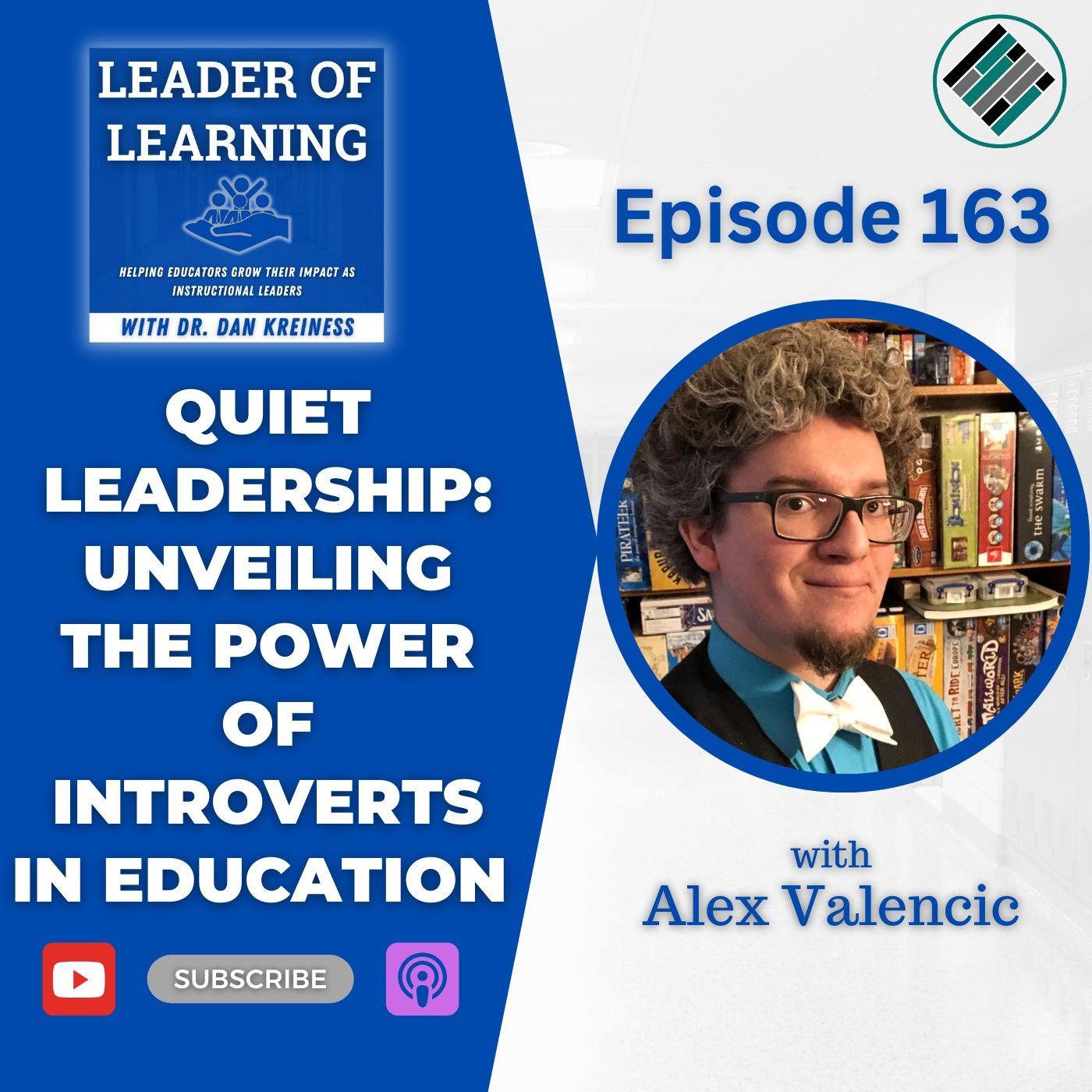
Episode 163 of the Leader of Learning Podcast features an interview with Alex Valencic (@alextvalencic), a professional learning coordinator in Freeport, Illinois. Alex joins us to delve into the world of professional development in education. We...

 Apple Podcasts

 Spotify

 Castro

 RSS Feed
Episode 163 of the Leader of Learning Podcast features an interview with Alex Valencic (@alextvalencic), a professional learning coordinator in Freeport, Illinois. Alex joins us to delve into the world of professional development in education. We discuss the shift towards personalized and teacher-driven learning, sharing examples from Alex's district. The conversation also explores the importance of learning from and observing other teachers, as well as the unique challenges faced by introverted leaders. Alex's insights and personal experiences offer valuable perspectives on effective leadership and fostering an inclusive educational environment.
Full show notes and more information about this episode can be found at https://leaderoflearning.com/episode163.
Download my free guide “The Teacher’s Guide to Becoming a School Leader” at https://leaderoflearning.com/guide
Purchase “The Transformational Leader’s Reflection Guide” at https://leaderoflearning.com/journal
Download my FREE eBook “Lead to Inspire Growth” at https://leaderoflearning.com/ebook
Enroll in my free course “Unlock Your Leadership Potential” at https://leaderoflearning.com/freecourse
Sign up for my email newsletter at https://leaderoflearning.com/news
SUBSCRIBE ON YOUTUBE at https://youtube.com/drdankreiness to watch inspirational and educational videos about leadership and digital learning
Consider Becoming an Official Sponsor - https://leaderoflearning.com/press-kit
Talk Studio is my recording platform of choice for video, audio, and even live streaming. For more information about Talk Studio and to receive 20% off your first billing cycle on ANY paid plan you sign up for, visit https://leaderoflearning.com/melon
Gear that I use and love to recommend:
Mirrorless camera (Sony zv-1) - https://amzn.to/3zdxKlR
Main microphone (Shure SM7b) - https://amzn.to/3Mi5SzE
Backup microphone (Shure MV7) - https://amzn.to/38M9Vqv
Budget microphone (Samson Q2u) - https://amzn.to/38MeukB
Audio Interface (Focusrite Scarlett 2i2) - https://amzn.to/3xdocWq
Wireless lavalier microphone (AnkerWork M650) - https://amzn.to/3TUlsXN
Key lights 2pk (Sokani P25) - https://amzn.to/3mcNq0X
Ring light (Neewer 18”) - https://amzn.to/3tfnB46
Budget studio lights (Neewer Dimmable LED 2pk) -
0:00 So you're a leader of Learning right, But are you an introvert or maybe shy or a little quiet at times? Can you still lead and do your job effectively? That's what we're going to discuss in this episode Stick around. Welcome to the Leader of Learning podcast. I'm your host, doctor Dan Krinis, and this is where I help educators grow their impact as instructional leaders because my research and leadership experiences have led me to understand that someone like you, regardless of your role or your title, can have a tremendous impact on your organization. I chat with inspiring guests who are truly making an impact as instructional leaders. Whether this is your first time listening or you come back for more, I hope you've subscribed to this show on your preferred podcast app so you don't miss any of the great episodes, topics, or guests. Anyway, I'm so glad you've tuned in. Now let's get started. Welcome back once again, Leader of Learning too. What is the first interview episode that we have had in a while. I'm so glad you're joining us, and I'm so glad that you've come back to us after a hiatus that we took here in the summer months and early in the fall, but we're back, and I just wanted to start out by saying that if you do enjoy, and maybe you have enjoyed for a while the content that's shared on this podcast,
1:32 but you're not yet connected to the Leader of Learning community, please go ahead and sign up for my email newsletter. The easiest way to get there is by going to Leader of Learning dot com, slash news or following the links in the show notes below, or on my website. If you follow the Leader of Learning newsletter already, I really appreciate it. But if you're not yet, go ahead and click the link or get to the the web page that I just listed and join us there for some really great content and of course updates about what's going on with Leader of Learning and the amazing content that gets shared. As for this episode, we have a very special guest joining us. Alex Valencik is an educator, former small business owner, and devoted advocate for professional development with a wealth of experience in a variety of education roles.
2:28 Alex currently serves as the Professional Learning Coordinator in Freeport, Illinois. During our conversation, Alex and I delve into some interesting stuff about the ever evolving landscape of professional development and education. We're going to explore the need for a shift away from traditional sit and get models toward more personalized and teacher driven learning experiences. We're also going to discuss the powerful impact of teacher to teacher learning, emphasizing the value of obs and learning from one another's classrooms. Alex even shares insights from a book he's currently reading about job embedded professional development and the importance of creating space and time for teachers to learn and grow together. Finally, Alex brings a valuable perspective to the table as we explore the topic of introverted leadership. We discuss how introverts can thrive as leaders and leverage skills such as listening, inclusivity, reflection, seeking consensus, and mediating conflict. Throughout our conversation, Alex's passion for supporting educators really shines through. He shares stories of his own journey from overcoming self consciousness about public speaking to his commitment to creating safe environments where all voices are heard and valued. If you're an educator seeking fresh ideas, professional growth and a network of like minded individuals. This episode is for you. Get ready to be inspired, empowered, and equipped
4:00 with the tools to become a true leader of learning. So coming up after these messages, stay tuned in as we embark on this educational journey with Alex Valencik all right, Leader of Learning. Welcome back to this episode and welcome back to the show again. Took a little hiatus, but we are back now and bringing on the first guest in a while, Alex Valencik. Alex Valencik, sorry, Alex and I have gotten to know each other quite a bit over the last couple of years, especially with the connections we have to to Teach Better team participating in the Teach Better conference, the admin mastermind various Voxer and Facebook groups, and someone who I think is very, very knowledgeable about a lot of things education and we're going to get into that in just a minute. Let me tell you a little bit though about Alex. He is. He does it all. He's an educator, former small business owner, boy scout leader, volunteer, drug prevent specialist, and as he calls it, a geek of all things. He's worked as a substitute teacher, a fourth grade teacher, curriculum coordinator, and since July of twenty twenty one, he's been serving as the Professional Learning Coordinator in Freeport, Illinois. And there you go. I think both of us share that passion for professional development and supporting and coaching teachers. So Alex, welcome to the show. That was a lot, But if there's anything else I missed, please go ahead and let the listeners know a little bit more about who you are. Oh,
5:31 I mean, I think that definitely guys catch a lot of it. I'm excited to be on the show. I am a massive consumer of podcasts and a few years ago I got onto a podcast in first one actually it's actually the Teach Better Talk podcast way back twenty nineteen, I think what's when. I was on it for getting ready for the Teach Better nineteen conference way back when. And I've been on a bunch of podcast since then, but I've listened to so many of them, and yours it's wanted that caught my attention, and I've listened to every single one of the episodes. So I'm excited to be a part of it and just kind of connect with other people and talk about leading learning. We'll see where the conversation goes, you know, speaking of seeing where the conversation goes, I think you actually led me into a question that I wasn't expecting to ask you, but I really want to. So you're a let me make sure I get the title right, A professional learning coordinator. And you just mentioned how you really love consuming podcasts, and I do too. Obviously, I love consuming them. I love creating this one. And what I really love about podcasts because I listen to mostly educational podcasts, but not exclusively, what I love about them is it allow they allow me to be that lifelong leader and to consume and gain professional learning and personal learning in ways that are not so traditional. So I guess I wanted to start there and ask you why it is you value gaining professional
7:05 learning in these sort of non traditional ways, and maybe what else you do to develop your own learning, and what you would recommend to teachers, especially new teachers, when it comes to professional learning, maybe outside of the traditional stuff that they get from their schools and their districts. So you know, when it comes to like podcasts especially, it was something that my initial introduction to podcasts was a lot of hobby focused ones to hear about like the true crime stories or sports podcast or like the business self help ones, and or there would be ones like kind of the long form storytelling. Episodic storytelling is like, I don't really care about any of that. But it was back about twenty sixteen, when I started interviewing for leadership jobs all up and down the state of Illinois. I'dized like sometimes I'd have like a three four hour drive to get to a job interview, because Illinois is the stage, just like a very long state and a kind of a wide state, and so to have these long drives. And one time I was like, I should look up some education podcasts, so like I can just have some very fresh ideas in my mind when I get into an interview, and that's really what God Me started with it. And that's something I love about them is you're getting ideas that are very fresh, Like you're not waiting for someone to get it published in a book, which you can put in a book proposal, get it accepted by a publisher, and it could be two three years sometimes before it actually hits the market, or like even blogging and like journal articles,
8:39 sometimes there's a delay. It feels like podcasts are very much a real time format of learning, and it also allows me to connect with a huge number of people very quickly. Much almost every time I listened to a podcast, I find some way to connect with whoever that guest was, and of course the person who's hosting the podcast. It's just it's interesting in my role the number of times someone they'll a question will come up about needing some support and providing professional learning on a topic, and I'll be like, oh, hey, there's this person that I know that we could reach out to. And it happens a lot, and someone's like, how do you know all these people? I'm like, well, combination of listening to podcasts, reading a lot of books, and my connections with the Teach Better team, which you mentioned, like I feel like almost everyone I know in education has converged in the Teach Better team. But it's I guess to get to that question though, like why podcast is a form of learning, It's just it's much more raw than other things, Like it's it's hard for people to filter themselves and stript themselves as much when they're doing a podcast, and I really appreciate that side of it, even though it's it's not something that you can get like professional development credits when you're looking at like license renewal. But to me, that's a big part of it is that professional learning is not just about getting those credits that you can submit for renewing the license, but it's about growing yourself as an educator, as a leader, and growing your network to be able to better support students, teachers, families, whoever it is you're
10:11 trying to work with. This podcast is a proud member of the Teach Better podcast Network, Better Today, Better Tomorrow, and the podcast to get you there. Explore more podcasts at www dot Teach Beetter podcastnetwork dot com. Now let's get back to the episode. That's awesome, actually believe it or not. In response to what you mentioned about gaining professional credits or continuing continuing education credits, there was at one time, I don't know if it still exists, there's an educator named doctor Randall Sampson, and there was an actual accredited graduate program that would give you credit for things like listening to podcasts and participating in Twitter chats and some of these really non traditional professional learning opportunities. I'll have to reach out to Randall. I haven't I haven't heard from him in a while see if that still exists. Speaking of not really connecting with people for a while, you mentioned being connected as an educator through social media, and you know organizations like teach Better. The first one that I really used to connect to educators and really branch out in terms of my own professional learning actually was Edgy Match. And I want to get a little vulnerable here for a minute, but I want to ask you your opinion too. I feel that in twenty twenty three, as we're recording this, we are not as connected. I don't feel or at least personally, I don't feel as connected
11:45 as I once did back in like twenty sixteen, twenty seventeen. And I don't know why. It could be the pandemic, It could be stress and burnout has gone way up. It could be that Twitter slash x is not quite the same as it used to be. I'm not sure. I have felt, though, like it's been harder and harder to keep connected with educators that I once did. And I'm wondering do you feel that too, or I guess is it just me? Now? There's I think there's a small group of educators I've been able to maintain that connection with and it's taken a lot more effort on my part to keep that going. Like I'm in a couple of boxer groups. One of them is with edging Match, and I know there's edging Match, like I think you know Sarah, She's got a lot of different things going on with that organization, and I think they have multiple boxer groups, but the one I'm in, I feel like sometimes it may only be like three or four maybe five people who are actually contributing to it, and then like it'll just go silent for a while and then someone will pop in with a question and you'll get a bit of activity and then disappears. I say that happen with Facebook groups. I feel like for me personally, like the changes that have happened with Twitter X, Like I can't just call it X. A good friend Carly Spina, who she does a lot of PD. She shares in one of her sessions and I was just in a workshop session there about a week ago that someone asks me, no
13:16 social media you're on and she rises very quickly that you can't be like, oh yeah, I'm on X, because that just has a very like different connotation when you say that. So it's like I will continue to call it Twitter, sometimes call it Twitter X. But the changes that have happened in that platform, I'm saying just the last year or so, I feel like educators have just left and haven't found a new home to connect with each other as easily as you could before. So yeah, it is a lot more difficult to keep those connections. But also it's a lot more difficult to make new connections with people because pretty much all the other platforms you have to know the person to be able to connect with them. You can't just like, well, I love about Twitter, you could search a hashtag and just immediately connect with a huge number of people, and those aren't gone. A lot of the platforms are the ones who have You still have to be connected with people in order to use them. So yeah, I think in some ways it has been really hard to keep growing and connecting with that PLN. Yeah, I don't know why. I think. I do think a lot of it has to do with you know, Twitter, slash x used to be that place where we all went to connect and do the chats and and you know, really stay up on the latest goings on, and I just feel like it's been it's been different, it's been harder. Anyway. I want to switch gears a little bit because I know that one of the things that
14:46 you mentioned to me recently, that you've been kind of studying more and looking into more is a topic that I find pretty fascinating because I think I can sort of see myself fitting in in this area. But tell us a little bit more about what you've been studying and learning when it comes to people who are more introverted as leaders, so, in other words, like leadership through the lens of people who are more introverted and I guess not quite as outgoing and what's the word I'm looking for, charismatic. Yeah, So I think you mentioned in my introduction one of the things I do is I'm a volunteer drug prevention specialist, and I think most people are like, have no idea what that actually means. There's an organization here in Illinois. It's the Sapling Good Mainteen Institute. It's a youth leadership program that has a focus on drug consubstance abuse prevention. And I've been part of that program since nineteen ninety nine, so it's been a huge part of my life for more than half my lifetime, and they have a summer camp each year, so you get hundreds of like middle school and high school students together on a college campus for a week to learn how to grow their skills as leaders. But there's a lot of those very stereotypical summer campy type things like the rock is loud cheers, the songs that are really goofy and ridiculous, and it's very loud and boisterous,
16:18 and there's a lot of effort to like try to get everyone to engage in these energizers, to break out of shells. And I realized a few years ago that that's really pushing a model of leadership being extraversion. And I'd look around the groups and I started working with the middle school students who were attending. I was a lot of them were introverted and they weren't comfortable participating in the games, the activities, the songs, the cheers. It's not that they weren't interested in the program, that just wasn't a way for them to feel energized. And it really got me thinking, like where what is the role for lead? What is the role for or introverts in leadership?
17:02 Myself, I am a legitimate Ambivert. When I was doing my graduate studies in leadership, we had to do like every single personality test known demand in one of our classes, and every single time on the introversion extroversion scale, I was like exactly fifty percent in the middle. So for me, it's, you know, there are times when I need to be around other people to connect with them and get energized from their presence, and there's other times I'm like, you know, I need to go into a quiet space to have time to reflect, to ponder and kind of re energize and recharge in that way. So I started digging more into this idea of what does it mean for an introvert to get their energy in the first place? And whereise that first and foremost, there's this misunderstanding that introverts are people who are just shy and anti social and don't want people. And we have this heavy influence for movies going back, you know, I when I did a workshop on this, I use the example like even like Greece the musical, The whole overarching plot of this show is this girl Sandy, who's clearly an introvert, needs to be fixed to become an extrovert. And and just goes downhill from there with all these movies in popular culture. So it's like, Okay, how do we tap into those skills? What are the skills that introverts have that help them succeed as a leader. And I turned to work from like Susan Kin, who she wrote that book Quiet and then she wrote a book
18:32 specifically for kids about quiet Power, and she just goes through like, here are the traits that introverts have, and there's some of those really big ones that I think about. It's like the idea of like, introverts very very broadly speaking, are very good listeners. They tend to be inclusive and reflective and want to have environments that are safe for all voices to contribute. And there's usually this trait of introverts of wanting to take time to observe and seek consensus to mediate conflict. And it's not that extroverts can't do those things, but those are traits that are more common for introverts. So when you think about in school leadership, when we're trying to bring about change, you can have that charismatic leader who goes out and gets everyone excited, on fire, ready to go. But sometimes it's nice to have that leader who's more in the background, leading from behind, making sure all the voices are heard and giving an opportunity for everyone to reflect on what they're doing. And that's what I've been focusing my work and have done a couple of workshops on this now is just bringing this idea to the forefront and inviting others who feel introverted to tap into their own leadership skills. Now point out that one of the first things I learned the very first time I did that workshop is that I'm very used to getting feedback from attendees as I'm presenting you from their facial expressions, their verbal expressions. Introverts are bringing it all in, they're internalizing if they're
20:07 thinking about, which means their faces are usually like just deadpan. And I remember the first time I did that workshop, I was like, I have no idea if they're like excited about this, if they're like accepting, or they're just like, what's this guy talking about? He's just completely office rockers, And it's like, I have no idea how I'm supposed to e gauge the audience when my entire audience are introverts who, by nature are not going to express things outwardly. And then I got the feedback and I looked through it and it was all overwhelmingly super positive, and I'll just share it as in aside. The best piece of feedback I got from that session, though, actually had nothing to do with the session topic. It was just a very short sentence that said, you have a good speaking voice. And for me that was huge because I received speech therapy services from kindergarten all the way until eighth grade and have always been very self conscious about the idea of speaking in public. And then it's like, you know, I need to let my voice be heard, even though it's something that I'm always very nervous about, and to have someone give me that feedback and be like you have a great delivery, Like your speaking voice is wonderful. We enjoy listening to you, but more importantly, we like hearing the ideas you share. I want to help other people feel comfortable doing that. So I'm going to be doing a conference session in February. And I actually went to one of the teacher leaders in my district and it's like, hey, you're an introvert, right, He's like, oh yeah, absolutely. I was like I wanted to come to this conference with me and help present on this topic, and he
21:37 was like, that's really scary. I'm like, I'm going to be there beside you the whole time, and he's like, all right, let's do it, and we're going to so just it's exciting to see ways that we can tap into the quiet leaders among us. You said a lot of really fascinating things, and as you were talking, I was thinking a couple of things. First of all, I think anybody listening to you when you go through kind of the descriptions of an introvert and an ambrovert and an extrovert, like they're kind of self reflecting a little bit. And I think for me, I'm right there with you. I'm in the middle. You know. I love going to conferences and getting together with educators and people who I've barely met in person before. Like you, you know, we know of each other, but we've only met in person one time, and even then it was very brief. And I think you were working more at the conference, and you know, you kind of were doing your own thing. But like as you mentioned too, in terms of introverts, just kind of taking a step back and like soaking it all in. And it also got me thinking now that I'm bringing the podcast back around, it's been about four years, almost to the day, back in twenty nineteen. In November, I put out episode fifty five of the podcast with a guest, Chrissy Romano Arabido, and she wrote quiet Kids Count, and it was a little bit more focused on as teacher classroom teachers, not forgetting about those introverted students, the ones
23:11 who aren't always raising their hands, the ones who were kind of you know, off to the side, or or maybe not succeeding as much as you'd want them to in cooperative learning activities and group activities. But but you know, so anyway, if you're listening to this and you haven't checked out that episode, it's been it's been a while four years, but you know, that could be something you check out as well. But in terms of introverts as leaders, I really do find that fascinating. And I'll tell you a quick story, uh, you know, Alex and maybe my listeners remember too, that I became an assistant principal a few a couple it's been a couple of years now, and it didn't last very long. And and one of the things that happened to me that didn't make me very comfortable. And given this conversation about introversion and all that stuff, my principle Essentially he didn't flat out ask me to, but he was basically telling me that I needed to have a bigger personality, be louder in the hallways, you know, in terms of making sure the kids were going in the right direction and doing the right things. And I kind of wanted to tell him, like, that's not really me, And I had trouble understanding why having a bigger personality in his opinion, so it seemed to me would make me a better leader in his eyes, and I really had I had some trouble with that because I
24:41 feel like I'm a good leader, but I also think that there are things that I can do as a leader, like you said, without being so charismatic. So I guess what I wanted to ask you next is when you're thinking about educators, maybe they're teachers who are or are wont to be wanting to be teacher leaders, or maybe they're actually aspiring to get into more formal leadership positions. If you could be maybe a little more specific in terms of thinking about and giving some advice for teachers who are introverted or lean more toward being an introvert, but yet they have these leadership qualities or ambitions. What are things that they might want to think about or can do to kind of, you know, really lead like they want to. So I'm going to first and foremost respond to like that idea of you know, in order to be a leader in a building and you have this big presence is I'm going to go back to Susan Kine and a quote that she shares from Mahatma Gandhi in a gentle way, you can shake the world that you don't have to make that change by being big and boisterous. I will always remember a teacher, she was truly a master teacher, who she had retired and I took over her classroom. She had taught in the same classroom for like twenty five years. There was someone who was hired after me, who was there for like two years, and I came in. She would substitute and I never
26:11 once heard her raise her voice remotely. She just had a very soft, gentle, firm voice. Students always listened to her like every time. There was never any doubt that she was able to command a room without being loud and boisterous, and it was just part of no. I don't know exactly what it was that she had about her, but you could see in her there was a confidence in herself. And I think that's maybe the big thing is for a leader who feels introverted is feel confident in who you are and what you have to contribute. Don't try to be someone else, because especially working in a school, kids they see right through that, like they immediately tell when you're trying to be someone else. So it's being who you are authentically one hundred percent, and you know it's also when it's like when you're looking for those roles I frequently encourage like student teachers and others who I may be working with when it comes to applying that you're interviewing the people who are interviewing you also, and it's not hiding that personality, and it's being able to promote those traits you have that you're there to help build consensus, to help others be reflective, to give the opportunities for every voice to have a share. Are there times when yes, maybe you are going to have to use that louder voice to be heard because it's in a busy hallway and there's
27:45 lots of kids going by. Maybe, but you can also be very quiet as you do that. I love. There's a comic I see sometimes when it's like they talk about you know, your mom yells your full name, but it's even worse when she's just leans in and whispers, because that's when you're like, oh, I'm in a lot of trouble now, because it's like that suddenly changing the tempo. That is a great way to be able to lead in take command a situation is when things are getting loud and getting raucous, using that quiet voice to get everyone's attention. It may not be as quick, but it's still just as impactful. So I think it's just really recognizing who you are and what you have to bring to the table.
28:27 And maybe it's also being like, hey, maybe I'm not the best person to be in the lunch room to try to quiet a cafeteria with five hundred kids. Maybe I'm not the best person for that specific role, which me is part of you you mentioned like being an assistant principle. I think there are times we really as a system need to re evaluate what we think of the role of the assistant principle as like, why is the assistant principle always have to be the disciplinary and the one who's handing out the punishment and the consequences. Why can't the assistant principle be the one who is leading professional learning and you know, guiding the PLC meetings while the principal is the one who is going into the cafeteria and at the like the bus drop offline. Like you know, it's I don't know who decided that those roles were so clear cut that that's what you have to do when you get that job. I feel like that's an episode for a different day. But you bring up a really good point, especially because you know, I did live that life of an assistant principle for a little while, and I still you know, we talked about being connected before. I belong to at least one Facebook group that's really all about the assistant principal position, And quite honestly, I've seen so many posts and comments and threads recently, and when I say recently, I mean over the last couple of years, where people in those positions just feel I don't want to say burned, out, but they have to wear so
30:00 many hats and and therefore put out fire. It feel like they have to put out fires all day, every day basically in the name of making sure that they are helping to allow the principle to do more of the things you mentioned before, being more of an instructional leader. And I know and I've felt this where assistant principles just don't feel like they're able to make that kind of impact as an instructional leader as a as a more of a coach, like a mentor, and you know, they have so much experience and knowledge as well. Again, probably an episode for a different day, but that's a it's it's a that's a fascinating topic as well. As we wrap up, I think one of the common threads and themes throughout a lot of our conversation tonight has been around growth and development, you know, professional development.
31:00 You know, you and I both are in roles where we are helping other educators develop themselves professionally. I guess I just wanted to ask you, like, where are we in the state of professional development. We talked a little bit before about some sort of non traditional ways that teachers can develop themselves. You mentioned working with some newer teachers and maybe where we headed in terms of really getting more specifically like the next generation of educators prepared for what they are facing. I think I've been very pleased over the last few years to see that in general our school system, the structure seems to finally be recognizing that everybody sitting and getting the same like PD at the same time in the same way is very rarely the most effective way to deliver that professional learning. Now, there are times when we need everybody to hear the same message the same time, the same way. A lot of those things have to do with like legal compliance, and may not just compliance, they're like legitimate safety issues for students. Like I always use the example when I talk about like blood borne pathogen training. It is really important for every single person to understand like the protocols for coming into contact with potential bloodborn pathogens because it's a health and safety issue. I get that, Like, yeah, everyone needs it.
32:31 Now do we need to take as much time delivering that. No, Like there's a colleague of mine who's like, here it is in a nutshell. If it's wet and sticky and not yours, don't touch it. Okay, we've all got that. We agree, let's move on to the more impactful learning. Like if the school or district is introducing something new that everybody's going to be implementing at the same time, Yeah, we need to get those like get the ground level, make sure we're all all on the same page. From my district, we are re implementing professional learning communities. We did it in the past and then it kind of got lost in the lost in translation and we realized we weren't really doing PLCs. So we're like, let's reboot this and let's make sure everyone's on the same page. Or what do we even mean by PLC because some people think it means it's just a meeting and others are like, no, it's a process of gathering together. But there's that. But I think in general we're moving away from that idea of everybody sits and gets the same thing. And in my district, we've really been trying to emphasize that. In our institute days, those in service days we are we set them up as essentially like one day conferences where we'll have a keynote speaker who comes in and their whole intention is to really inspire everyone and give them an invitation to take charge of the work we're doing. But then we'll have anywhere from like fifty to sixty breakout sessions going on over the
34:04 course of the day for the four hundred and fifty staff in the district who are attending, and it's allowing them to choose what they need based on their own professional goals, based on like school improvement plans. Sometimes it's a little less choice, Like you know, as year we implemented a new ELA program in our district and we're doing the PLC work elementary teachers, they didn't get a lot of choice in what they were doing because there were things that we need to get them all on the same page. No, we're doing that, And I'm also seeing more of the teachers teacher directed professional learning things like teachers saying, hey, I went to a conference or I was listening to a podcast and I heard this person and they did publish a book, and we want to get copies of that book and read it together on our own.
34:54 Just yesterday, I had a teacher who came up to me. We had we have a group we're working with and we had gotten for all of them who are participating in this cohort a copy of hatt these Visible Learning the sequel, and at the end of them, one of them came up is She's like, so I already got this book and I've already like marked it up and highlighted sections, so if someone else needs it, I don't need a copy. And it's just like, how awesome is that that an educator has taken their time to go out and just do that learning on their own, like trying to put together things like affinity groups or like minded educators come together. I see us moving more and more in that direction where we're really taking the voice of the teachers and acknowledging their expertise, their knowledge, those who have experienced doing things, and saying what can we do to help you grow instead of just saying, all right, we have a PD day and everybody's gonna do guided reading training, including the pe teachers who never in a hundred million years are ever going to do anything with guided reading. We're going to make you sit through the PD because we got to do something. So I think we are moving that way, sometimes moving faster, sometimes moving slower, but it looks like we're moving in that direction of valuing the voice of our professional staff. I agree. I'm glad you said that because just recently, a few weeks ago, we had a full day PD day in my district and they kind of modeled a lot of what you were saying in terms
36:25 of almost like a one day conference. There was no keynote, but there were two sessions in the morning for elementary, two sessions in the afternoon for secondary staff to do those kind of breakout sessions. Now, we called it an ED camp, and it wasn't really because it wasn't totally participant driven. They had educators from around the district propose sessions to present, so it was a little more formal in terms of the sessions and the presentations, but there was choice there. And it sounds like, although I I didn't see the feedback directly, it sounds like there was a lot of really positive feedback about that style of PD, and so I think that you're right, at least in my district, and it sounds like yours too. Heading in that direction of you know, teachers helping other teachers. One of the things that I personally still want to see more of is quite literally teachers helping teachers when it comes to like learning walks or just kind of watching how other teachers do things.
37:29 I tell people all the time that as a coach, an instructional coach, one of my favorite things about my job is that I get to learn from watching how so many different teachers get to do things. And I wish more classroom teachers would not just understand the value behind that, but actually be given the opportunity and take advantage of the opportunity to be able to learn from the teacher across the hall, the teacher down the hall from them, because I think that a lot of times we can learn so much much from one another. I'm going to end there. If you have more to say, I wouldn't mind if you edit some more comments, but we're going to start to wrap up here. You know, of course, as we end, if you could also let listeners know how they can connect with you if necessary, and if they want to learn more about any of the topics that we discussed tonight. But Alex, I want to say that you know, and I know that this interview was a long time coming, but I really appreciate your support of me, this brand, and this show, and of course for coming on as a guest, So thank you very much. Yeah, thank you for having me. Just a couple of final thoughts there. First of all, like that space for teachers to see each other to do their work. So I've been reading through them. Going to hold up for you.
38:45 It's this book Professional Development, What Works by Sally Jay Zapaida, And ninety percent of this book is about how that job embedded. Professional development means we need to give space for teachers to do the learning together. Just yes, I was at a school where a teacher came in to talk to a principal and said, I need to be able to go in and do observations of a colleague and I can't just give up my plan time every time. And the principal said, put it on my calendar. I will go watch your class. I will teach your lesson while you go observe your colleague. Because the principal's like, I know how to teach. I can do that, and I would love to see that happen more often. We're like the school leaders. Whenever possible, they go in and say, hey, we don't have enough subs to cover, but I can provide that coverage. You tell me what the kids are doing I'll go in, I'll keep I'll do that read aloud, I'll do that math lesson, I'll do the you know, the writing lesson that they're doing. I'll supervise while you go and observe each other. So I think that that's definitely something we can do, and I think that there's a lot of room for that. So just kind of that parting thought. But yeah, I would love to connect with any of your listeners and like say that I'm Alex Steve Lenzik on all the social media plans patforms. I'm still on Twitter, I'm on Facebook, like I joined blue Sky recently. I'm still not quite sure what's going on with Blue Sky.
40:07 I'm in threads and I wish that they had searchable hashtags because I think that would make that a really valuable platform. But pretty much, if you type in the name Alex Ski Valentik, even if you misspell the last name, you will still find me. I regularly google myself to check and usually the first thing that pops up is the picture of me with my bright blue shirt and my white bow tie and a vests. If you see the picture of me with the bow tie, you know it's me. Got the thick curly hair. You know, if people are just listening to this, they can't see me. But seriously, like it's the easiest way to find me. It's just google the name and I'm gonna pop up. I love connecting with educators. It's kind of my closing things that I've started doing a lot lately, is I let people know that I love and to appreciate each and every single one of them. And if there is anything at all I can do to help with anything at all, please just ask Dan. I know you know that I've made that offer to you several times. I think that's actually how we finally got me on the podcast. You're like, hey, I've got an idea of what you can do to help. I need a guest. And I was like, all right, we got it. Yeah, all right, Well I'm going to wrap it up right there because I really appreciate you, and I know you appreciate everyone else like you just said, so, Alex, thank you very much for coming on here, for giving us your time and giving us your insights. Really appreciate it. Thank you for having me. Well that's it for this episode. Thank you so much for listening. If you haven't done so yet, don't forget to subscribe to this show on your favorite podcast app. If you enjoy the content covered
41:40 on this show, I want to ask you to do this one thing for me. Please share it. The biggest favor you could ever do for me is to please let others know about what I'm doing and how I'm helping educators grow their impact as instructional leaders. I hope you can share this podcast with other educators, leaders, or anyone you think would love listening and learning. If you're interested in leaving a positive rating and review of this show, links to do so or always in the show notes for every episode. For more information about me or this show, and to access the great content that I share, please visit my website at Leader of Learning dot com. That's where you can find my online courses, YouTube channel, blog, how to connect with me on social media, and even ways that you can support the show, like donating or purchasing Leader of Learning merchandise. Thanks again, and remember, no matter who you are or where you are, you are a Leader of Learning