Coaching for Change: Breaking Through Teacher Resistance with Becca Silver
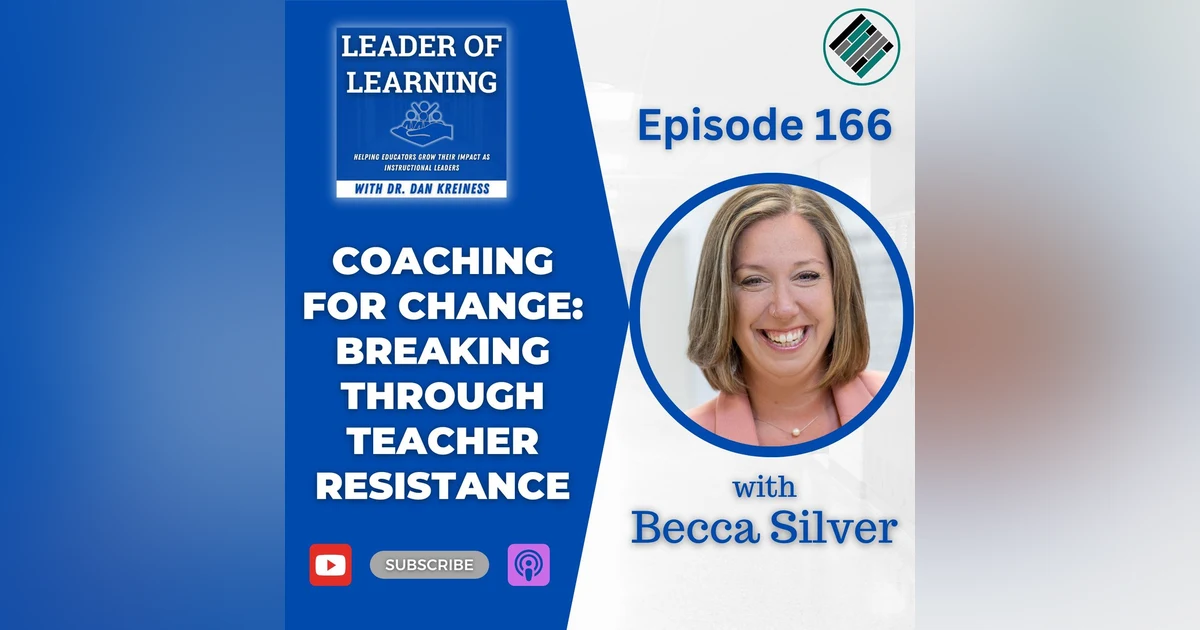
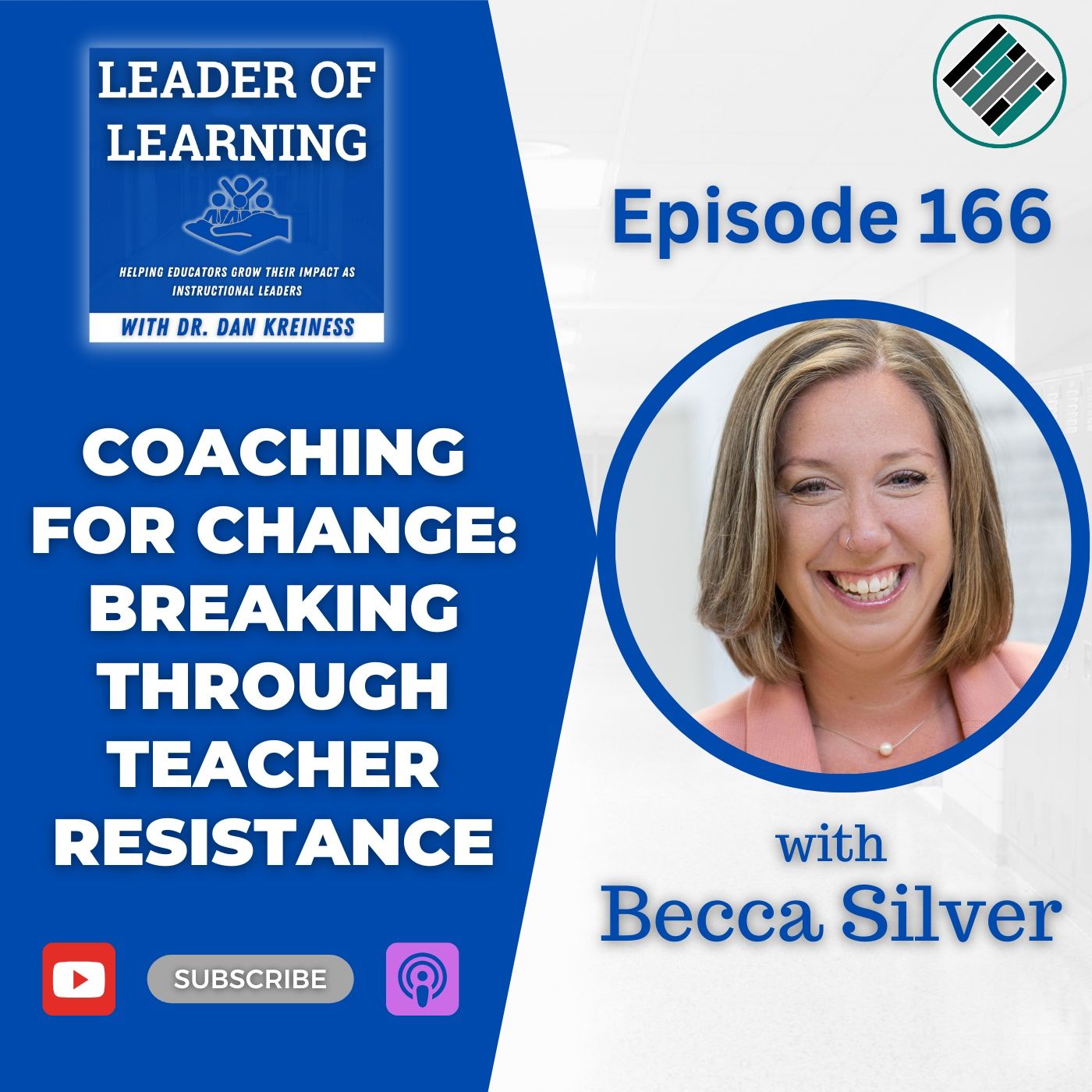
Welcome to episode 166 of the Leader of Learning Podcast. In this episode, our host Dan engages in a thought-provoking conversation with Becca Silver, founder and CEO of The Whole Educator. Together, they explore the intricacies of addressing...

 Apple Podcasts

 Spotify

 Castro

 RSS Feed
Welcome to episode 166 of the Leader of Learning Podcast. In this episode, our host Dan engages in a thought-provoking conversation with Becca Silver, founder and CEO of The Whole Educator. Together, they explore the intricacies of addressing resistance to change in professional development, particularly in the field of education. Becca shares her expertise in the neuroscience behind habit formation and discusses strategies for empowering educators to overcome resistance. The episode delves into the importance of trust, active listening, and celebrating small wins to create a supportive environment for educators.
Guest Information:
Becca Silver is the founder and CEO of The Whole Educator and host of the podcast Coaching the Whole Educator. She is a highly energetic and knowledgeable trainer who approaches leadership development with coaching skills and strategies that get at the root cause of ineffectiveness and burnout. Becca is a former educator, instructional coach, life coach and performance coach. Currently, she consults in a variety of states nationally and internationally working with instructional coaches and all levels of school, district and state-wide leadership. Her work focuses on helping coaches and leaders better support teachers, increasing job satisfaction, retention, resilience and growth.
Episode Resources:
Becca's Website
Becca’s Free Resources
Understanding Resistance to Change Blog Post
*************************************************
ACCESS MY INSPIRING RESOURCES:
SUBSCRIBE TO MY YOUTUBE CHANNEL
Sign up for my email newsletter
The Teacher’s Guide to Becoming a School Leader“
Lead to Inspire Growth” eBook
FREE “Unlock Your Leadership Potential” course
*************************************************
Consider Becoming an Official Show Sponsor - https://leaderoflearning.com/press-kit
Talk Studio is my recording platform of choice for video, audio, and even live streaming. For more information about Talk Studio and to receive 20% off your first billing cycle on ANY paid plan you sign up for, visit https://leaderoflearning.com/melon
Follow Dr. Dan Kreiness on Social Media:
Youtube Channel
Twitter/X
Instagram
LinkedIn
Facebook
TikTok
The Leader Of Learning Podcast is a proud member of the Teach Better...
0:00 I'm not going in with a thing, and I'm gonna make you do my thing. I'm gonna understand how you work as a human right. Welcome to the Leader of Learning podcast. I'm your host, doctor Dan Krenis, and this is where I help educators grow their impact as instructional leaders because my research and leadership experiences have led me to understand that someone like you, regardless of your role or your title, can have a tremendous impact on your organization. I chat with inspiring guests who are truly making an impact as instructional leaders. Whether this is your first time listening or you've come back for more, I hope you've subscribed to this show on your preferred podcast app so you don't miss any of the great episodes, topics, or guests. Anyway, I'm so glad you've tuned in. Now let's get started. Welcome in Leader of Learning to episode one sixty six. As you can tell, I am back and I am ready to put out episodes as consistently as I used to. You can definitely expect moving forward that episodes new episodes will come out every two weeks.
1:14 Here in episode one sixty six, I interview an amazing guest, Becca Silver. But before I get there, I just want to mention that I've come out with a new live webinar called Unlock your Leadership Potential. In that webinar, which is just under an hour, you'll learn how to grow your impact as a leader by prioritizing and valuing a high level of trust in your organization. In this under an hour webinar, you'll learn things like how trust is the foundation of relationships and other aspects of organizational success. Analyze the interconnection between trust and respect, Recognize the dangers of artificial harmony and what to do to avoid it, and refer let on your next steps as you carved your path as a leader. Anyway, I really hope you'll consider registering. I know you're gonna get a lot of value out of it. If you are head to Dankrinis dot com slash webinar to register. Now, speaking of getting a lot of value, I know that you are really gonna love this episode.
2:22 My guest, Becca Silver, is a seasoned consultant and entrepreneur who left the school system to pursue her passion for coaching and leadership. With years of experience, she's traveled across the US and internationally working with school coaches, leaders and districts to create a curriculum that focuses on mindset and motivation. Her work aims to better impact teachers and help them overcome resistance. I really really enjoyed this conversation, and this is definitely a real high impact episode because we talk about a passion of mine which is helping educators and really helping anyone kind of break through the resistance that they have toward change. I don't want to give too much away, so let's jump right in and after these messages is my interview with Beca Silver. Welcome back, Leader of Learning. I am very excited to bring on another guest here in episode one sixty six of the Leader of Learning podcast, Becca Silver, who is the founder and CEO of The Whole Educator. She is also a podcast host. She hosts a podcast called Coaching the Whole Educator. And I'm really looking forward to speaking with her about some topics that you know that I am passionate about already, things like of course coaching educators and then more specifically working with educators to really push through resistance and resistance to change, having a growth mindset, so I'm eager to dive
3:55 into it, but beca. I know I didn't give you enough of an introduct so if you could fill this in a little bit more on who you are, where you are, and what you'd do, awesome and thanks for having me on. I'm excited to have this conversation with you. I think it's going to be really exciting. So I'm Becka Silver. I was a teacher for ten years and after I left the classroom, I became a coach at a school, and at the same time, I also started life coach, and I discovered there were some crossover skills that were really helpful in my life coaching development that helped me in my instructional coaching development. And I was like, why did I not learn this right Because I'm like running around trying to make people do what I tell them to do. And I was like, there's this like mindset stuff and motivation stuff. I was learning about how humans think. And so I left the school system, became a consultant, and I started my own business and created a whole curriculum for coaches and leaders to better impact teachers, including their mindsets and mode innovations. And that's definitely part of the conversation we're going to have today around resistance. So I'm excited to be here. I've been doing this for over seven years. I travel around the US and internationally working with school coaches, school leaders, school districts, sometimes entire statewide entity as well. I'm curious about what you do more on a more granular level. When you say you travel around and you help schools, what does that look like? Who exactly are you working with and
5:28 how and what are you doing with them? And I the reason I'm so curious too is because obviously you know you know this, I'm sure as well. Like teaching is tough, it always has been, but it's been probably even harder over the past couple of years. And I think now more than ever, we need in education for educators to feel like they are being supported, I think in the ways that you are. So that's why I'm really curious. Yeah, So who I work with are instructional coaches and gosh leaders of all levels of school leaders, region leaders, district leaders, and also state wide leaders. And what I do with them. I'm always customizing what I do, so it's never exactly the same. I don't believe in one size fits all, and what I do with them is teach them how the brain works. And I have all these different modules and so I have the whole educator Academy and bring people through understanding how do we intentionally build trust the fact that we actually need to start with a foundation of trust and relationships.
6:33 We shifting mindsets towards a coaching mindset, away from what I call task centered coaching, towards human centered coaching. So shift you know, I'm not going in with a thing and I'm going to make you do my thing. I'm going to understand how you work as a human and I'm going through that. I'm going to empower you improve. So helping school coaches, school leaders gain those skills and practice them. The super uncomfortable role playing we there's a lot of self awareness that I do uncovering. There's always aha moments with the folks that I work with. So, yeah, transfer and you, you and I were talking about this earlier. It's really transformational learning that happens in most of my workshops, much more than infernal learning. I'm curious, what do you think in general, educators teachers are in need of when it comes to coaching at this point and has that and does it or has it changed over time that since you've been doing this? So what are you You're asking what are educators? What kind of coaching are educators in need of? Yeah?
7:45 Okay, oh that's so great. Oh I have not been asked that question that way. Usually it's like, what do coaches need to be doing? Here's the reason I asked this conversation. I didn't tell you this ahead of time, and I wasn't sure I was going to bring it up on so to speak. But this conversation is really timely because I am an instructional coach. I'm an instructional coach for digital learning, which means that usually I'm helping educators break through resistance and break through barriers when it comes to taking risks, trying new things, innovating their instructional practices with technology and with sort of future ready learning. However, sometimes, and it doesn't happen often, but sometimes I need to coach teachers in other ways. And one shining example that just happened, very relevant, very timely, is that I think I'd like to think, I hope that a close colleague that I work with in my school that I just kind of talked him out of potentially leaving not just the school but the profession. And that was a coaching conversation that I wasn't expecting and you know, really drastically shifted from what you might expect a digital learning coach or instructional coach for technology to be working with a teacher on. So that's really kind of what was the basis for me asking like, what are you seeing out there when you're in schools and working with coaches? What are they
9:16 needing to provide to teachers the most? I think in any situation where someone's feeling so burnt out they want to quit, they're experiencing resistance. I think, first of all, developed making sure that we are growing our trust and relationships with people and having them feeling heard. Step one, like I hear you. Step one right, And there's ways of listening, like actively listening, not just saying I hear you. I recently a coach that thought active listening was saying I hear you and then moving on like no, no, no, that's not listening right. Making sure people really and there's something there's neurologically, something that happens to our brains when that happened, and has anyone done the hand thing with you? No? Oh, you're gonna love this.
10:03 Okay, this is so great. So there's two important parts of our brain that are kind of important in this relationship. There's a what my friend calls the smart part of our brain, the prefrontal cortex, and then in the center of our brains are migdal So when we feel stressed out, when we don't trust someone, when we feel unsafe and anyway, if I feel like someone's making me do something that I don't want to do, we essentially flip our lid. And what I mean by that is our prefrontal cortex is in charge of critical thing logic, ability to be adaptable and flexible and pivot when we need to adapt to chain. Our smart part, the part we need online for coaching and teaching. Our migdala is in charge of our survival.
10:45 So that's where we get those emotional almost like irrational emotional responses to things. Right when we're getting when we feel unsafe, it's like I've got to get out of here, or I've got to protect myself fight, flight, freeze, fond that that all lives here. Okay, So we feel un and safe. Boom, I flipped my lid. My smart part of my brain is offline. And so as a coach, if I if I don't have trust with the teacher and I show up, I'm like, hey, we're going to be using near pod today. And the teacher's like, pen and paper has been great for you for the last twenty years, right, Boom, I don't trust you, don't tell me what to do. And then the coach is like, no, logically, here are the reasons why we should be using near pod. This is what it does to their brain.
11:26 We're resisting them, right, and when we feel seen and heard, this is actually what happens. We help put people, help people put their lid down, get the smart part of their brain back online, so we can have a conversation about imprint. So now we're really getting into the meat and potatoes. All right, let's take it back a second, because I want to I want to work back up to what you were saying and really get into the how behind how to work with educators coach teachers on breaking through that resistance, feeling more comfortable, feeling more confident. But first, let's make sure that the listeners understand what we mean by resistance and resistance to change.
12:07 As I told you before we hit record here, I've done a lot of work in this area over the past handful of years. It went into my research, my dissertation blog posts, lots of things that I've written and spoken about. So it's definitely a passion area of mine and clearly connected to my working with and coaching teachers on taking risks and and kind of just you know, helping them feel more comfortable in certain areas. So I'm curious to know what what your take on it is, how you would define it, and how how it shows up in your line of work. So how I would define resistance to change? Oh my god, I don't. I don't think I've ever actually like defined it. That's so great. First of all, before I do that, I want to acknowledge language that you've used.
12:54 That's fantastic, and I have not heard another human I use exact same language, And I want to, like, I don't know, highlight it, which is you say breaking through resistance. A lot of people use language around overcome resistance or you know there's like a like we're going to I don't know, like fixing, pushing, forcing language right, and we want to be careful that we're not resisting the resistance which is actually happens. So I just I wanted to say, yes, we use the same light scrape. So how do I how do how do I mean? How do I define? This is like off the cuff. This is not Becka being polished at all. But if I was going to to find someone experiencing resistance to change, which is an experience, right, a human is not I'm not I'm not resistant, and you're not resistant. We're not. This is not my label, right. So if I'm experiencing resistance to change, which everyone does, by the way, there's some If I'm resisting change, I uh, there's there's a part of me in my brain that doesn't want to do it.
14:01 There's a I have a motivation that I don't want to do it, right, So I might say something like, if I'm looking at cost benefit analysis, like the benefit of staying the same is higher than the cost, or I think the benefit of staying the same is higher than the cost of that. Yeah, you know, I want to look this up. When I was doing my research, I took from the research of another researcher and who studies this and I want to say it was back in episode sixty nine of the podcast I talked about this. It was a solo episode, no guest, just me and I kind of just got it all out there. You know, this is what I've learned about resistance and why it's significant in education, and I want to go back and take a look. But what's really cool is the researcher who whose work I used in my dissertation in my work actually reached out to me because he found that that at least the blog post, if not the podcast episodes. So that was really cool. It meant a lot. But you know, I think it's sound. It sounds obvious, but research shows that the more veteran teachers are the likeliest resistors, unfortunately, And I think to really boil it down and put some human language on it, and in Layman's terms, it's you. You get in your comfort zone, and I don't I don't say you you know not not you listening?
15:33 You you're listening because you want to grow yourself as an educator. But some educators find themselves more often than not don't mind my dog in the background. They find themselves more often than not in positions where they've been doing it for a while. Uh, Therefore they're comfortable with what they've been doing, or they're comfortable with certain curriculum or certain digital technological tools that they know the best, and when it comes to learning something new, that's when it requires sort of that that breakthrough, that breaking through the resistance, and they need a lot of help with that. So I guess really that's why where I wanted to take the conversation next, how do you or how do you support coaches and educational leaders then help these resistant teachers to break through that and to feel more comfortable with something that they need to do instructionally speaking. M yeah, So helping teachers experience resistance, I use the model that I'm made.
16:40 I use a couple models, but the model I mainly use is doctor Anthony Mohammad's levels of resistance. Do you know those? No? Oh, you're gonna love them. Okay, it's fantastic. He's a he's also a researcher. And so there are four levels. I think it's on a pyramid, and they go from least of resistance to most severe resistance. So level one resistance is motivated by I don't understand why the changes happen. And so it's the thing that I train coaches and leaders to do is communicate. This is the communicate. The skill that needs to be strengthened is communication, communicating the why. And the very important thing that I say very often is it doesn't matter what you say. Doesn't matter that you told them why. It matters what they hear. And that is distinct. It does not matter what you say. Right. So I've worked with lots of like district leaders all that, and I'm like, I told them, I told them why? How many times? In what ways have you told them? Why? Have you figured out a way that they can hear? If they're still resisting, they have not integrated it for themselves, right. So that's the least severe form of resistance. The next one level two resistance is I don't trust you, so or they don't trust the change. So they might not trust the person that chose to make the change, they might not trust the person implementing the change. But trust is lacking, and so the thing to do is build the skills to build trust. And it's so funny in this kind of realm
18:12 of working with school coaches, school leaders, we talk a lot about building trust, but I don't see a lot of professional develop on how and we need. The methodology I use to build trust is from the Speed of Trust. Stephen m rcovey love his work. I just think it's he defines trust as the confidence we have in someone's character and competence. This is great, right, we can intentionally build it. Level three is someone's resisting trust because they don't they're not worth they're not they're not sure it's worth the risk. So there's a couple buckets here. They could not be sure it's worth the risk because they don't think they can do it. It might be a confidence issue or that they actually can't do it. It's a competence issue. So the thing to do is work with the teacher to have the confidence and competence to do with build capacity. And then level four is the motivation of resistance.
19:10 Is I identify as a resistor. And here's the thing I say in all my workshops are on resistance. Do not go there. I have my frustrated principles or like it's definitely that they are definitely lettle for and I'm like, you're not allowed to say this person's Level four resistor unless you have gone through and really addressed do they understand why is there a trust issued? You know, is it competence or confidence? Right? You can't actually say if they identify if you haven't gone through all those and it's kind of an easy almost like an easy way out if you're just going to label someone and the thing to do then is hold someone accountable and say, look, the change is happening and at the end of the day, you have to comply.
19:52 This podcast is a proud member of the Teach Better podcast Network, Better Today, Better Tomorrow, and the podcast to Get You That. Explore more podcasts at www dot Teach Better Podcastnetwork dot com. Now let's get back to the episode. I agree with a lot of what you're saying. It makes so much sense to me and what I kept thinking about, not just as you went through the levels, but especially as it relates to a more resistant or reluctant educator kind of realizing that about themselves is the fact that at the end of the day, in order to really quote unquote move the needle with that person and help them break through that resistance, ultimately they need to not just internalize it, but to start feeling some kind of like intrinsic motivation for themselves to want to be able to take the next step toward whatever it is that they're working on right, whatever it is that they've been resistant too. I did find that as you were talking the old episode and blog posts that I wrote about understanding resistance to change, and it's up at dankrinis dot com.
21:06 It's episode sixty nine of the podcast. And the researcher that I was referring to before, whose work I really pulled a lot from is Richard R. Snyder from Wartburg Wartburg College. But there was some more research that I looked into too, and I want to mention I want to highlight this one part of it. There were some researchers who noted the importance of what they consider rewards when it comes to teacher beliefs and resistance to change, and so they identified these types of rewards that are associated with it was really associated with the selection of careers. But the types of rewards are as follows in Extrinsic rewards which focused on income, level of prestige, and potential power. Ancillary rewards include work schedule and conditions. Psychic rewards are the internal feeling of fulfillment, and then they broke that down further into two types of specific to teachers, two types of teacher nostalgia that kind of fit in with these extrinsic rewards.
22:18 There's social nostalgia and then there's political nostalgia. And I think that a lot of times teachers get caught up in these, especially that social nostalgia, like, well, I feel comfortable and my colleagues feel comfortable doing something one way, and we're also it's like it's almost like peer pressure with among kids teenagers, like well if we're all kind of doing it this one way, like who are you to say that we need to do in another way? So there's that reward system, right, And when you think about how it becomes an intrinsic reward, it's like, well, what's in it for me? What do I get out of it? And I think sometimes not just teachers, but so many people have a hard time at first first seeing what's in it for them. You talked about like the why behind why you're asking someone to do something new. So I think having said all that, what I naturally need to ask you next is the how how can we start working with teachers? More specifically, to get them to internalize it more, get them to kind of feel that intrinsic reward and motivation for making some sort of change.
23:27 Yeah. Well, I think one thing I want to presence is the context that all this is happening within. There's something I call the a compliance culture. I think our schools, our school systems are really structurally based around a compliance culture. And what I mean by that is, someone at the tippy tops spends a couple million dollars on a new reading curriculum. Right, Someone of the top made a decision or maybe they had a little committee that helped them make a decision, right, and then it gets filtered through, right, and then all the principles need to just like middle people that you know, and then the principles need to implement this this curriculum that the district bought, right, and then the deaders have to implement you know, they didn't choose it right. It's it's the like I I chose this, and I want you to do it right. So use terms like buy in instead of owners a lot, right, I want you to buy into the change that someone else decided to make. Like the term empowerment. It's a little more, in my opinion, it's a little more growth mindset. Y Oh, it for sure is empowerment is and it's acknowledging though. And I use the term buying all the time because that's that's the context we're in, right, And I much prefer empowerment right now. I'm not here to inspire someone, I'm here to empower them, right And I love I love that you said that too. Okay, So how do we work with educators? I think we need to figure out what they need? What what inside of them has them not wanting to implement this change that they didn't decide? Right?
25:00 So do they not believe in the efficacy of themselves? And they not have their own self efficacy? Do they not believe in the efficacy of the thing they're being asked to implement? So for me, I'll give I'm gonna give a personal example. I lived, I taught abroad for three years and two of those years were in Africa and East African yea, And there every day, I didn't have power for a little bit every day, and I came So I was there for two years and I came back to the States and I was gone during the time that everyone got a smart board, a smart I came back with my flip phone and I was like, what is this? And I asked for the one trailer that didn't have a smart board.
25:41 I was anti technology for a whole year and no matter how much, and I'm very pro technology now, but for a whole year I resisted technology because I didn't understand why if I could teach without electricity, why would I need to teach with technology? Right? And so it was I level one resister. I didn't understand why. So that what I got, what the support I got was a lot of professional developments on the latest app and they would model and they would have us practice. There was a little skill building, but no one set me down and was like, hey, this is why we're doing so all of that to say, what educators need is someone to sit with them and figure out what do they need support in which and you know, my my frameworks, the levels, so you know, it's just like what what's motivating the rests. So I'm an instructional coach and I'm working with a teacher named Becca, and she's a really great teacher. Maybe she's been doing it a while, but there's something that is holding her back from some new initiative. Maybe it's a new technology. Where do I Where do I start with Becca? How do how do I get her to help kind of get her get out of her own way when it comes to trying something new. I get to know Becca. Hey, how's it going? Do you wind if I hang out in your class passroom for a little bit.
27:00 I stopped by Becca's classroom at least once a week, hopefully multiple times a week. Hey, how's it going? Can I come hang out for a little bit? Oh great? What do you think about this? I co plan with Becca? What do you think about this? I get I listen, listen, listen, listen to Becca. I hear the words she's saying. I hear the words she's not saying. I hear she talks about things. I figure out what's going inside on inside of her head that's causing her to not want to imp this change. There's not a one size fits all with After I did my dissertation, I took the themes from it and I kind of packaged those up into an acronym because we're educators. That's what we do, called scope and the sea in scope is honestly speaking, and my humble opinion, one of the things that is most missed when it comes to coaching teachers through through resistance or trying to build growth mindsets, and that's just trying to make someone feel comfortable and by addressing their discomfort. So it's a lot of what you were just saying. Some of the things that I heard you saying within the last few minutes are first and foremost getting to the why behind why someone is being asked to implement something new. Listening. I heard you say that a few times, Right, listen, get to know them really, like really listen. And then I also heard you say I think co plan. So I take that to mean you put yourself alongside of them,
28:32 right, You're not better, You're not in front, you're not behind, you are there with them. I love that, And you know, I'll just throw in a couple other things too, because I do find I do consider myself a little bit of an expert in this area as well. I find small ways in so take small baby steps and treat each each step of the way as incremental changes. You know, you definitely don't want to ask somebody to do too much too quickly. But then the part of that too that I think people miss that I really love to highlight is to celebrate small wins too. If someone is trying something new, especially when they've been resistant to it, if you don't take every opportunity you can to celebrate them, it's gonna be really tough to break through that. And again, I'll go back to the conversation that I had with a teacher that I work with at my school recently about basically, why, you know, why would you even think about leaving the school or ultimately the profession. And I needed to listen, like you said, and put myself right alongside that teacher and what where I normally would not like sharing a lot of oh, well, this is what I went through when I was in the classroom. I found myself having to do that with this teacher just because I think that I think it helped kind of put us on a level playing field and be like, listen, you're not the only one who's gone through some of the things that you're going through. But my point is, if I, I think, if
30:06 I didn't try with this teacher to point out all the really great things that he's done and celebrate even small victories that he's had over the years. I think it would have been difficult for him to kind of internalize that, like we were talking about a little while ago, hmm, agreed. And that's the the brain science around developing a habit actually is what you do when you're developing a new habit is you you want to develop a trigger, like what triggers me to do I don't know. I put on my pajamas and then it's my trigger to brush my teeth. Right, the habit the new habit, and once you do the habit to have that, actually, there's you celebrate that you did the habit is it. There's a chemicals that are released in your brain. They're like, ooh, we want to we want to do this again, right, the habit is you want it subconsciously doing it again. And so I you were talking about kind of having a teacher not leave right and celebrating what they're doing. And then there's also the just tiny tweaks and micro movements that we're having teachers do when even if they're not trying to quit, and celebrating those wins. Yeah, there's something in our brains when we're burnt out or I don't know what that teacher was dealing with that we can filter the negative stuff, like it's actually hard for us to see the positive stuff. As we start to wrap up a little bit, I'm going back to the blog post that I wrote based on the episode I did around understanding resistance to change, and I kind of wrap that up by saying, you know, I don't necessarily believe we can just end resistance, but
31:40 it's something that you know, especially in education, things change all the time. We know that, right, What do they say, like the only constant in education is that it changes so much? But I do think, of course, that there are ways to work with educators to help not eliminate, but sign unificantly reduce the amount of resistance. And I think we've mentioned some of those things already. If you still have more back, i'd be interested to hear what else you might think that we could do. But if there's anything else that you haven't shared with us yet, maybe about the work that you do or the work that you're inspiring coaches to do with teachers, i'd appreciate that. Otherwise, I would really like for our listeners to know how they can connect with you and reach out to you if necessary, and just learn more about what you're doing there with the Whole Educator. Absolutely.
32:30 So one other piece I haven't shared around resistance that I do work around is Crucial Conversations Work, And it's a book. It's fantastic, it's very meaty, it's like, it's very intense work, and there's a piece about we need to help people feel safe in conversation and so there are strategies for doing that, understanding and identifying mutual purpose and mutual respect in COMversations and that neurologically signals to our brain, oh I'm safe in this when someone's experiencing resistance, remember the're flipping lid right. So that's also another piece that I do with school districts, school years. So yeah, I want I wanted to share that. Where people can find me is the Whole Educator dot com. You can check out my podcast Coaching the Whole Educator. Yeah, I'm on Instagram at the Whole Educator, Twitter, Beca Silver, Underscore du I'm LinkedIn with Beca Silver and yeah, I would love There's a lot of free resources on my website. Feel free to go check those out. I also something ilse share with you Dan if it's appreciated. Is I have a free download of the Levels of Resistance that I share that people can look through as well, so I can send that to you. That'd be great. Yeah, I mean, i'll definitely put the link to your website and your socials in the show notes, but i'll drop the link to that resource as well. Yeah.
33:58 Awesome. And just I'd say, like the thing that most impacts my coaches and leaders is the whole educator academy, which is it's not a one stop It's not like I come in for one PD and I leave and everything. It's like, no, we actually do consistent work. So I want to leave everyone with if you're really committed to breaking through resistance, it takes continuous work. Wow. That's a really great conversations. I'm so passionate about this work my listeners and know all that I've been talking about it for six years plus that i've been doing this podcast. So I really appreciate you reaching out, and I'm really glad that we were able to get this scheduled. And just I love the work that you're doing. I really do, because I think it's so important and that's why I have committed to very similar work myself over the years. So thank you for that work that you're doing, and thank you for your time here in this episode. Thank you so much for having me. This is a fun conversation. Well that's it for this episode. Thank you so much for listening. If you haven't done so yet, don't forget to subscribe to this show on your favorite podcast app. If you enjoy the content covered on this show, I want to ask you to do this one thing for me. Please share it. The biggest favor you could ever do for me is to please let others know about what I'm doing and how I'm helping educators grow their impact as instructional leaders. I hope you can share this podcast with other educators, leaders, friends, or anyone you think would love listening and learning. If you're interested in leaving a positive rating
35:30 and review of this show, links to do so are always in the show notes for every episode. For more information about me or this show, and to access the great content that I share, please visit my website at Leader of Learning dot com. That's where you can find my online courses, YouTube channel, blog, how to connect with me on social media, and even ways that you can support the show, like donating or purchasing leader of learning merchandise. Thanks again, and remember no matter who you are or where you are, you are a leader of learning.