Demystifying Imposter Syndrome and Ways to Overcome it
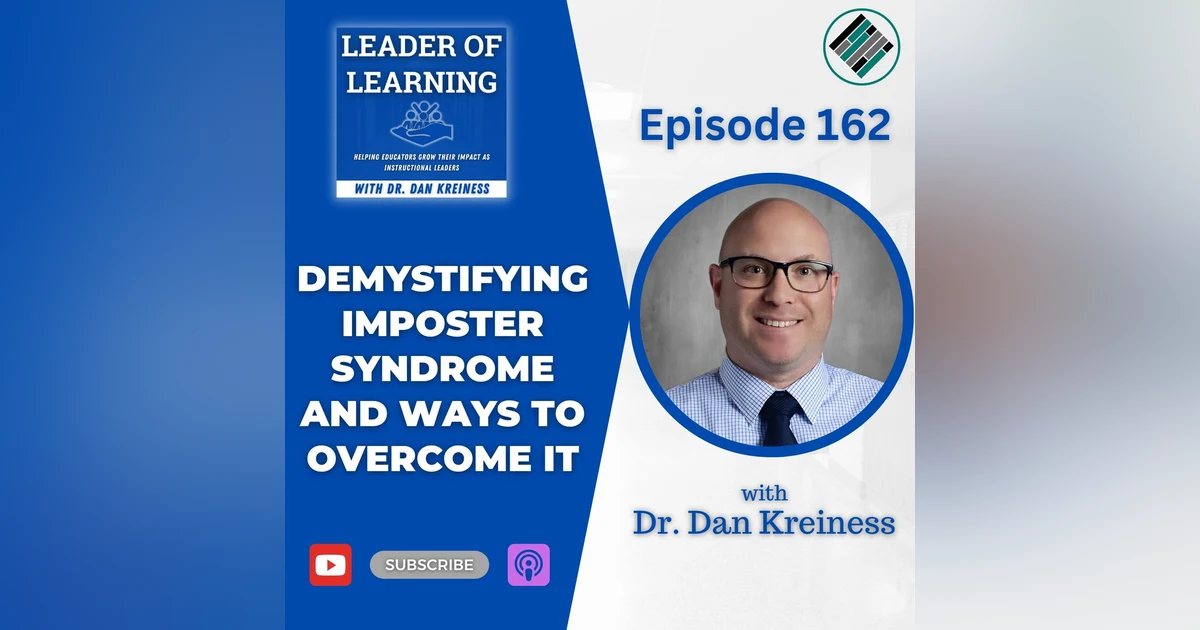

In episode 162 of the Leader of Learning Podcast, host Dr. Dan Kreiness opens up about his personal experience with impostor syndrome, which led him to examine the impact of this phenomenon on educators and content creators. He shares insights into...

 Apple Podcasts

 Spotify

 Castro

 RSS Feed
In episode 162 of the Leader of Learning Podcast, host Dr. Dan Kreiness opens up about his personal experience with impostor syndrome, which led him to examine the impact of this phenomenon on educators and content creators. He shares insights into understanding impostor syndrome, recognizing its various types, and provides strategies for overcoming it. In this episode, we will delve into the different facets of impostor syndrome, its effects, and practical methods for combating it.
Full show notes and more information about this episode can be found at https://leaderoflearning.com/episode162.
Download my free guide “The Teacher’s Guide to Becoming a School Leader” at https://leaderoflearning.com/guide
Purchase “The Transformational Leader’s Reflection Guide” at https://leaderoflearning.com/journal
Download my FREE eBook “Lead to Inspire Growth” at https://leaderoflearning.com/ebook
Enroll in my free course “Unlock Your Leadership Potential” at https://leaderoflearning.com/freecourse
Sign up for my email newsletter at https://leaderoflearning.com/news
SUBSCRIBE ON YOUTUBE at https://youtube.com/drdankreiness to watch inspirational and educational videos about leadership and digital learning
Consider Becoming an Official Sponsor - https://leaderoflearning.com/press-kit
Talk Studio is my recording platform of choice for video, audio, and even live streaming. For more information about Talk Studio and to receive 20% off your first billing cycle on ANY paid plan you sign up for, visit https://leaderoflearning.com/melon
Gear that I use and love to recommend:
Mirrorless camera (Sony zv-1) - https://amzn.to/3zdxKlR
Main microphone (Shure SM7b) - https://amzn.to/3Mi5SzE
Backup microphone (Shure MV7) - https://amzn.to/38M9Vqv
Budget microphone (Samson Q2u) - https://amzn.to/38MeukB
Audio Interface (Focusrite Scarlett 2i2) - https://amzn.to/3xdocWq
Wireless lavalier microphone (AnkerWork M650) - https://amzn.to/3TUlsXN
Key lights 2pk (Sokani P25) - https://amzn.to/3mcNq0X
Ring light (Neewer 18”) - https://amzn.to/3tfnB46
Budget studio lights (Neewer Dimmable LED 2pk) - https://amzn.to/392g16i
To leave a rating and review on Apple Podcasts -
0:00 I am so excited to be back. Thanks for joining me. In this episode, we're gonna dive into why I took such a long break in between episodes, and we're gonna dive deeper into imposter syndrome, what it is, how it affects people, some types of it, and of course, ways to go about getting rid of it once you have it. Here we go. Welcome to the Leader of Learning podcast. I'm your host, doctor Dan Krenis, and this is where I help educators grow their impact as instructional leaders because my research and leadership experiences have led me to understand that someone like you, regardless of your role or your title, can have a tremendous impact on your organization. I chat with inspiring guests who are truly making an impact as instructional leaders. Whether this is your first time listening or you come back for more, I hope you've subscribed to this show on your preferred podcast app so you don't miss any of the great episodes, topics, or guests. Anyway, I'm so glad you've tuned in. Now let's get started. Welcome back, Leader of Learning. First, and foremost, welcome to this episode.
1:21 More importantly, though, welcome back to the show. Admittedly, I have taken months away from this podcast and really gone on a hiatus away from creating content and putting out episodes like I have in the past. I won't go into too much detail here about why, but I did cover that in my latest newsletter. If you're not already subscribed to my email newsletter, go ahead and visit Leader of Learning dot com slash news and sign up today now. Although there were a lot of factors in why I haven't created content or published a podcast episode in a while, one of the reasons was at least the fact that I'm gonna admit and be a little vulnerable here. I think I was suffering from some imposter syndrome. I don't know about you, but imposter syndrome is something that I have thought about a lot as a content creator and even as an educator, because I do think it's something that I face fairly often and something that I think I've really had to come to terms with, especially as it relates to how to deal with it, how to cope with it, and ultimately how to try and overcome it. In this episode, what I want to do is kind of reair some content that I created around
2:52 imposter syndrome. I'm actually going to play the audio of two YouTube videos that I created. The first one is around what imposter syndrome is and how to recognize it, where I go through actually some different types of imposter syndrome. Next, i'll play for you the audio from a second or a part two of my mini series on imposter syndrome, and in that we'll discuss the ways in which you can help overcome imposter syndrome when you get it and when you recognize it in yourself. So first we'll start with that audio from the video on what is imposter syndrome and what are the types of it so we can recognize it within ourselves. Give it a listen. Here In this video, I'd like to go through what imposter syndrome is and the five different types of it, so you can recognize imposter syndrome when you see it or you sense it, and you might be able to identify yourself with any one of these five impostor syndrome types. We'll start with type number one. The first type of imposter syndrome is known as the perfectionist. Perfectionists set excessively high goals for themselves and when they fail to reach a goal, they experience major self doubt and worry that they're not going to be able to measure up, whether they
4:27 realize it or not. This group also tends to be control freaks, feeling like if they want something done right, they have to do it for themselves. Imposter syndrome type number two is superman or superwoman. People who experience this type of imposter syndrome are convinced their phonies amongst real deal colleagues or acquaintances. They often push themselves to work harder and harder to measure up, but this is just a false cover up for their insecurities, and the work overload may not only harm their own mental health, but also their relationship with others.
5:09 The third type of impostor syndrome is also known as the natural genius. People with this type believe they need to be a natural genius. They judge their competence based on ease and speed as opposed to effort. In other words, if they take a long time to master something, they feel shame. They don't just judge themselves based on ridiculous expectations, but they also judge themselves based on getting things right on the first try. When they're not able to do something quickly or fluently, they feel like a failure. The fourth type of imposter syndrome is known as the soloist. This type of imposter syndrome features people who feel as though asking for help reveals their phoniness. It's okay to be independent, but not to the point at which you refuse assistance so that you can prove your worth. And the fifth type of imposter syndrome is known as the expert. Experts measure their competence based on what and how much they know or can do. They believe that they will never know enough, and so they fear being exposed as inexperienced or unknowledgeable. So those are the five types of imposter syndrome. And I'm guessing that if you're watching this video right now and looking for more information about imposter syndrome and these types of imposter syndrome, you've probably faced it or you're facing it right now, and just like me,
6:40 it's something that you really need to know how to deal with. This podcast is a proud member of the Teach Better podcast network, Better Today, Better Tomorrow, and the podcast to Get You There explore more podcasts at www dot Teach beetterpodcastnetwork dot com. Now let's get back to the episode. I hope you enjoyed that and you took something away from that audio that really explained what imposter syndrome is and some of the types of imposter syndrome, so that when you face it, you can understand it better and recognize it better in yourself and identify how it's really coming about in you and how it's affecting you.
7:25 This last section of this podcast episode deals with what to do when you are facing imposter syndrome. So now I'd like to take you through some ways to actually combat or get rid of imposter syndrome when you get it. Give it a listen who gets imposter syndrome? Who faces it? Well, it can really be experienced and faced by anyone, but I think it's especially prevalent in people like me who are content creators or authors or speaks, people who are actually giving of themselves in a way that others can consume. It might even creep in into your professional lives if you're someone who is in charge of people tasked with creating things for others, or presenting to others, or really any type of role in which you're working with others. It's a little bit of a dangerous syndrome or experience because it really creates a lot of self doubt and it really affects your mental health. So I think these five tips or tricks could go a long way in helping someone's mental health and of course helping them overcome their impostor syndrome. The first tip I would give someone when trying to overcome their impostor syndrome is to find their why. Yes, it sounds
8:56 a little cliche or corny, but I go back to what Simon Sinic said about starting with your why or finding your why. If you've never seen Simon sinics Ted talk or read his book, start with why. Let me just explain it very quickly. Basically, Simon Sinic says that in the golden circle, what you want to do, especially again if you're someone who's creating content, or really in any field in which someone is working, is to understand why they do it. And I think that'll go a long way in helping you conquer your imposter syndrome. So, really finding your why means what is your purpose for doing what you do. I started off this video by telling you what my why is. I told you that on the Leader of Learning podcast and on this channel. My why is to inspire growth and transformation in education and beyond. And when I go back to that why, then it helps me under why I put out the content I put out, which also helps me not worry about the content that others are putting out, because frankly, I'm not the only one out there who's looking to inspire growth and transformation and education. There are other people and people who do it just as well, if not better than I do, and have more followers and viewers and subscribers than I do. But I still continue to do it because that's what
10:28 I'm passionate about and that's what fits with my why. So the second piece of advice I want to give you to help you overcome your imposter syndrome kind of goes back to and relates to the first one, but it's stop comparing yourself to others. Like I said, I'm not the only one who creates the kind of content that I create, and I bet you are not the only one who does the kind of job you do, or creates the kind of content that you create, or makes the kinds of decisions that you're faced with making, So stop worrying about others. Don't worry about what kind of money they make, or the content that they put out or the amount of subscribers they have. The reason I say that is because I know that, when it comes down to it, everyone has a different way of doing it, and so your way may work better for others. Let me give you an example. When I was a classroom teacher, there were other teachers who I knew students may have enjoyed more, they liked their classes more, they might have even created better connections with However, I, when given the opportunity over to my students for them to provide me with feedback, realize that one of the things they really appreciated most about my class is the way I explain things to them, how easy it was for me to help them learn new
11:58 things. So while other classes may have been more exciting or fun or engaging, and while other teachers may have been more of their favorites, they really did value what I brought to the table in my classroom in terms of the way I explained information. The way I taught them seemed to resonate with them better than a lot of the other teachers. So again, the second way of overcoming your impostor syndrome is to understand that you cannot compare yourself to others. You are the only you that there is in the world, and you need to embrace that in order to continue to do what it is that you want to do and to stop getting in your own way. The third way that I want to recommend to you to help stop that impostor syndrome is to understand that you have a unique voice and a unique story. As I mentioned in the second piece of advice, other people are doing what you do.
13:01 It's natural, it's okay, but you have your own voice, not the tone of your voice or how you sound, but the way you tell things, the way you tell your story. Storytelling is extremely important, and because you are the only you, no one else is going to be able to tell it like you. So while there might be other competitors out there, other businesses, other content creators, other educators, whatever it is you in your own way can only do what it is that you want in your way. I've learned that over the years as a podcaster and an author especially.
13:43 There are so many books out there think about how many books you can find or that you've read on self help or business tips and business marketing. Not everyone can read every single book, and not every book can ever become a best seller, but many books are out there that have hundreds, if not thousands of readers because that book presents the same or similar topics in a very different way. So understanding that you have your way of doing things will go a long way in helping you get rid of that imposter syndrome, because no two people will ever deliver the same message the same way. And so therefore, if you want to go ahead with something that you've been hesitant on at or that's really you know, weighing on you and you're just having so much doubt about it, understand that people may prefer to hear it from you or see it from you versus anyone else who might have even done it before you.
14:54 Number four and I know this is going to sound simple, and it's not. And I'll explain why. Is to build your confidence. And that sounds simple, but it's not. In a way. Your confidence level when it comes to imposter syndrome goes way down. But in order to build it up, I want you to think about your experiences and your accomplishments. You've gotten here for a reason. And I want to bring up a word that makes some people uncomfortable, and that word is expert or expertise. You have a certain level of expertise that a lot of other people don't. It depends, of course, on who you are, what you do, and how you do it, and I get that, but building a level of confidence also means understanding your expertise. As an educator and someone who's been in several leadership positions and coaching positions where I've had to support other people, I've had to realize my expertise. And that's not to say I go around bragging about my expertise all the time, but sometimes it takes for me to step back and realize that I know just even a little bit more than some other people know, and that's why I'm in a position to coach them. That's not to say that I can't learn a lot from them too, because there's something that they know more than I do about. I want to give you an example. When I was first in a full time instructional coaching role as an
16:26 educator, I really struggled with having an expertise because I taught one content area. My experience at that point was only as an English or reading teacher, and then I was asked to coach and support all teachers in all content areas. And I really struggled with imposter syndrome because I thought, how am I going to help other teachers in content areas that I don't know and I'm not comfortable with. But when I stepped back and I thought to myself that I'm in this position because I know what good teaching and what good instruction looks like, it really helped me understand that it didn't matter what subject area it was.
17:10 What mattered was that I had certain skills or expertise that I can lend to other teachers, regardless of the content area. And that's my advice for you too. Realize your expertise, build your confidence, and really harness your knowledge and your accomplishments, and understand that you have at least a little bit more to give and a little bit more knowledge than most other people. Finally, the fifth way to overcome your imposter syndrome is to build up your abundance mentality. Let me back up for a second. The terms scarcity mentality versus abundance mentality have been discussed in literature for years, especially when it came to the book The Seven Habits of Highly Effective Peace People and one of my favorite books for leadership and for business, Lead from the Heart. In these books, the terms scarcity versus abundance refer to someone's mentality and their willingness to share with others or to open themselves up to others. When I think about scarcity, I think about just, you know, not having anything, having nothing, something is scarce, it's almost non existent, which really means in this case that your willingness to share with others is kind of non existent. You keep it to yourself, versus having an abundance mentality when you are overjoyed and
18:41 overwhelmed with the thought of sharing what you know with others. Going back to what I said a few minutes ago about expertise, an abundance mentality means you want to give some of that expertise to others. So really, to go from a scarcity mentality to an abundance mentality kind of takes another type of mentality known as a growth mindset. In order to grow yourself from getting from a scarcity mentality to an abundance mentality really means that you need to overcome that imposter syndrome. Step back and say to yourself, I, based on my experiences, my knowledge, my accomplishments, and my expertise, I have a lot to offer and I want to be able to give that to other people.
19:32 So there you go. Those are the ways that I think you can overcome imposter syndrome once you recognize that that's what you're facing, either in your personal life or your professional life. I would love to hear from you. This is not my way of just putting an episode out into the world and forgetting all about it. I really would love to know not only what your thoughts are around what I've shared here today, between what imposter syndrome is, how to recognize it, the different types of it, and of course how to overcome it. But I would love to know how does imposter syndrome affect you and have you or will you try some of these methods to help overcome it.
20:18 Please reach out to me either DM me on social media at doctor underscore CRINAS or send me an email danat Leader of Learning dot com and let me know how and in which ways This episode on imposter syndrome resonated with you the most. Now, just because this podcast was away for months doesn't mean that I am not serious about getting back on a more consistent release schedule. So thanks once again for joining me here, and please know that we will be back with more episodes real soon of the Leader of Learning podcast. Well that's it for this episode. Thank you so much for listening. If you haven't done so yet, don't forget to subscribe to this show on your favorite podcast app. If you enjoy the content covered on this show, I want to ask you to do this one thing for me. Please share it. The biggest favor you could ever do for me is to please let others know about what I'm doing and how I'm helping educators grow their impact as instructional leaders.
21:29 I hope you can share this podcast with other educators, leaders, friends, or anyone you think would love listening and learning. If you're interested in leaving a positive rating and review of this show, links to do so are always in the show notes for every episode. For more information about me or this show, and to access the great content that I share, please visit my website at Leader of Learning dot com. That's where you can find my online courses, YouTube channel, blog, how to connect with me on social media, and even ways that you can support the show like donating or purchasing Leader of Learning merchandise. Thanks again, and remember, no matter who you are or where you are, you are a Leader of Learning,