How to Implement Effective Math Instruction with Kyle Pearce and Jon Orr
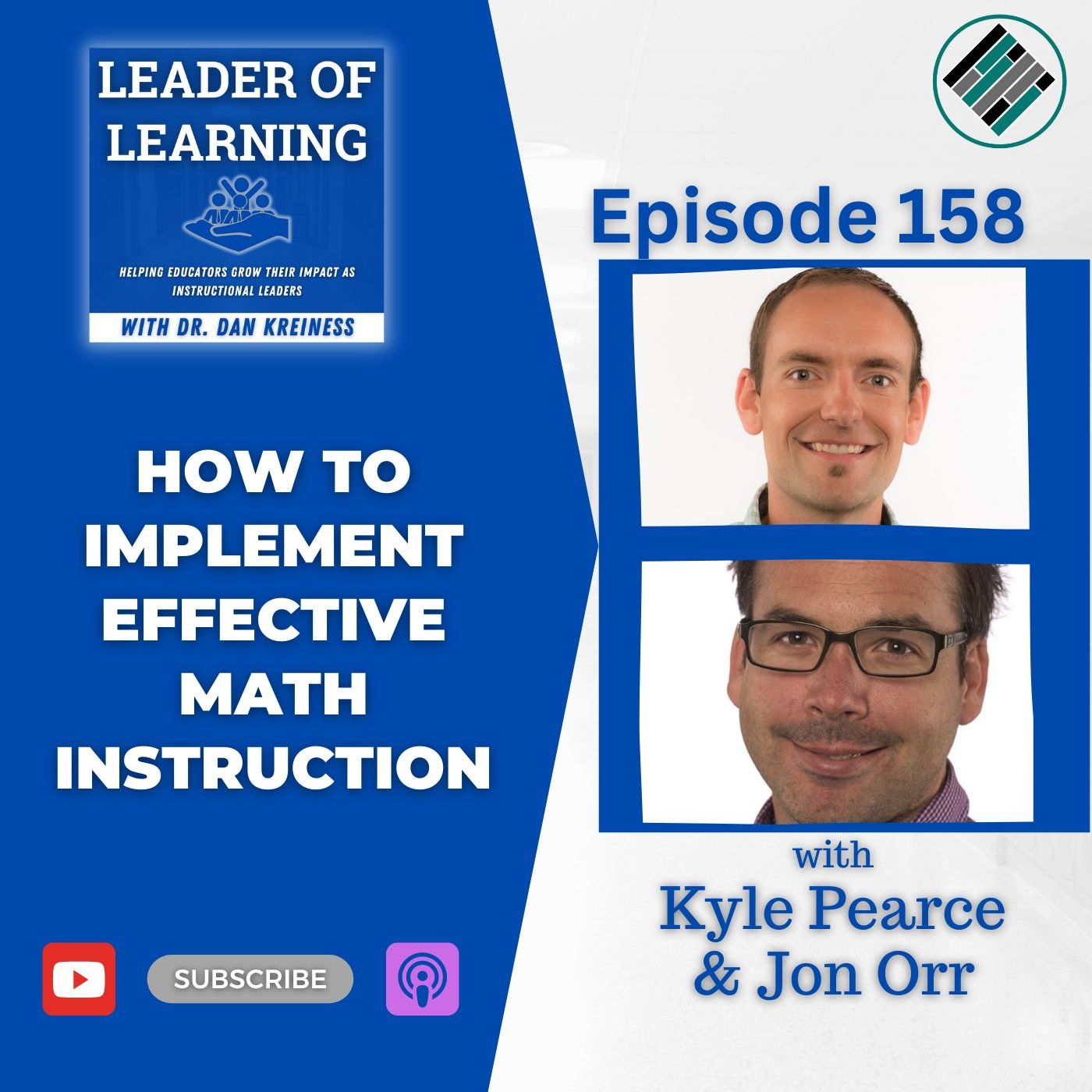
Episode 158 of the Leader of Learning Podcast features an interview with Kyle Pearce and Jon Orr (@makemathmoments), co-hosts of the Make Math Moments podcast. Kyle is the K-12 Mathematics Consultant with the Greater Essex County District School Board...

 Apple Podcasts
 Spotify
 Castro
 RSS Feed
 Episode 158 of the Leader of Learning Podcast features an interview with Kyle Pearce and Jon Orr (@makemathmoments), co-hosts of the Make Math Moments podcast. Kyle is the K-12 Mathematics Consultant with the Greater Essex County District School Board and Jon is a high school math teacher at John McGregor Secondary School in the Lambton-Kent District School Board in Ontario Canada. In the episode, Kyle and Jon discuss supporting math educators such as how to strengthen the six parts of any effective district/school math program, what to focus on first when helping your your fellow teachers shift their content knowledge in mathematics, what prevents students from applying their prior knowledge and understanding when solving word problems, how to transform current curriculum resources into engaging experiences, and teacher moves necessary to build a community of resilient problem solvers.
Full show notes and more information about this episode can be found at https://leaderoflearning.com/episode158.
Download my free guide “The Teacher’s Guide to Becoming a School Leader” at https://leaderoflearning.com/guide
Purchase “The Transformational Leader’s Reflection Guide” at https://leaderoflearning.com/journal
Download my FREE eBook “Lead to Inspire Growth” at https://leaderoflearning.com/ebook
Enroll in my free course “Unlock Your Leadership Potential” at https://leaderoflearning.com/freecourse
Sign up for my email newsletter at https://leaderoflearning.com/news
SUBSCRIBE ON YOUTUBE at https://youtube.com/drdankreiness to watch inspirational and educational videos about leadership and digital learning
Consider Becoming an Official Sponsor - https://leaderoflearning.com/press-kit
Melon is my recording platform of choice for video, audio, and even live streaming. For more information about Melon and to receive 20% off your first billing cycle on ANY paid plan you sign up for, visit https://leaderoflearning.com/melon
Gear that I use and love to recommend:
Mirrorless camera (Sony zv-1) - https://amzn.to/3zdxKlR
Main microphone (Shure SM7b) - https://amzn.to/3Mi5SzE
Backup microphone (Shure MV7) - https://amzn.to/38M9Vqv
Budget microphone (Samson Q2u) - https://amzn.to/38MeukB
Audio Interface (Focusrite Scarlett 2i2) - https://amzn.to/3xdocWq
Wireless lavalier microphone (AnkerWork M650) - https://amzn.to/3TUlsXN
Key lights 2pk (Sokani P25) - https://amzn.to/3mcNq0X
Ring light (Neewer 18”) -
0:00 There was not a focus on understanding the math the way we're trying, you know, the way we should be doing it now, and that's made a shift to change instruction and because of that, all these teachers are underprepared to teach math at a conceptual level. Welcome to the Leader of Learning podcast. I'm your host, doctor Dan Crinis, and this is where I help educators grow their impact as instructional leaders because my research and leadership experiences have led me to understand that someone like you, regardless of your role or your title, can have a tremendous impact on your organization. I chat with inspiring guests who are truly making an impact as instructional leaders. Whether this is your first time listening or you've come back for more, I hope you've subscribed to this show on your preferred podcast apps so you don't miss any of the great episodes, topics, or guests. Anyway, I'm so glad you've tuned in. Now let's get started. Hey, they're a Leader of Learning. Welcome into episode one fifty eight. If you like me and in the field of education, you may have recently had like I did, spring break, which means a couple of things one. It means that there's a light at the end of the tunnel. It means that the end of the school year is approaching.
1:27 It also means that you likely had some time to rest and relax and hopefully rejuvenate and kind of get that energy that you might need for that final push to the school year. That was me Last week. I had my spring break, and although it was a little bit late in the school year, it was very much appreciated. And now I am back and I do have some renewed energy for the rest of the school year. Just before we get into this episode, I want to cover a couple of housekeep items. First of all, I have a very exciting announcement. That is, after five plus years, almost five and a half years doing this podcast, I decided to jump ship and leave one podcast network and join another. And so I am very excited and proud to announce that this podcast, Leader of Learning, is now part of the Teach Better podcast network. If you've never heard of Teach Better before, they offer amazing services to support educators and schools and districts across the country and even worldwide. I've been a part of Teach Better now for several years first really getting involved with their Administrator and Leadership Mastermind program.
2:45 I've now gotten myself into their entrepreneur Mastermind program and still fairly recently was named a Teach Better Ambassador, and I'm really proud of that. Last year I went to the Teach Better conferences in person in Akron, Ohio, and I'm really excited to be going back again in twenty twenty three. I hope to see you there. But for more information on the Teach Better team, head to teach Better dot com. And one more bit of housekeeping before we get started, and that is I really appreciate you listening to these podcast episodes, and I certainly hope that you get a lot of value out of them. But in case you didn't know, my content creation doesn't stop at just creating these podcast episodes. I have a YouTube channel, I create blogs, sometimes not as consistently out as I would like to, but I also provide a lot of content in a fairly regular email newsletter. And so I wanted to ask you that, if you're appreciating and valuing the information that gets shared from me and my guests on this podcast, if you wouldn't mind going ahead and subscribing to that email newsletter because I really think you'll get a lot more value you out of it. Plus I give away some pretty great freebees just for signing up to my email list. Anyway. For more information on how to subscribe, head to Dancrenis dot com. Slash news now onto episode one fifty
4:15 eight. When my guests in this episode, Kyle Pierce and John Orr reached out to me to ask me to come onto the show, I was at first a little hesitant, but that hesitation ultimately led to the reason why I wanted to bring them on. These guys are the host of Makemath Moments podcast as well as the co owners of Make maath Moments as a as a business as a company, and really they're in the business of debunking some myths around math instruction and basically doing the work that it takes that's necessary to help schools and districts kind of revitalize and rethink what math instruction should be about. Like I said, I was kind of hesitant because math is not really my thing and my experience as a teacher was pretty much as far away from math as you could get. But in my career I have definitely faced some imposter syndrome, I guess is the best way to call it around this idea of being able to support teachers in subject areas that I'm not super comfortable with, and so because of that, I thought it would be a great idea to invite them onto the episode so that they can give me and you some tips and tricks and really solid advice for how to ramp up and like I said, revitalize the efforts behind making the math instruction at schools and parts of districts really
5:48 impactful and really effective. So I know that you're going to get a lot of value out of this conversation because I already have and I can't wait for you to listen. So coming right up after these messages is my interview with Kyle and John all Right, leader of Learning, Welcome back. I am very excited to talk. I can't believe I'm saying this. I'm very excited to talk about math here in this episode because I have the guys from Make Math Moments, Kyle and John, Thank you guys for comment. Let me just talk about them a little bit. So. Kyle Pierce is the K to twelve mathematics consultant with the Greater Essex County District school Board and John Orr is a high school math teacher at John McGregor's Secondary School. And I hope I'm pronouncing this correctly. The Lampton Kent District School Board and Ontary nailed awesome together. They co founded Make Math Moments, and I know they host the Make maath Moments podcast, And so we got a couple of pod fellow podcasters on here too. Guys, thanks so much for joining me. Let's let's start with Kyle. I know I didn't give my audience enough of an introduction to you. What else can you tell us about who you are, where you are and what you do? Now that's about it. Just math.
7:01 That's all we do. Know. Yeah, I'm I'm, as you mentioned, math consultant, but formally in the high school math classroom. And I came out did a coaching role for a number of years where I was I was teaching in the morning and then going out and doing a coaching role in the afternoon for middle grades, and then now being K through twelve, I've sort of been stretched in all directions. So you know, I kind of look at it as as sort of the reverse as to how you would you might want to do things starting in high school and working my way all the way back, and now I can better see at a distance, you know, where some of these struggles and mathematics come, where they start, and then ultimately trying to work through ways that we can help more students understand the mathematics, but even more so, helping more educators feel confident in teaching the math. And when we say confidence, like also just get them excited about it, because obviously, you know, it's contagious, right when you're excited about something, students are excited. If you're scared of it, if you're not confident in that subject area, then obviously students are going to take that whether you say it or not. They see your actions and you know, really that's the work we've been digging into. And uh yeah, John, how about you, buddy. Yeah, that's a that's a great intro for you. Cal But me also high school math teacher here in southern Ontario, Canada, and and I was a teacher you know that you probably remembered in
8:35 school. I was very traditional, very make sure that I guess we I always like to sum it up on our podcast. It was like I always focused on math content and getting like the rules out, the procedures out in helping you know, I thought I was helping kids by by giving them everything up front. I was that teacher that you imagined a high school teacher. And it wasn't until you know, a number of years into my teaching career that I made shifts and changes UH to better serve my students and think about what really mathematics education is and in terms of thinking and content knowledge and pedagogy knowledge. UM, So that was kind of that's kind of where where I have have started. UM, Kyle and Kyle and I have been you know, collaborating for the last number of almost ten years now on our teaching practices in the math class on on sparking curiosity, engaging students, UM really deep diving deep into sense making with kids so that they understand the mathematics at a conceptual level. And and that's kind of morphed also into the work that we do here at make Math Moments and supporting teachers but also supporting leaders and district district leaders and math coaches and consultants on how to change their programming and how to how to how to help UH districts change math instruction from the top down.
9:58 That's uh a math, but it's great. So I you guys are former or or you're you're still in in education obviously, but but classroom math teachers, I was the furthest thing from a math teacher. I was in a classroom LA teacher now turned digital learning coach because I'm one of those guys who got good at incorporating instructional technology. So I will admit that math is not something that it's not. It's not that I'm bad at it. I'm okay at it. I don't love it, and I definitely wouldn't have wanted to teach it. And I think Kyle, Um, I'm gonna put words in your mouth. I don't remember what you said, but just before we hit record here, you kind of alluded to the fact that a lot of people think that math stinks. Again, I forget how you said it, but and that wasn't it. But like, I don't I don't even know where I'm going with this question, but like, how did we how did we get here? Yeah, you know what, It's It's interesting because I'm guessing that many of your listeners as well, And this is the part that I think really is intrigued both John and I. You know, we began working obviously as educators. We all start working with students, and then you start to realize, woe, if we can start influencing change with educators, we can actually help more students. And then when you go another level up and you start looking at people in leadership role, so folks like yourself and administrators and superintendents and all of the leaders, what you start to see is
11:31 you start to see a pattern that the story you just said is actually happening with a lot of other leaders out there right where they're going. You know, like I'm I'm okay at the math I again, you know, similar to your scenario. I can't remember exact words you use there, but you know, you sort of suggested as though you were like, it wasn't necessarily the thing that you were getting out of bed excited to teach in the morning. And if you think about that, and then we extrapolate that and say, if a large majority of our leaders weren't those educators, it makes it incredibly difficult for you folks in your roles to help math educators or teachers who are teaching math, because that's the other piece is that you know, we don't have necessarily math specialists in every grade level, right, And in many districts there's generalists, and again they have a very similar story. So that's really where our work has sort of evolved to, is like we need to help our leaders to better understand what is effective math instruction, but then also they also need to be able to notice a name like where like what is the mathematics learning? Because the reality is I'm going to guess Dan that one of the reasons why you feel the way you do is probably because you were taught in the way that John just described. Right. You were taught to follow steps and procedures and memorize rules, and you know, whether you understood the rules or not, you maybe squeaked by right, And I always say I was a lucky one. I never understood the mathematics. And until you
13:05 understand the mathematics at a deeper conceptual level, only then can we actually put good teaching practice into play that will actually show results in the classroom with our students. Let me ask you a question, as as an ELA teacher in the classroom, I don't know that this impacted me as much as maybe teachers and other subject areas. But I've heard throughout my career everyone should be all teachers should be reading teachers, right right, I guess I guess what I'm wondering is like, should we also think of ourselves all as math teachers? Or or a better question is like are there ways to fit math in to other subject area? I mean, science is the obvious one, right, but are there are there ways of fitting math into other subject areas that we should be exploring more? John? What do you what do you say to that is that's on the right track? I don't know. Yah, yeah, well us being a math gurus and also like just loving uh math geeks.
14:07 Jo, Yeah, math geeks. I got the wrong G. You know, G we're there, but yeah, like I hear exactly what you're saying. We you know here in Ontario. You know, I think if you walked into any school, they would say the same thing about literacy, that we're all literacy teachers. We're all kind of helping students kind of develop their literacy skills. But but I think we could. I'd like to say that we would. We were all should be helping numerous cy skills and building our our ourn understanding and working with number um. I think that's that's so important that we do that. But I think I think I think there's like there's there's a good I get worried about it though, right. So it's like when we start to go, hey, we're teach I'm going to teach a math lesson, and then some of us who are thinking, like, there are certain things that we want to make sure that we bring out so that students are experiencing math and experiencing a conceptual understanding of math before building procedural fluency. I think I think us as a mean when I say us, like us teachers who are probably I would say probably almost every every teacher at this point in their career or or any point in their career, just by age, didn't go through a system that put an emphasis on building conceptual understanding.
15:26 And it's no fault. It's no fault of us or are who we are, or even our teachers. It's just the system that was designed primarily because of textbooks and the way that that content was a focus to go off to university and there wasn't any focus on any of the other kind of pathways like that. There was not a focus on understanding the math the way we're trying, you know, the way we should be doing it now. And that's made a shift to change instruction, and and because of that, we've got to you know, all all these teachers are underprepared to teach math at a conceptual level so that they can build procedual fluency. Because that procedual fluency, conceptual understanding gets blurred and people think, oh, I need to like make sure kids know their math facts. That's so important. We got to memorize their math facts. And I think everybody wants that, right, Like everybody wants kids to know math facts when they come out of school. It's but do we want them to understand how these concepts are are are interwoven with each other. Do we want them to understand how how to actually like make good use of their number sense versus just straight memorization. So so we we've got a bunch of teachers who aren't probably prepared or equipped yet to teach at that level and teach that understanding first. So I get worried when we're gonna be like everybody should teach numbers. But if we're gonna just teach numbers the way we were all taught numbers and we're all taught math. I'm gonna say
17:00 no, I'm gonna say we don't want that. We want to educate all of our teachers to come at it from a place of conceptual understanding, to build procedual fluency. And that's actually like in the work that we do, that's actually just one like that when we talk about conceptual understanding building procedural fluency, which is which is one of the eight effective teaching practices for Men's CTM. That's kind of just one area of what we know in the work that we've been doing, of six big areas to improve math instruction in schools. I have like a burning question that I feel like this is a perfect opportunity for me to ask too math geek slash gurus, but also, John, you kind of like set me up for this one. The shift right from what i'll call old school or more traditional ways of learning math to this new sort of conceptual style. I'm guessing you guys have heard this before too, But as an educator and a parent, I certainly have seen where other parents call it common core math. Right, it just seems like such a departure from the way we learn John, you mentioned some of those math facts, right, like we grew up having to either memorize things or learn formulas and and I'm not saying that that's not being taught nowadays, but I do understand that there has been or or we're trying desperately maybe to shift toward more of
18:30 that conceptual model. Um, I guess. So, I guess my question really is like, are you guys seeing that as well? In the math world, are there is there still such a hesitation especially by parents but also by teacher even school leaders when it comes to like okay, but but students really need to know how to do mental math or you know, you know whatever it is that that's so more of that traditional model. Well, it's it's so interesting because you know, and I can totally understand and relate, and you know, kind of John had already alluded to it. It's like no fault of their own, right. Even there's some educators out there, they're going, Okay, I'm going to try to do this thing that I was never taught as a student, Right, So I'm going to try to do this thing which is called understanding what's really happening here. And I'm gonna then do that for students, but I'm not only going to do that, I'm going to also do it in a way that's going to craft an experience for them to understand it. But I still don't understand it yet. So okay, that's that's a tall task. And then somehow I'm going to also be able to see far enough down the road that it actually connects to the thing that I learned in school. So, you know, I think one of the easiest ones is, you know, to think about the standard algorithm, right, two digit by two digit multiplications probably the best example of it.
19:56 You know, kids I remembers as a kid. You know, you start with the ones, and you know, you multiply the ones, and then you multiply this way, and then you have to carry and then you drop a zero, and all of these things that you did, All of those things are happening for a very specific reason. And the model that we try to build through, and we'll say common Core. Common Core is a curriculum, So it's just you know, a series of expectations or standards that they've put together along a developmental trajectory. The problem is is that the educators weren't given the training to actually do this well. So you can only imagine, you know, if all of a sudden they say, hey, you know, we're coming up to the end of this school year and they say, hey, Kyle, you know next year we're going to have you teach chemistry. And I'm I'm not a science guy, right, So I mean, you can only imagine how well that's going to go. When I think I took one science course in school, I memorized it all, I never understood it, and now I have to go do it and they're telling me that I have to teach it through the common court, which means you need to help students understand what's actually happening here. So you can imagine that that's not a great move, you know, when we sort of rush into those things. So I think, in general, to paint a picture, if we do this well, then parents are going to love it because kids are going to be telling them why it's working, and they're going to be showing
21:26 them why that algorithm actually works. But the part that's really tough is when you're a parent and you only know how to stack two digit numbers and you only know the algorithm and the students trying to do multiplication using an area model or an array or any of the other developmental pieces that we weren't exposed to. So a parents sitting there going this is like a lot of parents to say, this is silly, this is a waste of time. This look at my kids frustrated. I'm frustrated. We're all frustrated here, like, let's just do this. And then they they show them how to stack it. The student mimics it, and then we think they understand how to multiply two digit by two digit multiplication. But in reality, all they've done is they've memorized a series of steps which in two three weeks maybe two three months, students will then start to fall falter and forget steps, and all of a sudden it's like they never learned it in the first place. So the reality is is that while it will take more time, it will take more effort as well. The result is so much richer, it's so much deeper that students actually understand what's happening. And really the goal is is that if I'm doing that algorithm, because again this isn't a conceptual versus procedural fluency, This is conceptual to help students understand and build procedural fluency. So if they falter here, they should be able to rewind and go, you know what this algorithm, I can't remember it, like I can't remember the step, and then they go, well, if I was to draw the array or
23:00 the area model, I could then reconvince myself why that actually works. Like that's what we do in all aspects of life. When something doesn't go right, you stop and you start to think of like what could not be working here, like the car's not starting, what isn't working here? And in mathematics, we've never really been set up with those tools. It's just it doesn't work. So I guess we're not starting the card today. Well, and I just want to add add something about I think you had talked about it's not an either or with conceptual understanding Kyle into procedural fluency, and I didn't I didn't elaborate too much on this on the idea of procedural fluency, but I think I think that's kind of where I where I was going a little bit with this idea that that people think procedural fluency is just knowing the facts, like knowing the algorithm knowing you know, these these these set of procedures that we all you all kind of remember from school or partly remember from school. But I mean, like when we talk real fluency and fluency just is that comfort level. But there's actually like three components of fluency, and that's being efficient, and that's being flexible and accurate. And I think when we when most people think about fluency, they think accurate, they think, let me just get there, like it's right, like I got the right answer. That's being fluent, but it's not. It's it flexible and efficient is thinking about when I'm solving this problem and I'm working with these numbers and maybe I'm using some mental math strategies, could I be flexible and try to
24:30 choose a strategy that works in this situation? And am I am I working with the most efficient strategy to solve this problem? Kyle, I think you always use an example of like when you're doing subtraction and it's like if I'm going to subtract, what is it like like nine hundred and ninety nine, and or it's like there's like a taking you know this now it's like it's like one thousand and one subtract nine hundred and ninety nine with the whole bunch of borrowing with zeros happening right there. And if you're following the algorithm, like you're thinking, I'm ac, You're I'm fluent, but it's like, well, you weren't very efficient, because really, what is the difference between those two numbers is another thing, another way to think about a strategy that's different than the algorith that is more fluent than say, someone who's just kind of trying to be accurate with it, with an accurate with with the the the the algorithm, the I'll help you out there, John, There you go. Thanks. This podcast is a proud member of the Teach Better Podcast Network, Better Today, Better Tomorrow, and the podcast to get you there.
25:32 Explore more podcasts at www dot Teach Better podcast Network dot com. Now let's get back to the episode. So I really appreciate the way that both of you guys explained that the conceptual compliments the procedural and vice versa. You kind of nowadays sort of can't have one without the other. Well, you can, but maybe that wouldn't be the best way to do it. And and and that sort of leads me to my next point, I guess, like, when teachers, when systems are still stuck more in that traditional or as you call it, more procedural model, how can we improve, right, how can we make math catch up with the times? I guess right?
26:23 And I know, like we've already talked about, there's some discomfort on the part of everyone, but especially I'm gonna just say again, especially parents. I think, right, it's just so different, and even some more veteran teachers who may have gotten into education at a time where teaching math looked very different. So um, A lot of a large part of my audience, of course, are educators. Many of them are classroom teachers. I don't know for sure how many our math teachers, but I would love if we could sort of kind of break this question down into three parts. My question really is like, how can we improve and how can we find that happy place in terms of marrying the conceptual with the procedural as classroom teachers, as sort of those intermediate level leaders, like people in my position as coaches.
27:18 Now in my district, we're fortunate enough to have math coaches, literacy coaches, and digital learning coaches. So there are content and based coaches but I know that a lot of districts aren't fortunate enough to have them. Maybe they have a department chair, maybe their administrators are still really the ones who are the instructional leaders, So how then can the administrators support that? So really it's the same question, but if you if you could tackle it from like how to teachers help, how to coaches and other sort of middle level leaders help, and then administrators. Yeah, well, let's start with classroom teachers, and you know, we'll kind of work our way up the up the chain there. But with classroom teachers, I think one of the best things that you possibly can do is that before you teach a concept, when you think about this. You know, some people, as we're recording this, are going into the weekend, and you know, they are thinking about what am I teaching next week? And when I think about what I'm teaching next week, am I planning to tell students exactly how to do something?
28:22 And if that's the case, I'm essentially trying to teach the students how to mimic or how to memorize steps and procedures, right, which really means we're not really focusing too much on the conceptual understanding Rather, what we could do is we could say, hm, what is it that I'm trying to teach? I think about the intentionality of my lesson, and then I start to think about, like why does it work? What is it that I'm doing that helps to make this thing work? And if you were to google that thing and say why does this work? Or conceptually might be a good word to put in there as well, you will find that stuff is out there, right, like the content is out there. So if you actually are looking for it and you actually think about it and you say, you know what, I want to actually help you understand why. So if I think about integers, like why when I add or multiplying integers is probably a really good one, Like why when you multiply two negative numbers, is it a positive? Like when you ask middle school teachers, they typically say it's just a rule. Like I just tell them, this is what it is.
29:27 But the reality is there's a reason why. And the part that's really tough, and I think this is the hardest part of all is being okay to say, wow, I actually don't know why. I'm the teacher and I don't know why that actually happened, And this is happening to John and I all the time. Like when we have a concept and we're going in to help a teacher or help in a school, we think about that concept. There's times where we're like, I have no idea why that works, and we've always done it, but if we want to teach kids to actually understand this, then we need a better understanding of it. So it really ultimately comes down to us doing more math. And the more people you can do that math with, the better off you'll be. So if we can do that with a partner like another colleague, if we can do that with a large grade band of educators where we're all trying to tackle it in different ways, what you start to see is what really happens in a math classroom when kids are given the opportunity to problem solve, Because Dan, you're going to solve it, likely in a different way than the way I'm going to.
30:30 What we're going to notice is the research will show there will be a majority that are going to solve it in a particular way, and then there's going to be smaller pockets solving it in different ways, and those give us clues as to where students are along that trajectory. So my big takeaway there is figuring out what is it that I'm going to teach and why it works and then actually doing the math and that will give you such a huge payoff even if you aren't blessed to have say a coaching model or a lot of MATHPD going on in your district at the current time, John, why don't you take the next class? Well, I was just going to add add to like the next step onto that. Like you you alluded to it by having you know, part part of the teacher prep that they're doing is is doing what you said. But then in the classroom and you also you also mention this, but it is worth say mentioning again is that you're giving the students or crafting experience for the students to experience a situation before you're telling them that situation. So so I think like to make sure that we are very clear you can build you you can tell conceptual understanding to a student, it doesn't mean they're going to like grasp it and understand it or experience say why that works. And I think that's that's a bigger piece for us, is we want to make sure that our students are are the ones doing the thinking in the classroom. It's too often that I thought, you know, thinking back to my you know, my first ten years of teaching, and I was doing all of the thinking in the classroom by giving everybody they needed instead of
32:00 instead of holding that back until it was until it was really needed and sometimes just not needed. For you to be the one that's the gatekeeper of knowledge. A lot of times you can build on what students are showing you, Like Kyle said, is there you may be showing you and maybe your job is to make sure it is your job to make sure that you're tying some of these thought processes together to get at the intentionality that you've you've decided on in uh in the forefront of that of that lesson. And that's that's an art that's that takes practice because we're we've come from a system that didn't see, that didn't try, that didn't weren't trained on being flexible in the classroom for say, seeing this student's solution on that problem, this student's got that different solution. How do I blend those together so that everybody makes sense of both and how does that tie to my my actual learning goal for the day that as I said that that takes time, debts takes effort, that takes training. We've got to we've got to bring our our our teachers comfort level with mathematics up first and that and then we can kind of layer in the pedagogy piece after. And I think, I think, what's happening in MATHPD right now with with you know, if you've got you know, your leaders listening, going like we're going to make sure we have MATHPD happening over here, and we've got our math coaches doing this here. I think a lot of I think social media helped with this this issue. Kyle and I are experiencing with all the districts we're working with that we actually have to take a step back and help our teachers understand the mathematics first and then bring in pedagogy
33:34 next. Whereas there's a lot of flashiness with pedagogy happening right now, and they're like layering on this pedagogy and then realizing afterwards that it's not making a difference because teachers still are trying new strategies in the classroom for engagement or for understanding, but they themselves are not understanding that math. So We've got to take that step back first and in build those those those teachers understanding of math at all levels, because you know, I have, like I said before, I have a degree in mathematics, but still needed to learn conceptually how mathematics can be represented with different models, different strategies. I was always that I knew this the one way and that was it. And once you see that there are different ways of modeling things and using different strategies, mathematics is such a beautiful subject to kind of teach in that case, to address to adjust dan the the the next piece which is which is thinking about going up up the chain a little bit in helping say leaders think about think about the math program itself. And that's that's actually a lot of the work that Kyle and I are doing now, UM, is that we are helping school districts, schools themselves strengthen their math program UM. And a lot of the time we focus on six areas. UM. We've talked about a few even here today that we haven't really named. We kind of we we said, um, we we talked about pedagogy. That's one of the areas that we want to be strong in with our with our teachers. We talked about content knowledge
35:07 itself uh UM and the the UH the the understanding of the mathematics. That's a second area, but a but an area I think that we need to make sure we focus on, especially with the leadership side, the the administration side, or even higher than that UM and also even the coaching side is UH one that I think is often overlooked, which which we call we call like a like a vision side like UM. And this is about setting the vision for the math district or the math program that the entire district wants to implement. And oftentimes when you you ask someone to read their math vision for or their math school or district improvement program or improvement plan UH that that statement is very lofty and and very vague UM and and they'll they'll state, we're gonna, you know, we're gonna bring up students understanding through this. But then it's it's kind of like, well, hours, we'll go up by ten percent or whatever, not even it's not even number base usually you know, it's it's kind of like it's just it's just kind of very very kind of flowery language. And what we what we find when we kind of dig deep with districts that we work with is is that they need like a more streamlined, a more specific goal U set of goals to to follow in a and setting that vision is so important because you know, if if if we're not all working towards the same goal, then everybody's all over the place,
36:39 and if we're all focusing on all these things, then we're really not focusing on any of them and no one's getting the actual professional development that it's as important as as what the district is decided. So at the leadership level, one of those areas, uh that that we should focus on is is really setting clear goals that are measurable and actionable in developing those out and then communicating those down the line. And that's like every time we have a staff meeting, the goals get stated about mathematics. Every time we have just you know, maybe it's a math mathe meeting of all the math teachers, it's like a PD day, the math the vision gets stated. If there's an email that goes out related to mathematics, the visions are right right at the top.
37:23 It's it's something that we need to bond our teachers together so that we're all working towards the same goal and it just doesn't happen in districts I like to. I don't know, this is just something about me. I like to kind of boil things down, like bottom line it right, and I think in doing so it helps me kind of create takeaways. I think some of my takeaways, based on what both of you guys have been saying, are things like, first and foremost, growth mindset comes to mind. I don't know if you guys know this, my listeners probably do. Much of my doctoral research was in the area of how leaders can support growth mindset and teachers, and I think that, especially in the area of math education, there's still a lot of room for growth in terms of that mindset shift out of the traditional and more toward that conceptual based model that I'm going to call it the real world relevancy aspect of math that may have been missing when people like us old guys went to school way back when. And then the other thing, as you're saying, you guys both kind of mentioned this too, like where sometimes maybe teachers might be too quick, let's say, to go more toward I just want to try all these pedagogical type strategies. It's like, well, we really need to make sure that we're I don't want to say mastered, but we're confident enough with the actual math content in order to
38:57 kind of proceed from there. And then I love, John, what you were just saying about establishing that vision. I talk a lot about transformational leadership, and so much of that is that that mission driven organization where you, as the leader, are trying to get and this is maybe where you were talking about how it might even be like further up the line than just school based administrators. It's like we need everybody to buy in, right. We want to empower the school administrators to then empower their staff. Your point was great, it was really well taken. Like if you're if math is a real focus, right and you want to get more specific and more strategic about it, you're talking about it at gatherings, faculty meetings, PLC meetings, like whenever you can, you gotta you gotta name it, and you gotta focus on it, and it can't be so vague. I can't believe how quickly time passes when we're talking about math. I really didn't expect this.
39:54 We're like thirty four minutes. Then, what haven't I asked you, I really appreciate it, and you kind of you were able to do this without me asking about what you guys do with you know, make math moments, and it sounds like you guys are doing some really great work with districts. But as we start to wrap up, what haven't I asked you that you really want to make sure you get in here. Kyle will go to you next. Well, I was just going to say, like, first of all, like I think you nailed it. You're you're actually really helped us out by talking about growth mindset because that's one of the other areas, and you know, we haven't articulated it in this way, but when folks come to our website and they start to dig into these six areas we're talking about, we've actually sort of made this analogy of a tree. If you envision a tree, this is your math program and you can think of it as a classroom teacher, or you can think of it as a district leader.
40:45 They very slightly depending on which version you're looking at. If you're a classroom teacher, it's going to be more specific to your world and your environment. If you're a district leader, it's going to be focused in your world and leading all the educators in the system. But that educator mindset and beliefs is where we nestle growth mindset, and that's one of these other big pieces. And you know, so we've talked about a number of parts of this tree, and ultimately what we do with districts is we introduce them to the idea of the tree, the trunk being the leadership portion. This is the mission is this is what will like stand tall in a storm, right like, you need that to be so strong, you need to be balanced, you need it to be sturdy. And then underneath the ground, what's holding that trunk together is that content knowledge. That's the roots of the tree. So we've sort of talked about those two pieces. And then we've got pd structure in there, which is our limbs, and then we've got branches with which is pedagogy, and we've got leaves which is the resources in your classroom.
41:49 And then finally the sun, soil, water, which is that mindset Piecet you articulated. So ultimately, what we do with districts as we actually usually start them, and you're friends here listening on the podcasts are more than welcome if they want to try this themselves. We have a screener and we give it to our district leaders, but we also give it to the educators we work with, where it'll actually ask them some questions on a Likekard scale and it will take them through all six parts of the tree so that they can get a sense of where their program is flourishing and where maybe their program they might want to focus some of their energy. The reality is is that we can strengthen all the parts of our tree at every time. Right we know that growth mindset, we will never get there. The tree is never going to stop growing. We want to continually grow it. But what will happen is as they go through, we're going to ask them some questions and some of them are challenging questions, like they're gonna go huh, I never like I never thought about that before, and they might go closer to a zero on that question because they were unaware of it. And what will happen at the end is will actually get a report generated that will give them some actionable steps. So you had to you know, what do we do in the classroom? What do we do if we're a district leader, Like what do we do in these cases, Well, this report's actually designed so that you know, when John does this screener, out will pop a personalized report that focuses on the area that he might want to focus his attention on. And maybe it is the trunk and it's that leadership piece, or if you're in
43:19 the classroom, we call that like your pillars, your classroom pillars, the leadership piece of your classroom. And then we have some next steps that they can engage in through a lot of the resources we provide freely on our website. So I would say that would be a great next step for all of your listeners if they're intrigued here and they're going, wow, there's a lot to this. The one thing I can say is that this is a journey. And by all means all the districts we work with, we try to tell them like you cannot like people want to set these lofty goals, like John said, but then at the end of the year, monitoring usually doesn't really happen very well, and then all of a sudden goal shifts and now next year we're doing something, and we just we keep on chasing our tail.
44:01 So what we try to do is we want to set up districts and also classroom teachers with actionable next steps so that they can actually start making some gains and start strengthening different areas of their tree. And then we always encourage them, Hey, after a little while, come back and try that screener again, and like, let's see where you are now, Like does it say continue working down that path or maybe you want to change your attention a little bit and start going down another path to start strengthening that area of the tree. So hopefully that will be something that's useful for your team, because I know we could talk here all night about math, but I know you already told us you try to keep these episodes short, and I think we're stretching it pretty far here today. It really has been a great conversation.
44:47 And all right, John, I'll let you. I was just gonna say, Kyle talked all about the screener but didn't tell anybody where to go and try. They just have to find it aimless. So head on over to make maathmoments dot com forward slash grow, makemathmoments dot com forard slash grow, and you could take the screener and then, like Kyle said, it gives you a full report on how to make improvements in your district or in the classroom after your classroom teacher. You guys are pros. I was just going to ask you where they can find that, but you gotta covered. So I appreciate that. I appreciate the conversation. This has been great. I really didn't know what to expect. I'm being honest, you know, I started the conversation saying, like, I'm not a math guy. I was, you know, an e LA classroom teacher. I'm also certified in music, Like math is just it's not something I really have to think about that much, but I do have to were you know, I support math teachers and and my leader listeners, whether they're administrators, school administrators, district administrators, they support math teachers. So, um, this is some great stuff.
45:51 And like I said, some of my bigger takeaways out of this conversation or are things that I know that I can look to him prove about myself in the way that I support math teachers and the math system you know at my school. So I really appreciate it. I do hope my listeners check out the tools and the resources there at Makemath moments or make Yeah, makemath moments dot com or makemath moments dot com slash grow. That is really hard to say. I admire you guys just for saying yeah, it's very literati anyway, Kyle John, thank you guys so much. Thanks time and congratulations on all the success and with you know, everything you guys are doing, including your own podcast as well. Yeah, thanks, thanks very much.
46:37 Dan. Hey, hopefully it'll help some people, uh you know, get over that sort of displeasure for teaching math and get them excited about it. So if we can help, hopefully people will come say hi, thanks Dan. Well, that's it for this episode. Thank you so much for listening. If you haven't done so yet, don't forget to subscribe to this show on your favorite podcast app. If you enjoy the content covered on this show, I want to ask you to do this one thing for me. Please share it. The biggest favor you could ever do for me is to please let others know about what I'm doing and how I'm helping educators grow their impact as instructional leaders. I hope you can share this podcast with other educators, leaders, friends, or anyone you think would love listening and learning If you're interested in leaving a positive rating and review of this show, links to do so or always in the show notes for every episode. For more information about me or this show, and to access the great content that I share, please visit my website at Leader of Learning dot com. That's where you can find my online courses, YouTube channel, blog, how to connect with me on social media, and even ways that you can support the show like donating or purchasing Leader of Learning merchandise. Thanks again, and remember, no matter who you are or where you are, you are a Leader of Learning.